AI Data Readiness for NGOs: 7 Steps to Prepare Your Data
10 min readUpdated October 1, 2026
Okon PrinceSenior Data Scientist / Forward Deployed Engineer
A program team at an NGO wants an AI assistant to help caseworkers find guidance faster. The pilot is approved. Then someone opens the data. Case records sit in a separate system for each grant, survey forms changed between project cycles, notes are in three languages, and the consent forms never mention AI.
This is common. In the 2026 State of Nonprofit AI report by NTEN and The Bridgespan Group , 47% of nonprofit executives said having data organized enough to support AI was still in development.
That is what AI data readiness for NGOs comes down to: whether your data can support the decision you want AI to help with. This article explains why NGO data is different, the six gaps that stall projects, how to assess readiness, and how to improve it on a limited budget.
Why Data Readiness Looks Different in the NGO Sector
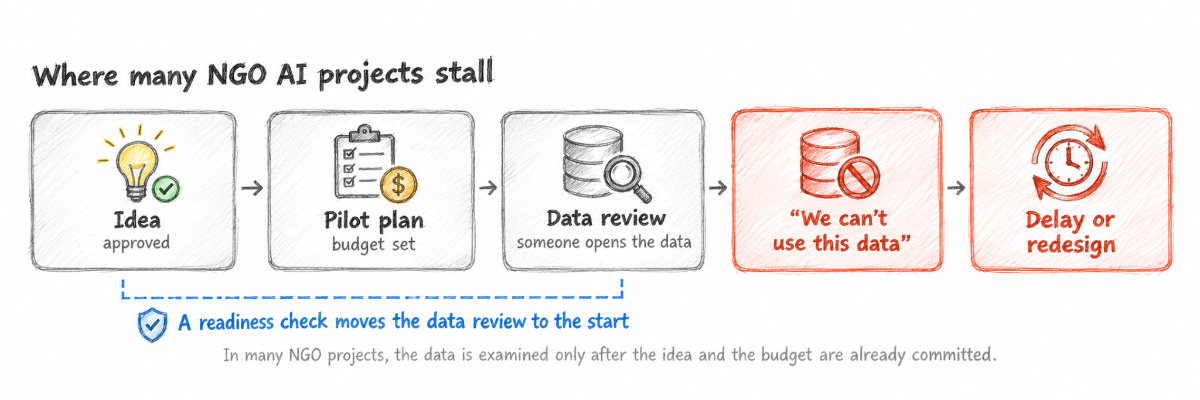
Most AI guidance assumes company data: a few core systems and customers who agreed to terms of service. NGO data is shaped by different forces, and Figure 1 shows where that often leaves a project.
Figure 1. Where Many NGO AI Projects Stall
Four structural differences explain most of the gap:
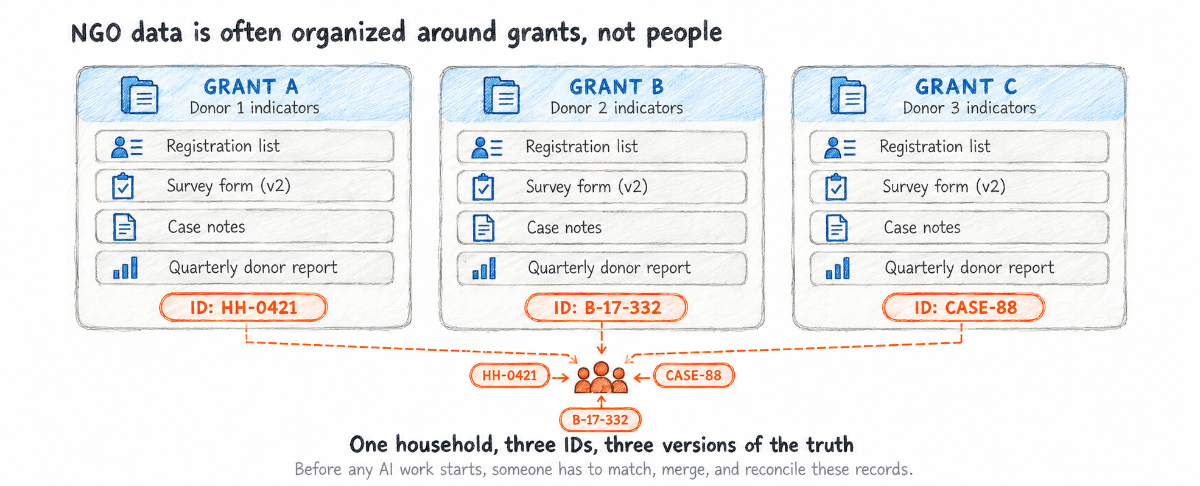
Funding is project-based, so data is too. Each grant brings its own indicators, tools, and templates, organizing data around donors rather than people (Figure 2).
Much of it is collected in the field, on paper or mobile tools, often with weak connectivity and several languages.
The people in the data are often at risk. Refugees, children, and survivors of violence can be harmed if records are exposed.
Data infrastructure is rarely funded. In the Charity Digital Skills Report 2026 , only 17% had received digital funding from trusts and foundations, down from 30% a year earlier.
Together, these forces mean an NGO can hold years of data and still lack what AI needs.
Figure 2. NGO Data Is Often Organized around Grants, Not People
In an NGO, the data problem is usually a funding and structure problem before it is a technology problem.
What Data Readiness Means for an NGO AI Project
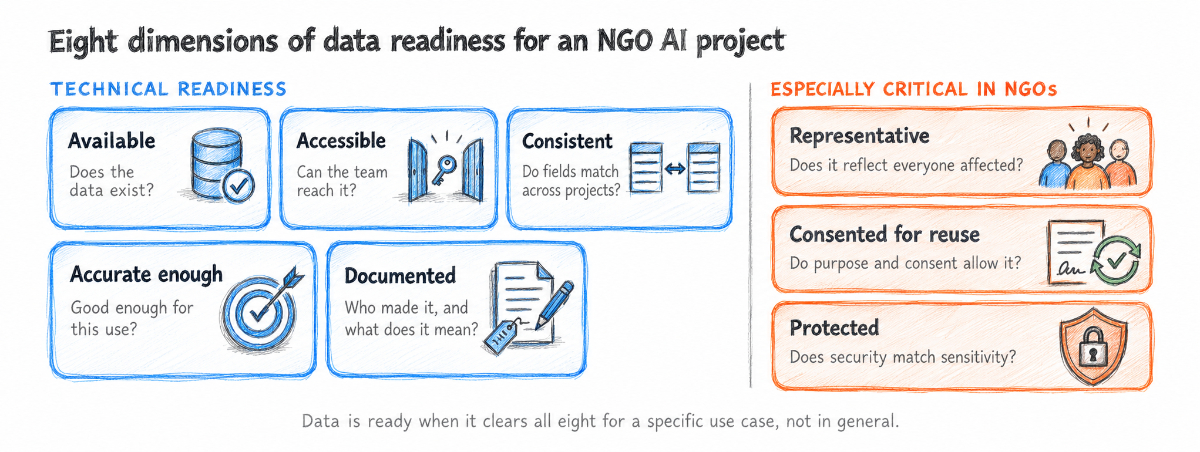
Data readiness does not mean perfect data. It means the data can support a specific AI use case well enough, and safely enough, for the people it affects. Figure 3 sets out eight dimensions to check.
Figure 3. Eight Dimensions of Data Readiness for an NGO AI Project
The first five are familiar from any AI project. The last three carry more weight in NGOs: whether the data represents everyone the system will affect, whether consent and purpose allow reuse, and whether protection matches the sensitivity of the records.
A dataset can score well on the first five and still fail the last three. Registration lists are a typical example: complete, consistent, and well documented, but collected for a single purpose and covering only the people a program already reached.
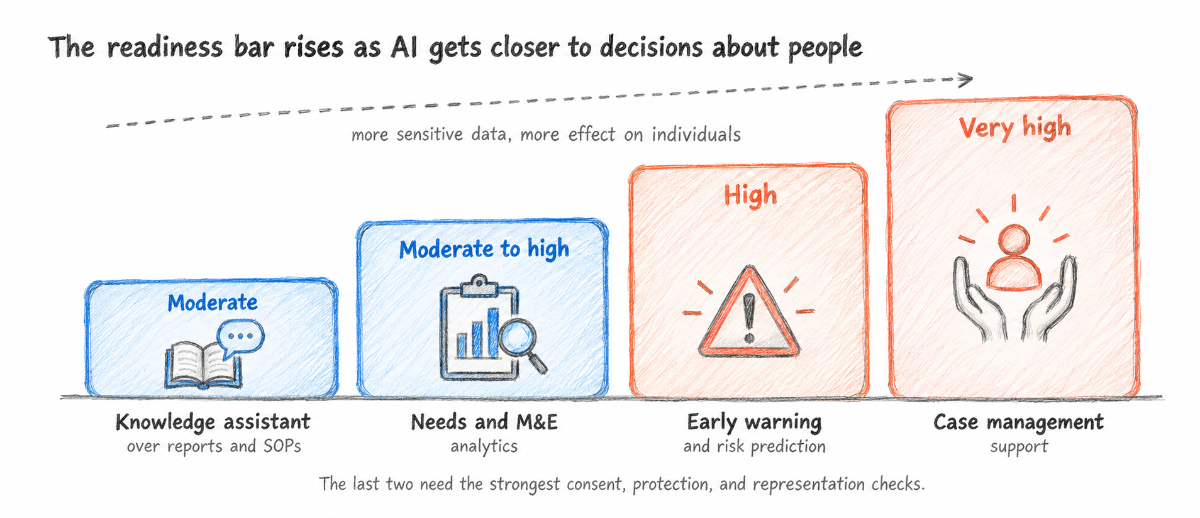
The bar also moves with the use case. A knowledge assistant that searches program reports needs far less than a model that shapes who receives support, as Figure 4 shows. The closer AI gets to decisions about individuals, the higher the bar.
Figure 4. The Readiness Bar Rises as AI Gets Closer to Decisions about People
Six Data Readiness Gaps Common in NGOs
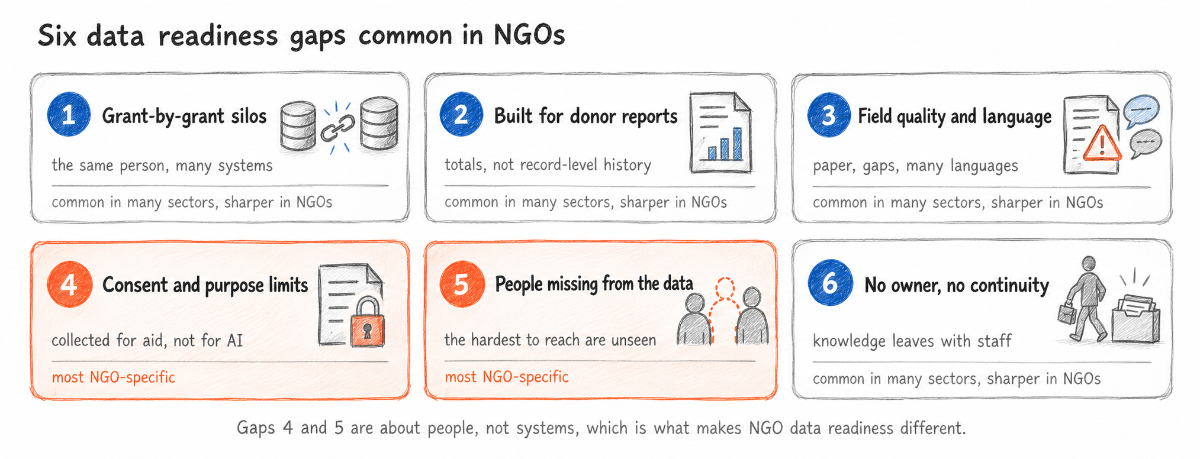
Most stalled NGO AI projects run into one or more of the same six gaps, summarized in Figure 5. Some appear in any organization, but gaps 4 and 5 are specific to working with vulnerable people.
Figure 5. Six Data Readiness Gaps Common in NGOs
1. Grant-by-Grant Data Silos
Each program tends to get its own database, spreadsheet, or survey form, so one household can appear under three IDs in three systems. Records that should match often disagree on names, dates, or locations, and nobody can say which version is current.
Omatic Software’s 2026 nonprofit technology report found that 70% of nonprofits manage five or more platforms. For an AI project, that means weeks of matching records before any model work begins, and that work is rarely in the budget.
2. Data Built for Donor Reports, Not Decisions
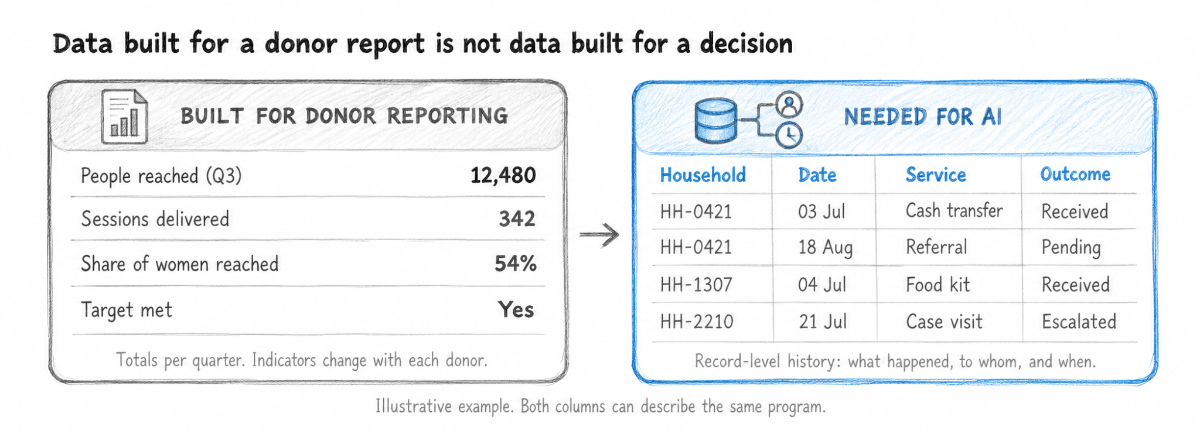
Much NGO data is aggregated to meet donor indicators, such as people reached or sessions delivered. Those totals work in a report but give a model little to learn from. A model meant to predict which households need follow-up cannot learn that from quarterly totals.
AI usually needs record-level history: what happened, to whom, and when. Indicators also change when donors change, which breaks the time series that prediction depends on. Figure 6 shows the difference.
Figure 6. Data Built for a Donor Report Is Not Data Built for a Decision
3. Field Data Quality and Language
Field collection brings inconsistent spellings of names and places, missing values, and free-text answers in several languages. Paper forms are often digitized weeks later by someone who was not there.
For generative AI, poor transcription weakens search and summaries. For predictive models, missing or late data makes outputs least reliable where they matter most. Translation and transcription are data work too, and they need time and budget like any other part of the project.
4. Consent and Purpose Limits
This is the gap most specific to NGOs. Data collected to register people for assistance was usually consented for that purpose only. Using it to train or run an AI system may need a new legal basis, anonymization, or a different design. Consent given in exchange for aid is also rarely fully free, which is another reason not to rely on it alone.
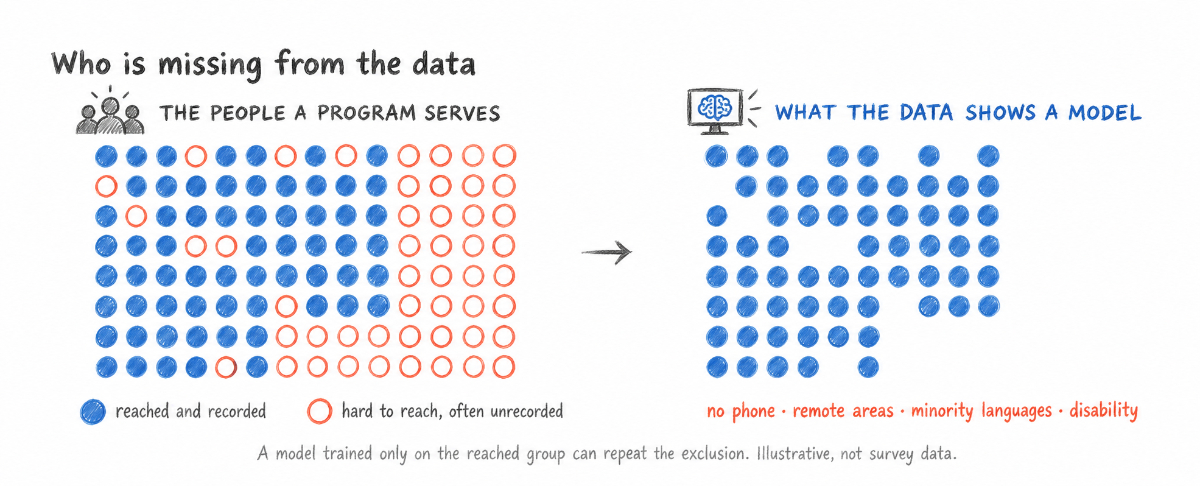
The hardest people to reach are often the least visible in the data: people without phones, remote communities, and speakers of minority languages. A model trained on that data can repeat the exclusion (Figure 7), and some people may be overlooked for help.
Check who is missing before a model is trained, not after complaints arrive. Even well-resourced systems have gaps. The State of Open Humanitarian Data 2026 found 68% of crisis data across 22 operations available and up to date, down from 74%.
Figure 7. Who Is Missing from the Data
6. No Owner, No Continuity
Staff turnover in NGOs is high, especially in field roles funded by short grants, and knowledge about datasets often leaves with people. Many organizations have no named owner for key data. When nobody owns the data, nobody maintains it, and an AI system that worked at launch slowly degrades as definitions drift and fields go unfilled. Naming an owner costs almost nothing, but it often decides whether a pilot becomes a service.
Most NGO AI projects don’t stall because the model is wrong. They stall because the data was never designed for the job.
How to Assess Your NGO’s AI Data Readiness
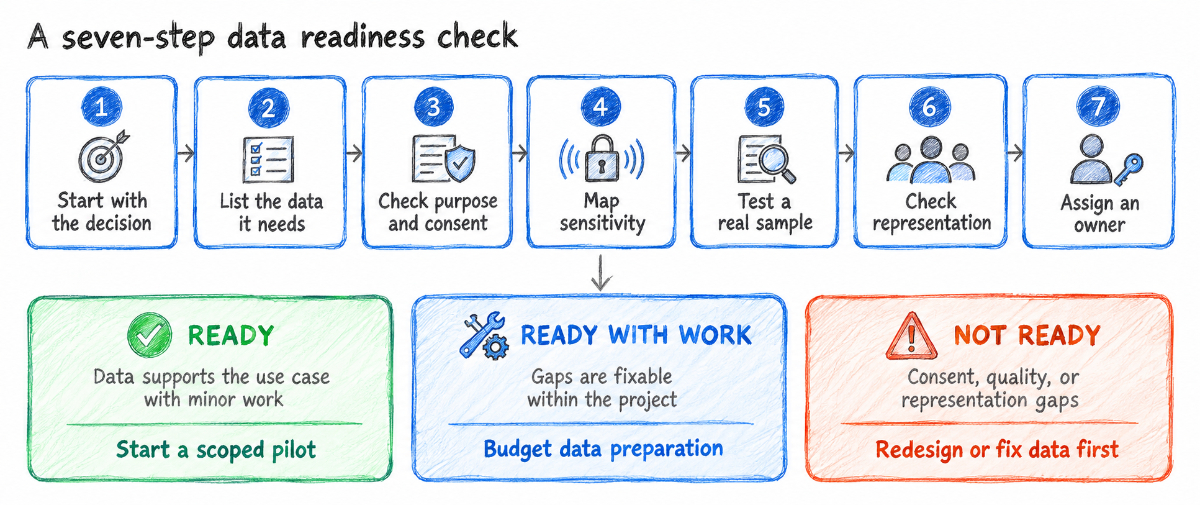
A readiness check does not need a data warehouse. It needs a specific question and a sample of real records. These seven steps work best in order:
Start with the decision. What should the AI system help someone do?
List the data that decision needs, by name, not as “our program data.”
Check purpose and consent. Can this data be reused for this purpose?
Map sensitivity. Which fields identify people or could put them at risk?
Test a real sample of a few hundred records for gaps and duplicates.
Check representation. Who is missing, and would that change the outcome?
Assign an owner who will maintain the data after launch.
The result usually falls into one of three levels, shown in Figure 8. Ready means a scoped pilot can start. Ready with work means the gaps are fixable, but data preparation needs its own budget line. Not ready means redesigning the use case or fixing the data first.
Figure 8. A Seven-Step Data Readiness Check
NetHope’s Nonprofit AI Readiness Benchmark, published March 2026, is a useful complement that scores data readiness alongside five other dimensions.
Improving Data Readiness without a Large Budget
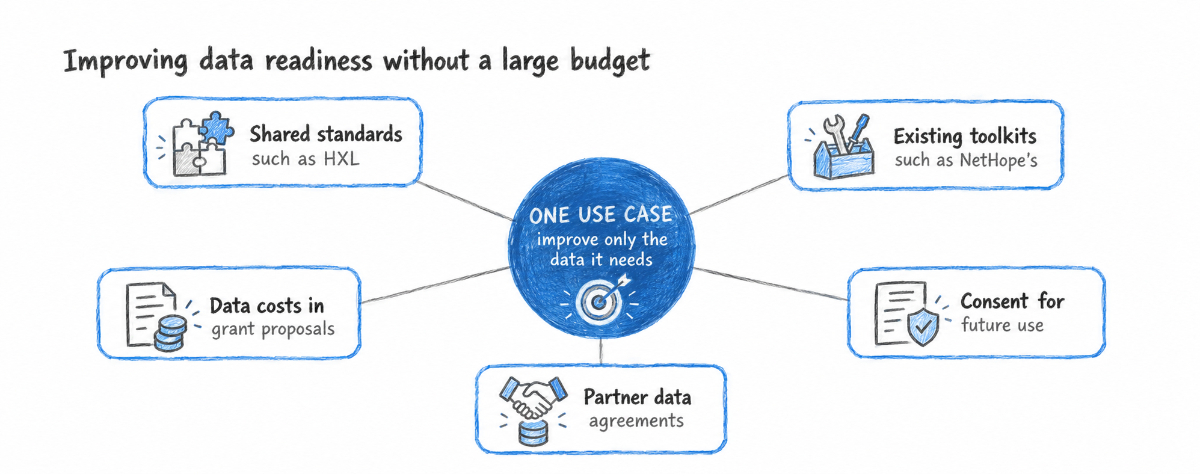
Most NGOs cannot fund a large data program, and they do not need one to start. Progress comes fastest from narrow, practical steps, and none of them requires new software (Figure 9):
Start with one use case and improve only the data it needs, rather than cleaning everything at once.
Use existing guidance, such as NetHope’s Data Governance Toolkit, instead of writing policies from scratch.
Write data cleaning, protection, and maintenance into grant proposals as program costs.
Build clear consent for future uses into new data collection, where appropriate.
Agree on data-sharing terms with partners before a joint AI project begins, including who owns the results.
Figure 9. Improving Data Readiness without a Large Budget
Data readiness improves fastest when it is tied to one clear use case and funded as part of the program.
How Omdena Can Help NGOs Prepare Data for AI
Omdena begins with the question this article began with: which decision should AI support? It then helps NGOs assess data readiness for a specific use case, design pipelines for cleaning and anonymization, and build models that work in multilingual, low-connectivity settings.
Its global community of AI engineers includes local talent who understand the context. In a project with International Social Service, the team built a case management prototype under strict confidentiality limits, using public cases and a small set of anonymized files.
How Umaku Supports Data-Ready AI Delivery
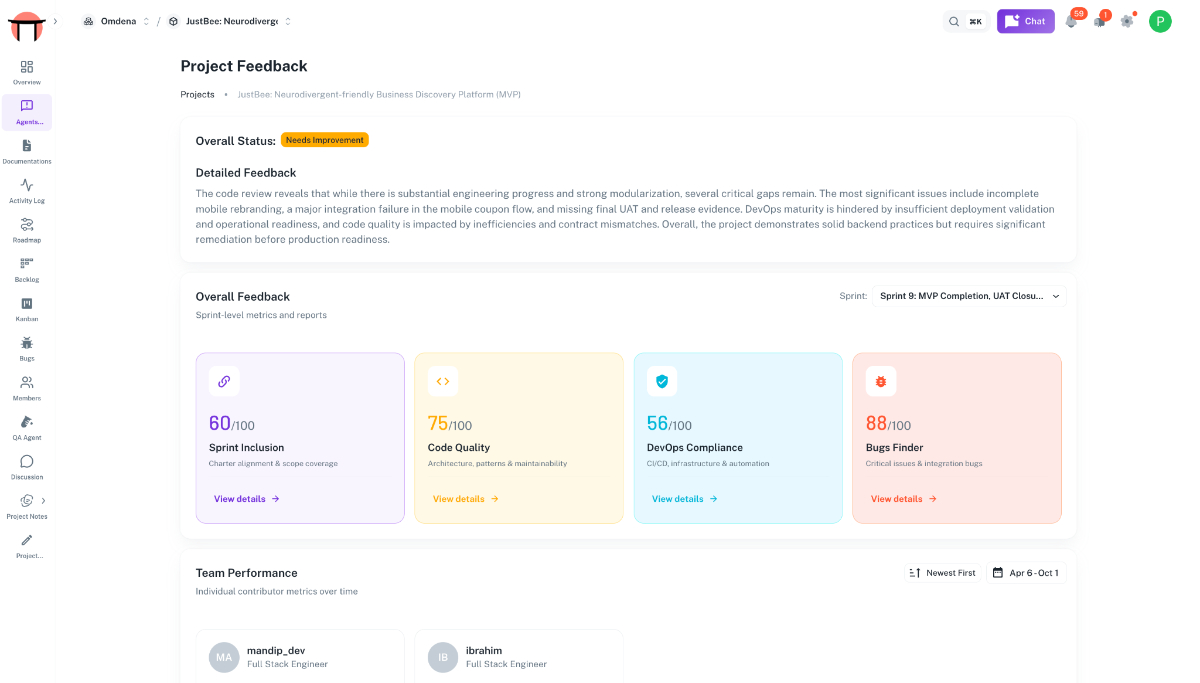
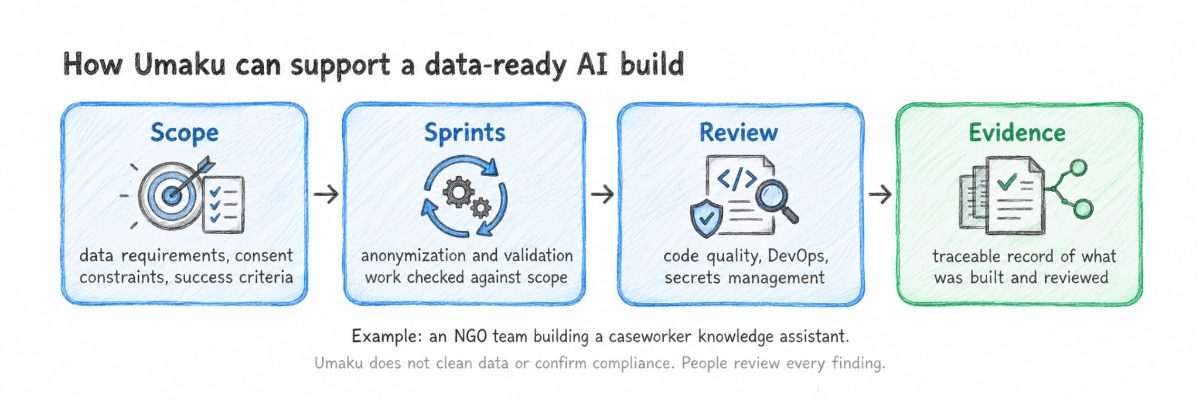
Umaku, Omdena’s agentic AI delivery platform, supports the engineering side of this work. An NGO team building a caseworker knowledge assistant could use Umaku to:
Figure 10.Umaku showing Agentic Feedback
Record data requirements, consent constraints, and success criteria in the project scope
Check that sprint work, such as anonymization and validation, matches that scope
Review pipeline code for quality and DevOps issues, including secrets management
Keep traceable evidence of what was built and reviewed, useful for donor reporting
Figure 11. How Umaku Can Support a Data-Ready AI Build
Umaku does not clean data or confirm compliance, and people review every finding. It adds visibility, so problems surface during delivery rather than after launch.
Ready Data Starts with the Decision
NGOs already hold some of the most valuable data for social impact. Registrations, case notes, surveys, and program reports describe real needs in real places. But most of that data was collected to deliver services and report to donors, not to power AI.
For an NGO, the useful question is not whether you have data. It is whether this data is ready for this decision, and fair to the people it describes. Answering that early costs far less than discovering the answer halfway through a pilot, with budget spent and partners waiting.
If your organization is planning an AI project, talk to Omdena about assessing your data readiness for a specific use case before development begins.
FAQ
What does AI data readiness mean for an NGO?
AI data readiness means that an NGO’s data is suitable, safe, and reliable enough for a specific AI use case. It depends on data quality, relevance, representation, consent, protection, documentation, and clear ownership—not on having perfect data.
What are the most common data readiness gaps in NGO AI projects?
Common gaps include grant-by-grant data silos, data designed for donor reporting rather than decisions, inconsistent field data and languages, limits on consent and reuse, underrepresentation of hard-to-reach groups, and the absence of a long-term data owner.
How can an NGO assess whether its data is ready for AI?
Start with the decision the AI should support, list the exact data required, check consent and purpose, map sensitive fields, test a sample for gaps and duplicates, assess who is missing, and assign someone to maintain the data after launch.
Why are consent and data protection especially important for NGO AI?
NGO datasets often contain information about vulnerable people, including children, refugees, and survivors of violence. Reusing that data for AI may require a new legal basis, anonymization, stronger safeguards, or a redesigned use case, so data protection expertise should be involved early.
Can an NGO improve AI data readiness without a large budget?
Yes. Focus on one clearly defined use case, improve only the data it needs, adopt shared standards, reuse existing governance guidance, include data work in grant budgets, strengthen consent for future collection, and agree on data-sharing terms with partners.
Share this article
Share on LinkedIn, send by email, or copy the direct link.