AI for Land Conflict Management: Turning News Data into Policy Insights
12 min readUpdated November 13, 2026
Omdena
India has committed 21 million hectares to land restoration, yet conflicts affect more than 3 million people each year and no system existed to alert policymakers as those disputes unfolded. Omdena partnered with the World Resources Institute to build an NLP pipeline scanning 65,000 news articles, categorizing conflict events, and matching each to government policies. Delivered: 98% classification accuracy, seven conflict categories, and an interactive policy recommendation tool.
The Problem: Land Conflicts Blocking India’s 21 Million-Hectare Restoration Commitment
Land degradation affects 3.2 billion people worldwide and costs the global economy approximately 10 percent of annual economic output each year. Dozens of countries have committed to restoring 350 million hectares of degraded land, a target that depends entirely on clear land use rights and stable community ownership. Where those conditions break down, restoration commitments remain on paper.
India sits at the center of this challenge. The country has committed 21 million hectares to land restoration, among the largest national commitments on Earth, yet land conflicts affect more than 3 million people each year. India also records the highest number of environmental land conflicts of any country, spanning disputes over farming, forests, mining, water, and wildlife.
When a conflict event emerged in a rural district, the officials responsible for resolution had no fast way to know it had occurred, no tool to identify the category of dispute, and no mechanism to surface the specific policies that applied. Monitoring happened manually, through regional teams scanning newspapers and filing reports, often with days or weeks of lag before the right decision-makers were aware.
The Partnership: Omdena and the World Resources Institute
Omdena partnered with the World Resources Institute, a Washington, D.C.-based global research organization focused on sustainable land use, food systems, and environmental policy. The client supplied the project’s core reference materials: a gold standard corpus of 200 annotated conflict articles and a database of 19 Indian government policy documents, covering topics from land acquisition and forest protection to farmers’ rights and mineral concessions.
The project team comprised 19 AI engineers and data scientists drawn from the Omdena global network. The team built a full NLP pipeline from raw news corpus to interactive visualization tool, with the client providing domain expertise and policy materials throughout the build.
Why Land Conflict Monitoring Is Hard: Four Structural Barriers
Scale of unstructured news data: The 65,000-article GDELT corpus contained news from Indian and international newspapers across three separate years. The vast majority of articles had no land conflict content. Filtering relevant signal from this volume, while catching rare but significant conflict mentions, required a classifier robust enough to handle heavily imbalanced class distributions without inflating false negatives.
Domain-specific vocabulary: Standard pretrained NLP models recognize common named entities such as people, companies, and places, but land conflict reporting contains actors and actions absent from general corpora. Terms specific to Indian land law, such as resettlement orders, patta rights, and gram sabha decisions, required custom entity training beyond what off-the-shelf models could supply.
Semantic gap between conflicts and policies: A news article about a drought-related farming dispute and a government policy on water rights may share few surface terms while being directly relevant to each other. Matching by keyword overlap alone produced poor recommendations. The model needed to compare documents by distributed meaning rather than by word frequency, requiring a vectorized semantic approach.
Geographic and temporal dispersion: Land conflicts in India span 28 states and union territories, across multiple reporting styles and regional political contexts. The corpus covered articles from 2008, 2017, and 2018, three time periods with different vocabulary and policy environments, requiring models that generalized reliably across years without overfitting to a single time window.
Building the Land Conflict Intelligence System: NLP Pipeline and Policy Matching
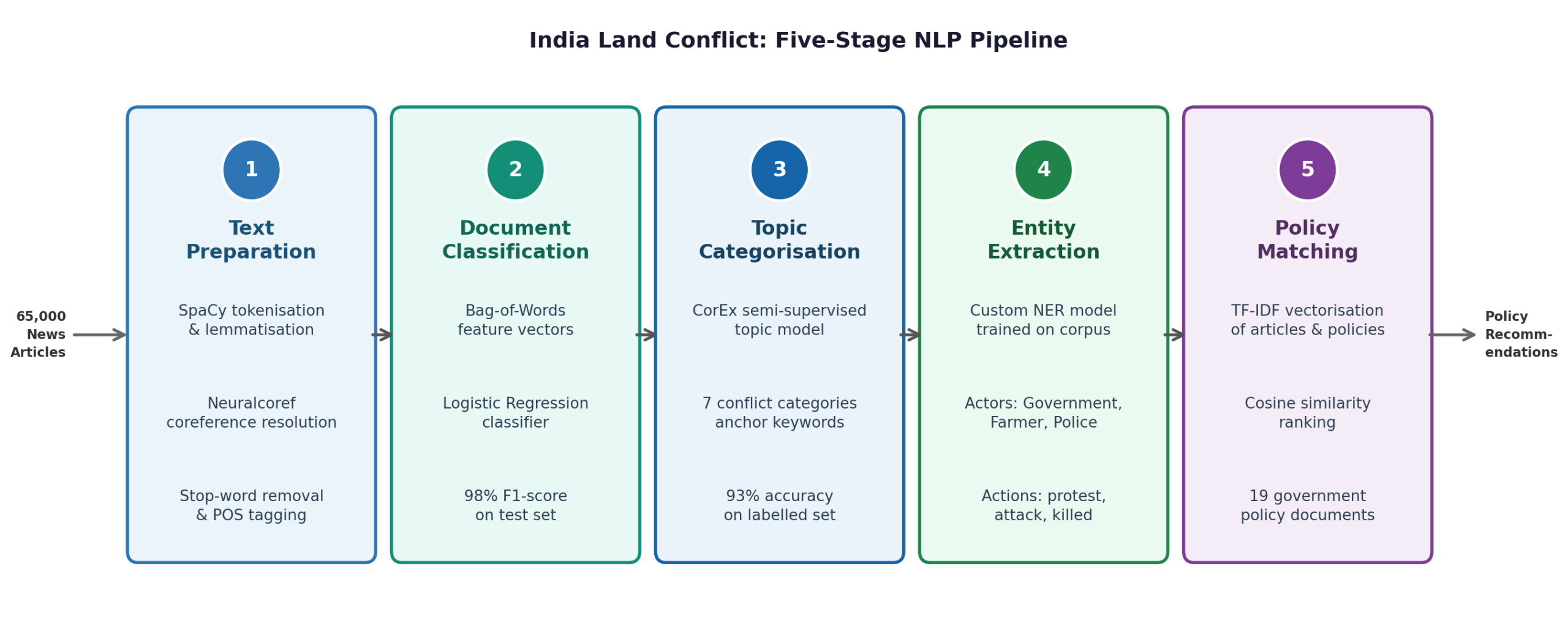
Five-Stage NLP Pipeline: From News Corpus to Policy Recommendations
Step 1: Text Preparation
All 65,000 articles and 19 policy documents were processed using SpaCy, an open-source NLP library that performed tokenization, part-of-speech tagging, dependency parsing, lemmatization, sentence boundary detection, and named entity recognition. Coreference resolution was then applied using Neuralcoref, a neural-net model that replaced all pronouns in each article with the nouns they referenced, reducing ambiguity before classification.
Step 2: Document Classification
A logistic regression classifier was trained on a 1,600-article annotated corpus, manually labeled as conflict-positive or conflict-negative. Articles were represented using Bag-of-Words vectorization, which encodes word frequency across the vocabulary without preserving word order. The trained model classified all 65,000 articles with precision, recall, and f1-score of 98% or greater, with negligible false positives and false negatives.
Step 3: Topic Categorization
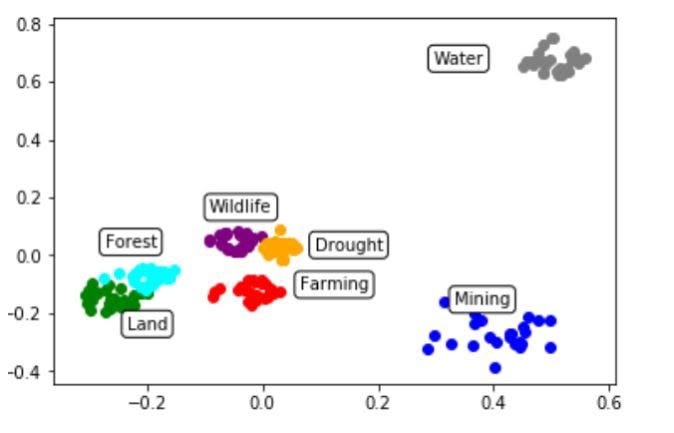
Conflict-positive articles were categorized into seven land conflict topics using CorEx (Correlation Explanation), a semi-supervised topic model that accepted domain knowledge as anchor keywords for each category. The seven categories were defined to align directly with WRI’s policy database, covering the full range of dispute types from land resettlement and farming to mining, deforestation, and water rights. The trained topic model achieved 93% accuracy.
CorEx topic model output: seven land conflict categories separated into distinct clusters
Step 4: Entity Extraction
Custom named entity recognition was trained on the annotated corpus to identify actors, actions, scale, locations, and dates specific to land conflict reporting. Standard NER models recognize generic entities; conflict articles required additional recognition of domain-specific actors such as Government, Farmer, Police, and Civilian, and actions such as protest, attack, and killed. Manual annotation of the training corpus provided the data for the custom recognizer.
Step 5: Policy Matching
Conflict-positive articles were matched to relevant government policies using cosine similarity, a metric that compares the distributional vocabulary overlap between two vectorized documents rather than keyword frequency alone. This allowed the model to surface policy relevance even when the article and policy used different surface terms. Each article received a ranked list of applicable policies with cosine similarity scores drawn from the 19-document WRI database.
What Was Delivered: An Interactive Land Conflict and Policy Recommendation Tool
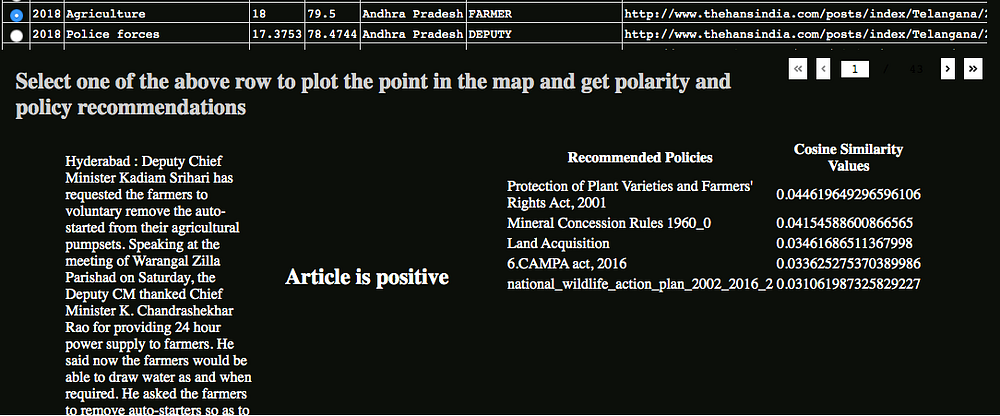
The policy recommendation engine: a selected conflict article alongside ranked government policies with cosine similarity scores
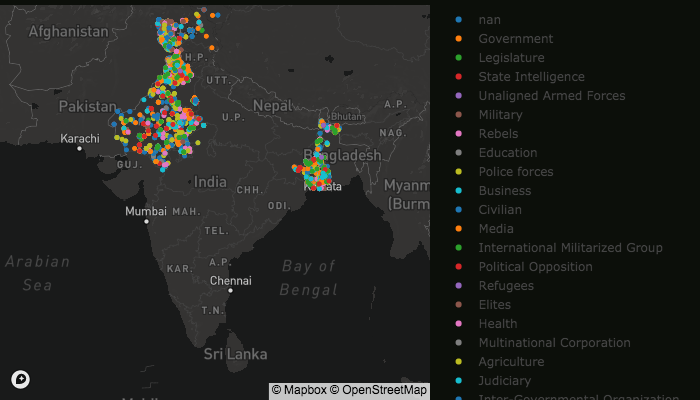
Interactive conflict monitoring map: A Plotly-based web application displayed geo-located conflict events across India as color-coded points on an interactive map. Users could filter events by conflict category, actor type, year, and region, navigate the full corpus visually, and drill into individual articles to see conflict details alongside matched policy recommendations, all without technical expertise required.
Policy recommendation engine: For each selected article, the tool displayed the top-matched government policies with their cosine similarity scores. Policies including the Land Acquisition Act of 2013, the Indian Forest Act of 1927, and the Protection of Plant Varieties and Farmers’ Rights Act of 2001 were surfaced contextually based on article content, giving policymakers a direct route from conflict detection to applicable legislation.
Open-source NLP pipeline codebase: The full five-stage pipeline, covering text preprocessing, classification, topic modeling, entity extraction, and policy matching, was released as an open-source codebase via OmdenaLore, Omdena’s open-source knowledge-sharing platform. The codebase is fully documented and replicable, enabling other researchers or governments to adapt it for new geographies or policy databases without restriction.
Impact: What Policymakers Could See That Did Not Exist Before
Before this project, no automated system existed to alert Indian policymakers when a land conflict emerged in the news, let alone surface which existing policies applied to its resolution. Monitoring happened manually, through regional teams filing reports with significant lag. This project demonstrated that NLP could close that monitoring gap at scale, processing years of news data in a single automated pipeline.
The proof of concept gave the client a concrete technical foundation for a production deployment across India’s 28 states. With the pipeline validated on three years of GDELT data at national scale, the next step would be integrating a live news feed and expanding the policy database to cover state-level legislation, rather than rebuilding the core architecture from scratch.
For a country where land conflicts affect more than 3 million people each year and block restoration of 21 million hectares, early-stage conflict detection at this accuracy level represented a meaningful operational advance. Policymakers could, for the first time, see conflicts as they emerged, categorized by type and location, with relevant policy options already surfaced alongside each event.
Benefits for Clients: From Manual Monitoring to Automated Land Conflict Intelligence
Evidence base for land conflict governance: The client received a data-driven conflict intelligence instrument that did not previously exist. The system transformed unstructured news into structured, geocoded conflict events linked to applicable government policies, giving policymakers a tool to monitor disputes as they emerged rather than weeks after the fact, and to respond with specific legislative authority rather than general guidance.
No specialist NLP expertise required to operate: The delivered web tool was designed for policymakers and analysts, not data scientists. Users could filter the interactive India map by conflict category, actor type, year, and region, and retrieve ranked policy recommendations through point-and-click navigation without any knowledge of the underlying classification or similarity models.
Open-source codebase via OmdenaLore: The full pipeline is available through OmdenaLore, Omdena’s open-source knowledge-sharing platform, with no license restrictions. Any government agency or research institution can audit the methodology, replicate the pipeline for a different geography, or extend the policy database without dependence on a third-party vendor or proprietary tooling.
What Building a Land Conflict Intelligence System Taught Us
Domain-specific entity recognition cannot be borrowed from general pretrained models
Standard pretrained NLP models recognize people, organizations, and locations but fail on the actors and actions that define land conflict reporting. Terms like gram sabha, resettlement order, and patta cancellation carry precise legal meaning in this context. Manual labeling of a training corpus for custom entities was time-intensive but essential. Without it, downstream policy matching would have operated on incomplete and inaccurate event data.
Semi-supervised topic modeling produces sharper categories when anchored to operational knowledge
An unsupervised topic model would have discovered categories from data alone, but the resulting clusters did not align with the seven conflict categories that WRI’s policy database was organized around. Using CorEx with anchor keywords derived from policy language kept the topic model grounded in operational use. The 93% accuracy of the final model validated this approach over a fully data-driven alternative.
Matching policy to conflict requires semantic comparison, not keyword search
Early experiments using keyword overlap to match articles to policies produced a high rate of irrelevant recommendations. A drought article mentioning water would surface water infrastructure policies regardless of whether the conflict concerned irrigation rights or flooding. Cosine similarity over TF-IDF vectors captured the full distributional meaning of each document, producing matches that aligned with the conflict’s actual legal and policy context.
What’s Next: Expanding the System from Pilot to Production
Model refinement with transformer-based classifiers: The logistic regression classifier and CorEx topic model represent a strong baseline, but transformer-based language models such as BERT could improve accuracy further, particularly on articles that mix multiple conflict types within a single report. Future iterations should evaluate transformer architectures against the existing logistic regression baseline on the gold standard corpus.
Expanded policy and legislative database: The current database covers 19 national policy documents. Adding state-level legislation, municipal land use regulations, and more recent amendments would increase the specificity of policy recommendations and reduce cases where the top-matched policy is a poor fit for the conflict’s geographic or jurisdictional context.
Geographic expansion beyond India: The pipeline architecture is not India-specific. Any country with a GDELT news corpus and a government policy database can apply the same methodology. Priority geographies include sub-Saharan African nations with active land restoration commitments and high rates of environmental conflict, where similar monitoring gaps and policy databases already exist.
Expanded news article library: The current corpus draws from three years of GDELT data: 2008, 2017, and 2018. Adding articles from intervening and more recent years would capture changing vocabulary, emerging conflict categories, and updated policy environments, improving the model’s generalization across time and making the detection pipeline more accurate on current events.
Key Achievements: Three Contributions That Advance Land Governance
A Five-Stage NLP Pipeline That Processed 65,000 Articles Without Manual Intervention
The pipeline integrated text preparation, document classification, topic modeling, entity extraction, and policy matching as an automated sequence across the full GDELT corpus. This demonstrated that NLP could replace manual conflict monitoring at scale, reducing a process that previously required analyst teams scanning newspapers to something deployable against a live news feed. The five-stage architecture is the project’s core transferable technical contribution.
A 93% Accurate Topic Model Aligned to Seven Real-World Conflict Categories
At 93% accuracy, the topic model met the threshold for routing conflict articles to policy categories without human review. That figure was not achieved by unsupervised topic discovery: it required anchoring the model to categories derived directly from the client’s policy database, ensuring the model’s output aligned with the legislative structure used to respond to conflicts rather than patterns in the news data alone.
An Interactive Web Tool That Connected Conflict Detection to Policy Response
Before this tool existed, moving from a news report about a land conflict to the specific legislation relevant to its resolution required specialist knowledge of both the news corpus and the policy database. The tool closed that gap: a policymaker with no data science background could select a conflict event on a map and receive ranked policy recommendations drawn from 19 government documents within seconds.
About the Project
Omdena partnered with the World Resources Institute to build an NLP proof-of-concept system for detecting and monitoring land conflict events in India and matching each event to applicable government policies. Working from 65,000 GDELT news articles and 19 policy documents, 19 AI engineers built a five-stage NLP pipeline and an interactive Plotly-based visualization tool, completed in April 2020.
FAQ
What data did the system use to detect land conflict events?
65,000 candidate articles were sourced from GDELT, covering Indian and international newspapers from 2008, 2017, and 2018, all translated to English.
How did the system match conflicts to government policies?
Each article was vectorized using TF-IDF and compared against 19 policy documents via cosine similarity, returning a ranked list of applicable policies with similarity scores.
Is the system deployed in production?
No. This was a proof of concept; further development and validation are required before operational deployment across India's 28 states.
Can the pipeline be applied to countries outside India?
Yes. Any country with a GDELT corpus and a policy database can apply the same methodology; the codebase on OmdenaLore, Omdena's open-source knowledge-sharing platform, is documented for adaptation.
Why was CorEx chosen for topic modeling over unsupervised approaches?
CorEx accepts anchor keywords that guide topic discovery toward WRI's policy categories; fully unsupervised methods inferred clusters that did not align with the legislative structure the tool needed to use.
Share this article
Share on LinkedIn, send by email, or copy the direct link.