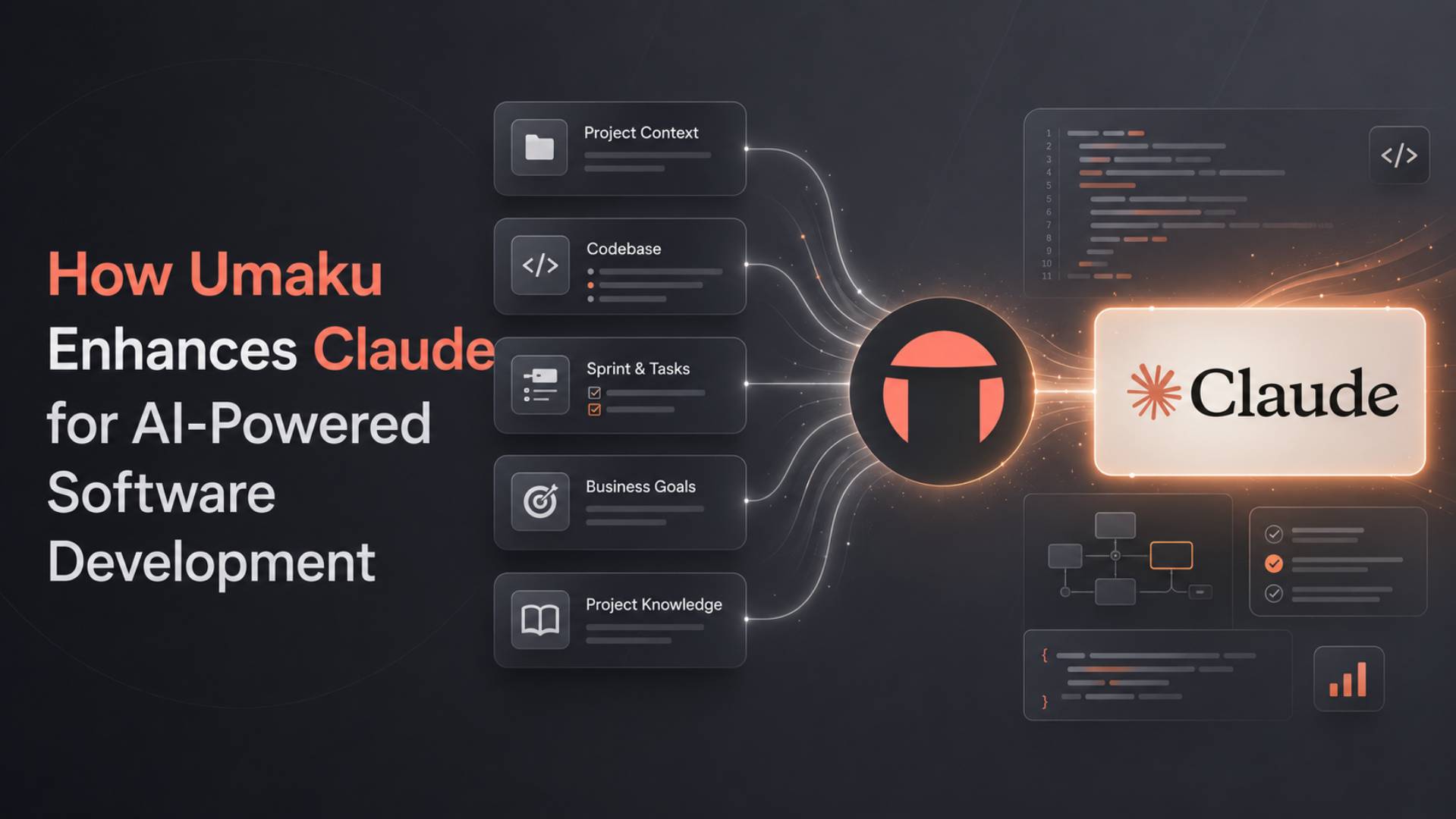
How Umaku Enhances Claude for AI-Powered Software Development
11 min readUpdated September 6, 2026
Okon PrinceSenior Data Scientist / Forward deployed Engineer
Engineering teams now hand Claude real work: writing code, drafting tickets, analyzing requirements, reviewing implementations, and documenting decisions. The results are often impressive yet oddly disconnected from the project itself, because a model can only reason about what it can see.
A software project is more than a codebase. It includes the business objective, the project charter, the technical architecture, sprint goals, tickets, documentation, and a history of decisions that never appears in any prompt.
This article examines why project context, rather than model capability, has become the binding constraint in AI-assisted development, and how connecting Claude to Umaku through the Model Context Protocol closes that gap while keeping the context the model must process under control.
Claude Is Powerful, but Software Projects Need More Than a Powerful Model
There is a difference between model intelligence and project context. Claude can produce excellent code or recommendations from whatever it is given. What it is given is the problem.
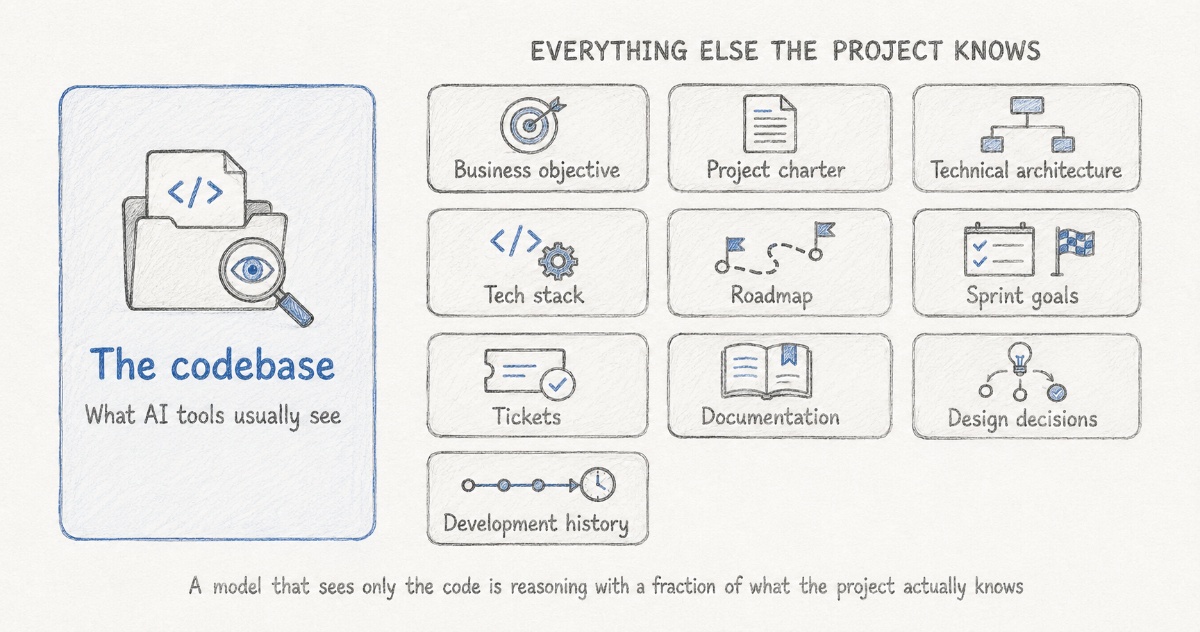
However capable the model, a generic AI assistant does not automatically know what the project is trying to accomplish, which sprint the team is in, what the current sprint goal is, which requirements are already defined, which tickets are complete, what technical decisions have been made, or what the business logic requires. Figure 1 shows how little of a project’s knowledge lives in the place AI tools usually look.
Figure 1. A Software Project Is More Than a Codebase
Omdena ran into this gap directly. In the team’s own experience building and demonstrating Umaku, mainstream AI agents could review code competently, but they were often missing the business and project context needed to judge whether an implementation was actually appropriate. Umaku was built to close that gap.
The challenge is not giving Claude more information. It is giving Claude the right information at the right time.
Umaku as the Context Layer for Claude
Umaku gives Claude structured access to two connected layers of project information. Together, they provide the business, technical, and operational context Claude needs to support project-specific work.
Umaku organizes project information into connected knowledge and delivery layers. The knowledge layer explains what the team is building and the constraints that should guide the work.
This layer explains what the team is building and the decisions guiding its development:
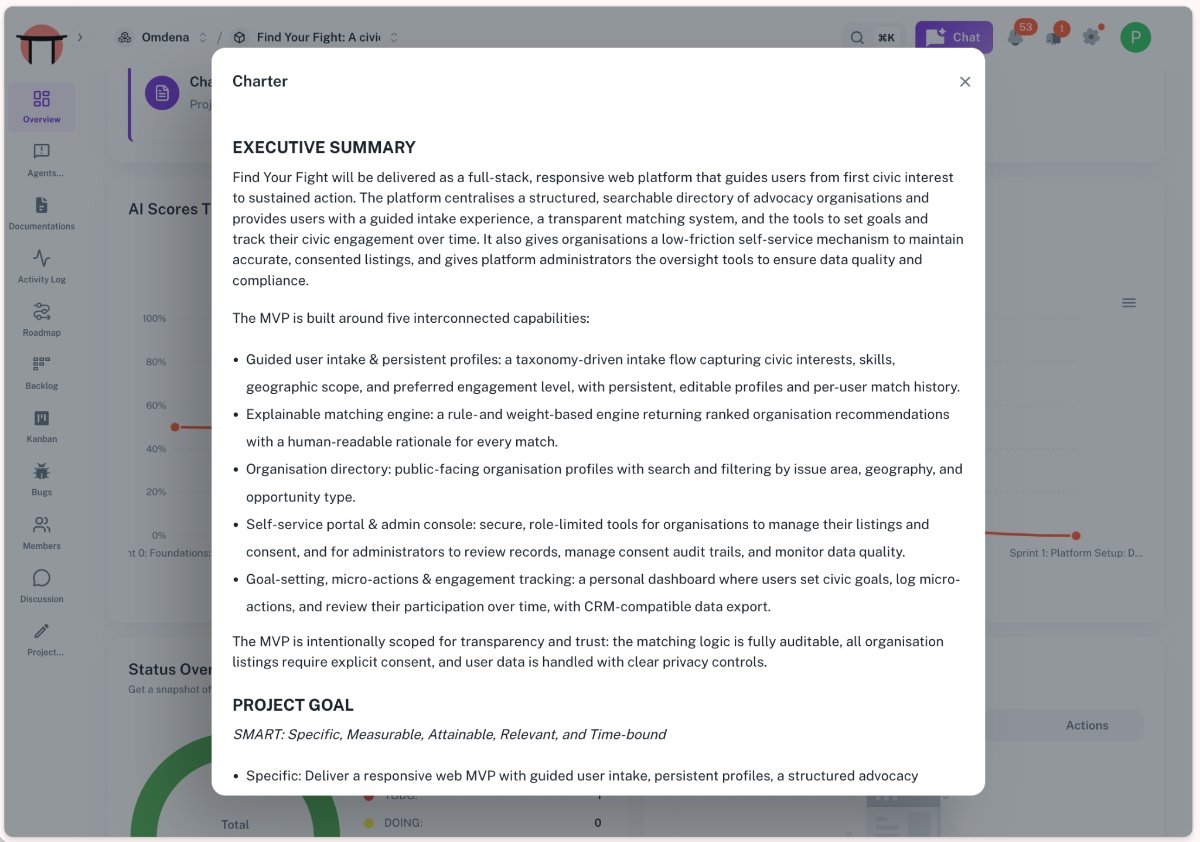
Project Charter
Figure 2. Umaku Project Charter
Defines the project’s goals, scope, business rules, and end-user requirements. Claude can use it to check whether a proposed feature or ticket supports the intended outcome instead of optimizing only for technical correctness.
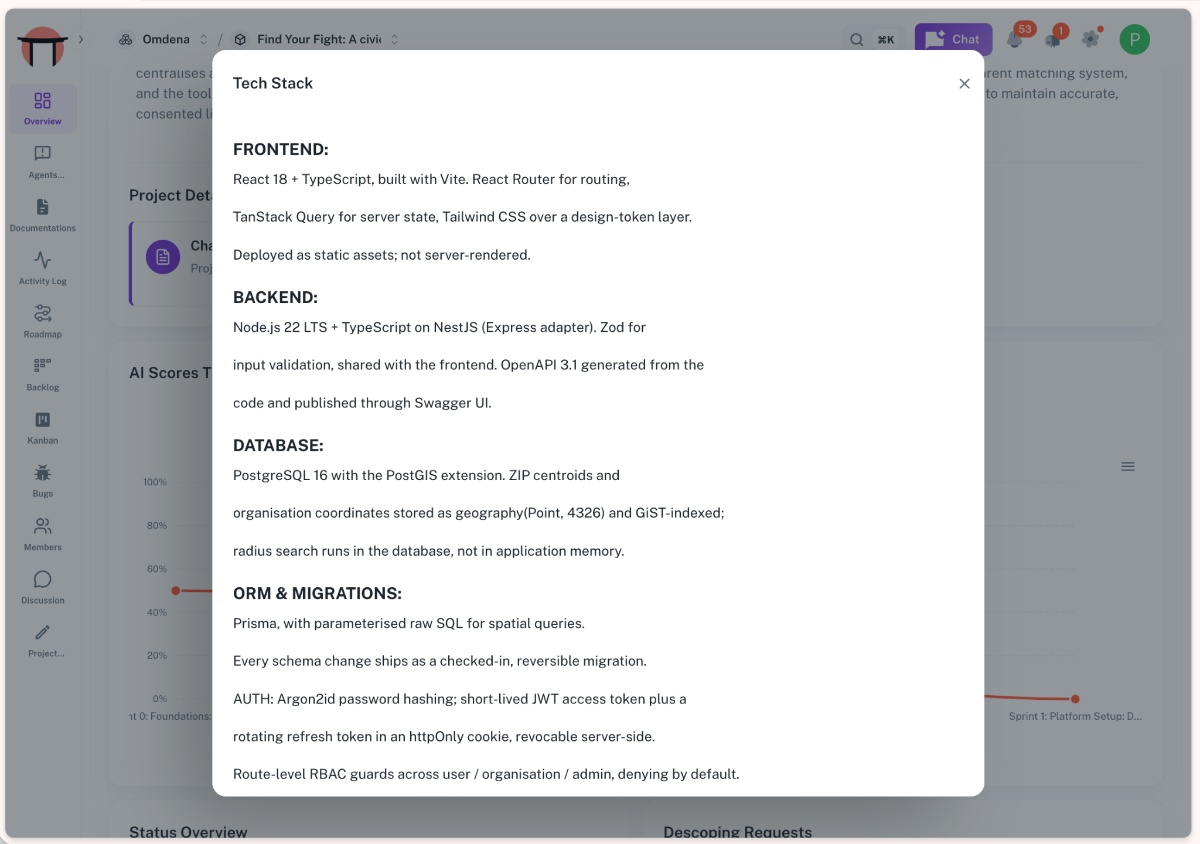
Tech Stack
Figure 3. Umaku Techstack
Records the approved frontend and backend technologies, frameworks, development tools, architecture constraints, and integration requirements. This helps Claude propose work that fits the system the team has chosen to build.
Resources
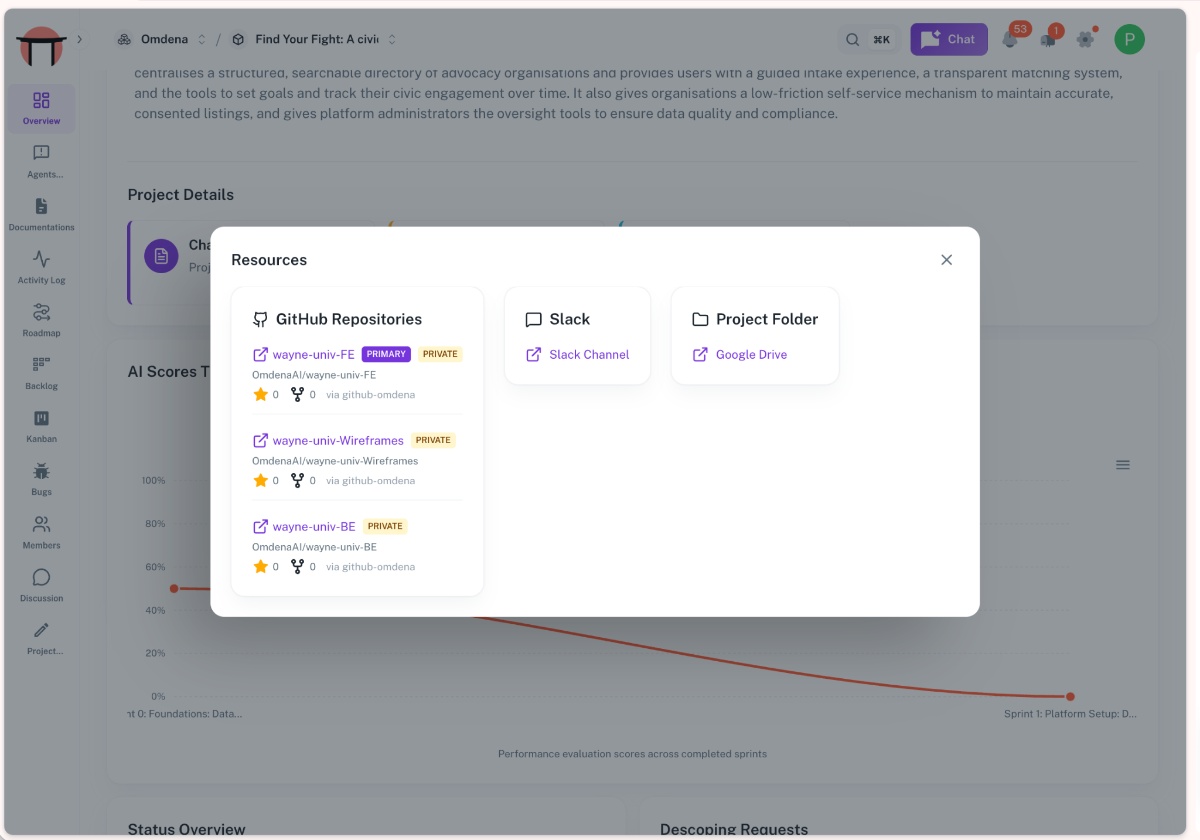
Figure 4. Umaku Resources
Connects the project to repositories, documentation, wireframes, meeting notes, and other working materials. In the recorded workflow, these sources mattered because the newer wireframes clarified flows that were not fully reflected in the charter.
Rather than reconstructing this knowledge in every conversation, teams can let Claude retrieve the sources relevant to the task and surface conflicts when those sources disagree.
Roadmap, Sprints, and Project Board
The delivery layer shows where the project is going, what the team is doing now, and what has already been planned or completed:
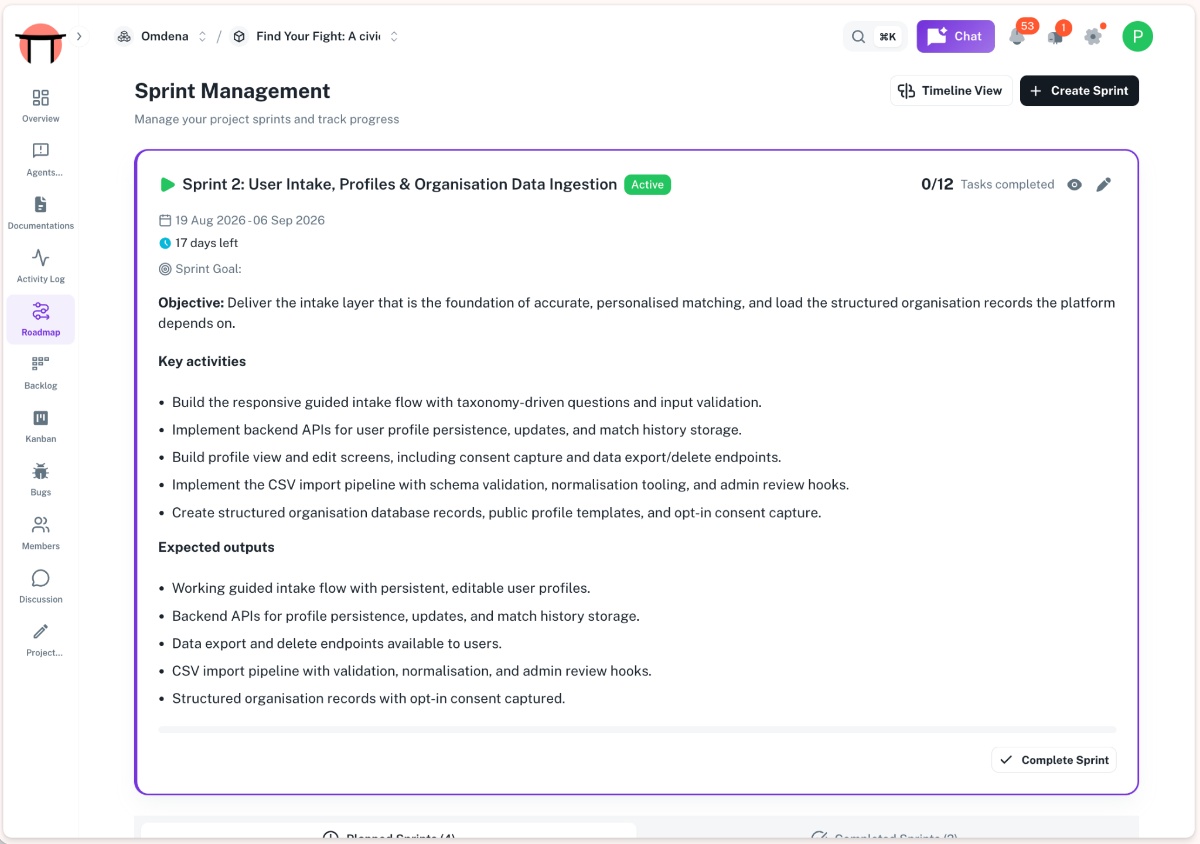
Figure 5. Umaku Sprint Management
Roadmap: organizes the planned direction, major deliverables, and sequence of work.
Sprints: record the current sprint objective and the work that belongs within its boundary.
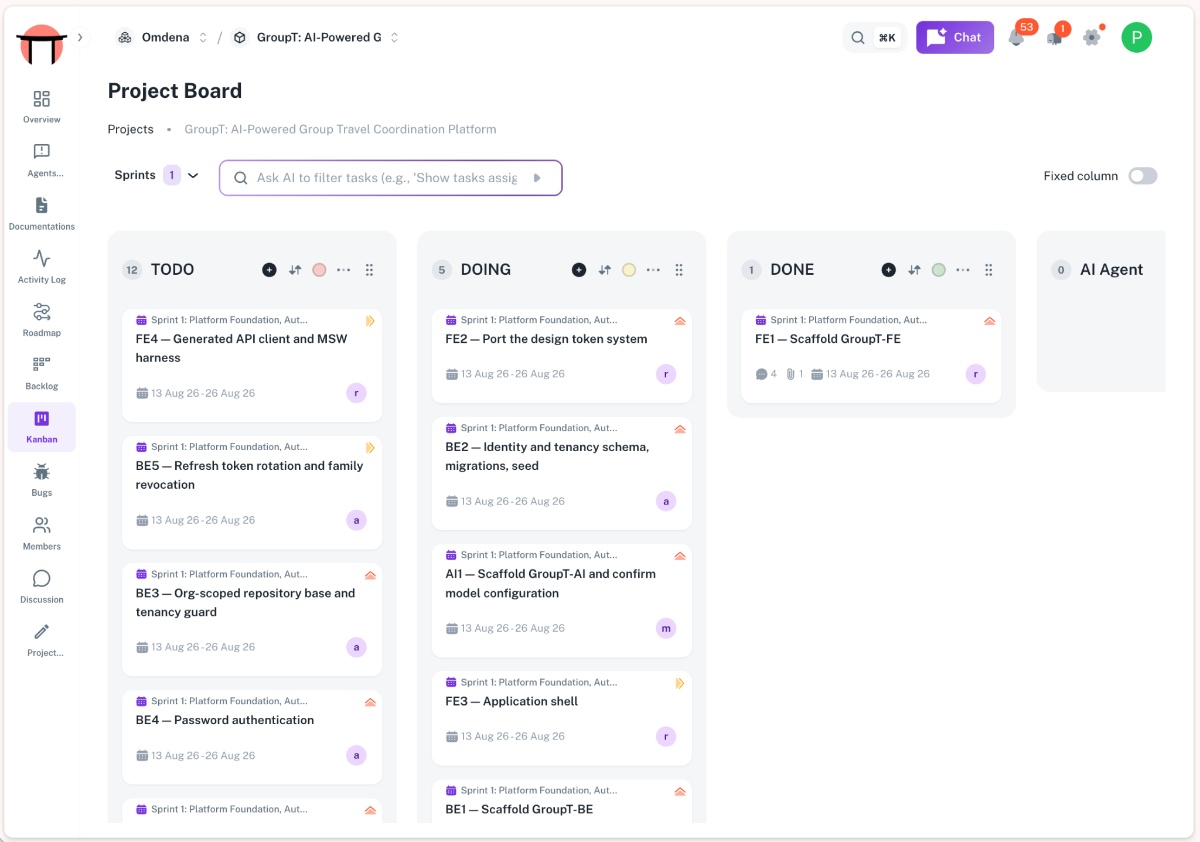
Figure 6. Project Board
Project board and tickets: capture individual tasks, requirements, priorities, estimates, assignments, dependencies, and supporting references.
Project status: shows completed, ongoing, and upcoming work so Claude can avoid duplicating existing tasks.
Together, these records help Claude distinguish the project’s overall ambition from the team’s immediate commitment.This distinction allows it to create Sprint tickets without pulling later roadmap requirements into the sprint or duplicating work already assigned to previous sprints.
A Clear Division of Roles
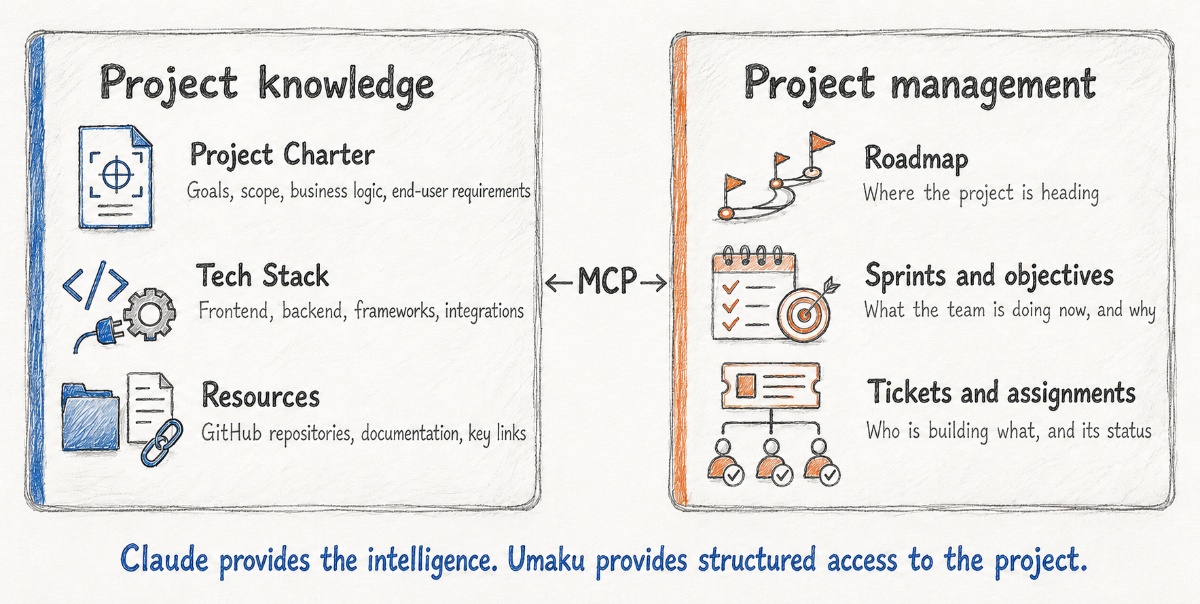
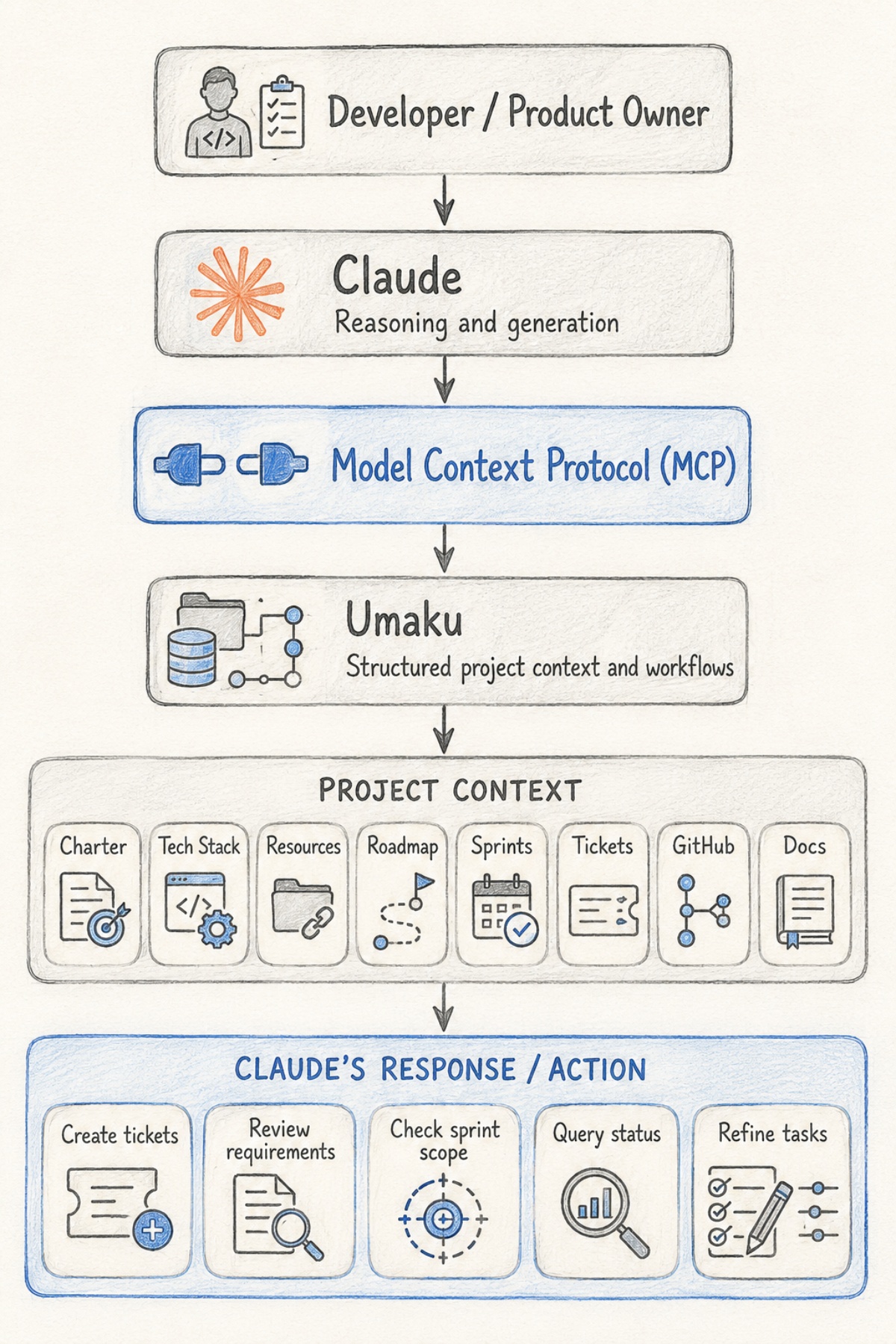
Claude provides reasoning and generation. Umaku provides governed access to project knowledge and delivery workflows. MCP connects the two. The result is not a smarter model, but a model working from a more accurate representation of the project. Figure 3 summarizes that division of roles.
Figure 7. Umaku’s Two Context Layers
What Changes When Claude Can Interact With Umaku
In practice, the integration creates a concrete planning loop: Claude starts with a sprint objective, retrieves the relevant project context, reconciles conflicting sources, creates scoped work, and returns that work to the team for review.
1. Claude Starts with the Sprint Objective and Project Sources
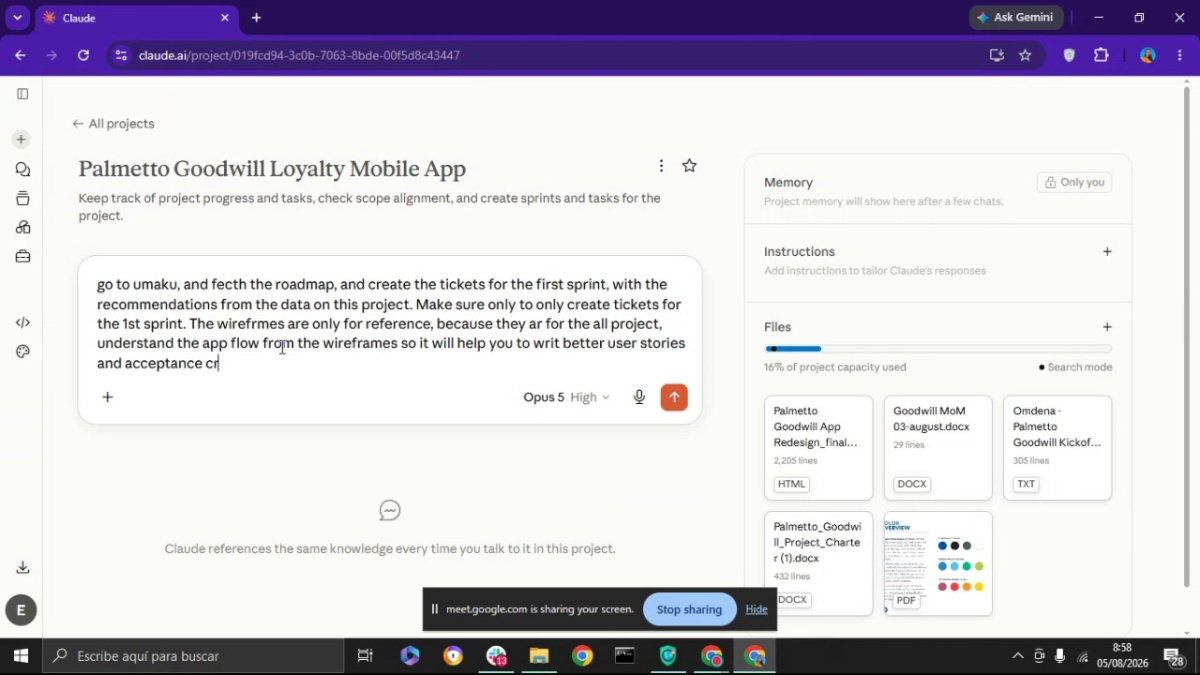
The team asked Claude to retrieve the Umaku roadmap and create tickets only for Sprint 1. The Claude project also contained the charter, meeting notes, redesign documentation, and wireframes, giving the model both the sprint boundary and the sources needed to interpret it.
Figure 8. Claude receives a precise Sprint 1 objective alongside the charter, meeting notes, redesign documentation, and wireframes.
2. Claude Retrieves Targeted Project Context
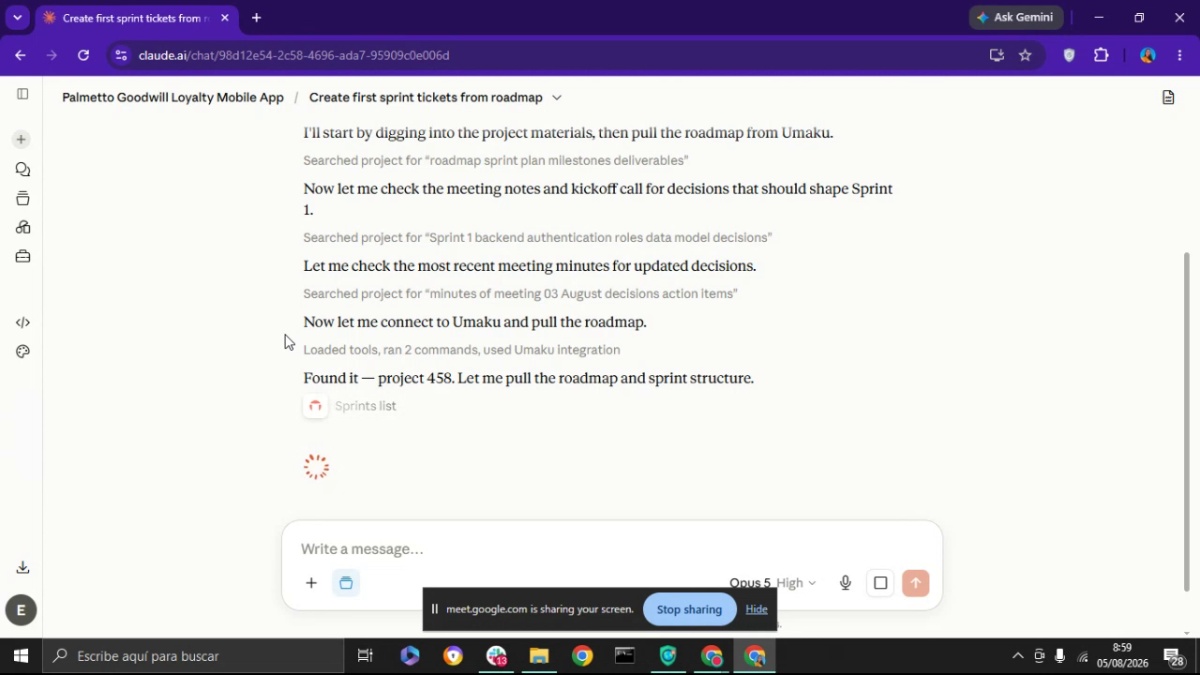
Claude reviewed the relevant project materials and recent decisions, then queried Umaku for the roadmap and sprint structure. It gathered what was needed to plan the sprint instead of treating the full project history as equally relevant.
Figure 9. Claude reviews recent project decisions, then retrieves the roadmap and sprint structure from Umaku
3. Claude Reconciles Conflicting Sources
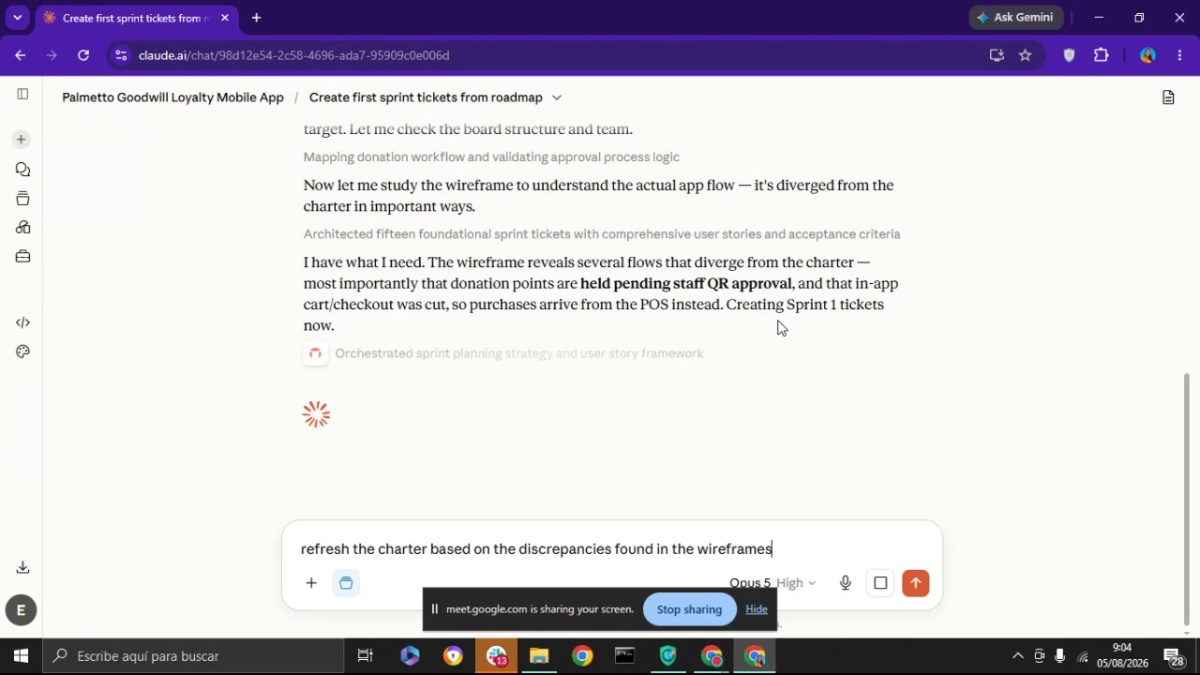
Claude compared the charter with the newer wireframes and found material differences: donation points required staff QR approval, while purchases came from the point-of-sale system rather than an in-app checkout. It used those workflow details to shape the user stories and surfaced the discrepancies for review instead of silently choosing one source.
Figure 10. Claude identifies where the wireframes supersede the charter, including QR-based donation approval and POS-managed purchases.
4. Claude Creates Sprint-Scoped Tickets
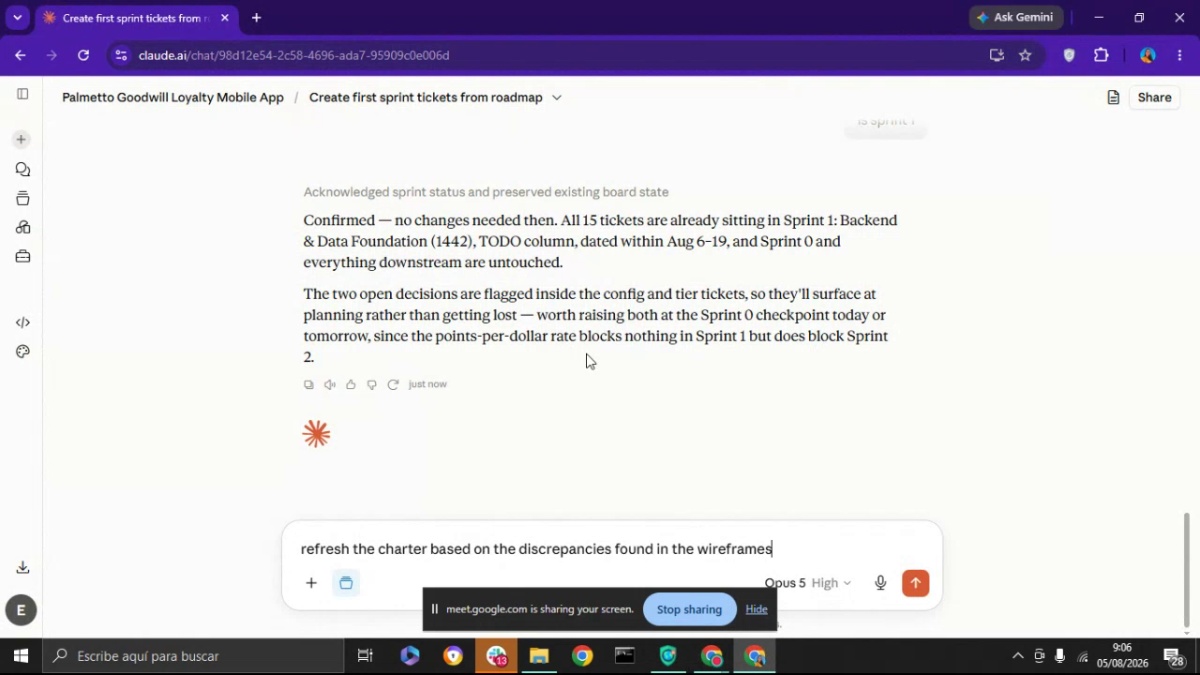
Using the roadmap, sprint boundary, technical decisions, and updated flows, Claude generated 15 Sprint 1 tickets. It preserved work already assigned to Sprint 0 and carried unresolved decisions into the relevant tickets for planning review.
Figure 11. Claude confirms 15 Sprint 1 tickets, avoids duplicating Sprint 0 work, and flags unresolved decisions for review
5. The Team Reviews and Refines the Work in Umaku
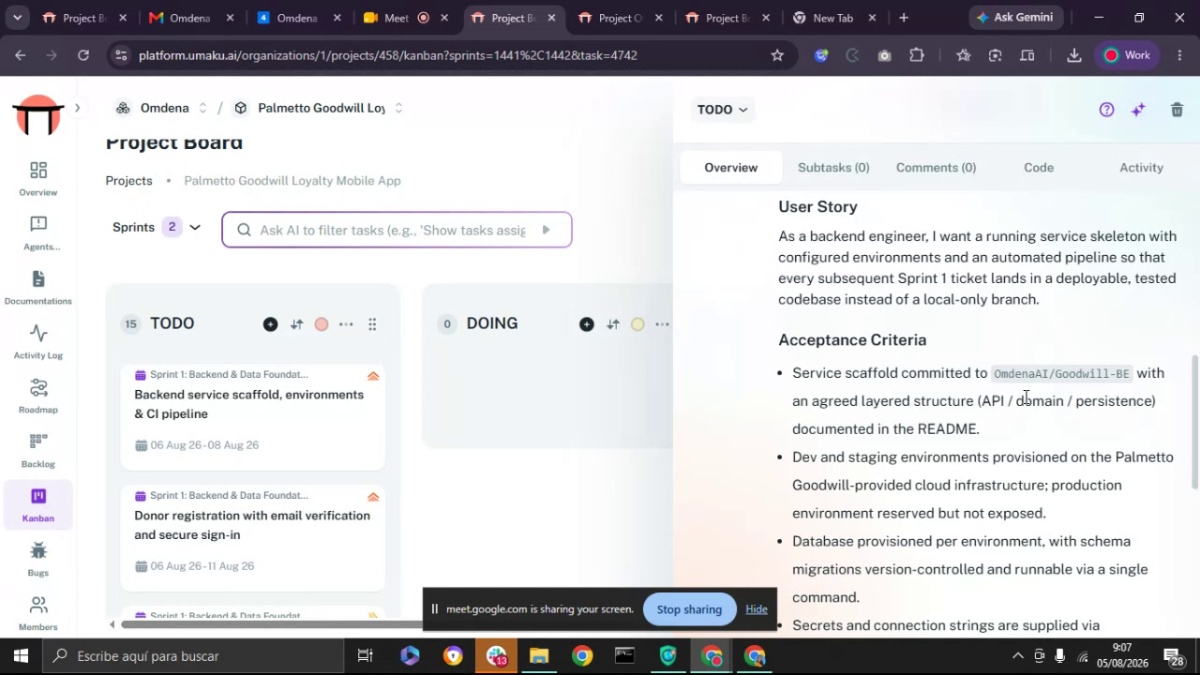
The tickets appeared on the Umaku project board with user stories, acceptance criteria, labels, priorities, estimates, dates, and repository references. The team could tighten scope, correct assumptions, adjust estimates, attach references, and approve the work where delivery is managed.
Figure 12. The team reviews generated tickets in Umaku, where scope, estimates, references, and acceptance criteria can be refined before development
Human oversight remains essential. Full-project sources can contain work beyond the active sprint, and source conflicts still require judgment. Claude accelerates retrieval and planning; the engineering team validates scope, resolves inconsistencies, and approves the final work.
The same connection supports work beyond sprint planning. Through Umaku, Claude can create and refine tasks, report bugs, check sprint progress, review dashboards, add comments, and support post-sprint analysis without requiring the team to manually transfer information between systems.
Access remains governed rather than open-ended: Claude can only see and perform the actions permitted for the connected Umaku user. These context-aware actions depend on a secure, standardized connection between Claude and Umaku. That connection is provided through MCP.
Why MCP Matters in the Claude + Umaku Workflow
The bridge that makes this possible is the Model Context Protocol, an open standard that gives AI applications a consistent way to interact with external tools and sources of context. In this workflow, MCP sits between Claude and Umaku: Claude sends a request, Umaku returns the relevant context or performs the action, and the result flows back into the conversation. Figure 9 shows the full path from a developer’s request to a grounded response.
Figure 13. The Claude + MCP + Umaku Architecture
For a given request, Claude identifies the information or action it needs, uses the available MCP capability, and receives a scoped result from Umaku. Claude can then reason over that result or ask Umaku to perform an authorized project action. MCP therefore turns Umaku from a separate project-management system into a source of context and workflows that Claude can use directly, without requiring the team to copy and paste project information into every conversation.
How the Integration Can Reduce Claude Token Usage
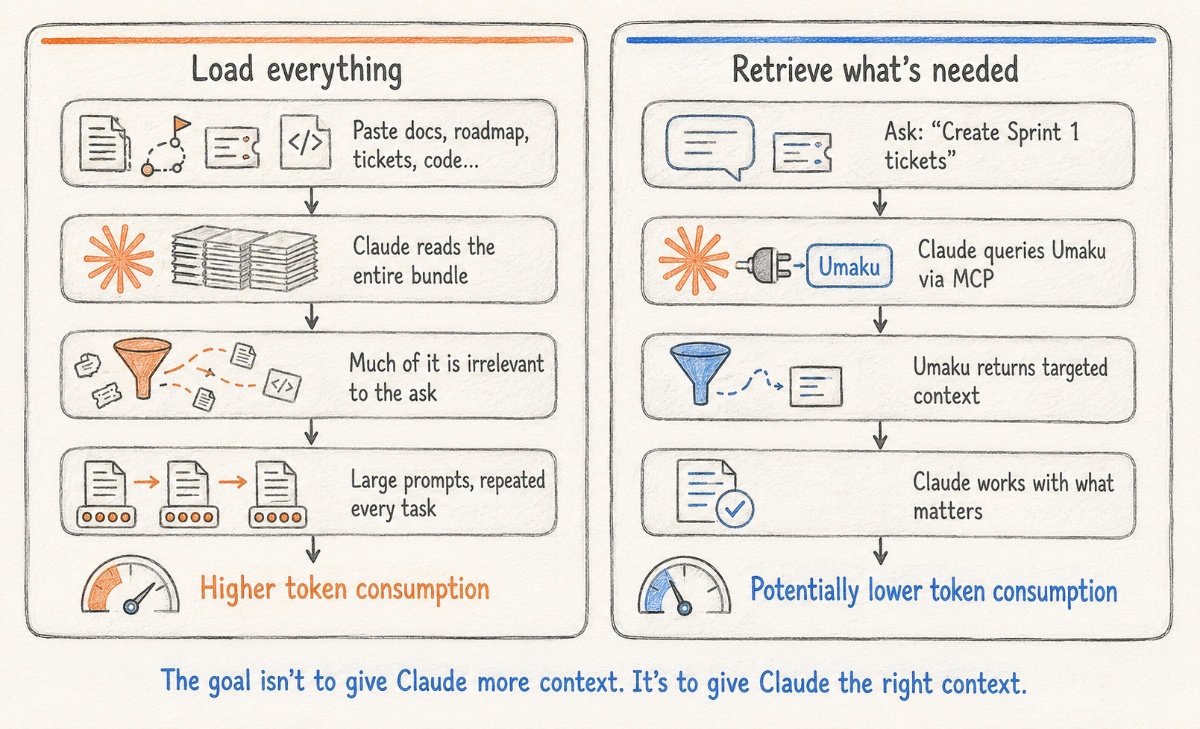
Imagine a project with 500 tickets, several sprint histories, extensive technical documentation, product requirements, design files, and multiple repositories. If the team asks a question about Sprint 3, Claude does not necessarily need the other 499 tickets or the complete project history. Repeatedly supplying all of that material increases input tokens and makes the model process information unrelated to the task.
From full-context loading to targeted retrieval
With Umaku, Claude can retrieve the specific project information required for the current task.
For example:
Sprint planning: Retrieve the current sprint goal, relevant requirements, and associated wireframes, not the complete project roadmap.
Ticket refinement: Retrieve the selected ticket, its dependencies, and the applicable technical documentation, not every ticket in the backlog.
Progress reporting: Retrieve ticket statuses and sprint completion data, not the entire project history.
Requirement lookup: Retrieve the relevant business rule or acceptance criteria, not the full Project Charter.
Why this can reduce token usage
The difference is straightforward:
Without Umaku: User request + manually pasted project documents + ticket history + requirements
With Umaku: User request + targeted context retrieved from Umaku
This pattern can reduce unnecessary model input, especially in workflows that teams repeat throughout the week. It can also make Claude’s responses more focused because the model receives information directly related to the task.
Figure 14. Two Ways to Make Claude Project-Aware
The benefit compounds in repeated workflows. Sprint-status checks, ticket refinement, and requirement lookups happen throughout the week; targeted retrieval prevents teams from resending the same large body of project information for each request.
Token efficiency is therefore one benefit of the integration. The deeper change is how Claude participates in the engineering workflow.
From AI Assistant to AI Engineering Workspace
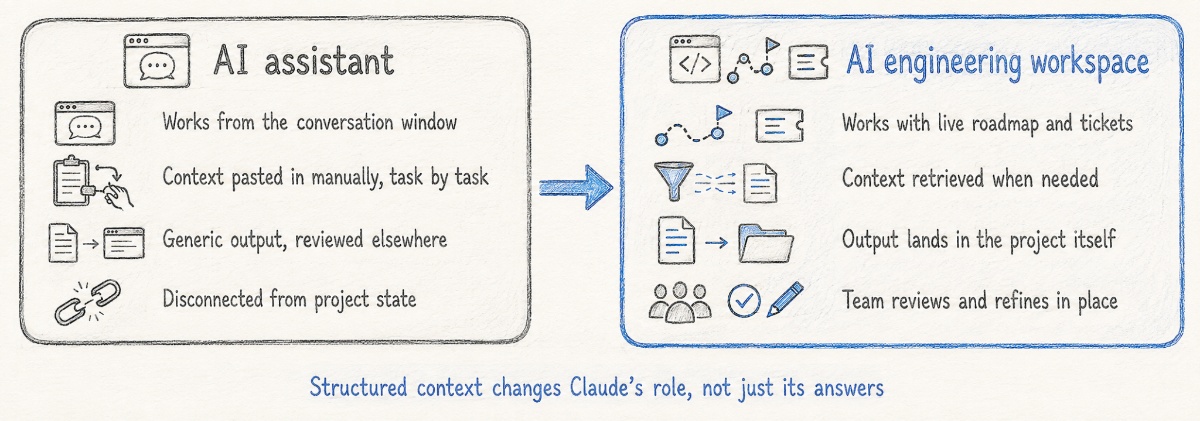
More efficient context delivery is only part of the change. The deeper shift is from using Claude as an isolated assistant to using it as an interface to the engineering workspace.
Without Umaku With Umaku
Figure 15. From AI Assistant to AI Engineering Workspace.
Without Umaku: A General AI Assistant
Depends on project information manually pasted into the conversation.
Responds from limited context and may miss business requirements or earlier technical decisions.
Produces suggestions or tickets that a team must transfer into its project-management system.
With Umaku: An Interface to the Engineering Workspace
Retrieves relevant requirements, roadmap items, sprint goals, tickets, and documentation.
Creates and refines work items within the project’s current scope.
Connects business objectives to development tasks using the project’s operational context.
Allows the team to review, adjust, and approve the resulting work inside Umaku.
Claude still provides the reasoning and generation capabilities, but Umaku grounds those capabilities in the systems where the team plans and manages delivery. The result is a shift from generating isolated text to participating in a governed, context-aware engineering workflow.
Why Context-Aware AI Matters for Engineering Teams
For engineering teams, this shift produces practical benefits beyond the individual workflow. Connecting Claude to live project context creates five clear advantages:
Less context switching: Teams do not have to move constantly between Claude, project documentation, tickets, and other systems to assemble the information needed for a task.
Better project alignment: Claude can work from the project’s actual objectives, requirements, and technical decisions instead of relying on generic assumptions.
Faster project-management workflows: Repetitive tasks such as creating tickets, refining requirements, checking sprint progress, and preparing work for development can be completed more quickly.
More efficient use of AI: Claude receives targeted information relevant to the current request instead of repeatedly processing large volumes of unrelated project context.
Better visibility and control: Work created through Claude returns to Umaku, where teams can inspect scope, sources, priorities, estimates, and unresolved decisions before approving it. Targeted retrieval can also help control token consumption by reducing unnecessary model input in repeated workflows.
Okon Prince is a Senior Data Scientist and AI/ML Engineer who builds intelligent, data-driven systems that solve real-world business problems.
Together, these benefits explain why structured project context is becoming as important as model capability itself.
Conclusion
The next stage of AI-assisted software development is not simply about more powerful models.
It is about connecting those models to the systems, data, workflows, and context where real work happens. Claude brings reasoning and generation. Umaku brings structured project context and development workflows. MCP provides the connection between them.
Together they let teams work with the actual project rather than a manually assembled snapshot of it, and when the model receives only the context it needs, teams can potentially improve both AI effectiveness and token efficiency. The future of AI-assisted engineering may be less about bigger prompts and more about better-connected context.
FAQ
What is Umaku’s role when used with Claude?
Umaku provides Claude with structured, project-specific context—including business objectives, technical decisions, documentation, roadmaps, sprints, and tickets. This helps Claude produce work that reflects the project’s actual requirements.
How does Claude connect to Umaku?
Claude connects to Umaku through the Model Context Protocol (MCP). MCP enables Claude to retrieve relevant project information and perform authorized actions in Umaku without teams repeatedly copying and pasting information into conversations.
How does the integration improve sprint planning?
Claude can retrieve the current sprint objective, review relevant project sources, identify conflicting requirements, and create sprint-scoped tickets. It can also avoid duplicating completed or previously assigned work and flag unresolved decisions for team review.
Can using Umaku reduce Claude’s token usage?
Yes. Instead of supplying Claude with the entire project history, Umaku enables targeted retrieval of only the information needed for a task. This can reduce unnecessary input tokens and produce more focused responses.
Does the Claude–Umaku integration replace human oversight?
No. Claude accelerates project research, planning, and ticket creation, but the engineering team must still validate scope, resolve inconsistencies, adjust estimates, and approve the resulting work. Access is also limited to the permissions of the connected Umaku user.
Share this article
Share on LinkedIn, send by email, or copy the direct link.