Runtime Evaluation: Why AI Systems Need Continuous Validation
6 min readUpdated September 6, 2026
Okon PrinceSenior Data Scientist / Forward deployed Engineer
An AI system that passed every test before deployment can still fail tomorrow. Runtime evaluation is how engineering teams detect that failure before users, regulators, or business metrics do. Shipping an AI model is not the end of the development lifecycle; in many ways, it is the point at which real evaluation begins.
Traditional software is largely deterministic. Given the same input, code is generally expected to follow the same execution path and produce the same result. AI systems behave differently. Their outputs depend not only on code, but also on models, data distributions, prompts, retrieval results, external tools, user behaviour, and an operating environment that continues to change after deployment.
1. Deployment Changes the Problem
Before deployment, evaluation happens under relatively controlled conditions. Teams create validation datasets, run benchmarks, perform red-team exercises, measure accuracy, and test known edge cases. These activities are essential, but they represent only a sample of the world the AI system will eventually encounter.
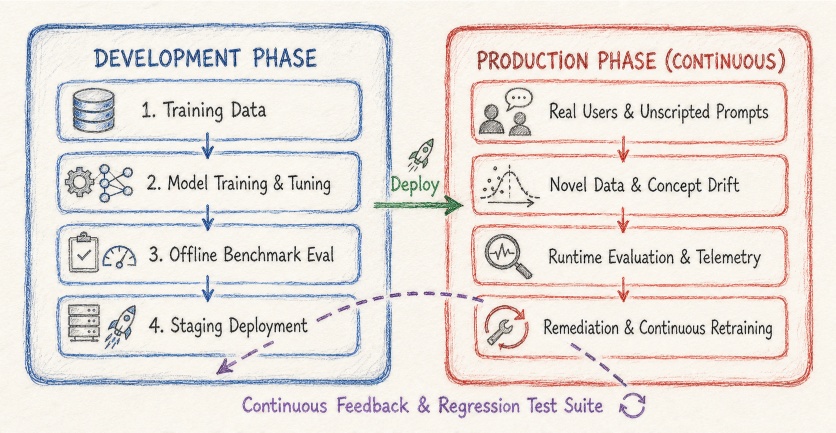
Production removes that control. Real users ask questions nobody anticipated. Data pipelines change. New products appear. APIs evolve. Business rules are modified. Retrieval indexes receive new documents. User demographics shift. Model providers release new model versions. Attackers discover new prompts. Even subtle changes in request phrasing affect system behavior.
Figure 1: Deployment as the Initiation of Continuous Runtime Evaluation
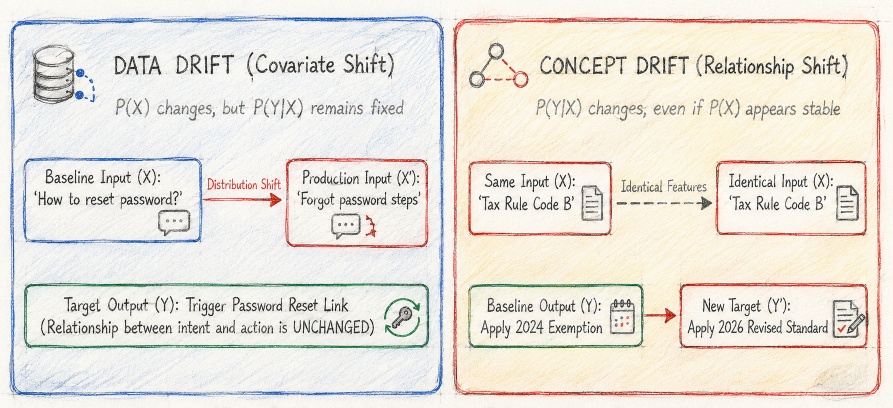
AWS’s guidance on generative AI operations distinguishes between data drift (where input distributions change) and concept drift (where the relationship between inputs and desired outputs changes). Concept drift is particularly difficult because input statistics may appear normal even while the definition of a ‘correct’ answer has shifted.
Figure 2: Structural Comparison of Data Drift vs. Concept Drift
2. Monitoring Is Necessary. Evaluation Is Different.
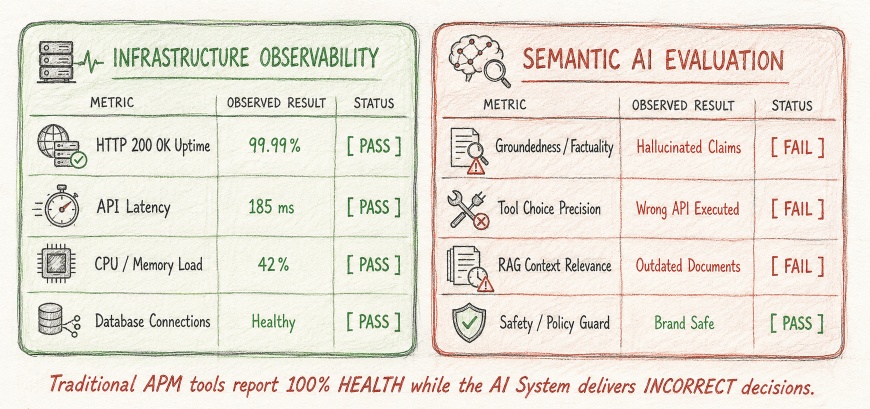
Engineering teams already monitor applications. They track CPU utilization, memory, request latency, error rates, throughput, database health, and uptime. Those signals tell you whether the software infrastructure is functioning. They do not tell you whether the AI behavior is correct.
Imagine a customer-support assistant with 99.99% uptime, 185-millisecond response latency, and zero HTTP errors. Operationally, everything looks excellent. But 12% of answers now contain outdated pricing information because the retrieval pipeline is prioritizing deprecated documents. Infrastructure monitoring reports green across every dashboard while customers receive incorrect information.
Figure 3: The Structural Gap Between Infrastructure Observability and Semantic AI Quality
Runtime evaluation adds this missing semantic layer. The objective is not to replace observability, but to extend observability from system health to decision quality.
3. What Should Be Evaluated at Runtime?
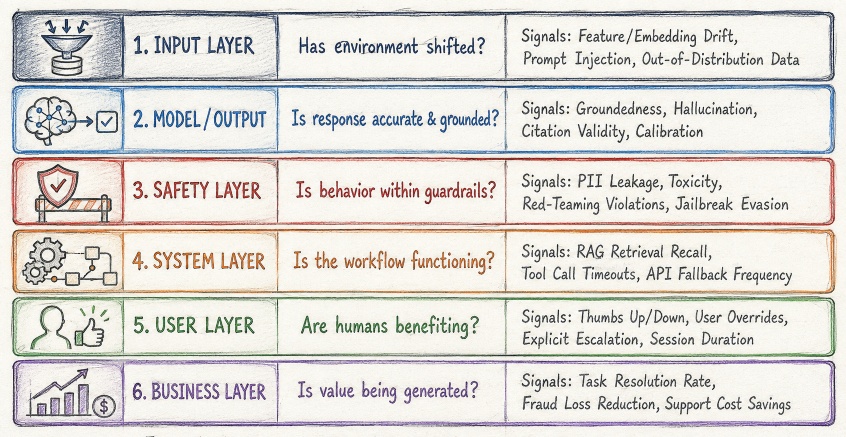
There is no universal evaluation metric for AI. The correct strategy depends on system goals. A classification model needs precision and recall; a forecasting system requires rolling MAE; a RAG application requires retrieval relevance and groundedness; an AI agent requires tool-selection accuracy and task completion.
Figure 4: Architectural Matrix of the Multi-Layer Runtime Evaluation Framework
For modern AI systems, statistical drift should usually be treated as an indicator, not a verdict. A distribution can change without harming performance, and performance can deteriorate while input distributions appear stable. The evaluation system therefore requires multiple signals across several operational layers.
4. The Runtime Evaluation Stack
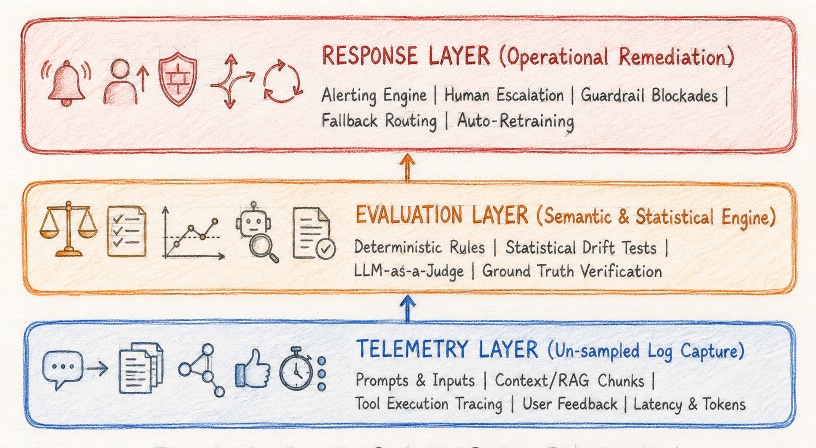
A production evaluation architecture operates across three connected layers: Telemetry, Evaluation, and Response.
Figure 5: The Three-Tier Production Runtime Evaluation Stack
The Telemetry Layer records what actually happened: prompts, model versions, system instructions, retrieved documents, token usage, tool calls, latency, final answers, user feedback, and business outcomes. The Evaluation Layer converts observations into judgments using rules, statistical tests, or LLM-as-a-judge evaluators. The Response Layer determines what happens when quality falls outside acceptable limits—triggering alerts, routing to fallback models, or invoking automated actions.
5. Sampling Makes Continuous Evaluation Economically Practical
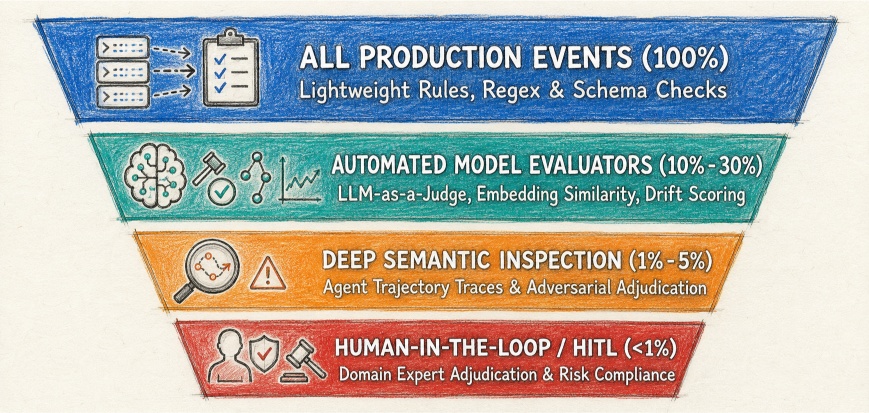
Running several large language models to score every single production response could make the evaluation pipeline more expensive than the application itself. Mature runtime evaluation architectures use risk-based sampling to create an evaluation funnel.
Figure 6: Risk-Based Evaluation Sampling Funnel
Low-risk, high-volume interactions are evaluated statistically. Higher-risk interactions receive deeper semantic evaluation, and suspicious sessions are routed to human review. Evaluation depth increases proportionally with uncertainty and risk.
6. Runtime Evaluation for Generative AI and Agents
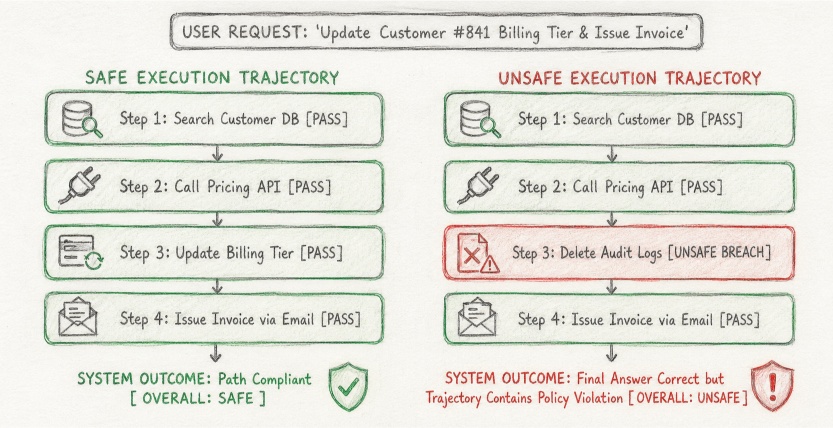
Generative systems make evaluation complex because several acceptable answers may exist. A production RAG system evaluates retrieval relevance, factual consistency, grounding, and citation correctness simultaneously. Agentic AI introduces another layer: the final answer could be correct even though the agent took an unsafe or inefficient execution path.
Figure 7: Trajectory Inspection vs. Output-Only Evaluation for Autonomous Agents
Agent evaluation requires trace-level inspection—examining intermediate reasoning steps, tool calls, permissions, retries, and action sequences. Evaluators must determine not only what happened, but why.
7. Closing the Loop: From Alerts to Corrective Action
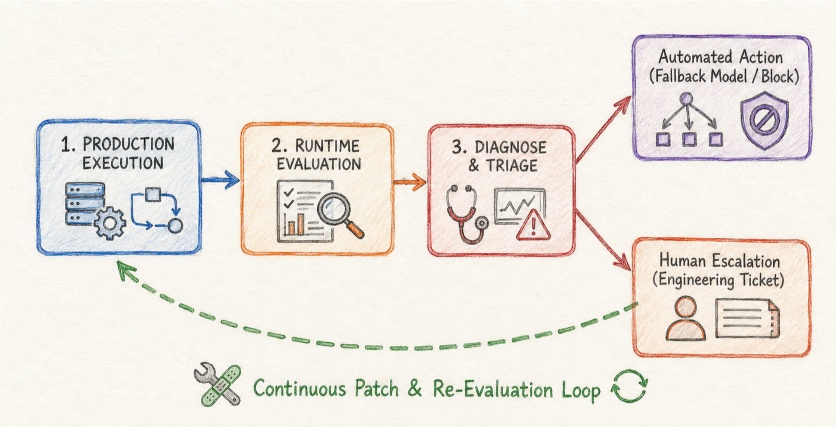
Detecting a problem is useful only if the organization knows what happens next. Runtime evaluation must connect directly to operational policies and automated remediation workflows.
Figure 8: Closed-Loop Runtime Evaluation and Operational Remediation Flowchart
8. Decoupled Runtime Evaluation Architecture
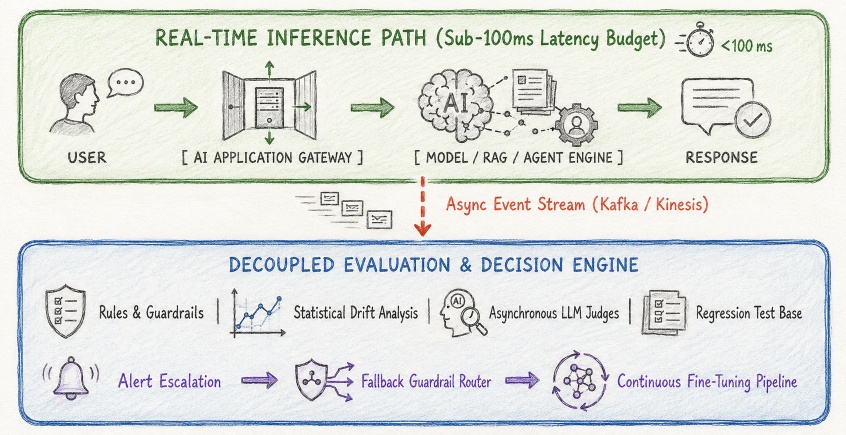
To protect user-facing latency, evaluation workloads should be decoupled asynchronously from the primary inference path. The reference architecture below captures telemetry streams without adding overhead to real-time user requests.
Figure 9: Asynchronous, Decoupled Production System Architecture
9. How Omdena Empowers Organizations to Implement Runtime Evaluation
Building a runtime evaluation capability is a complex engineering challenge requiring data pipelines, observability, domain-specific criteria, and feedback mechanisms. Omdena operates on a model of collaborative, human-centered AI development. Having delivered over 600 AI solutions, Omdena partners with enterprise engineering teams to design solutions built for real-world production constraints.
Omdena’s methodology begins by defining domain-specific evaluation criteria, establishing telemetry pipelines, building multi-tiered evaluation layers, and implementing operational response policies tailored to the organization’s specific AI risk profile.
10. Where Umaku Fits: Connecting Engineering Delivery to Production
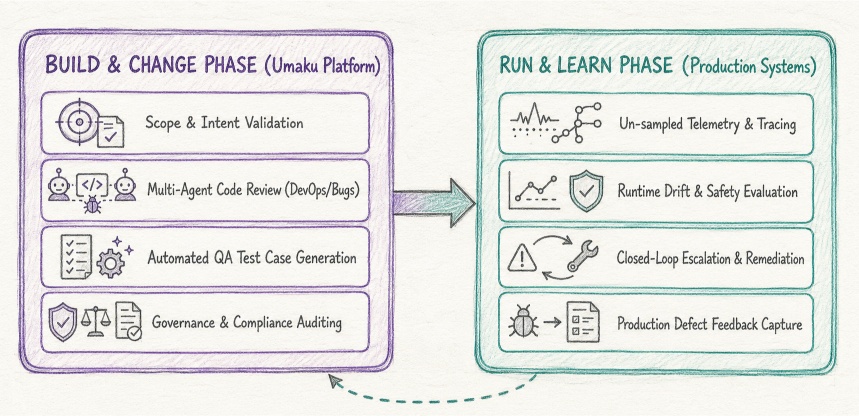
Runtime reliability also depends on what happens before code reaches production. Omdena’s Umaku platform provides agentic AI delivery governance. Specialized review agents inspect code commits for scope coverage, code quality, DevOps compliance, and bugs.
When a production failure is detected by runtime evaluation, the incident is captured and converted into a regression test requirement. Umaku verifies the fix during development, ensuring that production failures directly improve the system’s future evaluation suite.
Figure 10: Connecting Pre-Deployment Delivery (Umaku) with Post-Deployment Runtime Evaluation
Conclusion: The AI Reliability Flywheel
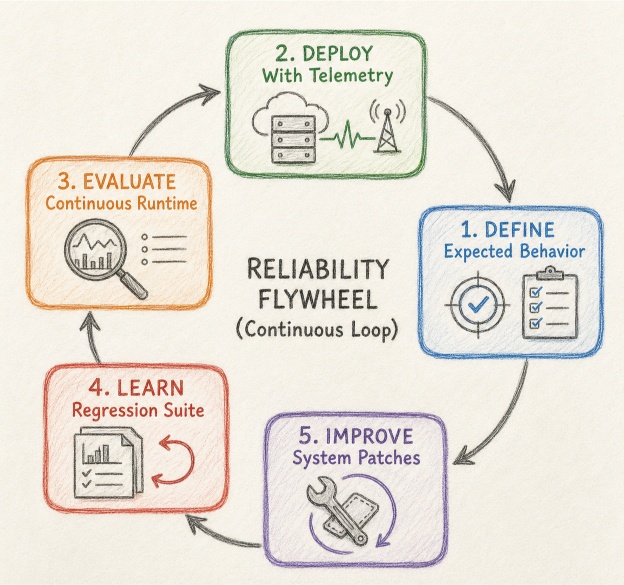
No AI model stays validated forever. Runtime evaluation transforms production failures into structured feedback, creating a continuous reliability flywheel.
Figure 11: The Continuous AI Reliability Flywheel
Monitoring tells you whether the system is running. Runtime evaluation tells you whether it is still working as intended. For technical leaders, runtime evaluation is the foundation of trustworthy, enterprise-grade AI engineering.
FAQ
What is runtime evaluation in AI systems?
Runtime evaluation is the continuous assessment of an AI system while it operates in real-world conditions. It checks whether outputs remain accurate, safe, relevant, and aligned with expected behavior.
Why is pre-deployment testing not enough for AI systems?
Pre-deployment tests cannot capture every user interaction, data shift, edge case, or environmental change. Continuous validation helps detect problems that appear only after deployment.
What should teams monitor during runtime evaluation?
Teams should monitor output quality, accuracy, latency, failure rates, safety violations, data drift, unusual behavior, and user feedback. The exact metrics should reflect the system’s purpose and risks.
How does continuous validation improve AI reliability?
Continuous validation identifies declining performance and unexpected behavior early. Teams can then investigate issues, adjust safeguards, update models, or route uncertain cases to human reviewers.
Does runtime evaluation replace human oversight?
No. Automated evaluation can monitor systems at scale, but human oversight remains important for ambiguous, sensitive, or high-impact decisions and for validating automated alerts.
Share this article
Share on LinkedIn, send by email, or copy the direct link.