
Skip to content

AI Implementation Guide 2026: From Planning to Production

Learn how to plan, build, and deploy AI solutions that deliver measurable business value. Explore implementation strategies, costs, timelines, common challenges, and real-world examples.

  • Assess your organization's AI readiness
  • Choose between building, buying, or partnering
  • Estimate AI implementation costs and timelines
  • Understand the six pillars of production-ready AI
  • Explore 20 real-world AI case studies
  • Use a 15-question leadership workbook
Download the Free AI Implementation Guide (opens the form in a new tab)

Get a step-by-step guide to planning, building, and scaling AI solutions, with implementation frameworks, cost estimates, and real-world case studies.
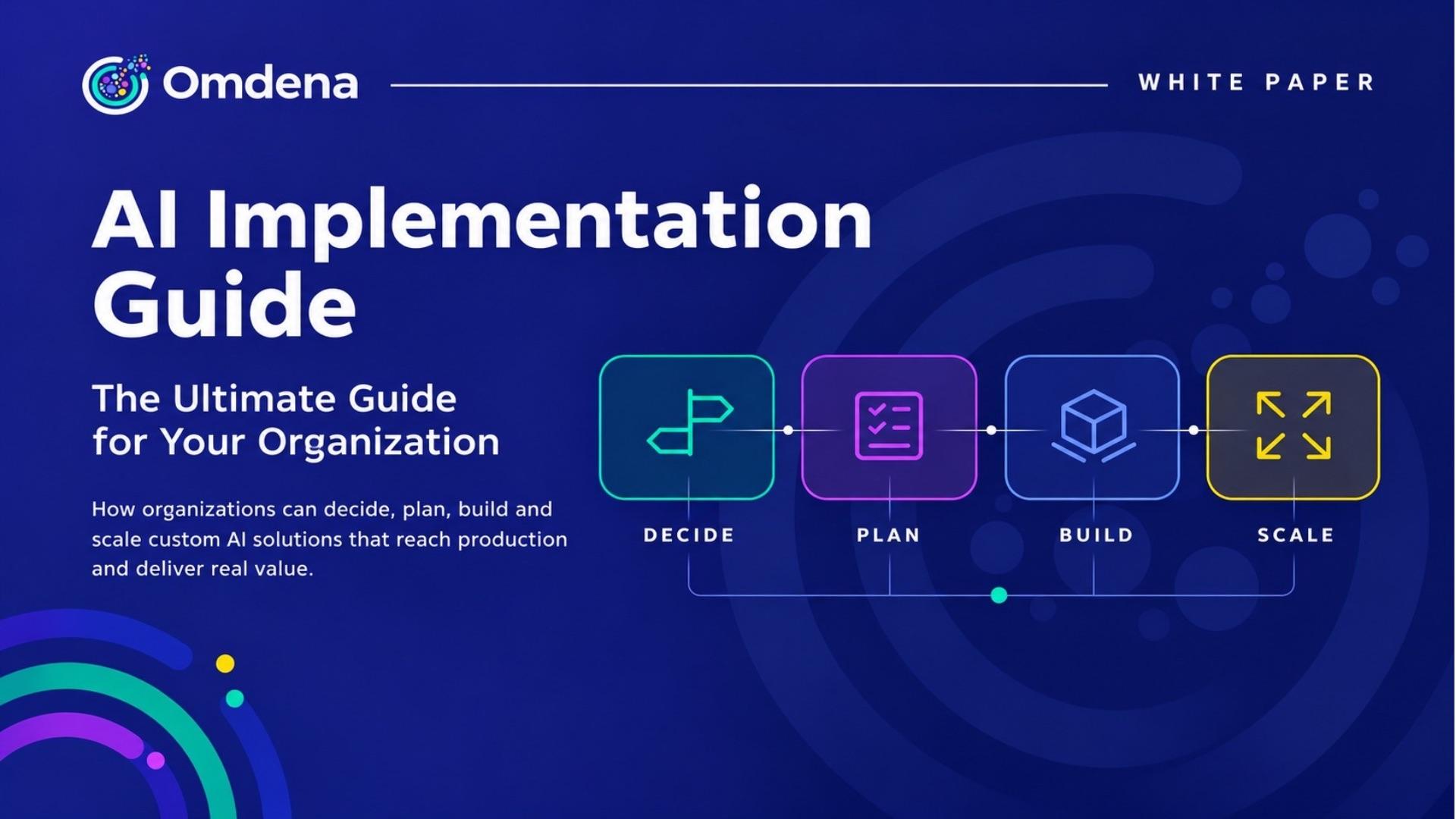
AI Implementation Guide in 2026: From Planning to Production cover

Who this guide is for

This guide helps organizational leaders make informed decisions about AI investments, implementation, and long-term operations.

  • CEOs and business leaders
  • CTOs, CIOs, and technology leaders
  • Heads of AI and Data Science
  • AI product and program managers
  • Digital transformation leaders
  • AI engineering and implementation teams

Why AI projects fail

  • Unclear business objectives and success metrics
  • Poor data quality and fragmented systems
  • Unexpected implementation and operating costs
  • Difficulty moving AI prototypes into production
  • Weak governance and limited user adoption

What you’ll learn

  • Evaluate your organization's AI readiness
  • Select the right AI technology and delivery approach
  • Plan realistic budgets and implementation timelines
  • Build reliable, production-ready AI systems
  • Manage AI risks, governance, and compliance
  • Measure AI performance and business impact

Real-world AI implementation examples

Explore AI projects across healthcare, logistics, agriculture, energy, humanitarian response, and other sectors.

Humanitarian response

Predicting disaster-affected populations and estimating relief supplies

Road safety

Automating road-safety assessments using computer vision

Logistics optimization

Optimizing delivery routes and reducing costs

Environmental monitoring

Detecting mangrove canopy changes using satellite imagery

Wildfire detection

Detecting smoke with computer vision to support faster alerts

Six pillars of successful AI implementation

  1. Data readiness
  2. Model architecture
  3. Evaluation & testing
  4. Deployment & operations
  5. Governance, safety & compliance
  6. People and change management

AI implementation planning tools

  • AI readiness assessment
  • Build, buy, or partner decision framework
  • AI technology selection guide
  • AI cost and timeline planning framework
  • AI implementation risk assessment
  • 15-question leadership workbook
Get the guide

Omdena’s track record

Organizations served
300+
AI solutions delivered
600+
Countries impacted
60+
“Extremely promising project results, not just for Save the Children, but for the entire field of actors.”
John Zoltner, Senior Advisor of Technology for Development and Innovation, Save the Children

Ready to move beyond the pilot?

Book a 30-minute exploration call. We’ll help you see what it takes to build human-centered AI your teams will actually use.