AI Data Readiness: Preparing Your Data for Production AI
10 min readUpdated August 10, 2026
Prince OkonSenior Data Scientist
A company builds a RAG assistant, an internal copilot, and a forecasting model. Every demo is impressive. Then production begins: the assistant retrieves outdated documents, gives conflicting answers, misses obvious context, and the forecasts wobble. Engineers tune prompts and swap models, and nothing sticks, because the model was never the problem. The data was.
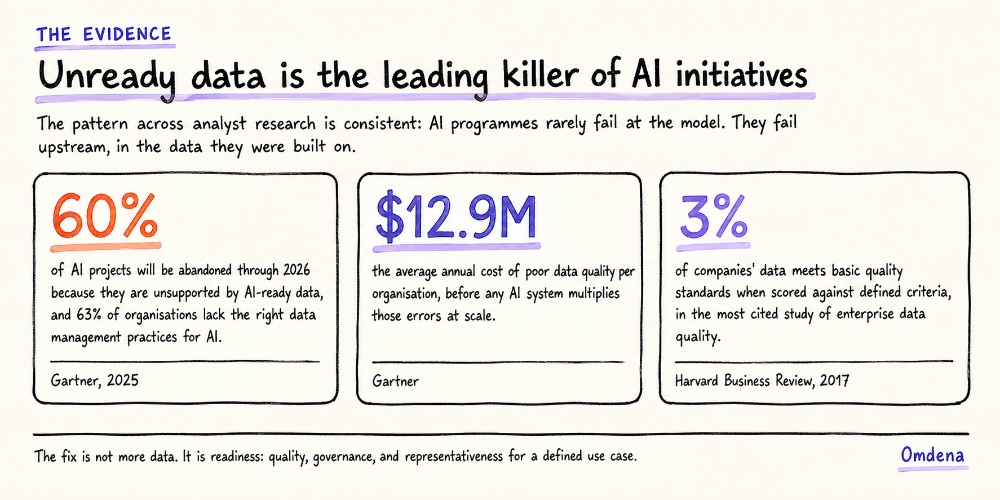
The pattern is universal. Gartner predicts 60% of AI projects will be abandoned through 2026 for lack of AI-ready data, and 63% of organizations admit their data practices are not ready for AI.
This article explains AI data readiness: the missing foundation between prototypes and production. You will learn what readiness actually means, why projects fail without it, a six-pillar framework that goes beyond clean data, a practical seven-step preparation roadmap, and a ten-question checklist you can score your own organization against before the next AI business case is approved.
What Is AI Data Readiness?
AI is not limited by model intelligence. It is limited by data readiness: whether enterprise data is accessible, trustworthy, contextual, governed, continuously maintained, and aligned to a specific AI use case. That last clause matters most, because readiness is never universal.
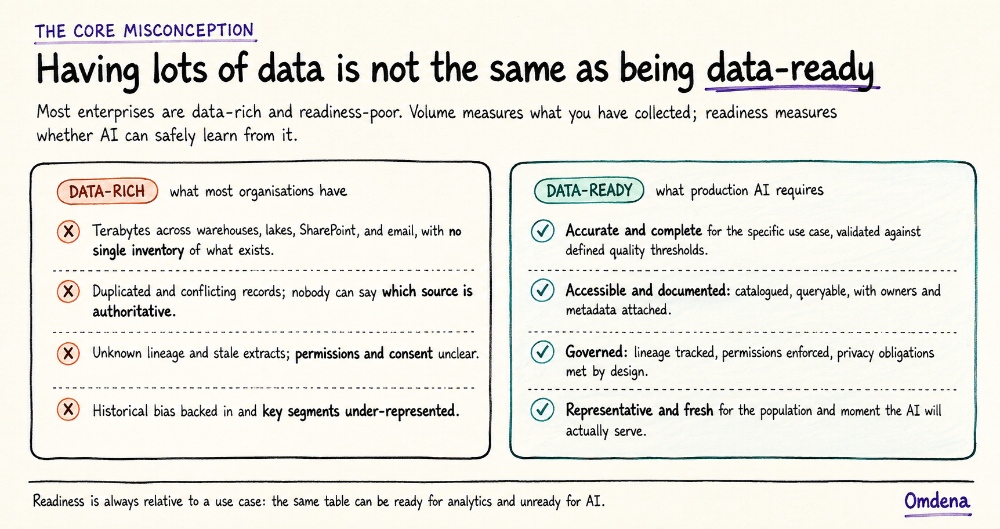
Notice what is absent from that definition: volume. Most enterprises answered the volume question years ago. Warehouses, lakes, and document stores hold more than any AI project could consume, yet the estate remains rich in bytes and poor in trust.
A crucial distinction follows: high-quality data is not the same as AI-ready data. A table can pass every traditional quality check and still fail AI, because it lacks the metadata, permissions, retrieval structure, or business meaning the AI needs.
Figure 1. Data-rich versus data-ready: the gap most AI programmes fall into.
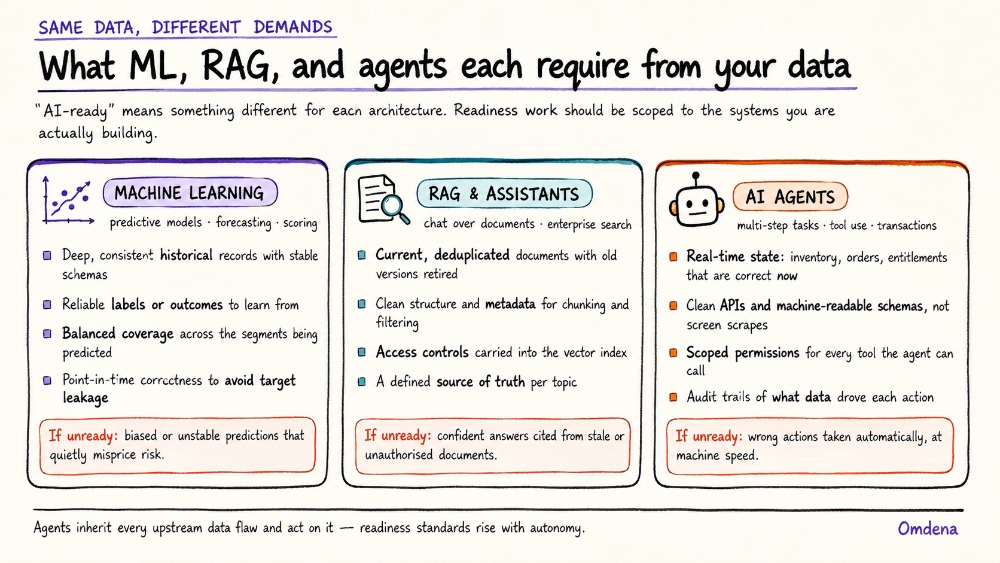
Readiness also depends on the intended application. Machine learning, RAG, and agents stress data in different ways, and readiness for one is not readiness for the others.
Figure 2. What machine learning, RAG, and agents each demand from data.
Standards rise with autonomy: a flawed report misleads a reader, but a flawed agent acts on every upstream defect at machine speed. Understanding why projects collapse without this foundation makes the case for investing in it.
Why AI Projects Fail Without Data Readiness
The root causes hide in plain sight, and most predate the AI initiative by years: data silos, missing metadata, duplicate records, unclear ownership, stale documents, inconsistent business definitions, broken pipelines, and weak governance. Individually, they are nuisances. Fed to AI, they become behaviour.
In production, those causes surface as familiar symptoms:
Hallucinations and poor RAG answers, as assistants confidently cite outdated or conflicting documents.
Wrong recommendations, as models learn from incomplete or unrepresentative history.
Agents taking incorrect actions, because live state was stale or permissions were unclear.
Lost business trust, the compounding cost, because users who catch the AI wrong once stop using it.
Most AI failures begin as data problems, not model problems, and the analyst record backs this up.
Figure 3. The analyst consensus: AI initiatives fail upstream, in the data.
Harvard Business Review found only 3% of companies’ data meets basic quality standards, poor data quality already costs organizations an average of $12.9 million a year, and MIT’s finding that 95% of GenAI pilots show no return fits the same pattern. Avoiding it requires knowing what readiness is made of.
The Six Pillars of AI Data Readiness
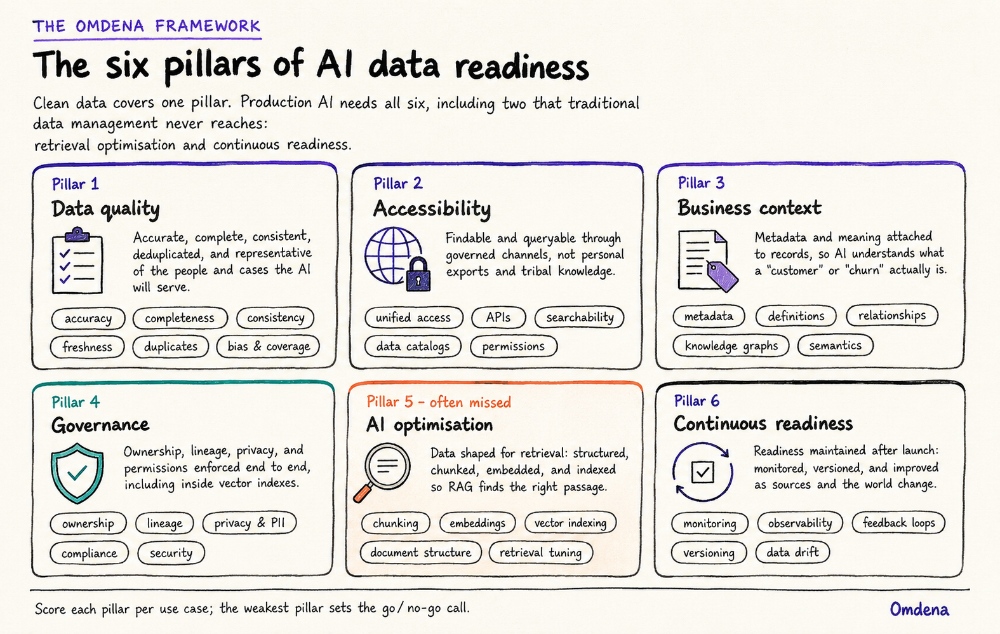
Most guidance stops at “clean your data”. Production AI needs a wider frame. Omdena’s framework spans six pillars, including two that traditional data management never reaches: retrieval optimisation and continuous readiness.
Figure 4. The six-pillar AI data readiness framework.
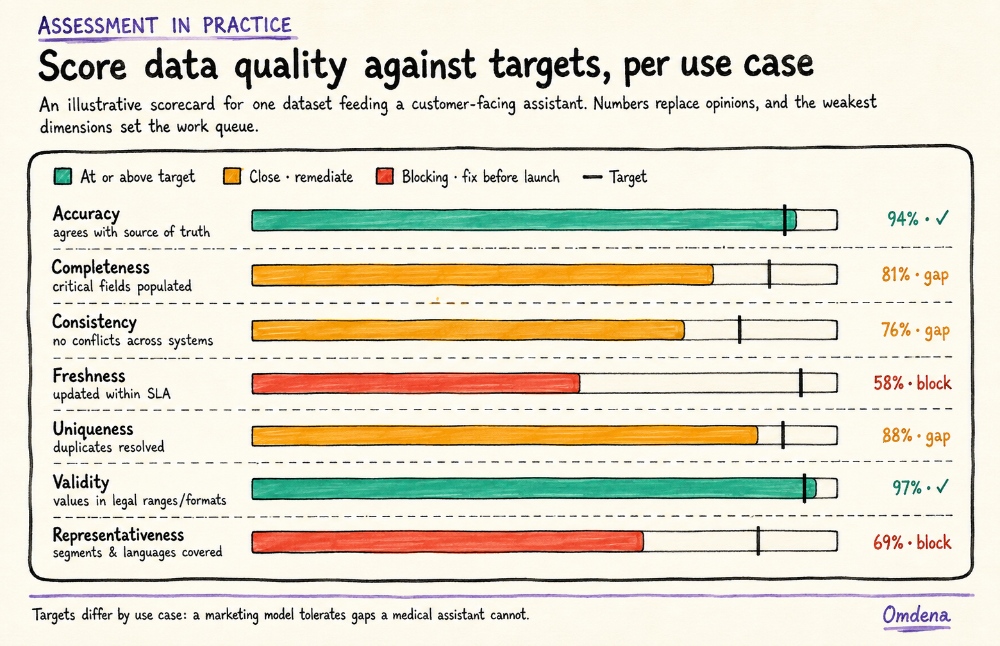
Data quality covers accuracy, completeness, consistency, freshness, deduplication, and representativeness. It is measured, not asserted, against targets set per use case.
Figure 5. Quality scored against use-case targets: numbers replace opinions.
Accessibility means AI systems and teams can actually reach the data: unified access, APIs, searchable catalogs, and managed permissions.
Business context gives records meaning through metadata, agreed definitions, relationships, and semantics, because AI needs to know what a “customer” is, not just fetch rows.
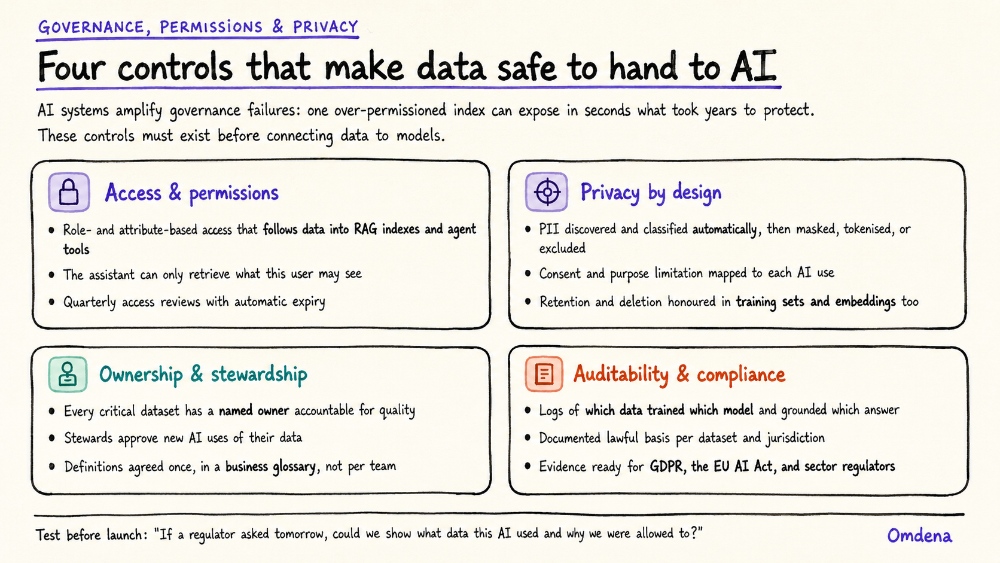
Accessibility has a sharp edge AI makes sharper: permissions. An assistant that retrieves from an over-permissioned index can expose in seconds what access controls protected for years, so entitlements must follow the data into every vector store and agent tool.
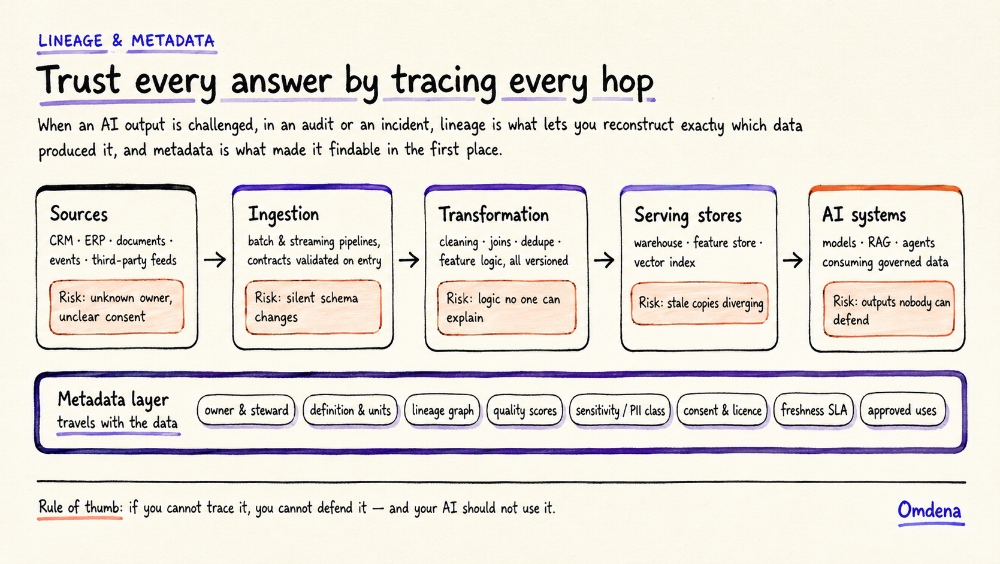
Governance makes usage defensible: ownership, lineage, privacy, compliance, and security enforced end to end, including inside vector indexes.
Figure 6. Lineage across the pipeline, with metadata travelling alongside.Figure 7. Four governance controls that make data safe to hand to AI.
AI optimization is the pillar most enterprise articles miss: structuring, chunking, embedding, and indexing data so retrieval actually finds the right passage. A pristine document repository can still make a terrible knowledge base.
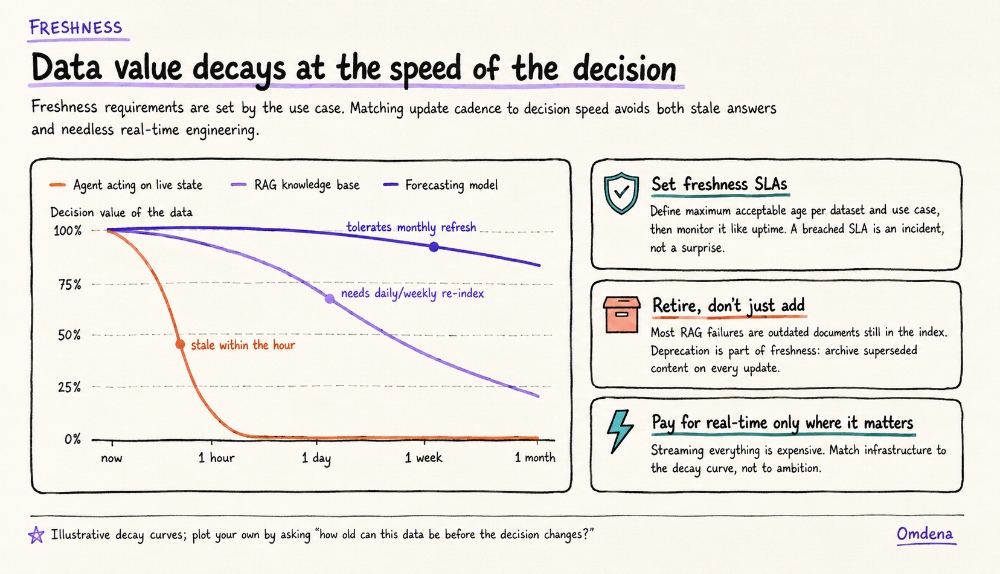
Continuous readiness keeps all of it true after launch: monitoring, feedback loops, versioning, and drift detection, because data value decays at the speed of the decision.
Figure 8. Value decay by use case, and the practices that keep pace with it.
Six pillars describe the destination. The next question is the route.
Preparing Enterprise Data for Production AI
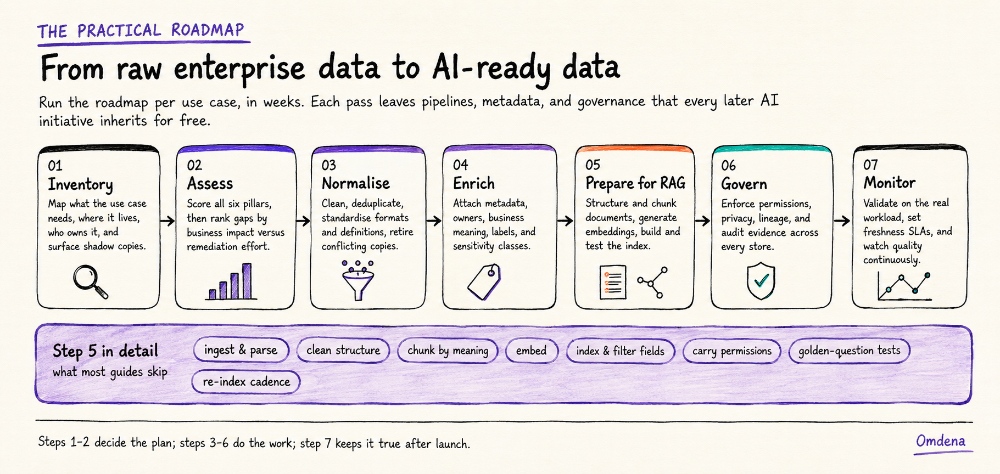
Readiness work fails in two familiar ways: the five-year enterprise-wide cleanup that outlives its sponsors, and the pilot that skips preparation entirely. The roadmap below avoids both by running per use case, in weeks.
Figure 9. Seven steps from raw enterprise data to AI-ready data.
Timebox the front of the roadmap. Two to four weeks of inventory and assessment is enough to fill a credible plan for one use case; perfection at this stage only delays the value it exists to unlock.
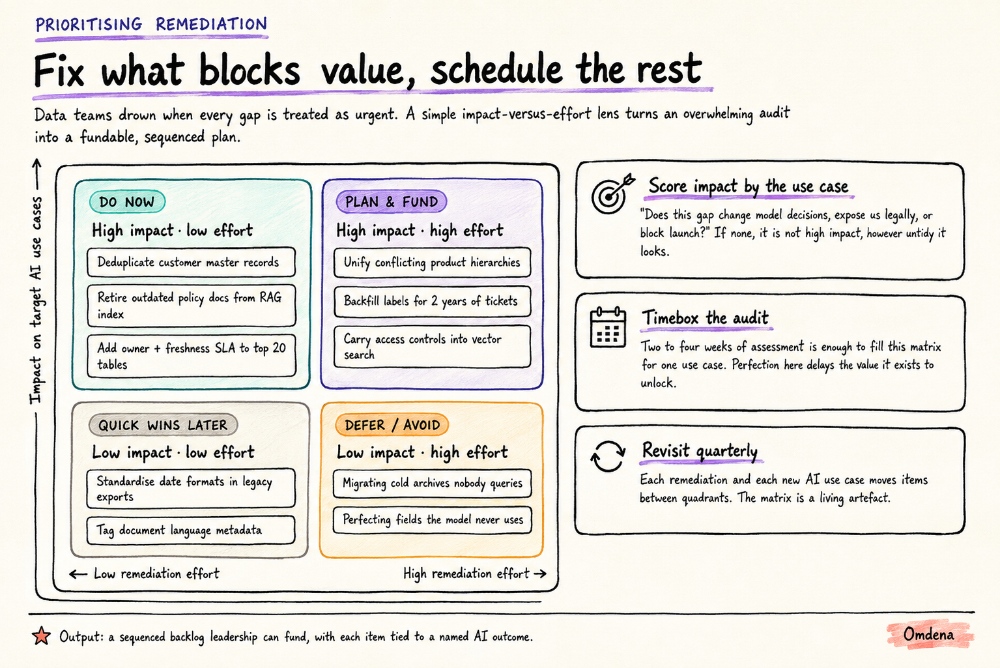
Two steps decide whether the roadmap delivers. The first is prioritisation inside step 2: score every gap by business impact versus remediation effort, fix what blocks the use case, and schedule or skip the rest.
Figure 10. Impact versus effort: turning an audit into a fundable, sequenced plan.
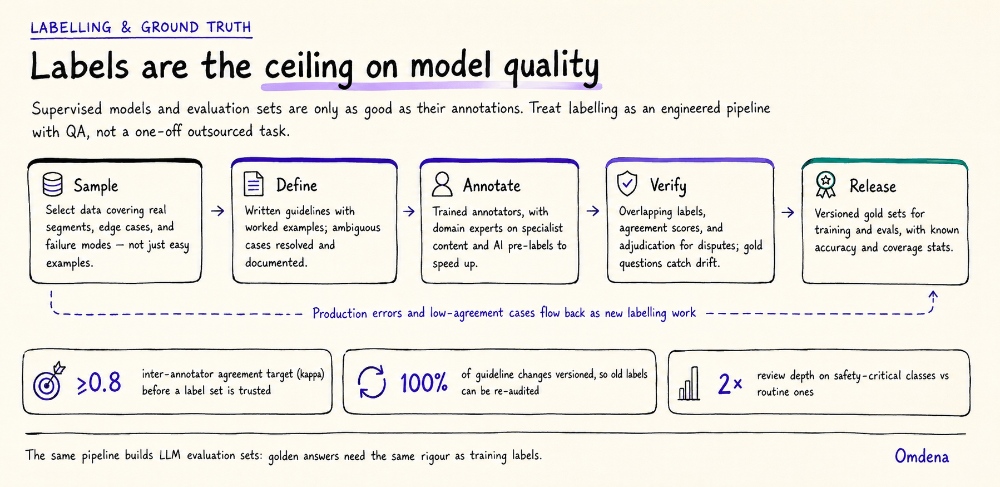
The second is enrichment in step 4, where labelling lives. Models learn from labels and evaluation sets judge against them, so annotation quality caps everything downstream. Treat it as an engineered pipeline with guidelines, agreement checks, and versioned gold sets, not a one-off outsourced task.
Figure 11. Labelling as a pipeline: sample, define, annotate, verify, release, loop.
Validation then proves readiness on the real workload before launch: quality gates on the production extract, bias and coverage tests per segment, retrieval accuracy on a golden question set, and privacy checks on everything entering training sets and indexes. Which raises a fair question: how ready are you right now?
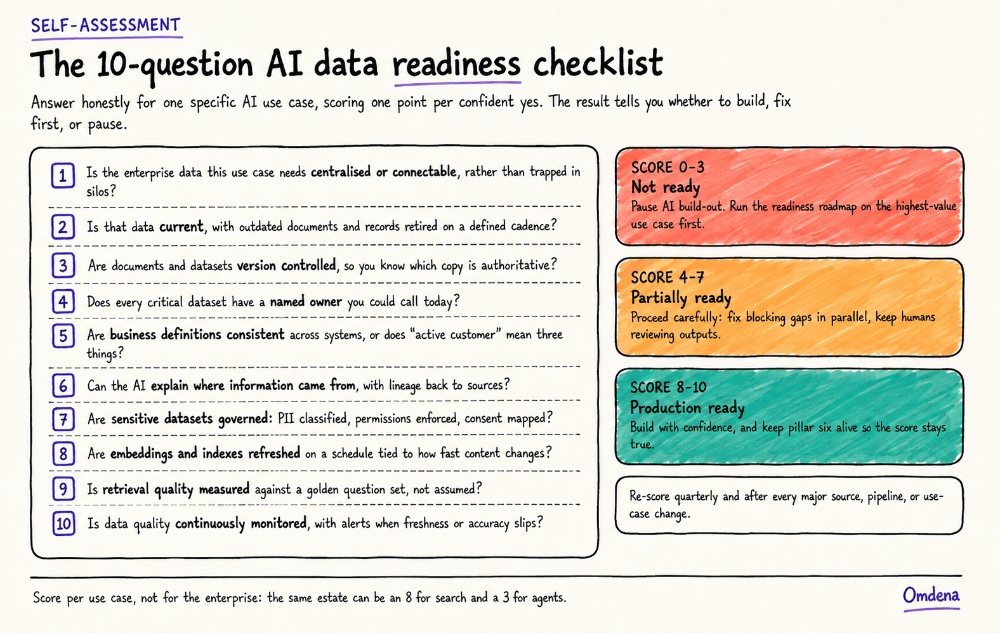
The AI Data Readiness Checklist
Before funding the next AI use case, score it against ten questions. One point per confident yes; be honest, because production will be.
Figure 12. The ten-question self-assessment, with score bands.
Score per use case, not for the enterprise. The same estate can be an eight for internal search and a three for autonomous agents, and averaging the two produces a number that means nothing.
A score of 0–3 means not ready: run the roadmap before building. A 4–7 means partially ready: proceed with humans reviewing outputs while you close blocking gaps. An 8–10 means production ready, provided pillar six keeps the score true. Staying at eight or above is a matter of habits.
Best Practices for Enterprise AI Data Readiness
The organizations that stay ready share a small set of operating habits:
Treat data as a product, with owners, consumers, SLAs, and a roadmap, and design for AI from day one.
Build metadata and business definitions early; they are cheap on day one and brutally expensive to retrofit.
Break silos deliberately, prioritising the sources your flagship AI use cases depend on.
Prepare unstructured data properly: structure, chunk, embed, and measure retrieval quality against golden questions.
Monitor continuously and review regularly, treating a breached freshness SLA as an incident, not a surprise.
Ownership makes the habits stick. Where readiness belongs to everyone, it belongs to no one; the organizations that sustain it name a steward per critical dataset and hold them to the same review cadence as any product owner.
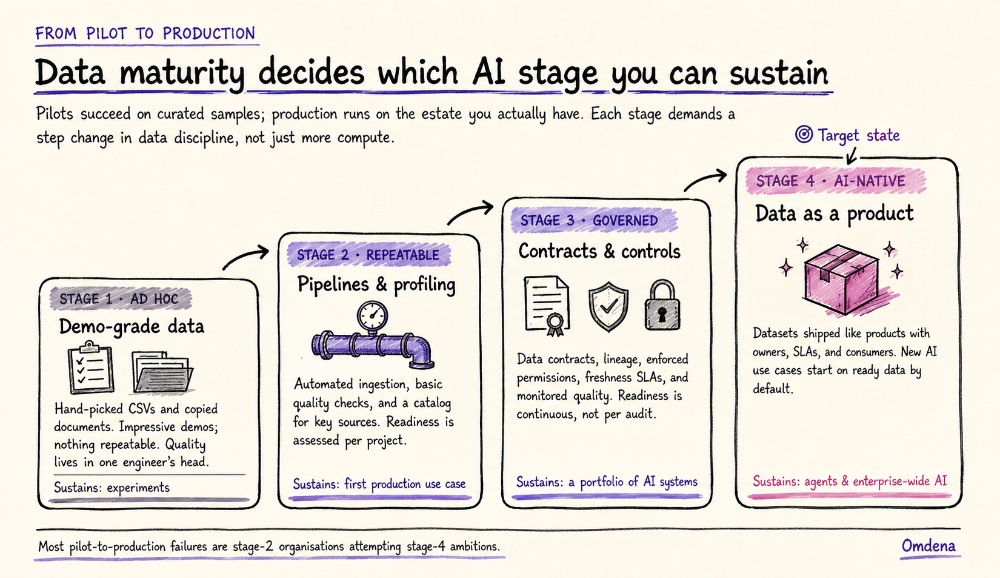
The unifying message: AI readiness is continuous, not a one-time cleanup project. Sustained over time, these habits carry an organization up a visible maturity curve.
Figure 13. Data maturity stages and the AI ambitions each can sustain.
Most pilot-to-production failures are stage-two organizations attempting stage-four ambitions. The honest move is to match ambition to maturity, then climb deliberately, and this is where an experienced partner changes the odds.
How Omdena Helps Organizations Build AI-Ready Data Foundations
Omdena has spent years on the unglamorous side of AI: making real-world enterprise data usable in production, across 600+ AI solutions for 300+ organizations in 60+ countries.
For organizations preparing data for production AI, Omdena provides:
AI readiness assessments that score your estate against the six pillars for a named use case, producing the prioritised backlog in Figure 10.
Data architecture and modernisation: pipelines, integration, catalogs, and RAG implementation built to production standards.
Governance and privacy implementation, from PII discovery and masking to lineage, permissions, and audit evidence. Custom datasets and expert annotation where ground truth is missing.
Enterprise AI strategy and capacity building, so your teams run the readiness cycle themselves on every later use case.
And because readiness work is itself a long, complex delivery, Omdena runs it on a platform designed to preserve its context: Umaku.
How Umaku Supports AI Data Readiness
Production AI depends not only on well-prepared enterprise data, but on preserving the delivery context around it: why a pipeline was built, which definitions were agreed, and what changed since. That context usually evaporates between sprints. Umaku, Omdena’s delivery platform, exists to keep it.
Applied to a data-readiness programme, Umaku preserves and enforces that context:
Project and business context in one place: requirements, technical documentation, sprint history, and code repositories linked, so knowledge survives team changes.
AI-assisted reviews on every commit verify that claimed pipelines, quality gates, and masking steps match the actual code, with evidence and citations.
Continuous evaluation and delivery insights flag risks in transformation and validation logic before they corrupt datasets downstream.
Measured outcomes: Umaku reports 20–35% earlier risk detection and 15–30% better delivery predictability across projects.
The result: readiness work, so often the invisible half of AI delivery, becomes as observable and accountable as the model work it enables.
You Don’t Have an AI Problem, You Have a Data Readiness Problem
When production AI disappoints, organizations instinctively blame the model. Most of the time they are looking in the wrong place. Production AI runs on trusted data, business context, governance, accessibility, and continuous maintenance, and it fails quietly without them.
If you retain one habit, make it this: never fund an AI use case without a readiness score attached. Before the next business case is approved, require five answers in writing:
Which datasets does this use case depend on, and who owns each one?
What does it score on the ten-question checklist, measured, not asserted?
Which gaps block launch, and what does remediation cost and take?
Can we prove, with lineage and permissions, that we may use this data this way?
What monitoring, versioning, and freshness SLAs keep it ready after go-live?
Organizations that invest in AI-ready data foundations deploy faster, carry less operational risk, and compound value with every use case. The rest keep discovering, one abandoned pilot at a time, that the model was never the problem.
FAQ
What is AI data readiness?
AI data readiness is the extent to which an organization’s data is accessible, trustworthy, contextual, governed, continuously maintained, and aligned to a specific AI use case. It goes beyond traditional data quality by ensuring data has the structure, metadata, permissions, and business context AI systems need to perform reliably in production.
Why is AI data readiness important?
AI data readiness provides the foundation for reliable production AI. Without it, organizations can experience hallucinations, inaccurate recommendations, incorrect agent actions, and declining user trust due to outdated, incomplete, inconsistent, or poorly governed data. Preparing data before deployment helps reduce these risks and improves the chances of moving AI projects successfully from prototypes to production.
What are the six pillars of AI data readiness?
The six pillars of AI data readiness are data quality, accessibility, business context, governance, AI optimization, and continuous readiness. Together, they ensure that data is accurate and accessible, has the necessary business meaning and controls, is optimized for AI workloads such as retrieval, and remains reliable as the underlying data and AI systems change.
How do you prepare enterprise data for AI?
Preparing enterprise data for AI involves a structured roadmap that includes assessing the current data estate, identifying and prioritizing gaps, establishing ownership and governance, enriching and preparing data, validating it against the intended AI workload, and continuously monitoring its quality and readiness. The preparation should be performed per AI use case rather than as a broad enterprise-wide cleanup project.
How can you assess AI data readiness?
Organizations can assess AI data readiness using a use-case-specific checklist that evaluates factors such as data quality, accessibility, business context, governance, AI optimization, and continuous maintenance. The article's ten-question assessment assigns one point for each confident yes: a score of 0–3 indicates the use case is not ready, 4–7 means partially ready, and 8–10 indicates production readiness, provided ongoing monitoring maintains that level.
Continue with Omdena
Share this article
Share on LinkedIn, send by email, or copy the direct link.