AI Policy Intelligence for the German Foreign Office: Turning Complex Policy Documents into Decision-Ready Insights
8 min readUpdated September 9, 2026
Omdena
German Foreign Office policy officers had to manually review hundreds of UN stakeholder submissions with no way to compare positions across documents. Omdena partnered with the Data Innovation Lab to build an AI system that could search, summarize, and compare the full corpus in 12 weeks. Delivered: three summary types, a natural language policy chatbot, and stakeholder alignment heatmaps — verified with no hallucinations.
Key Outcomes
Outcome
Detail
AI policy assistant
Proof-of-concept system for GDC document retrieval, summarization, and comparison
Documents processed
15 GDC submissions (10 PDFs + 5 Power BI) across 7 UN digital topics
Summarization modes
Three types: extractive, abstractive (~400 words), and Chain of Density (3–5 sentences)
TruLens relevance
0.88 (extractive index) and 0.94 (abstractive index)
TruLens groundedness
0.99 (extractive index) and 0.88 (abstractive index)
TruLens correctness
0.90 (extractive index) and 0.96 (abstractive index)
Stakeholder heatmaps
Manhattan distance heatmaps of entity position divergence across GDC topics
The Problem: Hundreds of Unstructured Submissions and No Tool to Navigate Them
During the UN Global Digital Compact consultation, the German Federal Foreign Office received hundreds of submissions from governments, NGOs, and private sector entities. Documents arrived in two formats — structured PDFs and Power BI dashboard entries — with no shared schema and no tool for cross-document analysis or position comparison.
Foreign policy officers had to read, compare, and synthesize this corpus under tight negotiation timelines. There was no structured way to identify consensus or divergence between stakeholder positions before entering talks.
The Partnership: Omdena and the German Federal Foreign Office’s Data Innovation Lab
Omdena collaborated with the German Federal Foreign Office’s Data Innovation Lab — affiliated with GovTech Campus Germany — over 12 weeks to build a proof-of-concept policy document intelligence system. The DIL selected the UN Global Digital Compact negotiations as the test case: a well-scoped corpus with seven defined digital policy topics and a clear end user. A 14-member Omdena data science team delivered the build.
Why Policy Document Intelligence Is Hard: Format Diversity, Diplomatic Language, and Hallucination Risk
Inconsistent document formats: PDFs varied widely in layout, encoding, and scan quality. IBM DeepSearch could not parse several scanned submissions accurately, and no fallback OCR approach achieved adequate quality within the PoC timeline.
Diplomatic language is deliberately convergent: K-means, DBSCAN, and hierarchical clustering all produced poor Silhouette scores on the GDC corpus. UN entities use shared diplomatic framing that suppresses surface differences between positions — a property of the data, not a model failure.
Hallucination risk in a high-stakes context: A policy officer acting on a misattributed summary risks misjudging a negotiating partner. TruLens monitoring was built in from the outset, covering groundedness, relevance, coherence, correctness, and harmfulness across both pipelines.
Building Diplomacy GPT: Two LLM Pipeline Architectures
The project ran in two phases. Phase 1 established core retrieval and query functionality. Phase 2 replaced it with a more capable custom pipeline suited for production development.
Phase 1: LlamaIndex Prototype
A five-component LlamaIndex pipeline ingested PDFs via PyPDF, indexed document chunks using text-embedding-ada-002 in Weaviate, and surfaced responses through a gpt-3.5-turbo-1106 retrieval agent. The agent broke complex queries into subqueries before combining answers and returning them to the Streamlit UI. This served as a working prototype before committing to a custom architecture.
Phase 2: Custom ETL Pipeline
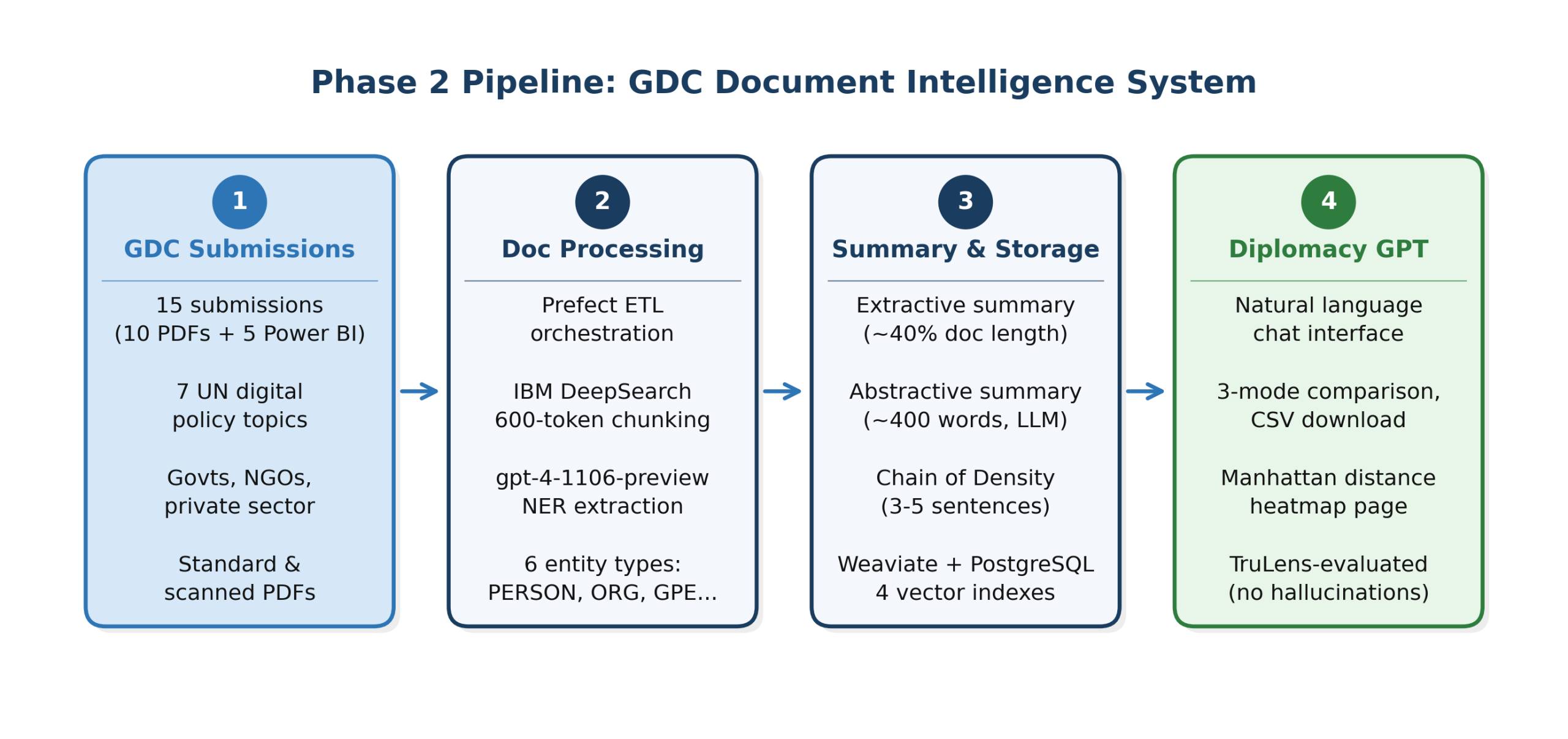
Figure 1: Phase 2 pipeline — GDC documents flow through IBM DeepSearch chunking, gpt-4-1106-preview NER, three-mode summarization, and Weaviate vector storage before reaching the Diplomacy GPT interface. Image source: Omdena.
Phase 2 used Prefect orchestration and IBM DeepSearch to structure PDFs into labeled sections in 600-token chunks. gpt-4-1106-preview handled NER across six entity types — PERSON, ORG, GPE, EVENTS, DATE, LAW — selected for its 128K context window and one-third lower cost than gpt-4.
Three summary types were generated per document-topic pair at ingestion time and stored in PostgreSQL:
Extractive: Most relevant sentences per chunk (~40% of original document length)
Chain of Density: 3–5 compressed sentences, iteratively dense
All summaries were embedded using text-embedding-ada-002 across four Weaviate indexes, with raw documents in S3 on AWS. Ingestion took 5–10 minutes per document. Retrieval was near-instantaneous.
Heatmap Visualization
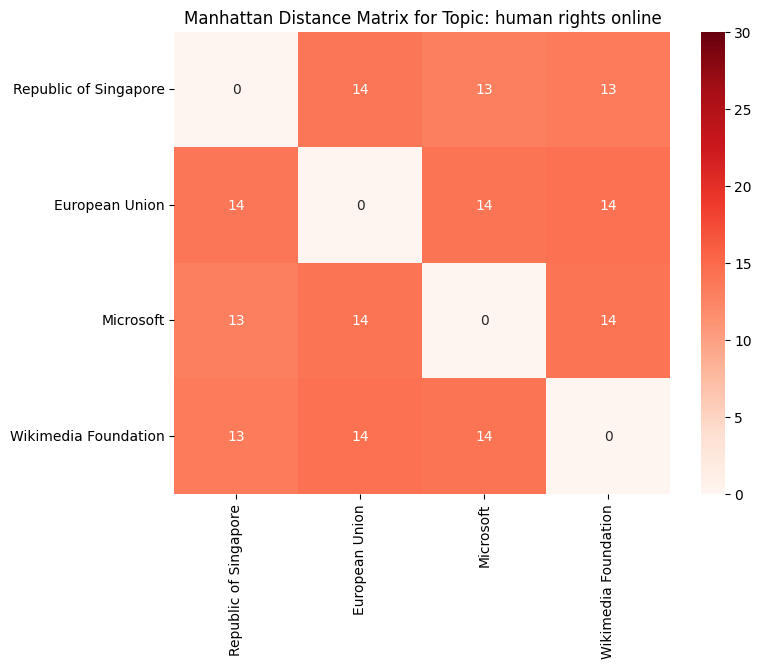
Figure 2: Manhattan distance heatmap comparing entity positions on Human Rights Online — one of seven GDC negotiation topics. Lower values (lighter cells; 0 on the diagonal = identical documents) indicate closer alignment between stakeholders. Image source: Omdena
Pairwise similarity heatmaps compared entity positions across GDC topics. Three distance metrics were tested; Manhattan distance produced the widest, most interpretable range of distinction and was selected for all stakeholder visualizations.
What Was Delivered: Diplomacy GPT — A Policy Intelligence Web Application
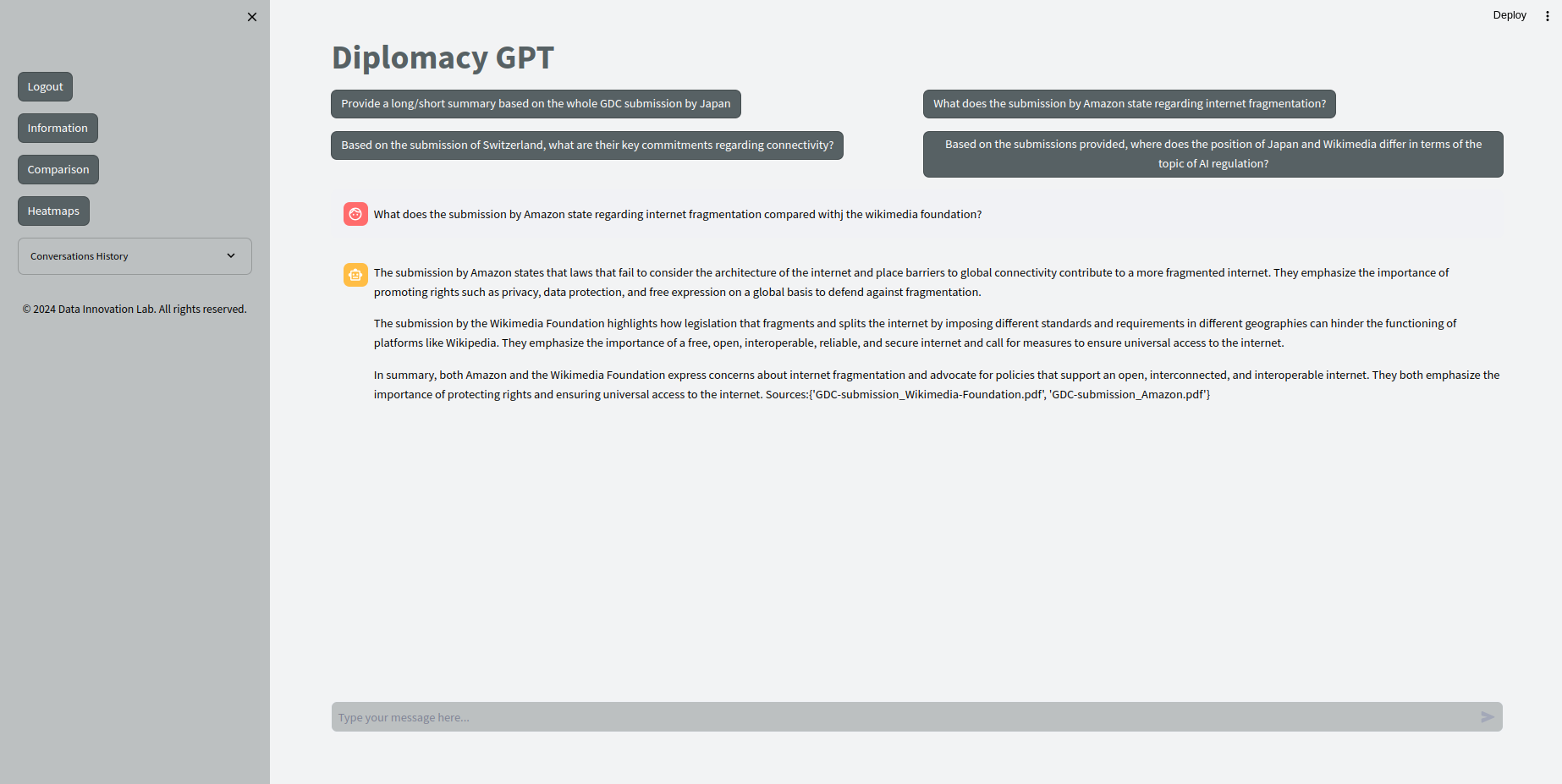
Figure 3: Diplomacy GPT chat interface — policy officer submits a comparative query and receives a sourced LLM-generated response, with sidebar navigation to Comparison, Heatmaps, and Conversation History pages. Image source: Omdena.
Diplomacy GPT was delivered as a Streamlit web application hosted on AWS EC2. Policy officers registered, logged in, and queried the full GDC corpus in natural language. The system embedded each query, retrieved relevant chunks from Weaviate, and returned LLM-generated responses with source document attribution. Three interface pages:
Chat: Natural language queries; sourced LLM-generated responses (e.g., “How does the EU’s position differ from Microsoft’s on internet fragmentation?”)
Comparison: Select entities and a GDC topic; all three summary types returned in a structured, downloadable CSV table
Heatmaps: Pre-computed Manhattan distance matrices across all seven GDC topics — no statistical expertise required
Impact: A Queryable Policy Intelligence Layer Where None Existed Before
Before this project, the DIL had no queryable layer over the GDC corpus. Policy officers reviewed documents manually with no structured way to compare positions across entities. Diplomacy GPT made the full corpus queryable for the first time — designed explicitly as decision support, with all final judgments remaining with the policy officer.
The TruLens evaluation gave the DIL more than a working demo. Relevance 0.88–0.94, groundedness 0.88–0.99, correctness 0.90–0.96, no hallucination alarms. Any future production build can be measured against those numbers.
Benefits for Clients: The Data Innovation Lab and German Federal Foreign Office
Queryable intelligence layer: A working PoC with a clean technical foundation — Prefect ETL, Weaviate, PostgreSQL, TruLens baseline — ready for production development without rebuilding from scratch.
No technical training required: Policy officers register, query, and download comparative summaries in minutes. Heatmaps visualize position alignment without requiring statistical expertise.
Open-source via OmdenaLore: The full pipeline is auditable and adaptable by any government agency or research institution at no license cost.
What Building Diplomacy GPT Taught Us
Standard clustering fails on diplomatic data — the language is designed to converge
K-means, DBSCAN, and hierarchical clustering all failed on the GDC corpus — poor Silhouette scores across every configuration tested. UN entities use shared diplomatic framing that suppresses surface differences between positions. That is a property of the data, not a model limitation. Knowledge graphs, which capture relationship structure rather than semantic similarity, are the more promising direction.
Pre-generating summaries at ingestion is the right trade-off for a read-many corpus”
Five-to-ten minutes to ingest per document; near-instantaneous at query time. Batch-ahead generation is clearly the right call for a corpus ingested once and queried many times.
Government PoCs need an ethical evaluation framework built in from day one
The team applied the Microsoft RAI Impact Assessment Framework and TruLens from day one — treating responsible AI as a design constraint, not a compliance checkbox. The result: a concrete harm inventory, XAI objectives, and quantified quality scores the DIL could use in their own governance process. A government agency cannot act on a PoC it cannot audit. Without this baseline, further investment is a much harder decision to justify.
What’s Next: Production Infrastructure, Expanded Corpus, and Knowledge Graphs
The PoC processed 15 documents as a deliberate scope decision. A production build needs:
Full corpus: Ingest the complete UN GDC submission corpus
Scanned PDFs: Azure AI Document Intelligence — tested and confirmed capable of parsing scanned submissions to structured JSON
Knowledge graphs: A layer over the existing NER output to surface entity relationship patterns that vector similarity cannot detect
Topic modeling: BERTopic, most promising of three approaches tested alongside LDA and NMF
Production stack: Django/React.js UI, AWS Beanstalk for auto-scaling, parallelized summary generation to reduce the 5–10 minute ingest window
Key Achievements
Three-mode LLM summarization system evaluated for diplomatic use
Extractive, abstractive (~400 words), and Chain of Density (3–5 sentences) — generated per entity-topic pair at ingestion time. TruLens evaluation: abstractive index achieved relevance 0.94, groundedness 0.88, correctness 0.96.
Stakeholder position heatmap visualization for negotiation preparation
Manhattan distance matrices across seven GDC topics, showing entity alignment at a glance. Selected over cosine similarity and Euclidean distance after adversarial testing confirmed the widest interpretable range of distinction.
Fully evaluated RAG pipeline ready for beta testing
Phase 2 pipeline — Prefect ETL, IBM DeepSearch, gpt-4-1106-preview NER, Weaviate, PostgreSQL — evaluated across twelve TruLens metrics. No hallucination alarms flagged.
About This Project
Omdena partnered with the German Federal Foreign Office’s Data Innovation Lab over 12 weeks to build a proof-of-concept AI policy assistant for the UN Global Digital Compact negotiations. A 14-member team delivered a two-phase LLM pipeline combining Prefect-orchestrated ETL, IBM DeepSearch document structuring, three-mode summarization, Weaviate vector retrieval, and stakeholder heatmap visualization, evaluated using TruLens across twelve quality metrics..
FAQ
What problem did the project aim to solve?
It addressed the overwhelming volume of policy documents diplomats must review by automating research, summarization, and comparison tasks.
How does the AI tool help policy officers?
It retrieves relevant information, generates targeted summaries, and compares stakeholder positions, saving time and improving decision quality.
What technology powers the solution?
The tool uses Large Language Models (LLMs) and vector-based document retrieval to analyze, summarize, and synthesize large text corpora.
What makes the summarization feature useful?
It allows users to choose summaries tailored by topic, stakeholder, or negotiation domain—providing precise insights instead of generic summaries.
What is the Heatmap Insights feature?
It visually maps agreement and disagreement between stakeholders across negotiation topics, helping identify consensus and conflict zones.
Does the system replace human diplomats?
No. It enhances human expertise by removing manual workload and enabling more informed, strategic decision-making.
Can this solution be scaled to other government sectors?
Yes. The approach and architecture can be adapted for lawmaking, regulatory review, international cooperation, and public policy analysis.
Share this article
Share on LinkedIn, send by email, or copy the direct link.