Building AI agents has become significantly easier with tools like Claude, n8n, AI copilots, and low-code builders. Many companies have already started experimenting with internal prototypes and early-stage agentic AI systems. However, turning those experiments into stable, deployable systems that teams can actually use across the organization is where most companies struggle.
According to a 2026 IDC study, 65% of organizations expect full agentic AI deployment within the next two years. As adoption accelerates, business leaders are increasingly asking an important question: What does it actually cost to move from an AI prototype to a reliable production-ready system that teams can use across the organization?
The answer largely depends on how complex the system becomes once it needs to support core business workflows, integrations, and security requirements. In this guide, we’ll break down why AI prototypes fail in real business operations, what it costs to build and deploy operational AI systems, hidden expenses, and how Omdena’s modern AI delivery model helps organizations deploy AI agents more cost-effectively.
TL;DR (Quick Summary):
Building AI agent prototypes is easier than ever with tools like Claude, n8n, AI copilots, and low-code builders.
The real challenge begins when organizations try to scale those prototypes across actual business operations.
AI implementation costs increase because of integrations, workflow reliability, security requirements, monitoring, maintenance, and multi-team usage.
Most companies underestimate hidden costs such as prompt optimization, infrastructure scaling, human oversight, and long-term maintenance.
Traditional AI consulting projects often become expensive due to fragmented workflows, repeated rework, and custom implementation approaches.
Omdena reduces implementation overhead through its proprietary agentic AI platform, structured delivery workflows, deployment-focused QA, and vetted global AI talent network.
Typical organization-wide AI deployments may cost $50k–$100k+ traditionally, while Omdena’s delivery model ranges around $12k–$30k, depending on scope.
The most successful companies start with focused AI use cases, validate ROI early, and scale gradually across the organization.
Why Prototypes Often Break in Business Operations
Your team successfully built a working prototype. Now you’re trying to roll it out across business operations, but facing challenges such as:
Unreliable and inaccurate outputs
Unstable prompts and workflow failures
Poor integrations with enterprise systems
Lack of visibility into performance and failures
Security and compliance concerns
Scaling limitations
Dependency on one internal builder or a small AI team
Unclear accountability and long-term maintenance
In many cases, prototypes work well in controlled demos but struggle under day-to-day operational demands. So, what does it actually cost to move an AI prototype to a stable, deployable, production-ready system?
What Does It Cost to Turn an AI Prototype Into a Production-Ready System?
Building an internal AI prototype is now relatively inexpensive. However, costs increase significantly when organizations try to make those systems reliable, secure, scalable, and usable across core business workflows.
The investment depends less on the prototype itself and more on everything required around it. As companies expand AI adoption, they often need integrations, multi-user access, workflow stability, monitoring, security controls, and ongoing maintenance.
The table below shows how costs typically increase as companies move from experimentation to organization-wide AI deployment:
AI Deployment Stage
What’s Happening
Traditional Cost
Omdena Cost
Internal AI prototype
Small workflow or assistant
$10k–$15k
$5k-$10k
Team-level AI deployment
Integrations and operational rollout for one team
$15k–$50k
$8k–$12k
Organization-wide AI system
Cross-functional workflows, monitoring, security, and maintenance
$50k–$100k+
$12k–$30k
So why do costs increase so dramatically once companies move beyond the prototype stage?
Why AI Agent Development Costs Increase After the Prototype Stage?
Many AI agent prototypes are built quickly, but costs rise significantly once organizations try to use those systems across core business operations. In many cases, early prototypes are designed for experimentation, not for long-term reliability, scalability, and organization-wide usage.
Common reasons for cost increases include:
MVPs were rebuilt later for production use
Integrations with enterprise systems
Workflow failures at a larger scale
Security and governance were added too late
Limited testing and evaluation early on
Fragmented ownership across teams
Custom infrastructure decisions that increase maintenance complexity
As a result, many companies spend months reworking prototypes that were never designed for stable long-term deployment.
However, delivery models are only one part of the equation. Several technical and operational factors still play a major role in determining the final cost of an agentic AI system.
Key Factors That Influence Production-Ready AI Agent Development Cost
Several technical and operational factors determine how expensive an agentic AI system becomes once it moves beyond the prototype stage.
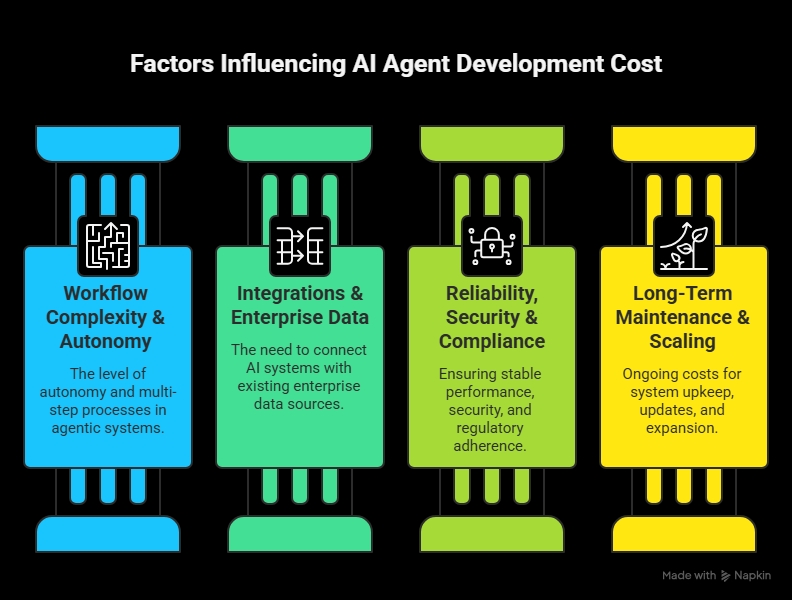
Factors Influencing AI Agent Development Cost
Workflow Complexity & Autonomy: Costs increase as agentic systems become more autonomous. Multi-step workflows that involve reasoning, decision-making, tool usage, and human oversight require significantly more implementation effort and testing.
Integrations & Enterprise Data: AI systems often need access to CRMs, ERPs, internal databases, cloud storage, and business tools. Connecting these systems reliably while managing permissions and workflows can become one of the largest implementation cost factors.
Reliability, Security & Compliance: Production-ready AI systems require stable performance, monitoring, security controls, and compliance support. Industries like healthcare, finance, and insurance often require additional governance and human oversight.
Long-Term Maintenance & Scaling: Costs continue after deployment through infrastructure usage, system monitoring, updates, support, and scaling across teams or departments. As adoption grows, long-term maintenance often becomes a major part of the overall investment.
Now, let’s take a look at where companies actually spend money after the prototype stage and typical cost ranges.
Where Organizations Typically Spend Money After the Prototype Stage
Once an AI prototype starts showing promise, organizations usually invest in making the system stable, secure, scalable, and usable across actual business workflows. Most implementation costs typically come from the following areas:
Implementation Phase
Traditional Delivery Models
Omdena’s AI Delivery Model
Workflow Validation & Deployment Planning
$5k–$10k
$2k–$4k
System Integration & Workflow Expansion
$25k–$50k+
$5k–$10k
Reliability, Evaluation & Guardrails
$10k–$25k
$3k–$6k
Monitoring, Scaling & Long-Term Support
$3k–$15k/month
Optimized based on usage
Omdena’s AI delivery model, which we will discuss later, significantly reduces implementation overhead through its structured delivery processes, a vetted global AI talent network, deployment-focused QA, and its proprietary agentic AI platform. Now, let’s understand each implementation phase –
Once the prototype works, organizations usually need to validate how the system will fit into existing workflows, teams, and operational processes. This phase often includes workflow mapping, rollout planning, risk assessment, and ROI validation.
System Integration & Workflow Expansion ($5k–$10k+)
This is usually the largest implementation cost area. Costs increase as companies connect AI systems with CRMs, internal databases, enterprise tools, and multi-user workflows across departments.
Reliability, Evaluation & Guardrails ($3k–$6k)
AI systems require testing for reliability, stability, safety, and workflow consistency before wider deployment. This phase often includes evaluation, prompt optimization, human oversight workflows, and fallback mechanisms.
Monitoring, Scaling & Long-Term Support (Optimized based on usage)
Costs continue after deployment through infrastructure usage, monitoring, maintenance, support, and scaling across teams. As adoption grows, long-term operational costs often become a major part of the overall investment.
Beyond these visible expenses, businesses also encounter several hidden costs that are frequently underestimated during early planning stages.
Hidden Costs Businesses Often Underestimate
Many AI agent projects exceed their original budget because businesses focus mainly on initial development while underestimating long-term operational costs. In practice, the prototype is rarely the final production cost.
Common hidden expenses include:
Data cleaning and labeling efforts
Prompt tuning and continuous optimization
Model drift and performance degradation
API usage spikes as adoption scales
Human review and approval workflows
Compliance audits and security reviews
Infrastructure scaling costs
Vendor lock-in and migration challenges
Understanding these hidden costs is essential before exploring how Omdena’s AI delivery model can reduce implementation costs without compromising quality.
How Omdena’s AI Delivery Model Reduces AI Agent Development Cost
Traditional AI projects often become expensive due to fragmented workflows, unclear ownership, repeated rework, and fully custom implementation. Many teams build prototypes quickly but struggle when trying to scale those systems across core business operations. Omdena’s AI delivery model is designed to reduce this complexity while helping organizations deploy reliable AI systems faster and at a fraction of traditional development cost.
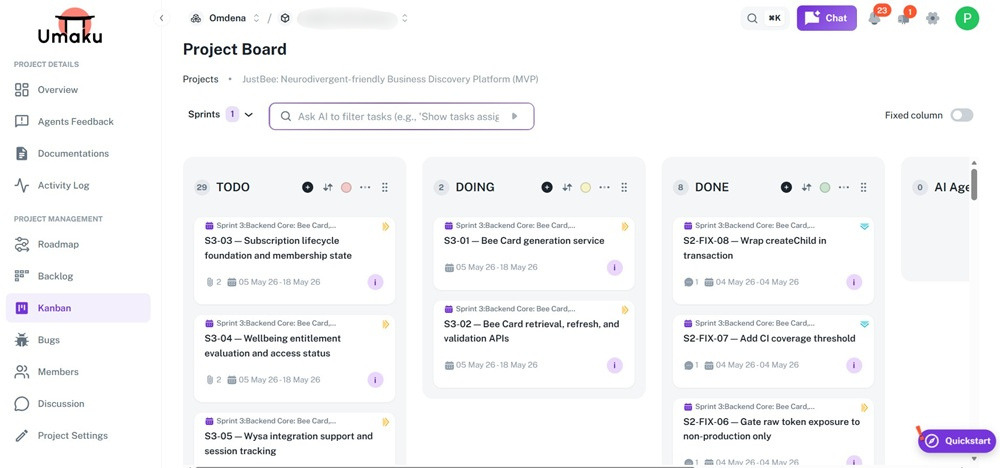
1. Proprietary Agentic AI Platform: Umaku
Omdena combines human expertise with AI-assisted execution through Umaku, its proprietary agentic AI platform. Umaku centralizes project planning, sprint coordination, architecture decisions, evaluation checkpoints, deployment tracking, and documentation into a single system.
Kanban Board in Umaku
This helps reduce:
Project misalignment
Late-stage rework
Delivery delays
Operational overhead
AI-assisted sprint management, code quality reviews, and integrated monitoring also help teams maintain faster and more consistent execution throughout the implementation process.
2. Structured AI Delivery Process
Omdena follows a structured implementation process that includes workflow validation, governance planning, architecture selection, evaluation, deployment, and long-term maintenance from the beginning of the project.
Instead of adding reliability, security, and evaluation later, these processes are built into the delivery early. This reduces implementation risk, improves system stability, and helps organizations avoid costly redesigns later.
3. Vetted Global AI Talent Network
Omdena gives organizations access to a global network of 30,000+ AI engineers, researchers, MLOps specialists, and domain experts across 80+ countries. This allows businesses to build specialized AI teams without the cost and complexity of hiring large in-house AI departments from scratch.
Global AI Talent Network
If your organization is planning to move from AI prototypes to production-ready AI systems, book an exploration call with Omdena. We can help you evaluate the right implementation roadmap for your use case.
Build AI Agents with Long-Term ROI in Mind
Building an AI prototype is easier than ever. The real challenge is turning those early experiments into stable, scalable systems that teams can reliably use across actual business operations.
AI implementation costs increase as organizations expand usage across workflows, teams, integrations, and enterprise systems. Businesses that start with focused use cases, validate ROI early, and scale gradually are more likely to reduce implementation risk and achieve sustainable long-term value.
Omdena helps organizations move from AI prototypes to production-ready AI systems through a structured delivery model, proprietary AI tooling, and a vetted global AI talent network. If your organization is exploring operational agentic AI systems, booking an exploration call with Omdena can help you evaluate the right implementation roadmap for your use case.
FAQ
How much does it cost to move from an AI prototype to a production-ready AI system?
The cost depends on how complex the system becomes once it needs to support actual business workflows, integrations, security, monitoring, and long-term maintenance. Traditional AI deployments can range from $50k to $100k+, while Omdena typically helps organizations operationalize AI systems at around $15k–$30k depending on scope and complexity.
What increases AI implementation costs after the prototype stage?
Costs usually increase when organizations try to scale AI systems across teams and workflows. Common cost drivers include enterprise integrations, workflow reliability, multi-user support, security requirements, compliance controls, monitoring, and ongoing maintenance.
What is the monthly cost of running an AI system?
Operational AI costs often include LLM API usage, infrastructure, monitoring, maintenance, support, and scaling. Monthly costs vary based on usage volume, integrations, number of users, and system complexity.
Why do many AI prototypes fail in business operations?
Many prototypes work well in demos but struggle in real business environments because they were not designed for long-term reliability, workflow stability, integrations, security, or organization-wide usage. Scaling an AI prototype usually requires significant operational and infrastructure improvements.
How can businesses reduce AI implementation costs?
Businesses can reduce costs by starting with focused use cases, validating ROI early, reusing existing infrastructure, and scaling gradually instead of building overly complex systems upfront. Structured AI delivery models like Omdena’s also help reduce implementation overhead through structured delivery processes, specialized AI tooling, deployment-focused QA, and global AI talent.
Continue with Omdena
Share this article
Share on LinkedIn, send by email, or copy the direct link.