AI Governance: A Practical Guide for Modern Organizations (2026)
14 min readUpdated August 11, 2026
Prince OkonSenior Data Scientist
Governance begins after the PoC succeeds. Here is how to govern AI systems once they are running in production.
AI is already embedded across modern enterprise. Copilots support daily work, agents execute multi-step workflows, RAG applications search company knowledge, and predictive models score risk and demand.
The challenge is no longer simply building AI. It is governing a growing portfolio of systems operating across business-critical workflows.
That growth creates practical questions. Who owns each model? Who approves deployments? How are hallucinations, drift, and past decisions monitored or audited? Who can stop an AI agent before it takes a harmful action?
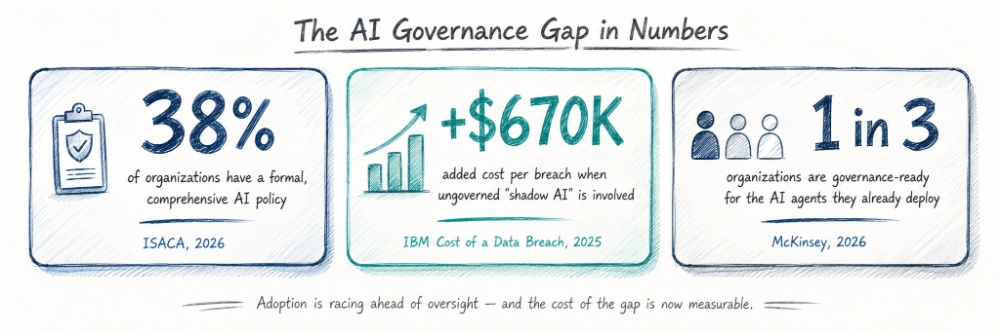
Ethics statements alone cannot answer these questions. AI governance can. IBM found that out of all organizations that recorded AI related security breaches in 2025, 97% lacked proper AI access controls. The most common of these security incidents occurred in the AI supply chain, through compromised apps, APIs or plug-ins.,
Shadow AI was involved in the majority of these breaches, adding $670,000 to the average breach cost. ISACA also reports that only 38% of organizations have a formal, comprehensive AI policy.
This guide explains what AI governance means in practice, why it becomes essential in production, the eight pillars that support it, and the frameworks, lifecycle controls, maturity levels, and production architecture organizations can use to implement it.
Figure 1. Adoption is racing ahead of oversight — and the gap now has a price tag.
What Is AI Governance?
AI governance is the set of policies, processes, technologies, and organizational practices that help organizations develop, deploy, operate, monitor, and continuously improve AI systems safely, responsibly, and in compliance with business and regulatory requirements.
Two words in that definition do most of the work: operate and continuously. Governance is broader than compliance because it covers:
People — roles, accountability, and skills.
Technology — registries, guardrails, and observability tools.
Processes — approvals, reviews, and incident response.
Risk — identification, assessment, and treatment.
Operations — monitoring, telemetry, and on-call ownership.
Continuous improvement — evaluation, retraining, and retirement.
A compliance program may pass an audit while its AI systems drift or misfire in production. A governance program is judged by whether those systems remain safe, accurate, and accountable every day they run.
That distinction matters because the risks surrounding AI have changed significantly.
Why AI Governance Matters More Than Ever
Three shifts have raised the stakes:
Generative AI changed the failure modes. LLMs and RAG systems can produce fluent but subtly wrong, biased, or leaky outputs that traditional software QA was not designed to catch.
AI stopped only suggesting and started acting. Agents can execute transactions, modify records, and coordinate with other systems, turning a bad answer into a bad action.
AI reached business-critical scale. Models now influence customer service, underwriting, hiring, and supply chains, where failures carry direct financial, legal, and reputational costs.
Organizations recognise these risks, but many are still behind. Gartner links GenAI project abandonment to poor data quality, inadequate risk controls, escalating costs, and unclear business value. McKinsey identifies security and risk concerns as the leading barrier to scaling agentic AI.
Governance maturity now determines how quickly an enterprise can move. To build that maturity, teams must first separate governance from the related disciplines it coordinates.
AI Governance vs. AI Ethics vs. AI Compliance vs. AI Security
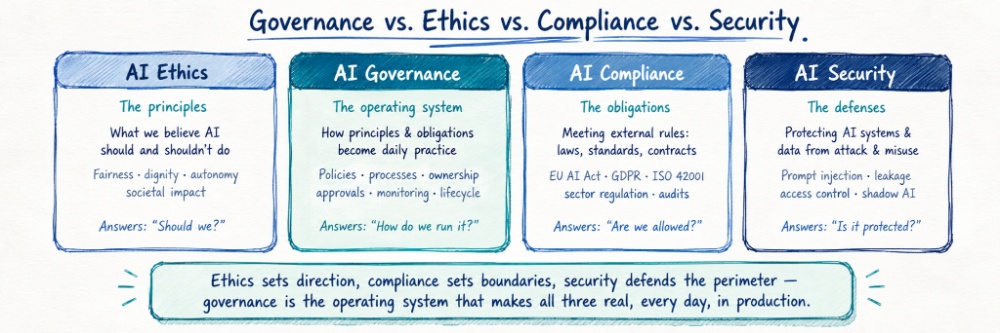
These four disciplines are related, but they do different jobs:
Ethics defines what the organization believes AI should and should not do.
Compliance defines what laws, regulations, and standards require.
Security protects AI systems and their data from attack and misuse.
Governance turns all three into operating practice through policies, named owners, technical controls, monitoring, and audit.
Ethics without governance remains a statement of intent. Compliance without governance becomes a scramble before each audit. Security without governance protects systems that may still lack clear accountability.
The difference becomes most visible when an AI system leaves the PoC environment and enters production.
Figure 2. Four disciplines, one operating system that makes them real.
Why Governance Becomes Critical After AI Moves to Production
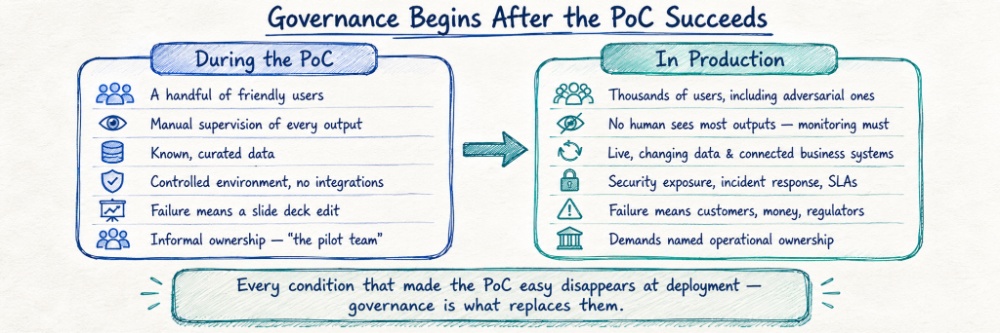
During a PoC, governance can feel optional because the conditions are forgiving:
Only a small number of friendly users interact with the system.
Teams can manually review most outputs.
Data is known, curated, and relatively stable.
Integrations and security exposure are limited.
Failures usually affect a demonstration, not a business process.
Production removes those cushions. Thousands of users may interact with the system, including careless or adversarial ones. Monitoring must replace manual supervision, data changes continuously, incidents require response procedures, and someone must own the system when it fails.
This is why governance becomes critical after the PoC succeeds. IBM found that 97% of organizations suffering AI-related breaches lacked proper AI access controls. The problem was not necessarily the pilot itself, but pilot-grade controls carried into production.
A production-ready governance programme therefore needs a clear structure. The eight pillars below provide that foundation.
Figure 3. Every condition that made the PoC easy disappears at deployment.
The Eight Pillars of Enterprise AI Governance
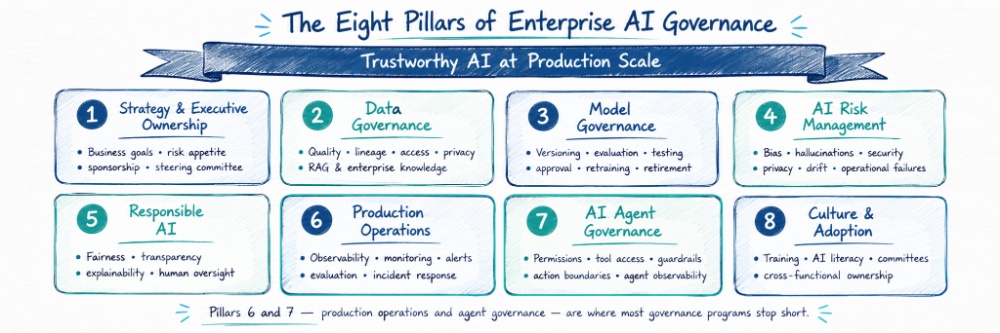
A governance program sturdy enough for production rests on eight pillars. The first five appear in most governance literature; the last three — production operations, agent governance, and culture — are where programs actually succeed or fail.
Figure 4. The eight pillars of enterprise AI governance.
Pillar 1: Strategy & Executive Ownership
Governance starts with executive accountability. Organisations need explicit AI goals, a stated risk appetite, executive sponsorship, and a funded steering committee.
That committee should own the AI portfolio. It prioritises use cases, approves high-risk systems, and resolves cross-functional disputes.
Pillar 2: Data Governance
Every AI failure mode has a data ancestor. Data governance covers quality, lineage, access control, and privacy so teams know what data trained or feeds each model and who may use it.
It also includes RAG and enterprise knowledge. The documents, wikis, and policies grounding LLM systems must remain current, permissioned, and versioned.
Pillar 3: Model Governance
Models need lifecycle discipline like any critical asset. Every deployed model and prompt should be versioned, identifiable, and reproducible.
Teams should test against defined thresholds, document approvals, retrain when drift justifies it, and retire systems deliberately. Dependencies must be mapped so obsolete models do not continue making decisions unnoticed.
Pillar 4: AI Risk Management
AI risk extends beyond model accuracy. It includes bias, hallucinations, prompt injection, data exfiltration, privacy violations, compliance breaches, operational failures, and silent drift.
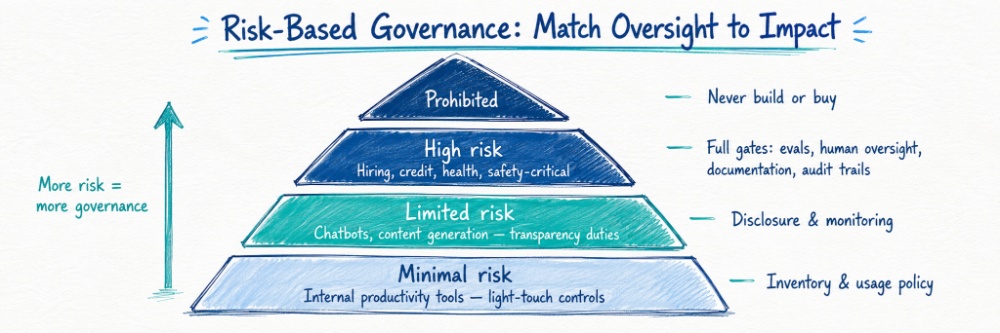
Mature programmes classify use cases into risk tiers and scale controls proportionally. A meeting summariser and a credit model should not follow the same governance path. This proportionality prevents governance from strangling innovation.
Figure 5. Match the weight of oversight to the impact of the system.
Pillar 5: Responsible AI
Responsible AI principles must become engineered controls rather than aspirations. Fairness requires bias testing, transparency requires user disclosure, and consequential decisions require explanations and appropriate human approval.
Every system also needs a named accountable owner. PwC’s research shows the implementation gap: only about six in ten organisations have moved responsible AI into core operations.
Pillar 6: Production Operations
Production operations are where governance becomes real. A governed AI system needs:
Observability — telemetry from models, prompts, and pipelines.
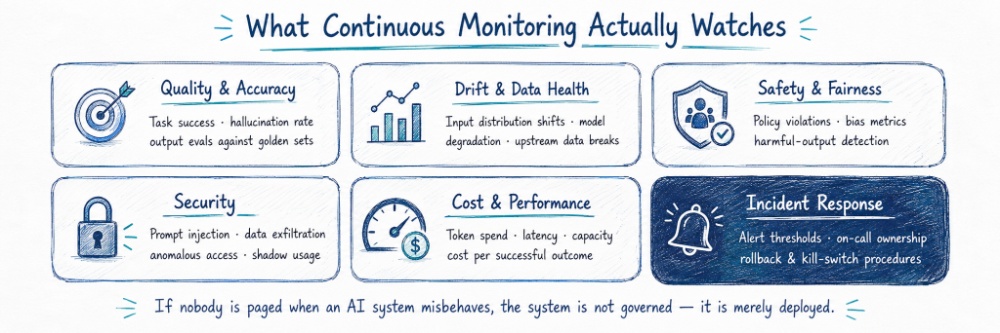
Monitoring — continuous tracking of quality, drift, safety, cost, and latency.
Alerts — thresholds that notify a human when performance degrades.
Continuous evaluation — tests on live traffic, not only before launch.
Incident response — runbooks, on-call ownership, rollback, and kill-switch procedures.
Continuous improvement — findings fed back into models, prompts, and data.
If nobody is notified when an AI system misbehaves, it is not governed. It is merely deployed.
Figure 6. What continuous monitoring actually watches.
Pillar 7: AI Agent Governance
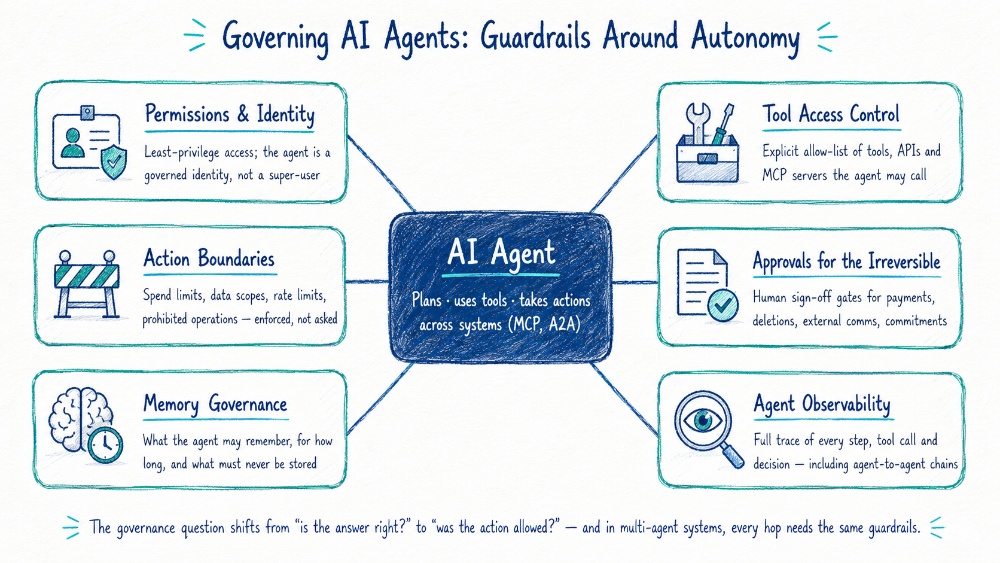
Agents change the governance question from “Is the answer right?” to “Was the action allowed?” Effective controls include:
Permissions and identity — agents operate with least privilege.
Tool access control — approved lists define which tools, APIs, and MCP servers an agent may call.
Memory governance — rules define what an agent may remember and what must never be stored.
Approval gates — humans approve irreversible actions such as payments, deletions, or external communications.
Action boundaries — spend limits, data scopes, and rate limits are enforced technically.
Agent observability — complete traces record every step, tool call, and agent-to-agent interaction.
The urgency is clear. Deloitte finds that only about one in five organizations has a mature governance model for autonomous agents, even as deployment accelerates.
Figure 7. Guardrails around autonomy: the six controls every production agent needs.
Pillar 8: Culture & Organizational Adoption
Governance that lives only in a committee will fail in the business units. Sustainable programmes invest in AI literacy and involve legal, security, data, engineering, and business teams in governance decisions.
Ownership must also become cultural. Teams should expect to name an owner, document a system, and pass an evaluation just as they expect code review. Adoption follows when governance is understood as part of professional AI delivery.
AI Governance Across the AI Lifecycle
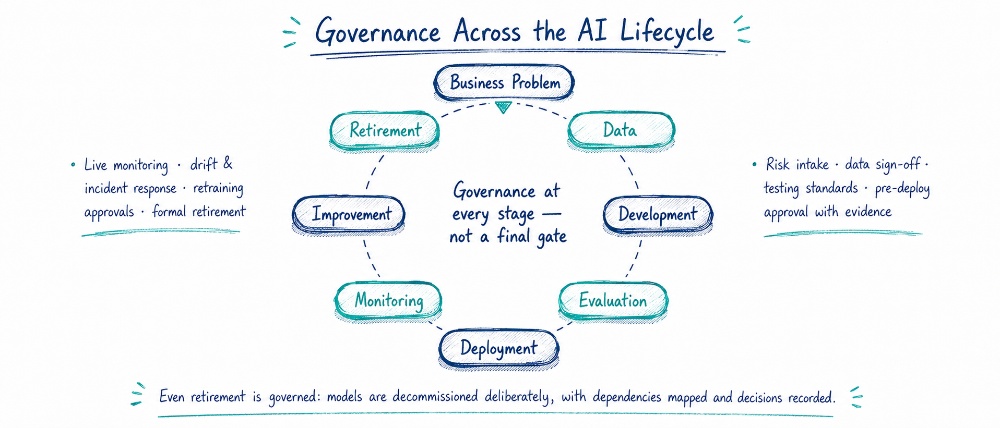
Governance fails when it appears only as a final approval gate. It works when controls are embedded across the lifecycle:
Business framing includes intake decisions and risk classification.
Data work includes quality, privacy, and lineage sign-off.
Model development follows documentation and testing standards.
Evaluation produces evidence for approval decisions.
Deployment is staged and includes rollback plans.
Monitoring continues throughout the system’s life.
Improvements follow change-management controls.
Retirement is deliberate, with dependencies and decisions recorded.
Governance is therefore a continuous lifecycle property, not a stamp added at the end. External frameworks help organisations design and validate those controls.
Figure 8. Governance at every stage — not a final gate.
Leading AI Governance Frameworks
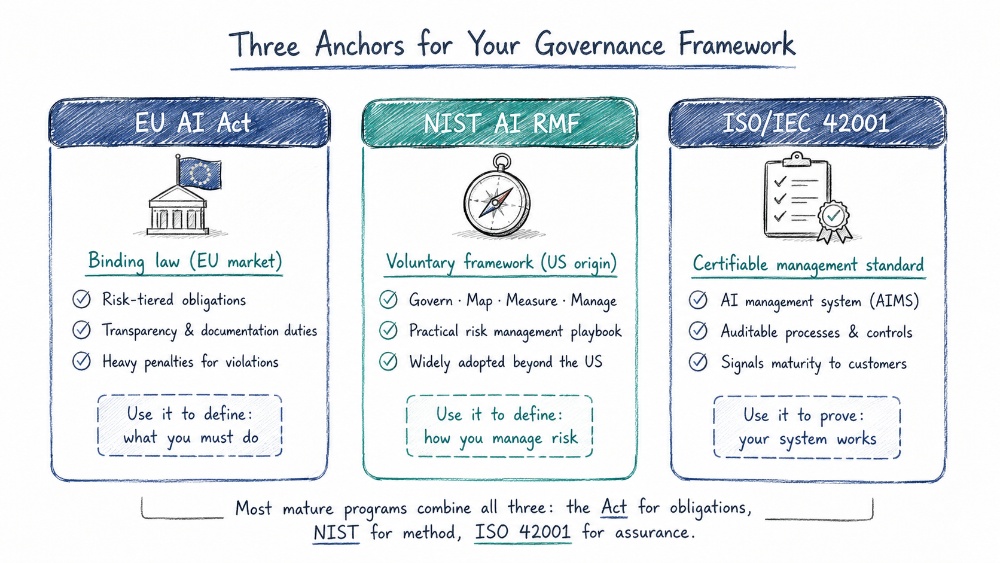
Four external reference points shape most enterprise programmes:
NIST AI Risk Management Framework — a practical method for identifying and treating AI risk through Govern, Map, Measure, and Manage.
ISO/IEC 42001 — a certifiable AI management system for organisations that need independent proof of governance maturity.
EU AI Act — binding requirements for organisations serving the EU market, including transparency and high-risk obligations.
OECD AI Principles — a shared vocabulary for national policy, board oversight, and cross-border discussion.
A practical combination is to use the AI Act for what must be done, NIST for how risk is managed, ISO 42001 for how governance is demonstrated, and OECD for the principles that frame the programme.
Even with strong frameworks, organisations tend to encounter the same implementation challenges.
Figure 9. How the major frameworks fit together.
Common AI Governance Challenges
The obstacles repeat across industries with remarkable consistency:
Shadow AI — employees adopt unsanctioned tools faster than IT can inventory them; 63% of breached organizations had no AI governance policy at all.
No ownership — systems run in production with nobody accountable for their behavior.
Poor documentation — models nobody can explain, trained on data nobody can trace.
No monitoring or evaluation — quality decays silently; problems surface via customer complaints.
Disconnected governance — policies written in one department, delivery happening in another, with no mechanism linking them.
Fragmented tooling — every team with its own stack, making enterprise-wide visibility impossible.
No audit trails — decisions that cannot be reconstructed for a regulator, customer, or court.
Agents with unrestricted permissions — autonomous systems holding broader access than any employee would be granted.
Governance slowing innovation — uniform maximum process applied to every use case until teams route around it, recreating shadow AI.
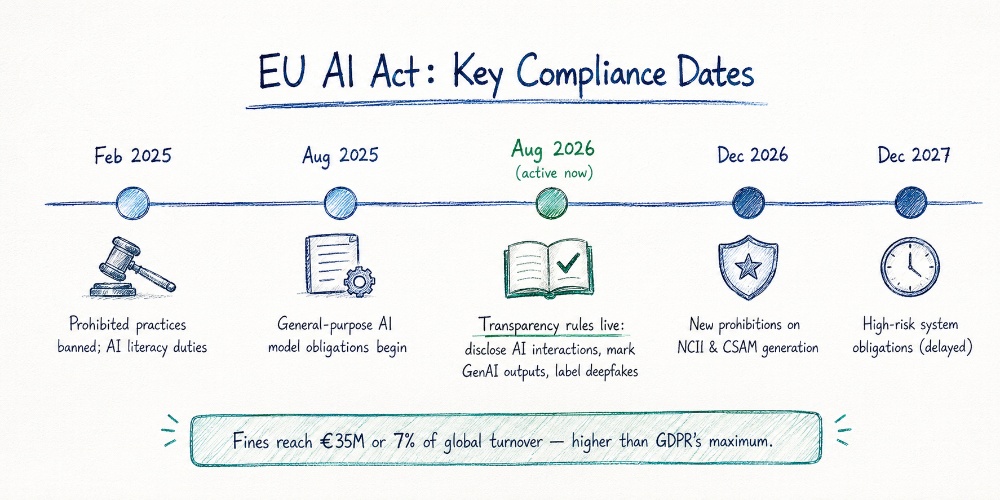
Figure 10. EU AI Act phase-in: transparency rules are live; high-risk obligations follow in 2027.
AI Governance Best Practices
The programmes that work share ten habits:
Govern by risk tier rather than applying one process to every use case.
Monitor continuously instead of relying on annual reviews.
Keep humans in the loop where stakes or ambiguity require judgement.
Make governance cross-functional across legal, security, data, engineering, and business teams.
Require evaluation evidence before every deployment.
Invest in observability as the foundation for oversight.
Document systems while they are built, not retrospectively.
Maintain a live AI inventory because organisations cannot govern what they cannot list.
Run approval workflows in tooling rather than email.
Automate governance through evaluations, policy-as-code guardrails, and default audit logging.
Together, these practices move governance from isolated controls towards a measurable maturity journey.
The AI Governance Maturity Model
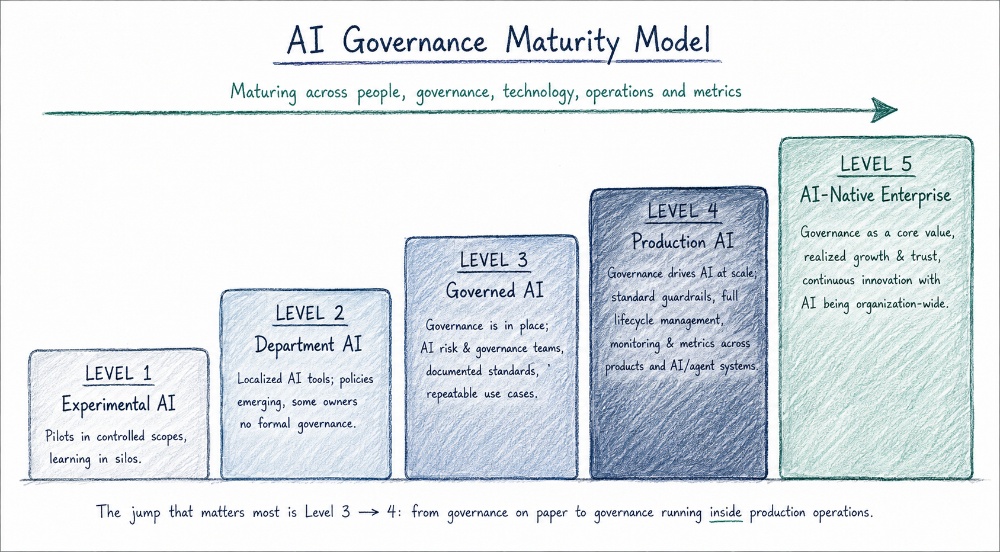
Five levels describe the governance journey:
Level 1 — Experimental AI: pilots run without formal policies, inventory, or metrics.
Level 2 — Department AI: teams create local value, but data remains siloed and ownership is informal.
Level 3 — Governed AI: the organisation has a steering committee, risk tiers, an AI inventory, approval gates, and documentation standards.
Level 4 — Production AI: continuous evaluation, observability, automated delivery gates, named operational owners, and audit trails are built into operations.
Level 5 — AI-Native Enterprise: governance operates as a shared platform, agents are governed by default, and metrics continuously improve policy.
Most enterprises sit between Levels 2 and 3. The most important transition is from Level 3 to Level 4: moving governance from paper into production operations. That transition requires governance to become infrastructure.
Figure 11. The five levels of AI governance maturity.
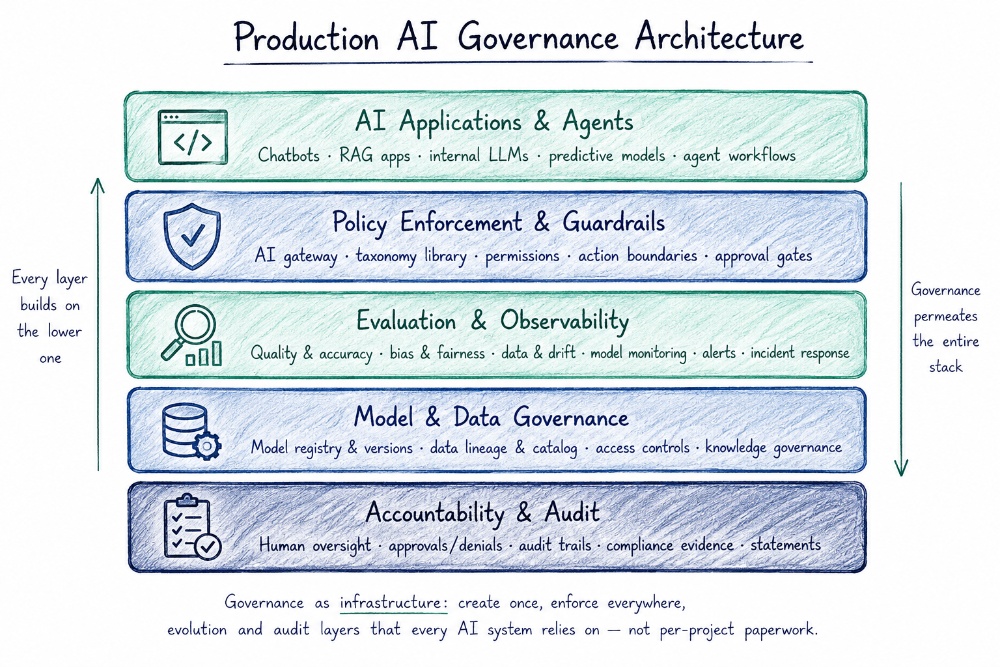
Governance as Infrastructure: The Production Architecture
At Level 4 and beyond, governance becomes shared infrastructure:
An enforcement layer provides AI gateways, guardrails, permissions, and approval gates.
An evaluation and observability layer produces telemetry, drift monitoring, hallucination monitoring, and alerts.
Model and data registries maintain inventories, versions, and lineage.
An accountability layer records ownership, approvals, and audit evidence.
Built once and shared, this architecture makes governing the twentieth AI system cheaper than governing the first. It also creates the operational foundation organisations need when working with an implementation partner.
Figure 12. Production AI governance architecture: shared layers every AI system plugs into.
How Omdena Helps Organizations Build AI Governance
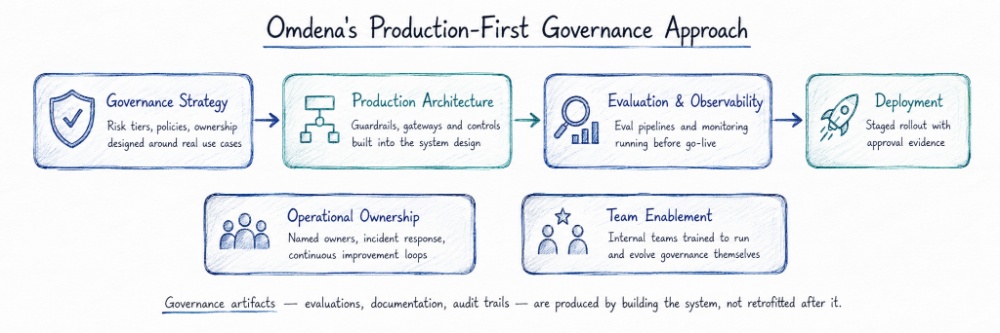
Most organisations seeking governance support already have AI systems that are live or approaching production. Omdena helps them:
Develop governance strategies based on their actual risk profile.
Design production architectures with guardrails and enforcement built in.
Build evaluation pipelines and observability systems that make quality measurable.
Deploy through staged, evidence-based rollouts.
Establish named operational ownership for every system.
Train internal teams to run and improve governance independently.
Because Omdena’s methodology is production-first, evaluations, documentation, and audit trails are created as part of delivery rather than added later as a compliance exercise.
Governance also needs to remain connected to the daily work of delivery teams. This is where Umaku supports the operating model.
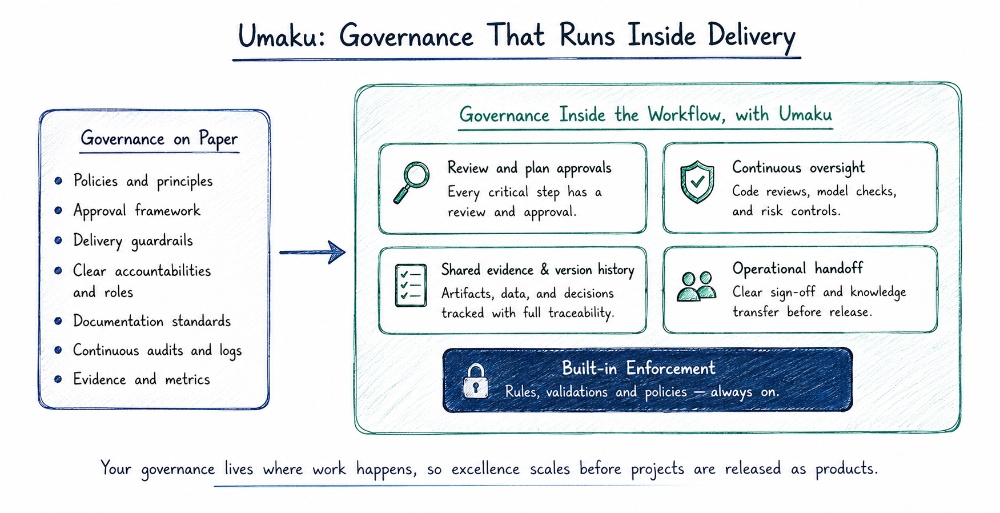
Governance frameworks often fail in the gap between policy and daily delivery work. Umaku closes that gap by keeping governance connected to how AI is built and operated.
It supports that connection across six areas:
Business context: goals, rules, charters, and success criteria stay alongside the work, so governance decisions reflect what the system is meant to achieve.
Technical context: architecture, repositories, frameworks, and dependencies remain connected to delivery, so reviews assess the real system.
Delivery governance: roadmaps, sprints, tickets, and approvals run in one tracked flow, making approval gates part of the work itself.
Context-aware reviews: AI-assisted code reviews and evaluations check work against the project charter and surface risk or readiness gaps early.
Continuous governance: sprint health, code quality, DevOps compliance, and bugs are monitored continuously through delivery telemetry.
Human oversight: review workflows, decision validation, approval gates, and feedback loops keep people accountable and decisions recorded.
The result is that governance stops being a separate activity. Business, technical, and project context remain connected throughout the lifecycle, while the required audit trail is generated through everyday delivery work.
Across both organisational governance and delivery operations, the central lesson is the same: governance must run continuously, not appear only at approval time.
Figure 14. Umaku: governance that runs inside delivery.
Conclusion
As AI moves into production, governance can no longer be treated as a legal checklist or ethics policy. It becomes an operational capability connecting strategy, people, technology, risk management, monitoring, and continuous improvement.
That capability must run for as long as the AI system does.
Organisations that embed governance across the AI lifecycle can scale trustworthy AI faster. Those relying on ad hoc controls face abandoned projects, costlier breaches, compliance failures, and declining stakeholder trust.
Build the eight pillars, embed governance across the lifecycle, and invest in production architecture. Govern AI the way you run software: continuously, measurably, and with a named human accountable at every critical point.
FAQ
What is AI governance?
AI governance is the set of policies, processes, technologies, and organizational practices that help organizations develop, deploy, monitor, and continuously improve AI systems safely, responsibly, and in compliance with business and regulatory requirements.
Why is AI governance important?
AI governance helps organizations reduce risks such as hallucinations, model drift, security breaches, compliance failures, and unauthorized AI usage while ensuring AI systems remain reliable and accountable in production.
What are the key pillars of AI governance?
The eight pillars of AI governance provide the foundation for managing AI systems throughout their lifecycle. They include strategy and executive ownership, data governance, model governance, AI risk management, responsible AI, production operations, AI agent governance, and culture and organizational adoption. Together, these pillars help organizations establish clear accountability, manage risk, ensure compliance, monitor AI performance, and operate AI systems safely and effectively in production.
What is the difference between AI governance, AI ethics, AI compliance, and AI security?
AI ethics defines principles, compliance ensures legal adherence, security protects AI systems from threats, and governance brings all of these together through operational processes, ownership, monitoring, and accountability.
Which AI governance frameworks should organizations follow?
Common frameworks include the NIST AI Risk Management Framework (AI RMF), ISO/IEC 42001, the EU AI Act, and the OECD AI Principles. Many organizations combine these frameworks based on their regulatory and operational needs.
Continue with Omdena
Share this article
Share on LinkedIn, send by email, or copy the direct link.