AI Operating Model: Scale AI from Pilots to Production (2026 Guide)
15 min readUpdated July 26, 2026
Prince OkonSenior Data Scientist
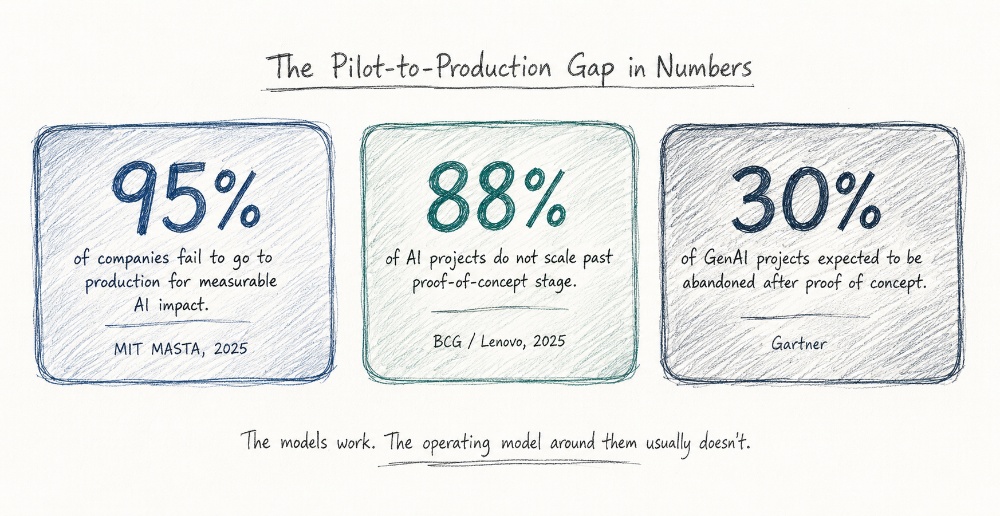
Walk through the AI portfolio of almost any large enterprise in 2026, and you will find the same inventory: dozens of experiments, internal copilots, agent prototypes, hackathon winners, and a long backlog of proofs of concept. What you will rarely find is production AI creating measurable business value. MIT’s NANDA study found that 95%of enterprise GenAI pilots deliver no measurable P&L impact, and IDC research with Lenovo found that 88% of AI proofs of concept never reach production.
The problem is rarely the models, and it is not that AI “doesn’t work.” These organizations have vision, strategy, and pilots. What they lack is an AI operating model — the execution layer that turns strategy into production systems, repeatedly. This guide explains what an AI operating model is, why its absence keeps AI stuck in pilot mode, and how to build one around six pillars, a continuous lifecycle, and a maturity path you can assess yourself against.
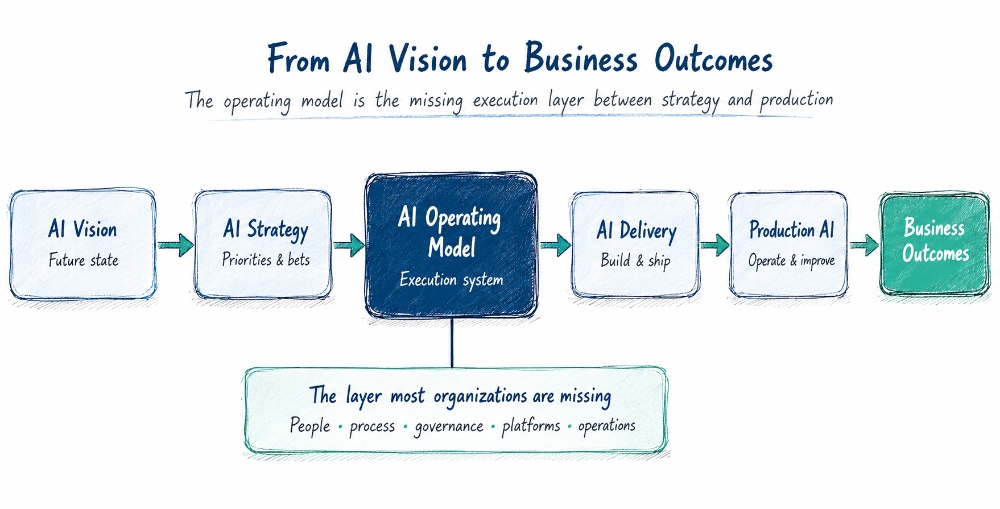
Figure 1. The AI operating model is the missing layer between strategy and business outcomes.
What Is an AI Operating Model?
An AI operating model defines how an organization structures its people, processes, governance, technology, and delivery practices to continuously develop, deploy, operate, and improve AI systems.
It is much broader than governance. Governance answers “what are we allowed to do?” An operating model answers who owns each AI system, how use cases move from idea to production, which platforms teams build on, how the lifecycle runs after deployment, and how value is measured. It covers ownership, delivery, platforms, lifecycle, measurement, and day-to-day operating processes. If strategy decides what the organization will do with AI, the operating model decides how it gets done, by whom, every day.
AI Vision vs. AI Strategy vs. AI Operating Model
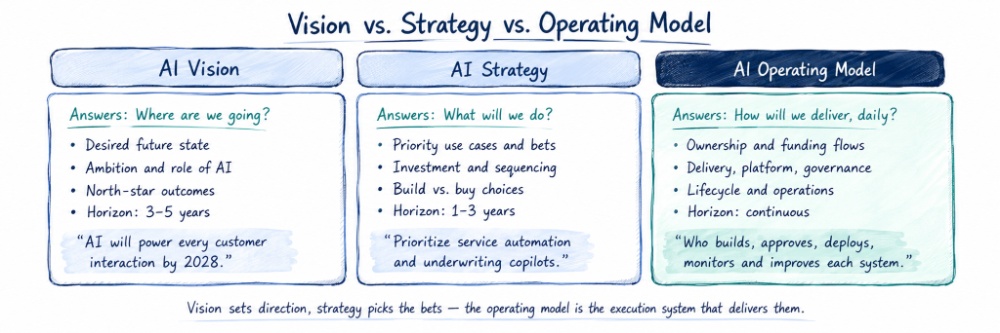
These three layers are often conflated, and the confusion is expensive: organizations write strategy documents and assume execution will follow. It doesn’t.
AI Vision: Describes the desired future state and the role AI will play in the business.
AI Strategy: Selects the organization’s priorities, including which use cases to pursue, where to invest, and in what order.
AI Operating Model: Defines the structures and processes that turn those priorities into running, governed, and measurable production systems.
Figure 2. Vision sets direction, strategy picks the bets, the operating model delivers them.
Why Most Organizations Get Stuck After AI Pilots
Adoption is no longer the problem. McKinsey’s State of AI survey reports that 88% of organizations now use AI in at least one business function — yet only about one-third are scaling it across the enterprise, and only 39% attribute any EBIT impact to AI at all, most of them under 5% of earnings. Gartner similarly predicted that at least 30% of GenAI projects would be abandoned after proof of concept, citing poor data quality, inadequate risk controls, escalating costs, and unclear business value.
Figure 3. The pilot-to-production gap, quantified.
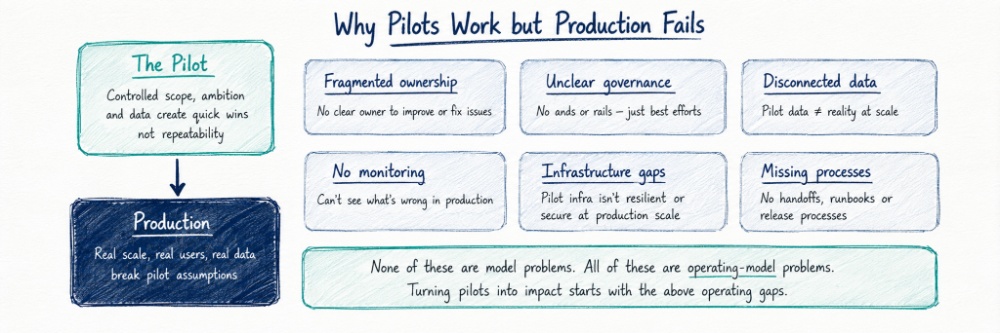
Pilots flatter; production punishes. A pilot runs on curated data, with one enthusiastic team, no SLAs, and success criteria defined by a demo. Production means real data, real users, real risk, and real accountability. The recurring blockers are structural:
Fragmented ownership — nobody is accountable for the system after the demo.
Unclear governance — there is no defined path from PoC to approved deployment.
Disconnected data — the pilot’s dataset bears little resemblance to enterprise data.
No monitoring — quality, drift, and cost go unobserved once live.
Infrastructure gaps — no route from a notebook to a secure, scalable platform.
Missing operational processes — no incident response, retraining, or release process.
Notice that none of these are model problems. All of them are operating-model problems — which is why buying better models never closes the gap.
Figure 4. Pilots succeed in protected conditions; production exposes every structural gap.
The Six Pillars of a Modern AI Operating Model
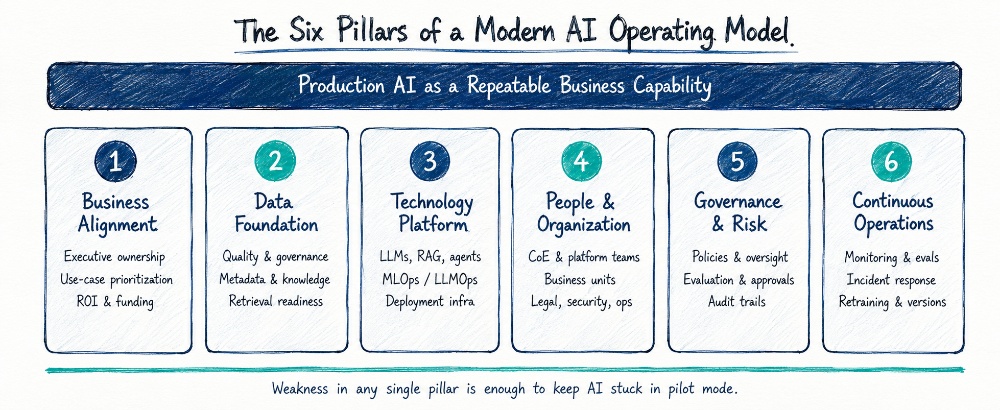
A workable operating model rests on six pillars. Weakness in any one of them is enough to keep AI stuck in pilot mode.
Figure 5. The six pillars of a modern AI operating model.
Pillar 1: Business Alignment
Production AI starts with executive ownership and a disciplined use-case portfolio. That means prioritizing by value and feasibility rather than novelty, setting ROI baselines before a build starts, and funding AI as a persistent capability instead of a string of one-off projects. When funding stops at the pilot, so does the AI.
Pillar 2: Data Foundation
Gartnerlists poor data quality first among the reasons GenAI projects are abandoned. A production-grade foundation covers data quality, data governance, metadata, and — increasingly important for LLM systems — enterprise knowledge that is retrieval-ready: documents, policies, and institutional context structured so RAG pipelines and agents can use them reliably.
Pillar 3: Technology Platform
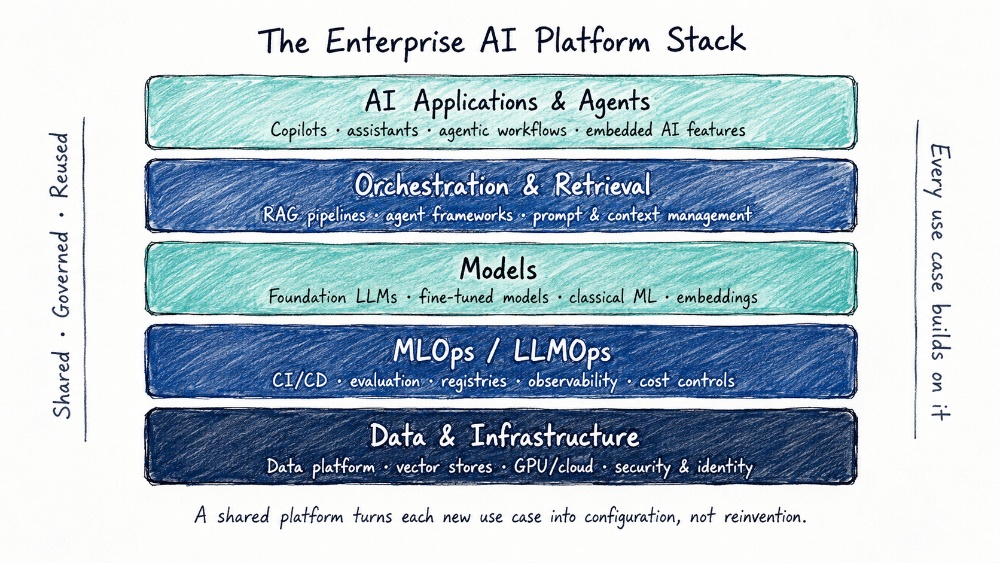
Scaling organizations converge on a shared platform rather than per-team stacks: foundation and fine-tuned models, RAG and orchestration, agent frameworks, MLOps/LLMOps for CI/CD, evaluation and observability, and secure deployment infrastructure. The payoff is compounding — with a platform, each new use case becomes configuration rather than reinvention.
Figure 6. A shared enterprise AI platform stack.
Pillar 4: People & Organization
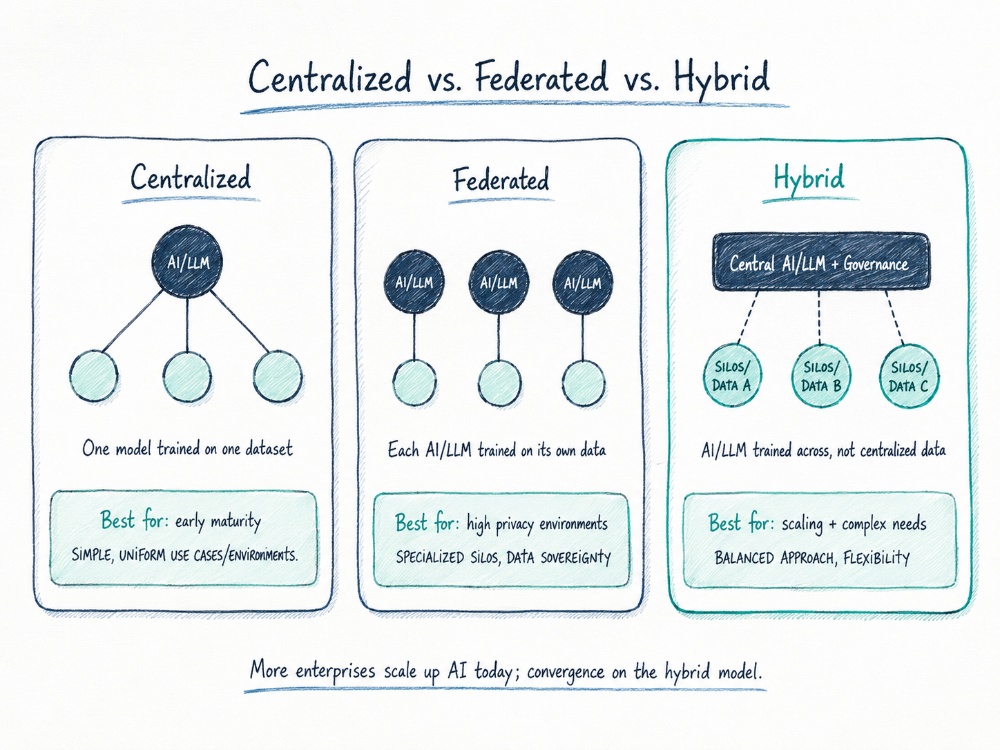
Production AI is a team sport spanning an AI Center of Excellence, platform teams, business units, engineering, product, legal, security, and operations. The structural question — centralized, federated, or hybrid — matters, but less than clarity: every AI system needs a named owner, and every function needs a defined role in the lifecycle. We compare the structures below.
Pillar 5: Governance & Risk
Effective governance is embedded in delivery, not layered on top of it: usage policies, human oversight, regulatory compliance, responsible AI standards, pre-deployment evaluation, approval workflows, and audit trails. The gap here is widening as agents arrive — Deloitte finds only about one in five organizations has a mature governance model for autonomous AI agents, and PwC reports that only around six in ten organizations have moved responsible AI into core operations.
Pillar 6: Continuous Operations
AI is never finished. Models drift, data changes, prompts degrade, costs creep. Continuous operations means monitoring and observability, ongoing evaluation against live traffic, incident response for AI failures, scheduled retraining and versioning, and — critically — named operational ownership for every production system. This pillar is the single most common omission in enterprise AI programs.
The AI Operating Model Lifecycle
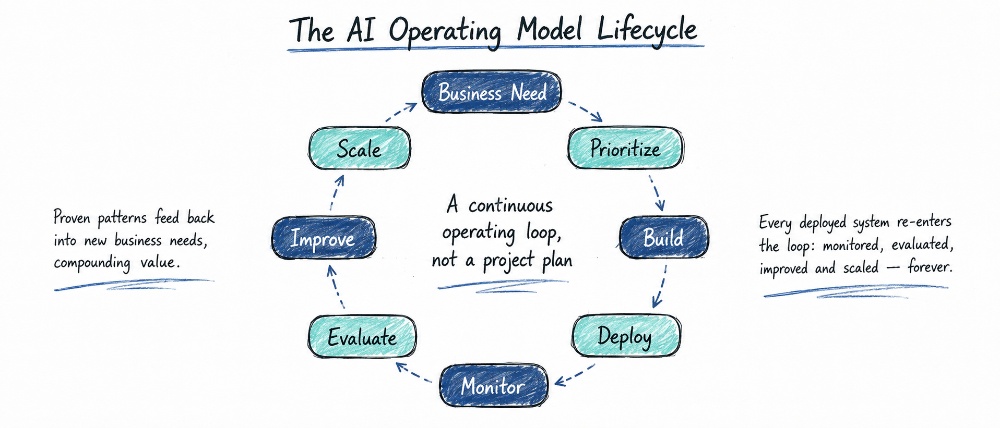
An operating model is not an org chart; it is a loop that runs continuously: a business need is identified, prioritized against the portfolio, built on the platform, deployed through governance, then monitored, evaluated, improved, and scaled — at which point proven patterns feed back into new business needs. Every production system stays inside this loop for its entire life. That is what makes an operating model an ongoing capability rather than a one-time transformation project.
Figure 7. The operating model runs as a continuous loop, not a linear project plan.
Choosing the Right Organizational Structure
As organizations scale AI beyond isolated pilots, choosing the right organizational structure becomes a critical decision. The structure determines how AI capabilities are distributed, who owns delivery, how governance is enforced, and how effectively expertise is shared across the enterprise. While there is no one-size-fits-all model, most organizations adopt one of three approaches depending on their AI maturity, business complexity, and scaling objectives.
Centralized: AI talent, decision-making, governance, and platform ownership are concentrated within a single central team, often an AI Center of Excellence. This model is well suited to organizations at an early stage of AI maturity because it promotes consistency, control, and efficient use of scarce expertise. However, as demand grows, the central team can become a bottleneck that slows delivery and limits business-unit ownership.
Federated: AI capabilities are distributed across individual business units, allowing teams to build solutions close to their customers, workflows, and domain expertise. This model supports speed, autonomy, and strong business alignment, but it can also create duplicated tools, fragmented standards, and inconsistent governance. It works best in mature organizations with strong shared platforms, policies, and enterprise-wide guardrails.
Hybrid: A central team owns the shared AI platform, governance standards, reusable tools, and enterprise architecture, while embedded teams within business units lead use-case delivery. This approach combines consistency and scale with proximity to business needs, making it the most practical model for many growing enterprises. Its success depends on clearly defined responsibilities and strong coordination between the central and embedded teams.
Figure 8. Centralized for early maturity, hybrid for scaling, federated for highly mature enterprises.
Operating AI Like Software, Not Projects
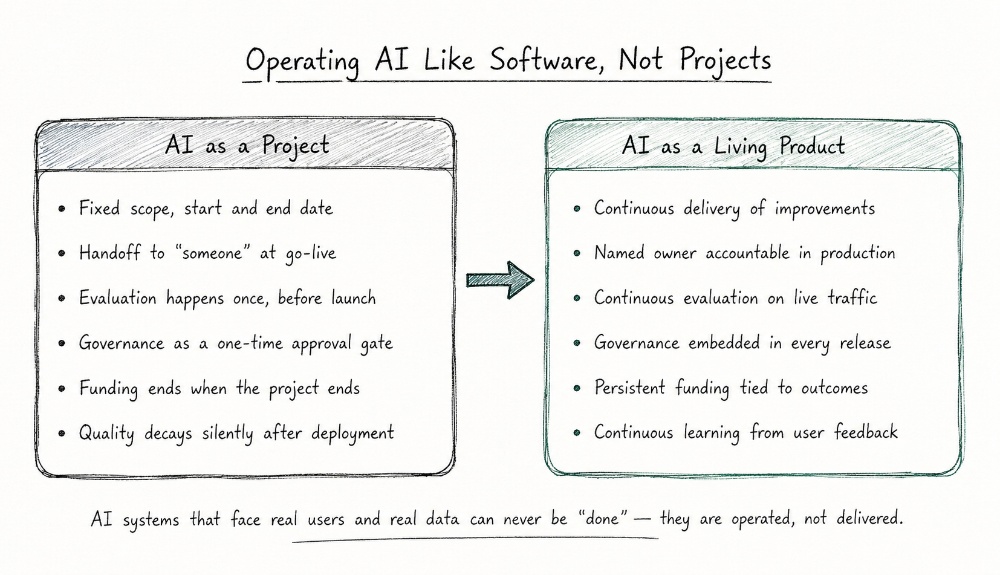
The deepest mindset shift is this: production AI must be run like a living software product, not a project with an end date. Projects have fixed scope, a go-live, and a handoff. AI systems facing real users and real data are never “done” — their quality decays silently the moment attention moves on.
Operating AI like software means continuous delivery of improvements, continuous evaluation on live traffic rather than a single pre-launch test, continuous governance embedded in every release, continuous learning from user feedback, and continuous ownership by a named team with a budget. Organizations that internalize this stop asking “when will the AI project finish?” and start asking “how is the AI product performing?”
Figure 9. Project thinking versus product thinking for production AI.
Common Mistakes When Building an AI Operating Model
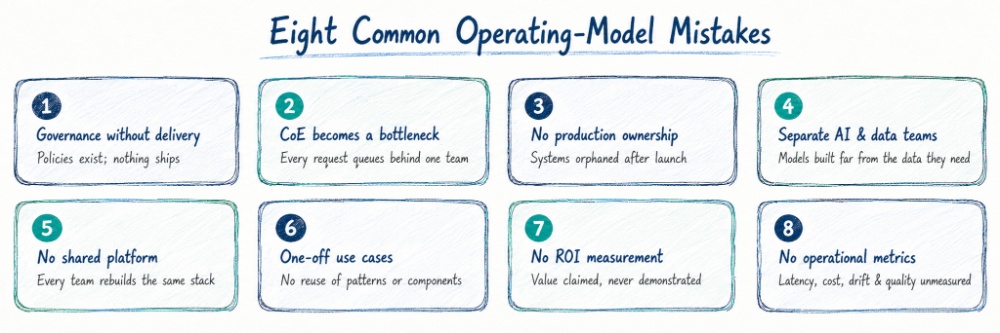
Even organizations that deliberately design an operating model tend to repeat the same failure patterns: building governance without delivery capacity, so policies exist but nothing ships; creating an AI CoE that becomes a bottleneck for every request; leaving production systems without owners; separating AI teams from data teams; letting every team rebuild its own stack instead of investing in a platform; treating every use case as a one-off; and measuring neither ROI nor operational health.
Building governance without delivery capacity — creating policies and oversight mechanisms without the teams, platforms, and processes needed to deliver production AI systems.
Turning the AI Center of Excellence (CoE) into a bottleneck — requiring every AI initiative to flow through a single central team, slowing delivery and limiting organizational scale.
Leaving production AI systems without clear ownership — failing to assign accountable owners responsible for system performance, maintenance, monitoring, and continuous improvement after deployment.
Separating AI teams from data teams — creating organizational silos that hinder collaboration, reduce data quality, and slow the development of reliable AI systems.
Allowing every team to build its own AI stack — duplicating tools, infrastructure, and engineering effort instead of investing in a shared enterprise AI platform.
Treating every AI use case as a one-off project — repeatedly rebuilding capabilities rather than creating reusable platforms, components, and delivery patterns.
Failing to measure business value (ROI) — deploying AI systems without defining or tracking the business outcomes they are expected to deliver.
Neglecting operational health — overlooking ongoing monitoring, evaluation, incident management, model drift, and cost tracking once systems are in production.
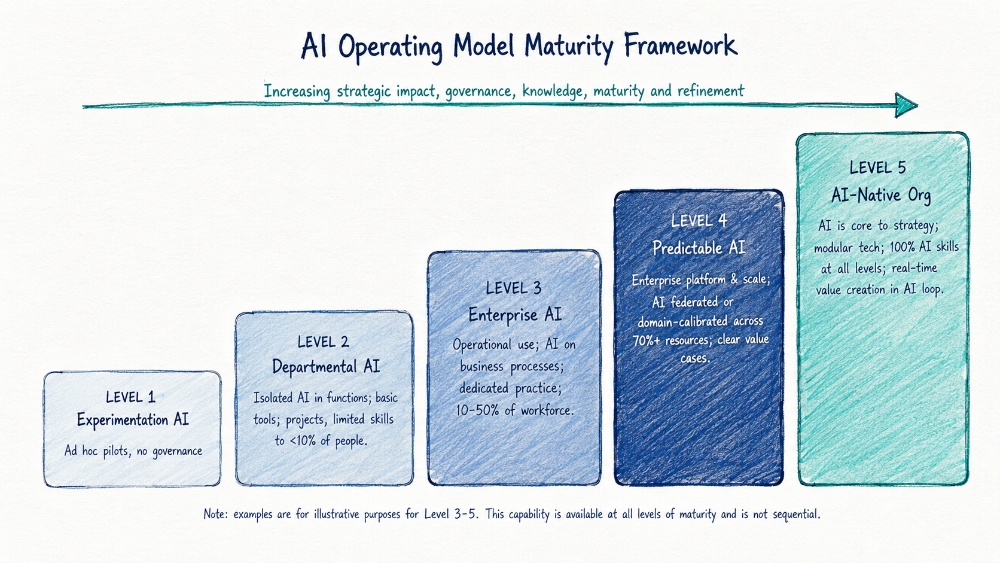
A simple five-level framework helps you locate your organization and identify what to build next. Assess yourself across people, governance, technology, operations, and measurement:
Level 1 — Experimentation: ad-hoc pilots by enthusiasts; no governance, no platform, no measurement.
Level 2 — Department AI: pockets of value with local tools and basic policies; data still siloed, nothing shared.
Level 3 — Enterprise AI: a shared platform and CoE, formal governance, a prioritized portfolio, first production systems.
Level 4 — Production AI: continuous delivery and evaluation, full observability, named production owners, ROI measured per use case.
Level 5 — AI-Native Organization: AI embedded in every workflow; federated teams on central guardrails; outcomes drive funding.
Most enterprises today sit at Level 2–3. The jump to Level 4 is precisely the jump the operating model exists to make — and according to Mckinsey, this is where the minority of companies that attribute real EBIT impact to AI separate from the rest.
Figure 11. The five maturity levels of an AI operating model.
How Omdena Helps Organizations Build an AI Operating Model
Designing an AI operating model is only the first step. The bigger challenge is embedding it into the way an organization delivers, governs, and continuously improves AI systems. Many enterprises already have AI strategies, governance policies, and promising pilots, but struggle to establish the people, platforms, processes, and ownership needed to scale AI consistently.
Omdena helps organizations bridge that gap by building the capabilities required for production AI, not just successful proofs of concept.
Align AI Initiatives With Business Priorities
Every engagement begins by identifying and prioritizing AI use cases that align with business objectives. Rather than pursuing experimentation for its own sake, the focus is on initiatives that can deliver measurable business outcomes and create a roadmap for long-term AI adoption.
Build the Technical Foundation for Scale
Omdena helps organizations establish the engineering capabilities needed to operationalize AI across the enterprise, including:
Designing production-ready AI architectures
Selecting appropriate AI, data, and cloud platforms
Establishing reusable engineering patterns
Integrating AI into existing enterprise systems
Implementing MLOps and LLMOps practices for deployment, monitoring, evaluation, and continuous improvement
Instead of delivering one-off solutions, the goal is to build reusable foundations that accelerate future AI initiatives.
Establish Governance and Operating Processes
Technology alone does not create a scalable AI organization. Omdena also helps enterprises design the organizational structures and operating processes that support long-term success by:
Defining governance frameworks and decision-making processes
Clarifying ownership across business and technical teams
Establishing AI delivery workflows
Recommending organizational structures based on AI maturity, whether centralized, federated, or hybrid
The objective is to ensure every AI system has clear accountability, defined operational processes, and sustainable ownership throughout its lifecycle.
Extend Internal Teams With Global AI Expertise
Omdena’s collaborative delivery model gives organizations access to vetted global AI talent in:
AI Engineering
Data Science
Software Engineering
Product Management
Domain Experts
Responsible AI Specialists
Working alongside internal teams enables organizations to accelerate delivery while transferring knowledge and building internal capability that remains long after the engagement ends.
A Production-First Approach
Omdena measures success by production outcomes, not pilot completion. Every engagement is designed to help organizations build AI systems that are:
Owned by accountable teams
Governed through clear operational processes
Continuously monitored and evaluated
Improved over time as business needs evolve
The result is an AI operating model that becomes a sustainable business capability rather than a collection of disconnected AI projects.
How Umaku Enables AI Operating Models
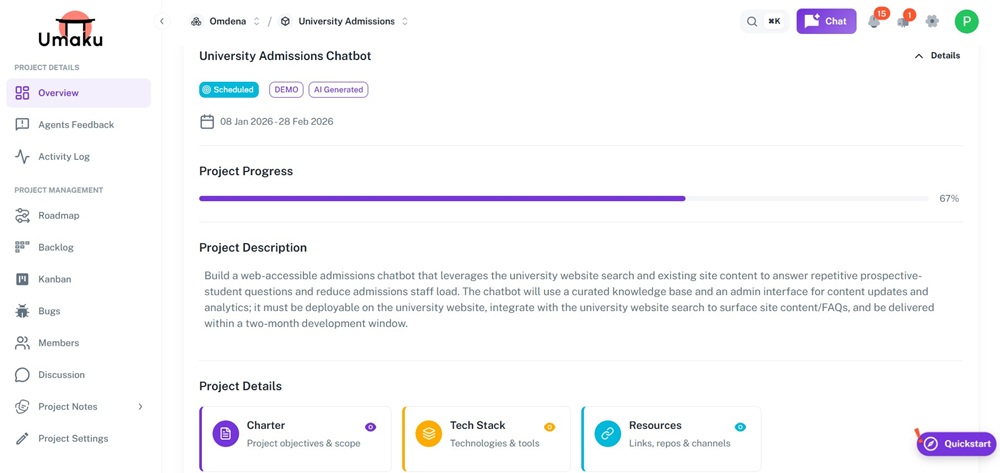
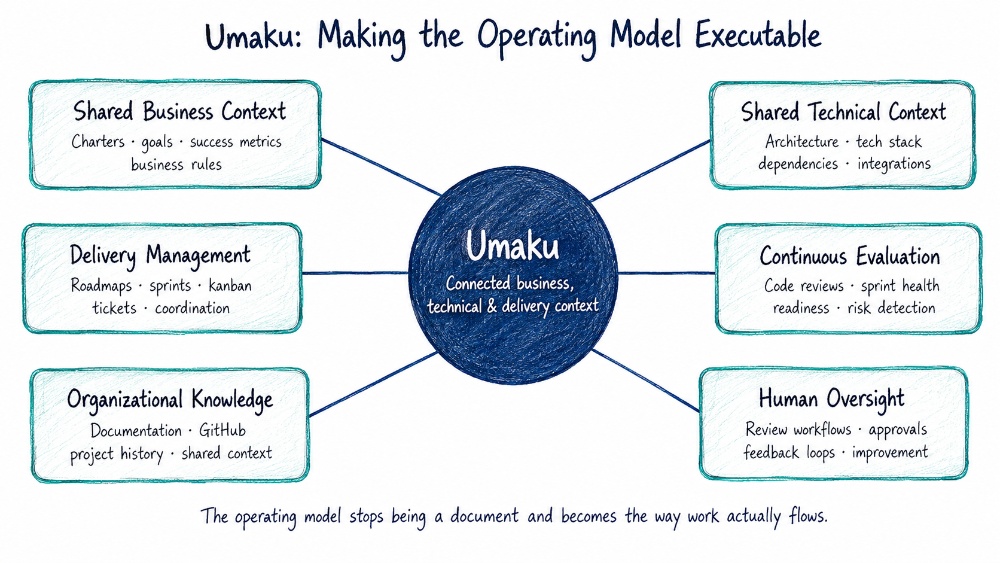
Most operating models fail in the gap between the document and the day-to-day work. Umaku, Omdena’s delivery platform, closes that gap by acting as the execution layer where the operating model actually runs. The capabilities this guide describes on paper exist in Umaku as one connected system: shared business context (charters, goals, success metrics, business rules), shared technical context (architecture, dependencies, GitHub), delivery management (roadmaps, sprints, kanban, tickets), continuous evaluation (AI agents reviewing every sprint), organizational knowledge (documentation and project history), and human oversight (review workflows and approvals).
Figure 12. Project Overview in Umaku
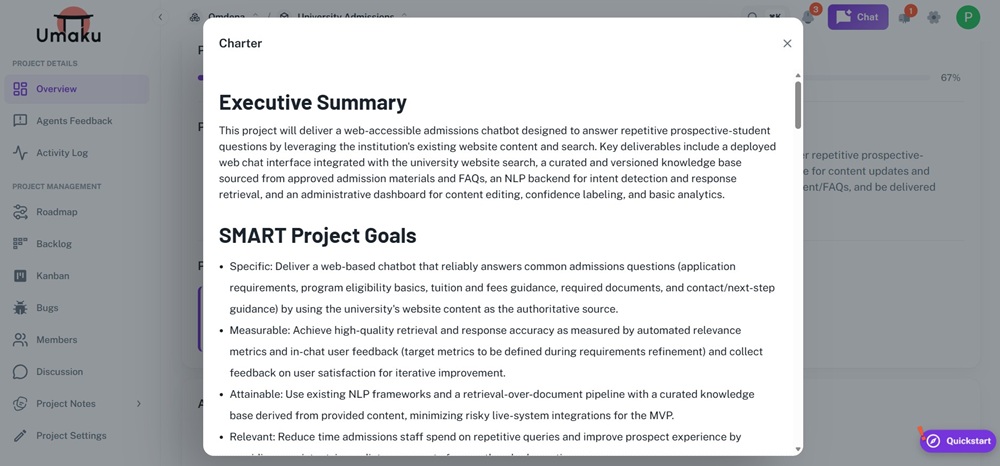
What that looks like in practice: every project opens with its charter beside its live delivery state — scope, timeline, progress, and the current sprint’s goal on the same screen as the work itself — so business intent and execution never separate.
Figure 13. Project Charter in Umaku
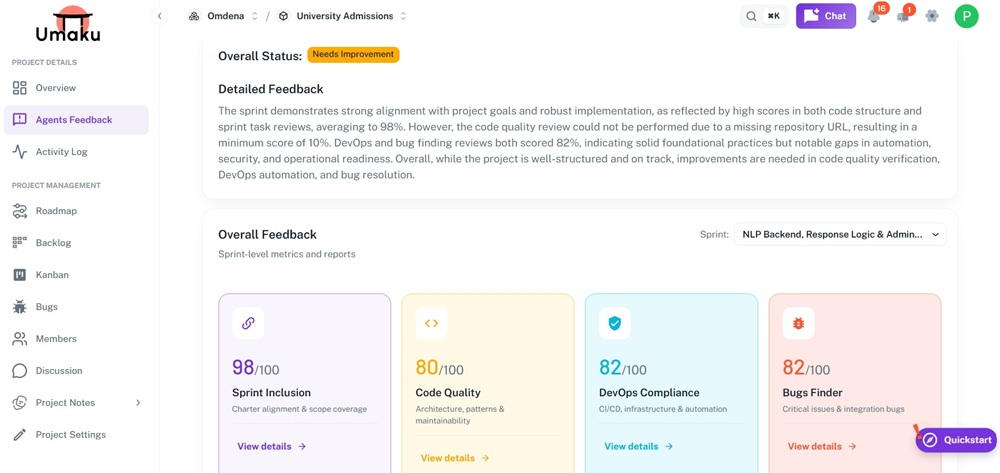
Continuous evaluation runs by default rather than by audit. Four AI agents — Sprint Inclusion, Code Quality, DevOps Compliance, and Bugs Finder — review every sprint and return a written judgement with scores and an overall status, turning “continuous operations” from a pillar on a slide into a recurring artifact the team reads and acts on.
Figure 14. Sprint-level evaluation by AI agents: an overall status with narrative reasoning and per-dimension scores.
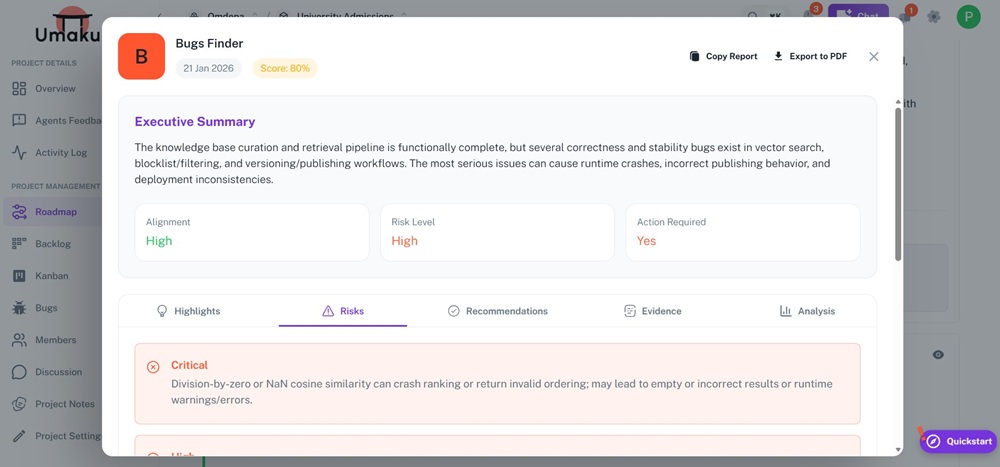
The findings are concrete enough to change the next sprint: risks are named at the level of schemas and flags — a mobile/backend contract mismatch caught by a review agent before UAT would have found it — which is how earlier risk detection materializes in day-to-day delivery.
Figure 14. Risk detection with action-required flags, specific enough to become next sprint’s objectives.
Because every initiative carries its business goals, technical constraints, and delivery state in one system, governance happens in the review workflow, evaluation happens in the delivery pipeline, and measurement happens against the success metrics defined in the charter. The operating model becomes executable rather than merely documented — which is precisely the Level 3-to-Level 4 jump this guide describes.
Figure 15. Umaku keeps business, technical, and delivery context connected across the AI lifecycle.
Turning AI Strategy Into Business Outcomes
Organizations rarely fail at AI because they lack strategy. They fail because they lack an operating model capable of turning experiments into production systems. The evidence is consistent: near-universal adoption, yet only a small minority achieving measurable P&L impact.
An effective AI operating model aligns strategy, people, governance, platforms, and continuous operations so that AI becomes a repeatable business capability rather than a collection of disconnected pilots. Build the six pillars, run the lifecycle as a loop, operate AI like software — and the pilot graveyard becomes a production portfolio.
FAQ
What is an AI operating model?
An AI operating model defines how an organization develops, deploys, governs, and continuously improves AI systems. It brings together people, processes, technology, and governance to help AI deliver long-term business value.
Why do AI pilots often fail to reach production?
Most AI pilots fail because organizations lack the processes, ownership, governance, and technical foundations needed to scale them. An AI operating model helps bridge the gap between successful experiments and production AI.
What are the key components of an AI operating model?
A modern AI operating model consists of six core pillars: business alignment, data foundation, technology platform, people and organization, governance and risk, and continuous operations. Together, they enable organizations to build and scale AI reliably.
How is an AI operating model different from AI governance?
AI governance focuses on policies, risk management, and compliance. An AI operating model is broader, defining how AI systems are built, deployed, operated, and continuously improved across the organization.
How can Omdena help organizations build an AI operating model?
Omdena helps organizations build AI operating models by combining its global AI talent network, structured delivery processes, and the Umaku AI delivery platform. From identifying high-value use cases to establishing governance, scalable architectures, MLOps, and operational ownership, Omdena enables organizations to deploy, govern, and continuously improve production AI systems with confidence.
Continue with Omdena
Share this article
Share on LinkedIn, send by email, or copy the direct link.