Artificial intelligence adoption has accelerated rapidly over the last two years. Companies are experimenting with AI copilots, n8n workflows, and internal automations across business operations. According to McKinsey’s 2026 State of Organizations report, 88% of organizations are experimenting with AI, yet only 1% describe their AI rollouts as mature.
Many AI MVPs work well in testing but struggle when exposed to actual business operations, integrations, scaling, and security requirements. That’s why most AI initiatives are stuck between prototype and operational deployment.
This is where AI outsourcing comes into the picture. Organizations increasingly need partners that can operationalize AI systems, integrate them into existing workflows, and deliver deployment-ready AI solutions.
In this article, we’ll explore when AI outsourcing makes sense, what businesses should look for in a partner, and how organizations can move from AI MVPs to production-ready deployment.
TL;DR (Quick Summary):
What is AI outsourcing – AI outsourcing involves partnering with external AI experts to design, deploy, monitor, and maintain operational AI systems.
Why do AI MVPs fall short – Many AI prototypes struggle in real business environments due to integration challenges, scaling issues, monitoring gaps, and workflow complexity.
When does AI outsourcing make sense – AI outsourcing becomes valuable when organizations already validated an AI use case but lack deployment expertise, infrastructure, or internal AI resources.
What should businesses look for in an AI partner – Businesses should prioritize deployment experience, workflow integration capabilities, MLOps expertise, monitoring systems, and structured delivery processes.
Common AI outsourcing mistakes – Common mistakes include focusing only on demos, ignoring deployment complexity, poor data readiness, and lacking long-term monitoring strategies.
Omdena’s approach to AI outsourcing – Omdena helps organizations move from AI prototypes to operational deployment through structured workflows, proprietary AI tooling, and a global AI talent network.
What Is AI Outsourcing?
AI outsourcing is the process of partnering with an external AI development team to design, build, deploy, and maintain AI systems. This can include AI engineering, workflow implementation, integrations, MLOps, monitoring, and long-term optimization support.
Traditional outsourcing mainly focused on software delivery and development capacity. Modern AI outsourcing is far more operational and infrastructure-driven. Businesses now require partners that can manage:
Data pipelines and workflow orchestration
LLM and AI agent implementation
AI evaluation and monitoring
Human review and governance workflows
Infrastructure scalability and reliability
Integration with existing business systems
As organizations move beyond experimentation, AI outsourcing is increasingly focused on operational deployment rather than prototype development alone. Building an AI MVP is now relatively accessible. However, many organizations discover that moving from a working prototype to a reliable production system is significantly more difficult than expected.
Why Many AI MVPs Never Reach Production
AI Prototypes Are Easier than Production Systems
Many AI MVPs work well in controlled testing environments. An internal chatbot may perform well in demos, an AI agent may succeed across a few test cases, and workflow automations may run smoothly on clean datasets. But real-world deployment introduces challenges such as hallucinations, API failures, latency, inconsistent outputs, scaling issues, security concerns, and workflow exceptions.
Low-Code AI Tools Hit Operational Limits
Tools like n8n, Zapier, Claude, GPT wrappers, and no-code AI agents have made AI experimentation more accessible. They are excellent for quickly validating ideas. However, businesses often outgrow these tools when they need custom integrations, compliance controls, workflow orchestration, monitoring, reliability, and production infrastructure.
AI Systems Require More than Model Access
Operational AI requires more than connecting to an LLM API. Businesses also need evaluation frameworks, testing pipelines, fallback systems, human review workflows, deployment pipelines, observability, and MLOps processes that keep systems reliable after launch.
This growing gap between experimentation and operational deployment is where AI outsourcing often becomes necessary.
When AI Outsourcing Makes Sense
You Already Validated the AI Use Case
Many organizations already have an internal AI MVP or workflow in place. Stakeholders may have approved the initiative after seeing early results from copilots, AI agents, or workflow automations. The next challenge is turning that experiment into a reliable operational system that can scale across teams and business processes.
Your Internal Team Lacks AI Deployment Experience
Internal engineering teams often have strong software development and automation capabilities. However, production AI systems introduce additional layers of complexity, including:
Model evaluation and testing
RAG and LLM architecture
AI observability and monitoring
Workflow reliability and fallback systems
MLOps and deployment pipelines
This expertise is still difficult and expensive to build internally, especially as demand for experienced AI talent continues to grow globally.
You Need Faster Implementation Without Building a Large AI Team
AI outsourcing gives organizations access to specialized AI engineers, structured delivery workflows, and deployment experience without the cost of building a large in-house AI department. This can significantly reduce implementation timelines while improving deployment reliability.
As more companies move beyond AI experimentation, choosing the right outsourcing partner becomes increasingly important.
What Businesses Should Look for in an AI Outsourcing Partner
1. Production Deployment Experience
Many vendors can build AI demos and MVPs. Far fewer have experience deploying AI systems into real operational environments. Businesses should look for partners that understand scalability, workflow reliability, integrations, security, and long-term system performance beyond prototype development.
2. Structured AI Delivery Process
AI implementation requires more than rapid experimentation. Reliable deployment depends on structured workflows that include:
QA and validation
AI evaluation and testing
Rollout planning
Monitoring and optimization
Deployment readiness checks
Without clear delivery processes, AI projects often become difficult to maintain after launch.
3. Ability to Integrate Into Existing Workflows
AI systems rarely operate in isolation. Successful deployment often depends on integration with existing business infrastructure, including:
ERP and CRM systems
Internal databases
Collaboration tools
Knowledge bases
Customer support platforms
Operational workflows
This operational integration is often where many AI projects become significantly more complex.
4. MLOps and Long-Term Monitoring
AI systems continue evolving after deployment. Models can degrade over time as workflows, user behavior, and data change. Businesses should prioritize partners with experience in monitoring, retraining, governance, observability, and long-term AI maintenance.
5. Cost-Effective Execution
Enterprise AI consulting can become prohibitively expensive for many organizations. Businesses increasingly look for partners that combine structured AI delivery, specialized expertise, and scalable execution without enterprise-level pricing.
This is where Omdena helps organizations move beyond AI experimentation through structured delivery workflows, a global AI talent network, proprietary agentic AI tooling, and more affordable production-ready implementation models.
Let’s take a look at how this approach works in practice.
How Omdena Helps Companies Move Beyond AI Prototypes
Many organizations already have working AI prototypes and internal automations. The challenge begins when those systems need to scale across operational workflows, integrations, and real work environments. This is where Omdena’s deployment-focused AI delivery approach comes into the picture.
Proprietary Agentic AI Platform: Umaku
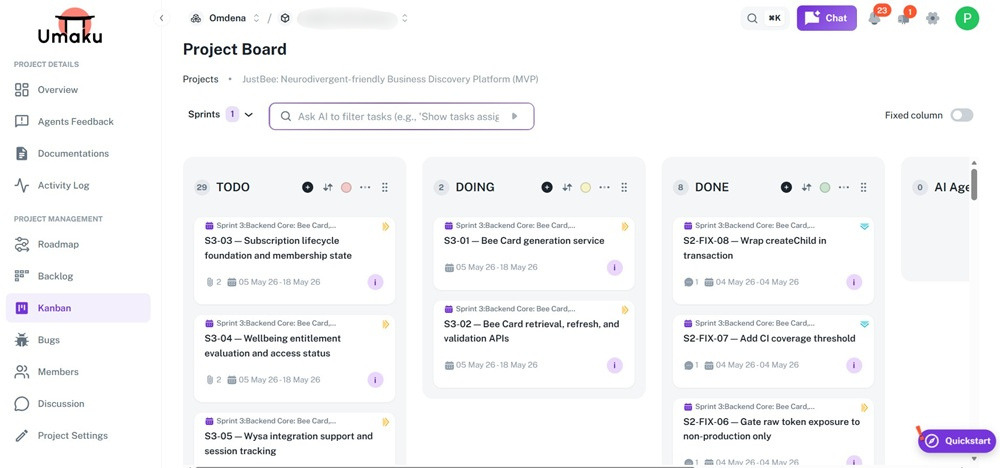
Omdena combines human expertise with AI-assisted execution through Umaku, its proprietary agentic AI platform. Umaku centralizes project planning, sprint coordination, architecture decisions, evaluation checkpoints, deployment tracking, and documentation into a unified workflow system.
Kanban Board in Umaku
This helps reduce:
Project misalignment
Delivery delays
Operational overhead
Late-stage implementation rework
AI-assisted sprint management, monitoring, and context-aware code review workflows also help teams maintain more consistent implementation quality throughout deployment.
Structured AI Delivery Workflows
Omdena follows a structured implementation process that includes planning, testing, evaluation, deployment, optimization, governance, and long-term maintenance from the start of the project.
Instead of treating reliability and monitoring as post-launch tasks, these workflows are integrated early into implementation. This helps reduce deployment risk while improving system stability and long-term usability.
Global AI Talent Network
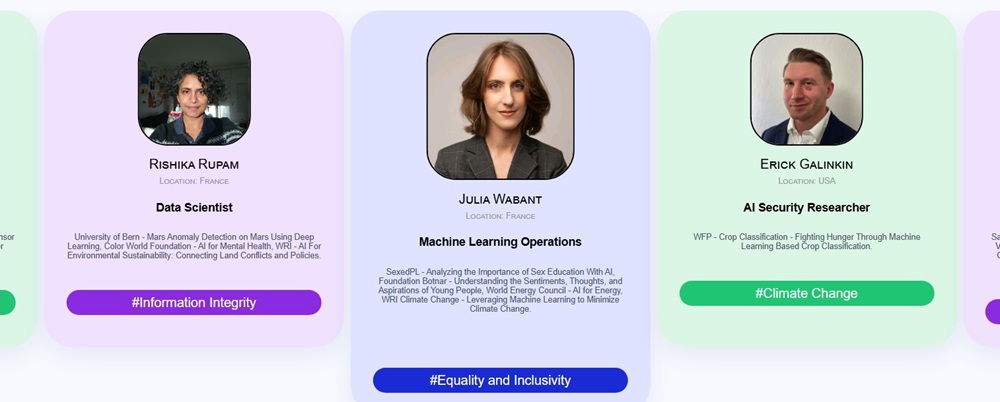
Omdena provides access to a global network of 30,000+ AI engineers, researchers, MLOps specialists, and domain experts across 80+ countries. This allows organizations to build specialized AI teams without the complexity and cost of scaling large in-house AI departments.
Global AI Talent Network
AI Capabilities Omdena Supports
Omdena supports a wide range of AI development capabilities, including:
Generative AI and LLM applications
AI agents and workflow automation
Computer vision solutions
Predictive analytics and machine learning
Natural language processing
Geospatial AI and remote sensing
Multimodal AI systems
Speech and conversational AI
OCR & document intelligence
MLOps & AI Infrastructure
Production-Ready AI Systems
Omdena’s delivery approach focuses on operational deployment through integrations, monitoring systems, fallback mechanisms, human review workflows, and long-term deployment support.
Even with the right outsourcing partner, organizations still need to avoid several common implementation mistakes that can slow down or derail AI initiatives.
Common AI Outsourcing Mistakes to Avoid
Many AI initiatives fail not because the technology is weak, but because implementation planning is incomplete. Avoiding a few common mistakes early can significantly improve deployment success.
Outsourcing before validating the use case – Building AI systems without first validating business value often leads to expensive experimentation with unclear outcomes.
Focusing only on model demos – A strong demo does not guarantee operational reliability. Real deployment requires monitoring, integrations, governance, and workflow stability.
Ignoring deployment complexity – Many teams underestimate the challenges involved in scaling AI systems across real business environments and operational workflows.
Poor data readiness – Incomplete, inconsistent, or poorly structured data can delay implementation and reduce AI performance significantly.
No ownership transfer or monitoring strategy – AI systems require long-term monitoring, retraining, governance, and internal knowledge transfer after deployment.
Choose Omdena as Your AI Outsourcing Partner
AI experimentation is now easier than ever with modern LLMs, low-code AI tools, and workflow automation platforms. But deploying reliable AI systems across real operational environments is still a major challenge.
Production-ready AI requires integrations, monitoring, evaluation, governance, scalability, and long-term maintenance. This is why many organizations now look for AI outsourcing partners like Omdena that understand operational deployment rather than just prototype development.
If your team has already validated an AI workflow and now needs a production-ready implementation, feel free to book an exploration call with Omdena to discuss the right deployment roadmap for your organization.
FAQ
What is AI outsourcing?
AI outsourcing is the process of partnering with an external AI development team to build, deploy, monitor, and maintain AI systems. This can include AI engineering, workflow automation, integrations, MLOps, AI agents, and long-term deployment support.
Why do many AI MVPs fail after initial testing?
Many AI MVPs work well in controlled environments but struggle in real operational workflows. Common challenges include hallucinations, scalability issues, workflow exceptions, monitoring gaps, security requirements, and integration complexity.
When should a company outsource AI development?
AI outsourcing often makes sense after a business has already validated an AI use case internally but lacks the expertise, infrastructure, or resources needed for operational deployment and long-term maintenance.
What should businesses look for in an AI outsourcing partner?
Businesses should look for partners with experience in production deployment, AI integrations, MLOps, monitoring, workflow reliability, structured delivery processes, and long-term AI maintenance support.
Can Omdena help move existing AI prototypes into production?
Yes. Omdena helps organizations move beyond AI experimentation through structured delivery workflows, a proprietary agentic AI platform, a global AI talent network, and long-term operational support as a fraction of enterprise development costs.
Continue with Omdena
Share this article
Share on LinkedIn, send by email, or copy the direct link.