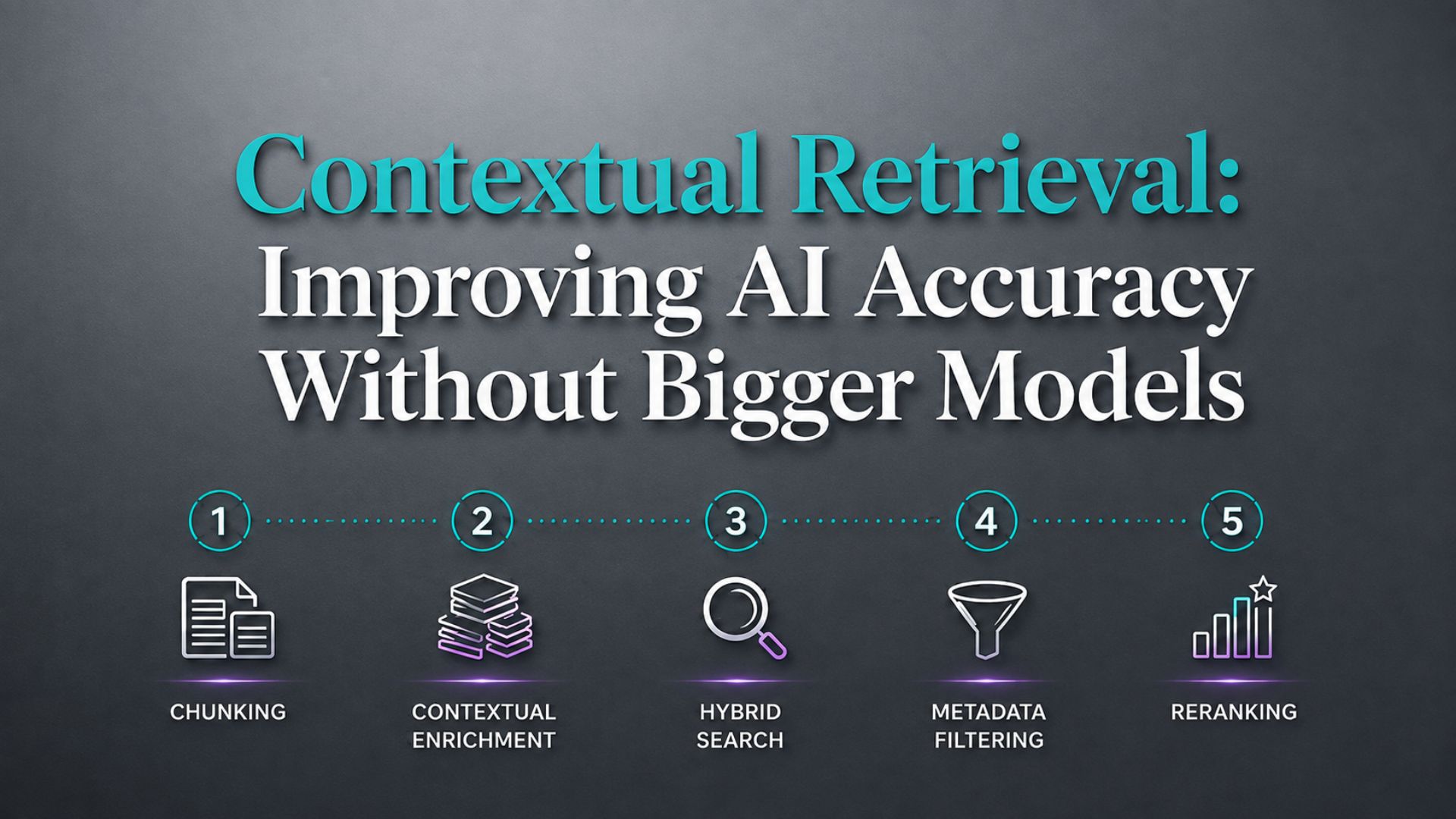
Contextual Retrieval: Improving AI Accuracy Without Bigger Models
9 min readUpdated August 11, 2026
Prince OkonSenior Data Scientist
The biggest accuracy gains in production AI come from giving models the right information, not more parameters.
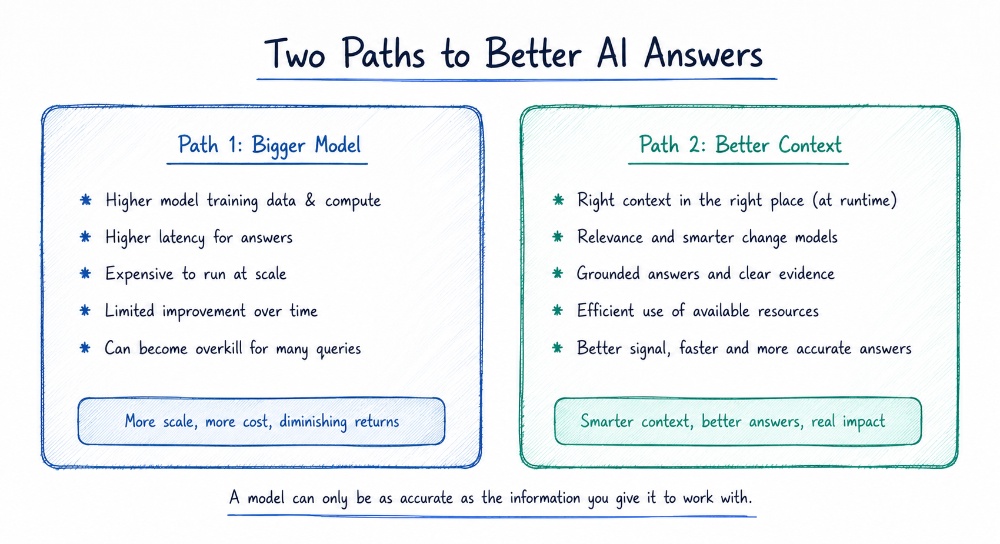
When an AI application gives wrong answers, the instinctive fix is a bigger model. It is usually the wrong fix. Most production failures are not reasoning failures. They are information failures: the model never saw the fact it needed.
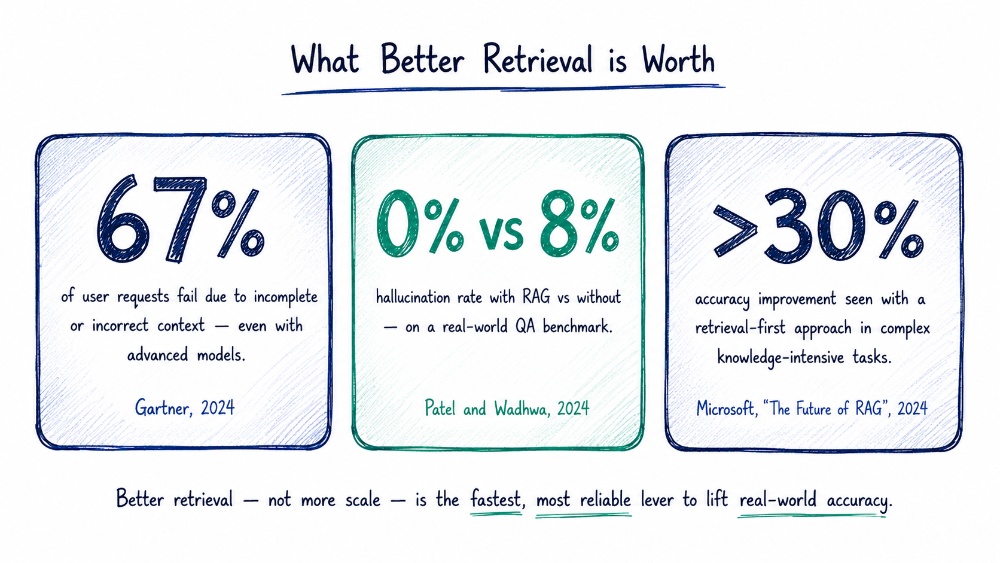
The evidence is hard to argue with. Anthropic cut retrieval failures by 67% without changing the generating model at all, and a clinical study eliminated hallucinations entirely just by grounding answers in retrieved evidence.
This guide shows you how to claim those gains. You will learn why bigger models and long context windows disappoint, how the five building blocks of contextual retrieval work (chunking, contextual enrichment, hybrid search, metadata, and reranking), how they assemble into one production pipeline, and how to measure whether retrieval is actually improving. By the end, you will see why better retrieval is the cheapest accuracy your AI budget can buy.
Figure 1. Scaling the model pays more for guesswork; scaling the context fixes the actual problem.
What Is Contextual Retrieval?
Contextual retrieval is the practice of engineering an AI system’s information supply so the model receives the most relevant, trustworthy evidence available at the moment it generates a response. It extends basic retrieval-augmented generation (RAG) with techniques that preserve and exploit context at every step.
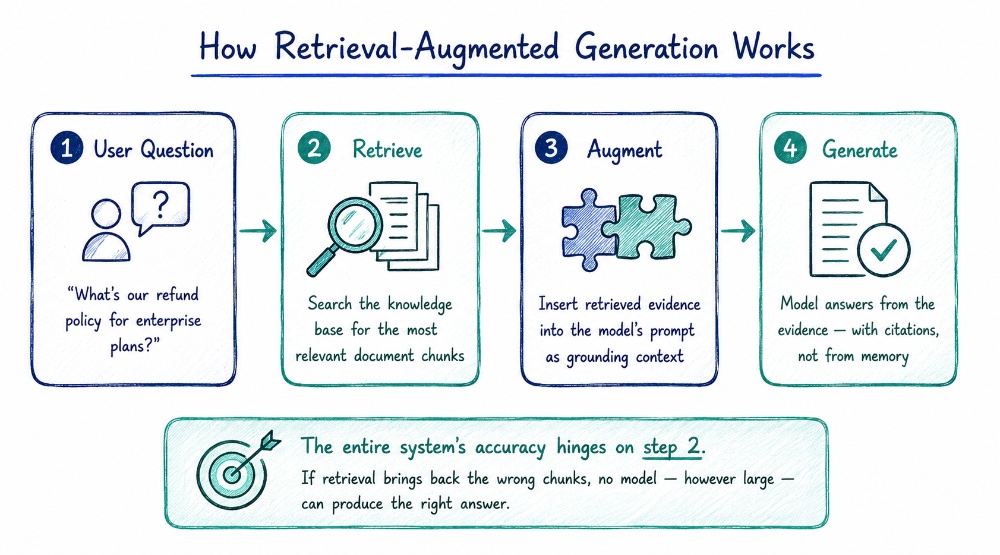
The premise is simple: a model can only be as accurate as what it reads. In a RAG pipeline, generation is the last step of four. Everything upstream decides whether the model answers from evidence or from memory.
Figure 2. Retrieval-augmented generation: the whole system hinges on the retrieval step.
Why Bigger Models and Bigger Context Windows Aren’t the Answer
If retrieval is the hinge, why do teams keep upgrading models instead? Because it feels like progress. In practice, a bigger model raises the cost of every call and adds latency, yet it still knows nothing about your contracts, policies, or codebase. It still hallucinates when asked about them.
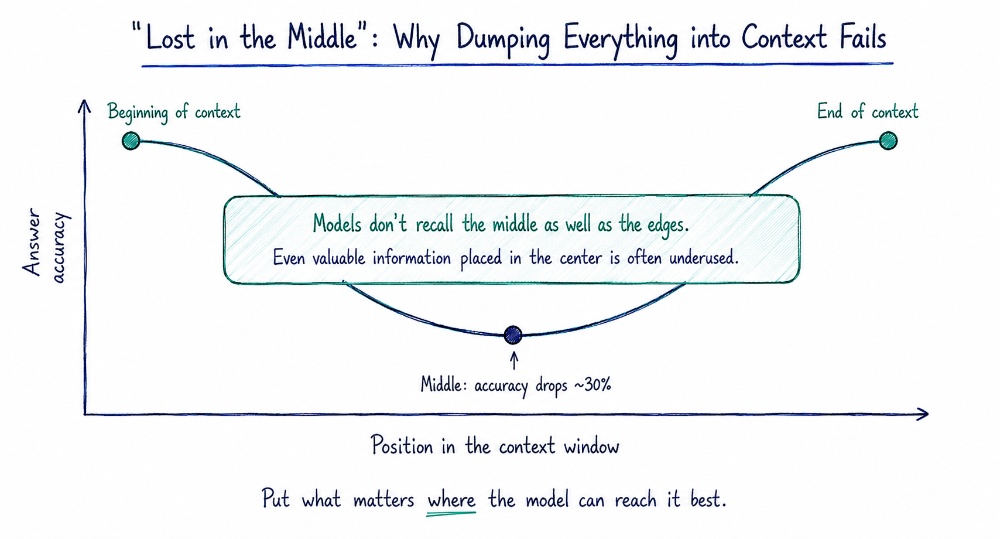
The other shortcut, stuffing entire document sets into today’s huge context windows, fails more subtly. The Lost in the Middle research found accuracy follows a U-shaped curve: strong at the start and end of the window, degrading by more than 30% when the key fact sits in the middle. You also pay for every token, relevant or not, on every call.
Figure 3. Give the model five right paragraphs, not five hundred pages.
Retrieval flips the economics: a few thousand carefully chosen tokens beat a few hundred thousand indiscriminate ones. High-stakes domains show what that buys. A radiology study recorded zero hallucinated statements with RAG versus 8% without it, and a public-health framework in Frontiers cut hallucination rates by more than 40%.
Figure 4. What better retrieval is worth, in numbers.
The Building Blocks of Contextual Retrieval
So how do you actually build retrieval that delivers those numbers? Five techniques do the work, and they compound: each one fixes a failure mode the previous ones leave behind.
1. Document Chunking
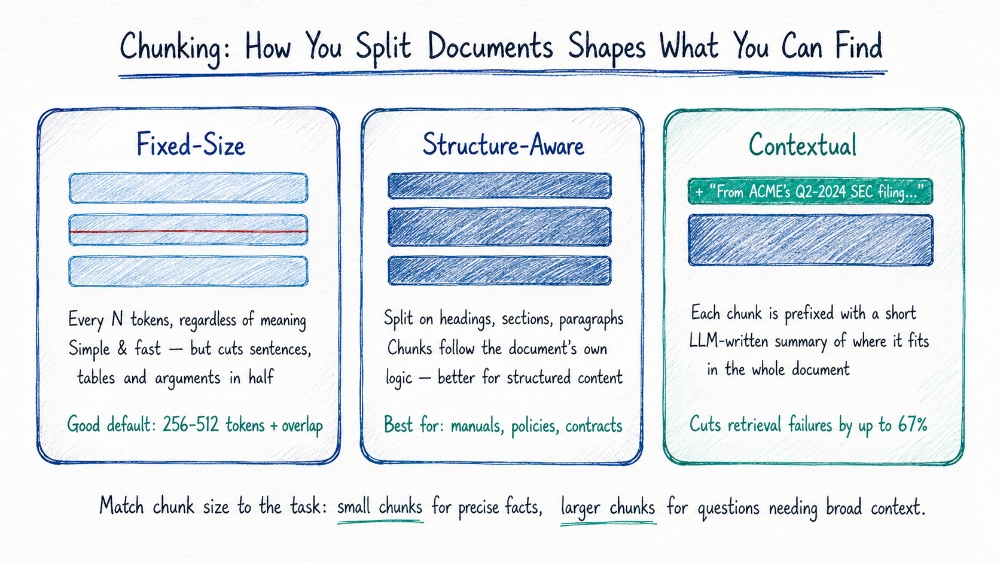
Documents must be split into chunks before they can be indexed, and how you split determines what you can find. The main strategies each fit different content:
Fixed-size chunking splits every N tokens. Simple and fast, but it blindly cuts sentences, tables, and arguments in half.
Structure-aware chunking follows headings, sections, and clauses. Better for policies, manuals, and contracts.
Size tuning matters too: research shows smaller chunks suit precise factoid questions while larger chunks win for broad-context questions.
There is no universal best, which is why retrieval must be evaluated rather than assumed. More on that below.
Figure 5. Three chunking strategies, and when each fits.
2. Contextual Enrichment: Putting the Context Back
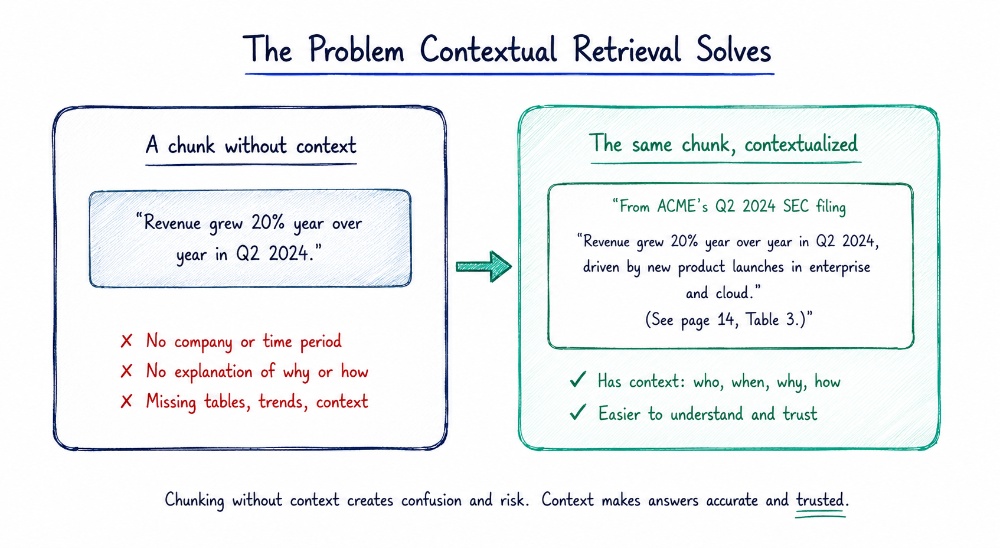
Whatever strategy you choose, chunking has a hidden cost: it destroys context. A chunk that reads “revenue grew by 3% over the previous quarter” is useless in isolation. Which company? Which quarter?
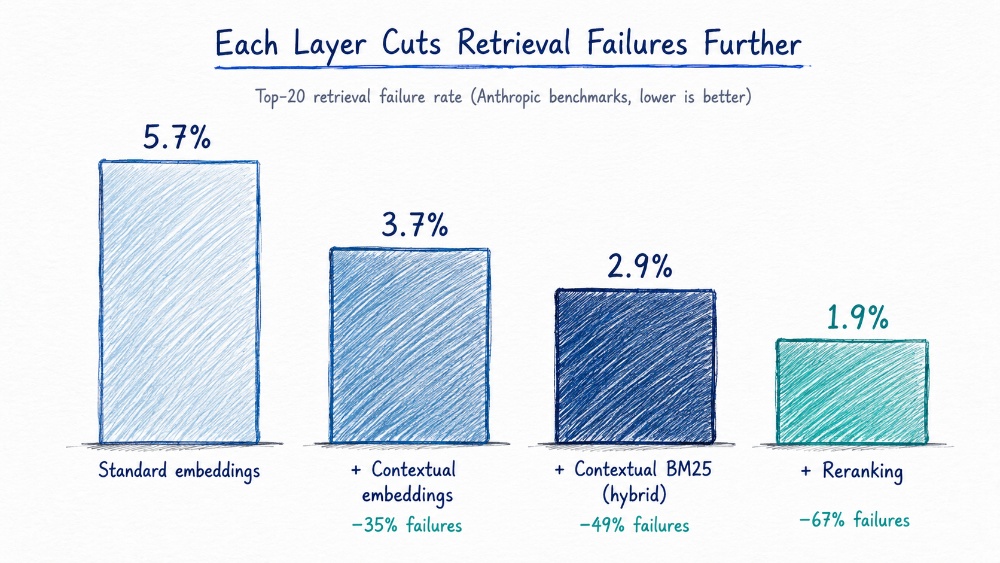
Anthropic’s technique fixes this by having an LLM write a short explanation of where each chunk sits in its source document, prepended before indexing. That single change cut top-20 retrieval failures by 35%. It runs once at indexing time, so it adds nothing to per-query cost.
Figure 6. The same chunk, before and after contextualization.
3. Semantic Search, Plus Keywords
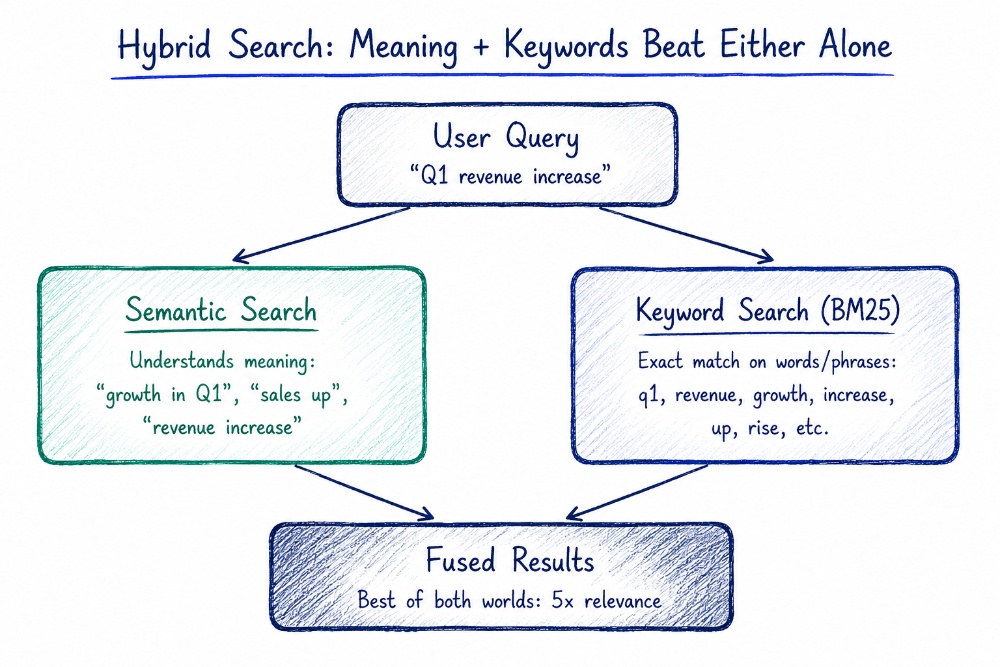
Well-formed chunks still need to be found, and no single search method finds them all. Semantic search embeds queries and chunks as vectors so meaning matches even when words differ: “payment failure” finds “transaction bug.” But embeddings are famously weak at exact identifiers such as error codes, SKUs, and names.
Classic keyword search (BM25) is strong precisely there. Production systems run both and fuse the results. In Anthropic’s benchmarks, adding contextual BM25 deepened the failure reduction to 49%.
Figure 7. Hybrid search: embeddings for meaning, BM25 for exact matches.
4. Metadata Enrichment
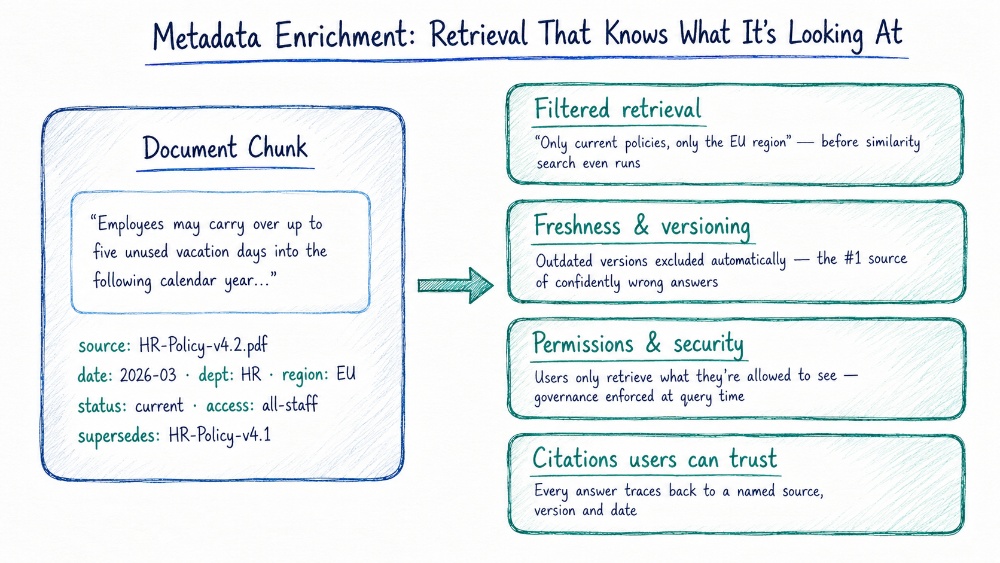
Hybrid search finds similar text, but similarity is not suitability. A chunk can be semantically perfect and still wrong: from a superseded policy, another region, or a document the user should not see.
Metadata fixes this. Tagging chunks with source, date, version, department, and access rights lets the system filter before similarity search even runs. It also powers the two things production users demand most: citations that name their source, and automatic exclusion of stale versions, the single most common cause of confidently wrong enterprise answers.
Figure 8. Metadata turns retrieval from “similar text” into “the right text.”
5. Reranking
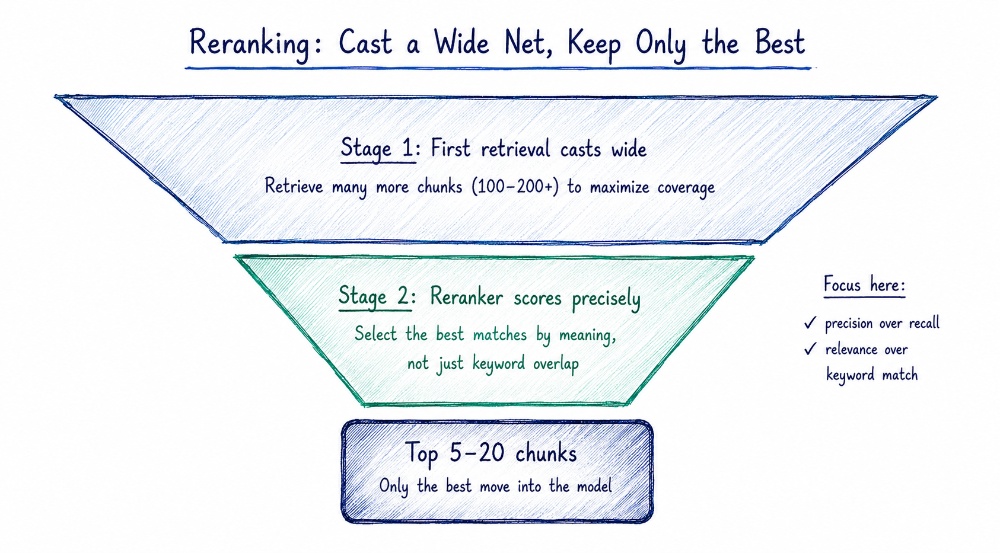
Even filtered, hybrid retrieval returns more candidates than the model should read. First-stage retrieval is built for speed, so it casts a wide net of perhaps 150 chunks. A reranker then reads the query and each candidate together, re-scores them precisely, and keeps only the top handful.
This two-stage design mirrors how search engines work: recall first, precision second. In Anthropic’s benchmarks, reranking took the total failure reduction from 49% to 67%. Passing fewer, better chunks also cuts token costs and reduces the noise that invites hallucination.
Figure 9. Cast a wide net, keep only the best.Figure 10. Each layer compounds: from a 5.7% failure rate to 1.9%.
Putting It Together: The Full Pipeline
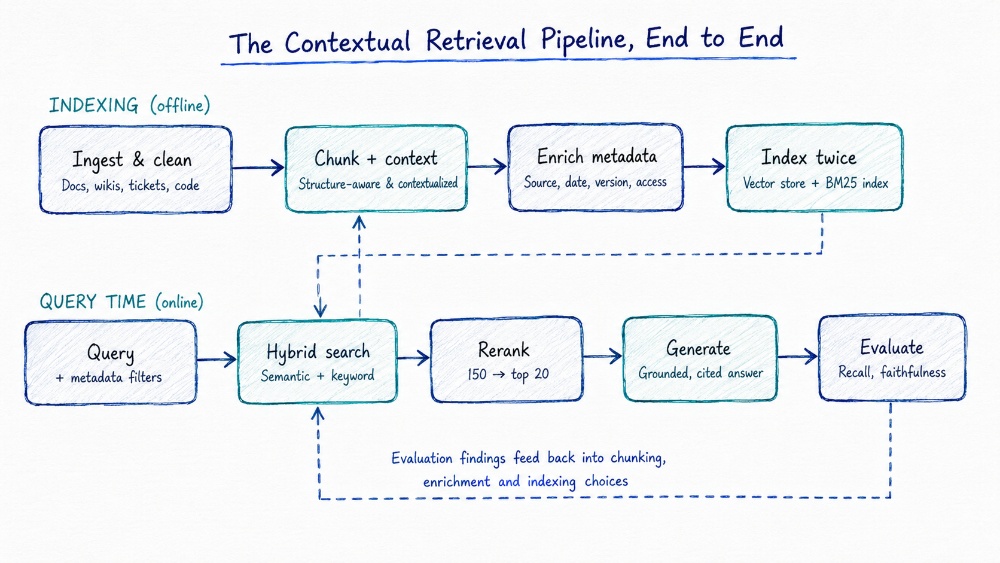
Individually, each block is a modest upgrade. Together they form one pipeline with two halves. Offline, documents are ingested, chunked with structure awareness, contextualized, enriched with metadata, and indexed twice: into a vector store and a keyword index.
Online, each query is filtered by metadata, run through hybrid search, reranked, and answered with citations. The final step, evaluation, is what makes the pipeline improve rather than decay, feeding production findings back into chunking and indexing choices.
Figure 11. The contextual retrieval pipeline, end to end.
Measure Retrieval, Not Just Answers
That evaluation step deserves its own discipline. Teams that only evaluate final answers cannot tell a retrieval failure from a generation failure, so they fix the wrong layer. Mature teams track retrieval separately:
Recall@k: did the right chunk appear in the top k results?
Precision: how much of what was retrieved was actually relevant?
Faithfulness: did the model’s answer actually use the retrieved evidence?
A small golden set of question-and-document pairs, run on every pipeline change, catches regressions the way unit tests catch bugs. The payoff is economic as well: with reliable retrieval, a smaller, cheaper model with great context routinely beats a frontier model with poor context. Every retrieval improvement benefits all use cases built on the same pipeline at once.
Common Mistakes
Most retrieval failures in production trace back to a short list of avoidable habits:
Chunking blindly at a fixed size and never revisiting it
Relying on embeddings alone and losing every exact-match query
Indexing without metadata, so stale versions poison answers
Skipping reranking and passing noisy candidates to the model
Ignoring retrieval evaluation, so nobody knows which layer is failing
Treating ingestion as a one-time event while the knowledge base drifts out of date
None of these require a bigger model to fix. They require treating retrieval as an engineered, evaluated system.
How Omdena Builds Production-Grade Retrieval
That engineering discipline is exactly where most teams need help. Getting a RAG demo working takes a weekend. Making retrieval accurate, governed, and continuously evaluated in production is a different job entirely.
Omdena builds that discipline into enterprise AI systems: designing chunking and contextualization strategies around each organization’s actual documents, implementing hybrid search and reranking pipelines, enriching knowledge with the metadata that makes retrieval trustworthy, and standing up the evaluation harnesses that keep quality measurable. Because the methodology is production-first, retrieval is engineered from the start for messy documents, changing knowledge, and real user queries rather than retrofitted after a pilot stalls.
How Umaku Applies the Same Principle to Delivery
Contextual retrieval is ultimately about one idea: the right context, at the right time, changes the quality of every decision. Umaku applies that idea to how AI projects themselves are run.
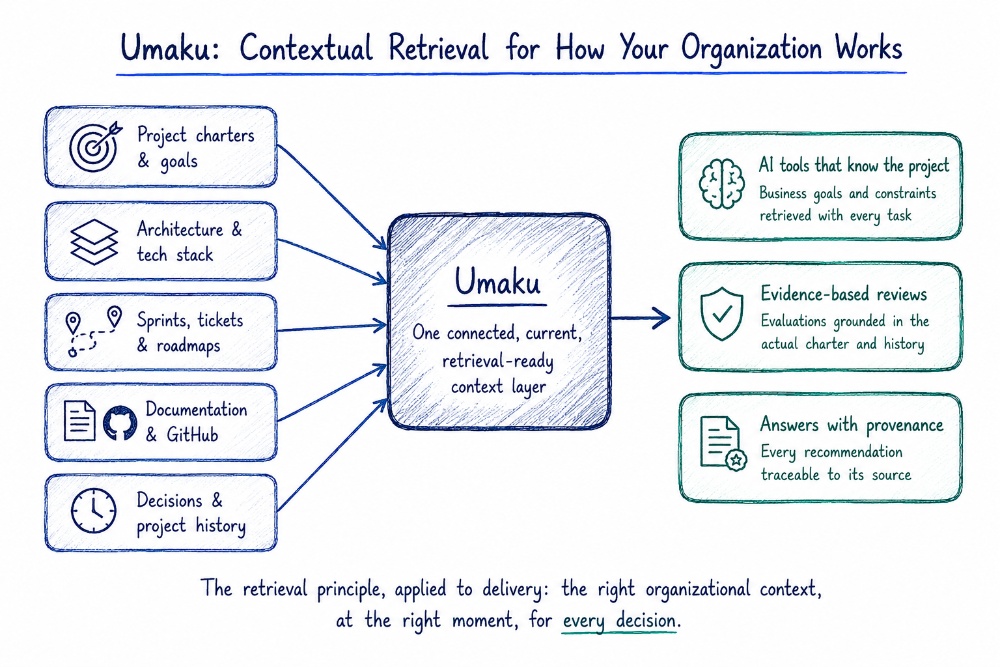
It connects the sources that usually live in silos: project charters, goals, and business rules; architecture and tech stack; sprints, tickets, and roadmaps; documentation, GitHub, and project history. Together they form one connected, current context layer for delivery.
AI-assisted work inside Umaku then behaves like a well-built RAG system. Reviews are grounded in the actual project charter, evaluations reference the real architecture and history, and every recommendation carries provenance back to its source. Fewer decisions get made from stale or missing context, and the team can trace every answer.
Figure 12. Umaku: the retrieval principle applied to organizational context.
Conclusion
The cheapest accuracy you will ever buy is better context. The evidence is consistent: contextual embeddings, hybrid search, and reranking cut retrieval failures by 67%, grounding eliminated hallucinations in clinical testing, and long-context shortcuts measurably degrade in the middle.
So before reaching for a bigger model, ask a better question: does the model actually see the information it needs? Chunk with structure, put context back into every chunk, search by meaning and keywords, filter with metadata, rerank for precision, and measure retrieval relentlessly. That is how AI systems become accurate, reliable, and affordable in production, where it counts.
FAQ
What is contextual retrieval?
Contextual retrieval is the practice of improving AI accuracy by supplying models with the most relevant and trustworthy information at the time of generation. It extends traditional retrieval-augmented generation (RAG) by using techniques such as contextual enrichment, hybrid search, metadata, and reranking to provide better context.
Why is contextual retrieval important for AI?
Contextual retrieval helps reduce hallucinations, improve response accuracy, and lower inference costs by ensuring AI models generate answers based on relevant evidence instead of relying solely on their internal knowledge or larger context windows.
What are the key building blocks of contextual retrieval?
Contextual retrieval is built on five core techniques: document chunking, contextual enrichment, hybrid search, metadata enrichment, and reranking. Together, these components improve retrieval quality and provide AI models with the most relevant information for generating accurate responses.
How is contextual retrieval different from traditional RAG?
Traditional RAG retrieves relevant documents before generation, while contextual retrieval improves every stage of the retrieval process through better chunking, contextual enrichment, hybrid search, metadata filtering, and reranking, resulting in more accurate and reliable AI responses.
How do you measure the effectiveness of contextual retrieval?
Teams typically measure contextual retrieval using metrics such as Recall@k, precision, and faithfulness. Evaluating retrieval separately from generation helps identify whether errors originate from retrieving the wrong information or from the AI model itself.
Continue with Omdena
Share this article
Share on LinkedIn, send by email, or copy the direct link.