Okon PrinceSenior Data Scientist / Forward Deployed Engineer
A company decides to build an AI application, estimates the development and model costs, and starts planning the project. Then the team opens the data, and the real complexity emerges: information spread across systems, inconsistent formats, duplicates, gaps, outdated records, missing metadata, and sources nobody can quite grant access to.
The stakes are documented: Gartner predicts that through 2026, organizations will abandon 60% of AI projects unsupported by AI-ready data.
This article explains what data readiness means for an AI project, seven ways poor readiness increases costs, and how to estimate and improve readiness before development begins. The standard is not perfect, and it varies by use case; the practical rule is that the less ready the data, the more work, and therefore cost, the project may require.
What Does Data Readiness Mean for an AI Project?
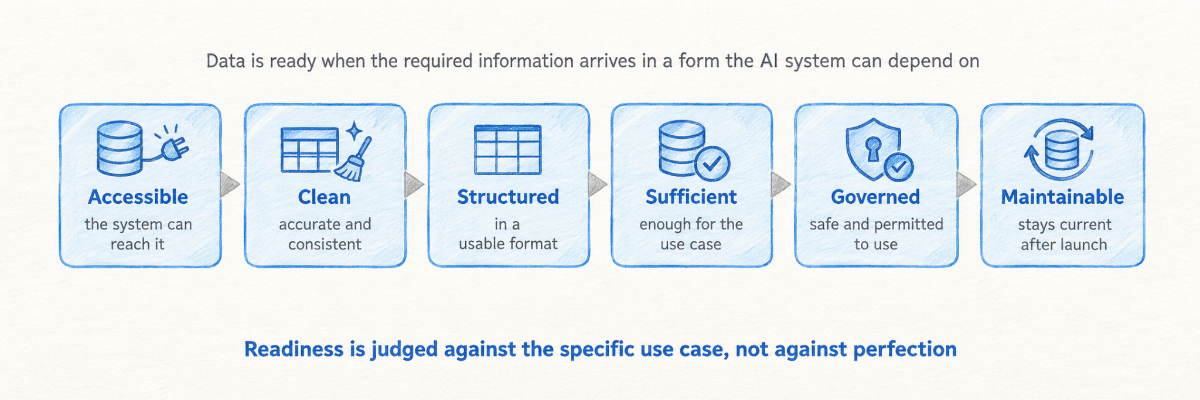
Data is ready for an AI use case when the organization can supply the required information in a form the system can depend on, as Figure 1 summarizes:
Accessible, relevant, and sufficient for the use case
Consistent, and accurate enough for the intended purpose
Structured appropriately, governed appropriately, and maintainable over time
Figure 1. What Data Readiness Looks Like
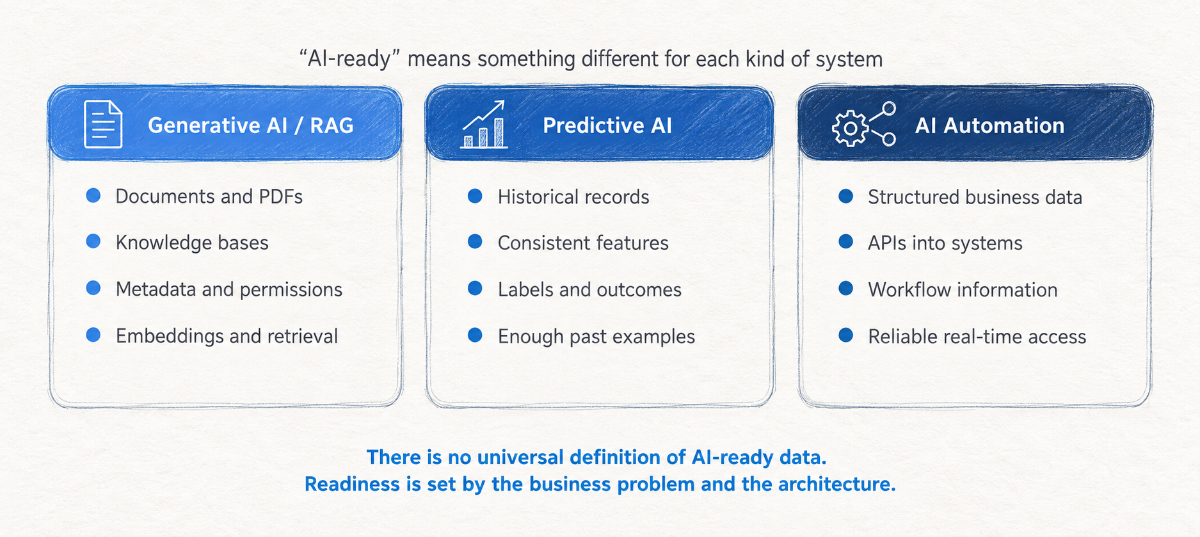
Note the phrase accurate enough. Readiness is always judged against the intended use: a marketing recommendation tolerates imperfections that a compliance workflow cannot. What readiness requires also differs by the kind of AI being built.
Generative AI and RAG
Documents, PDFs, and knowledge bases, plus metadata, permissions, embeddings, and retrieval pipelines.
Predictive AI
Historical records, consistent features, labels and outcomes, and enough past examples to learn from.
AI Automation
Structured business data, APIs into existing systems, workflow information, and reliable real-time access.
There is no universal definition of AI-ready data. Readiness is determined by the specific business problem and AI architecture, which is what keeps this from being a generic data-quality question. Figure 2 puts the three profiles side by side.
Figure 2. Different AI Systems, Different Data Requirements
Why Data Readiness Has a Direct Impact on AI Project Costs
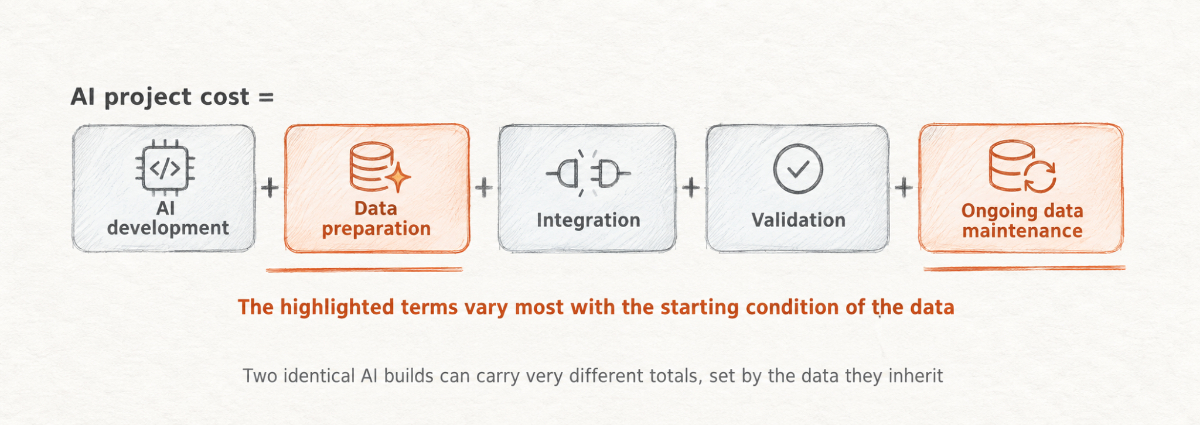
The connection to money is direct: AI project cost equals AI development plus data preparation plus integration plus validation plus ongoing data maintenance. The data terms vary dramatically with the starting condition of the data, as Figure 3 highlights. On an unready-data project, engineers spend paid time on:
Finding data and getting access to it
Cleaning, transforming, and connecting systems
Resolving inconsistencies and creating missing metadata and labels
Validating that the results can be trusted
Figure 3. Where Data Sits in the AI Budget
The baseline waste is already large before AI enters the picture: Gartner estimates that poor data quality costs organizations an average of $12.9 million per year.
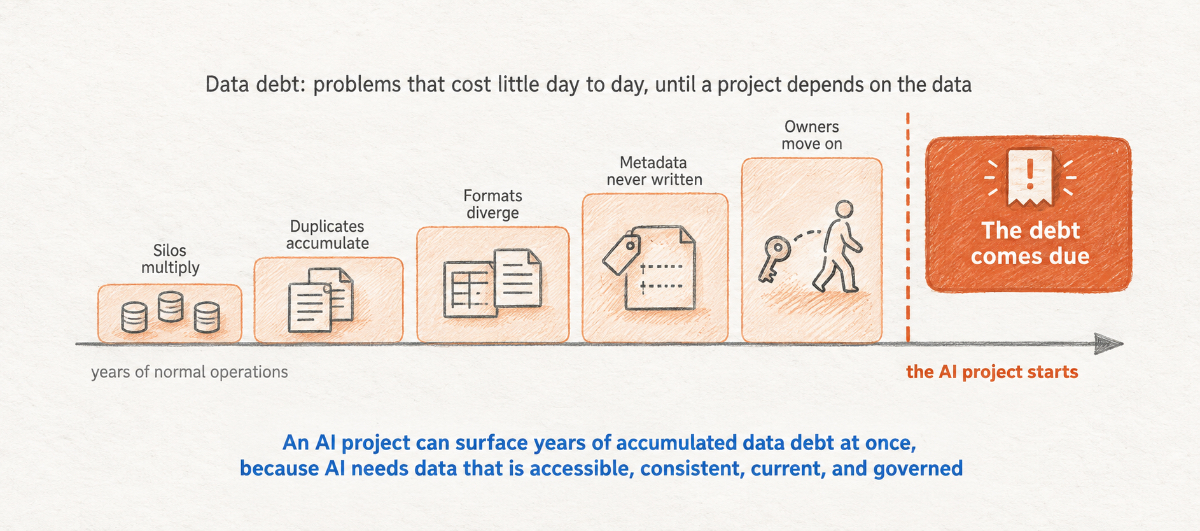
The useful concept here is data debt. Like technical debt, it is the accumulation of unresolved problems in the data environment, and it can build for years without being felt, because day-to-day operations route around it.
An AI project surfaces it all at once, because AI needs data that is accessible, consistent, current, and governed. As a working rule, not an absolute one: every unresolved data problem tends to become an engineering problem once an AI project depends on that data. Figure 4 shows the moment the debt comes due.
Figure 4. Data Debt Comes Due When AI Arrives
7 Ways Poor Data Readiness Increases AI Project Costs
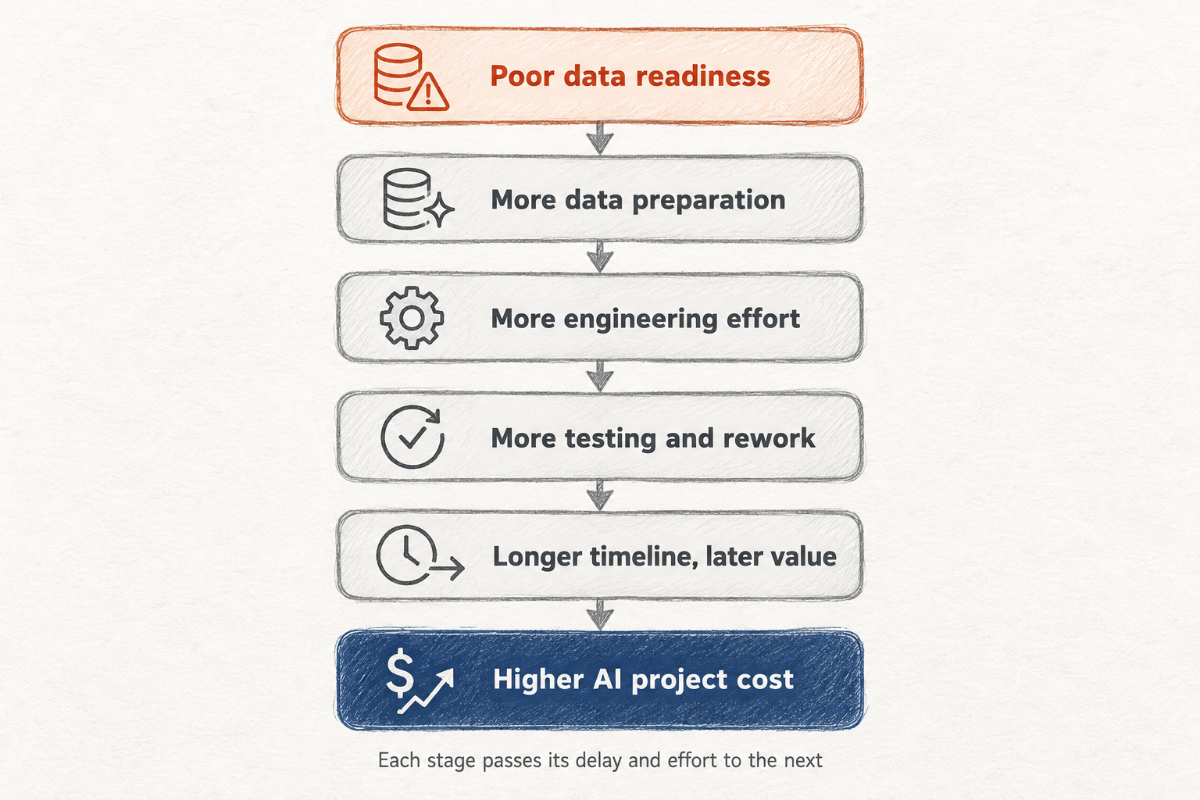
The cascade in Figure 5 is the summary version: poor readiness becomes preparation, engineering, rework, and delay. The seven drivers below are where it actually happens.
Figure 5. How Data Problems Increase AI Costs
1. Data Discovery and Access Take Longer Than Expected
Companies often know they have the data without knowing where it lives, who owns it, whether it can be accessed, which version is authoritative, or how often it changes. The reality is usually a spread across CRM and ERP systems, databases, shared drives, spreadsheets, PDFs, and third-party tools, each with its own owner and its own rules, and mapping that spread is work in itself.
Cost implication: paid engineering time goes to locating data and negotiating access to it rather than building the AI application itself, and none of that work is visible in the demo.
2. Cleaning and Standardizing Data Adds Engineering Work
Common issues include duplicate records, missing fields, different naming conventions, inconsistent formats, incorrect values, conflicting records, and outdated information. Customer information might exist in three systems under different identifiers and formats; before an AI application can use it reliably, those systems may need to be reconciled, and the pipeline needs transformation and validation steps to match.
Cost implication: more data engineering, more testing, and a longer implementation, with each unreconciled source multiplying the cases the pipeline must handle.
3. Unstructured Data Requires Additional Processing
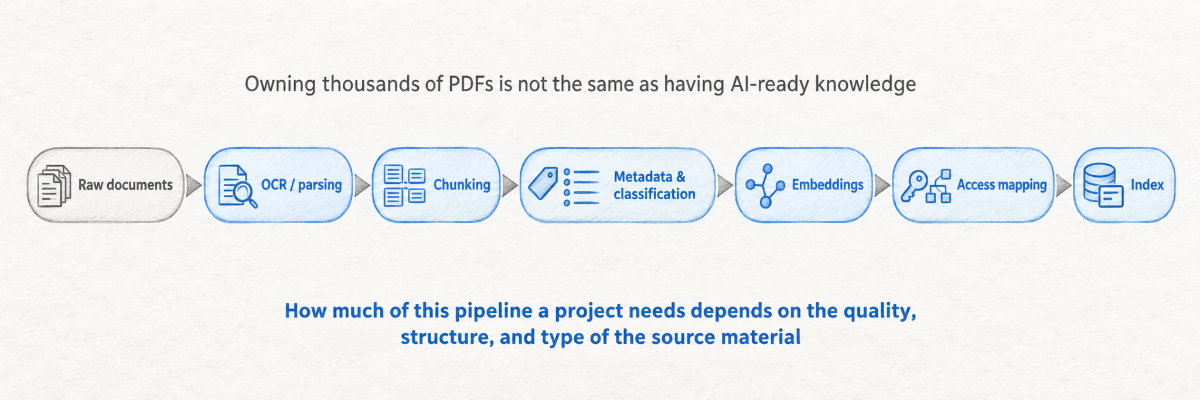
Especially relevant for LLM and RAG applications: a company may hold thousands of documents, but having PDFs is not the same as having AI-ready knowledge.
Depending on the source material, the work can include OCR, parsing, chunking, metadata extraction, document classification, embedding generation, access-control mapping, and indexing, as Figure 6 traces. Not every RAG system needs all of it; the amount of processing depends on the quality, structure, and type of the sources.
Cost implication: each processing stage is engineering effort the budget must carry before the AI produces value.
Figure 6. From Documents to AI-Ready Knowledge
4. Missing Labels and Historical Data Can Increase AI Development Costs
Predictive and classification systems need historical examples and labels. When those don’t exist, teams may need manual labeling, annotation, domain-expert review, dataset creation, or additional data collection.
Labeling is not purely technical work: human experts often have to decide what a correct classification even is before anyone can apply it at scale.
Cost implication: the real cost is not labeling software; it is the human time required to create a dataset the model can be trusted to learn from, and expert hours are usually the scarcest resource on the project.
5. Poor Data Quality Creates More Testing and Rework
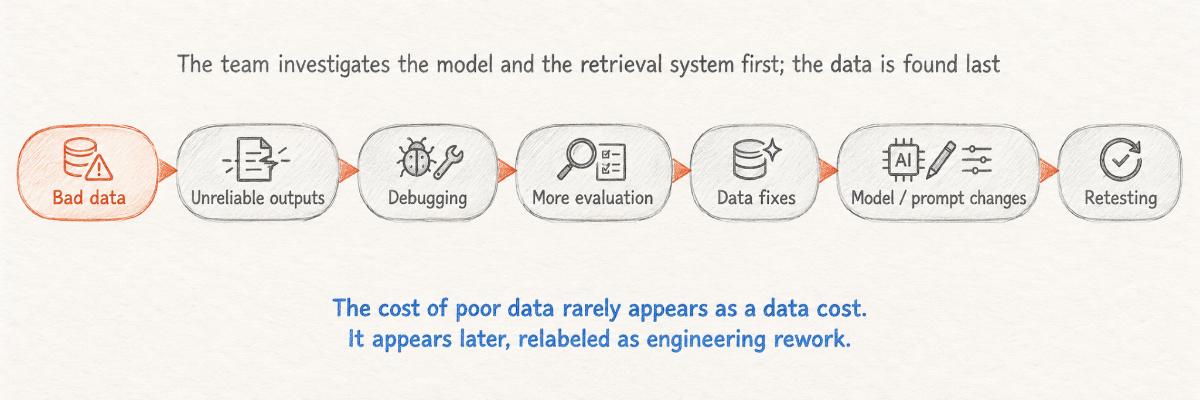
Data problems propagate. Bad data produces unreliable outputs, which trigger debugging, additional evaluation, data fixes, model or prompt changes, and retesting, the chain in Figure 7. If an AI assistant keeps retrieving outdated policies because the source documents were never properly versioned, engineers typically investigate the model and the retrieval system before anyone finds the root cause in the data.
Key point: the cost of poor data isn’t always visible as a data cost. It surfaces later, relabeled as engineering rework, which is exactly why it escapes the original estimate.
Figure 7. How Bad Data Becomes Engineering Rework
6. Data Governance and Security Add Cost When Addressed Late
Readiness also means the data can be used safely: sensitive information identified, access permissions and ownership settled, retention and auditability defined, regulatory requirements met, and role-based access in place.
A dataset can be technically available yet still not ready, because nobody can say who should access it or how it may be used.
Cost implication: governance discovered late forces architecture changes, additional controls, security reviews, rework, and delayed deployment, all at post-design prices. The point is budget impact, not regulation for its own sake.
7. Data Maintenance Becomes an Ongoing Cost
Preparation is not a one-time expense. After going live, new documents arrive, records change and get corrected, business processes evolve, schemas shift, and new sources appear.
RAG systems need new material processed, indexed, and made retrievable; predictive systems need pipelines that keep collecting and validating fresh observations.
Key message: data readiness is not a milestone to pass once. It is an ongoing requirement for keeping the AI system useful, and it belongs in the operating budget from day one rather than arriving as a post-launch discovery.
How to Estimate the Cost of Getting Data AI-Ready
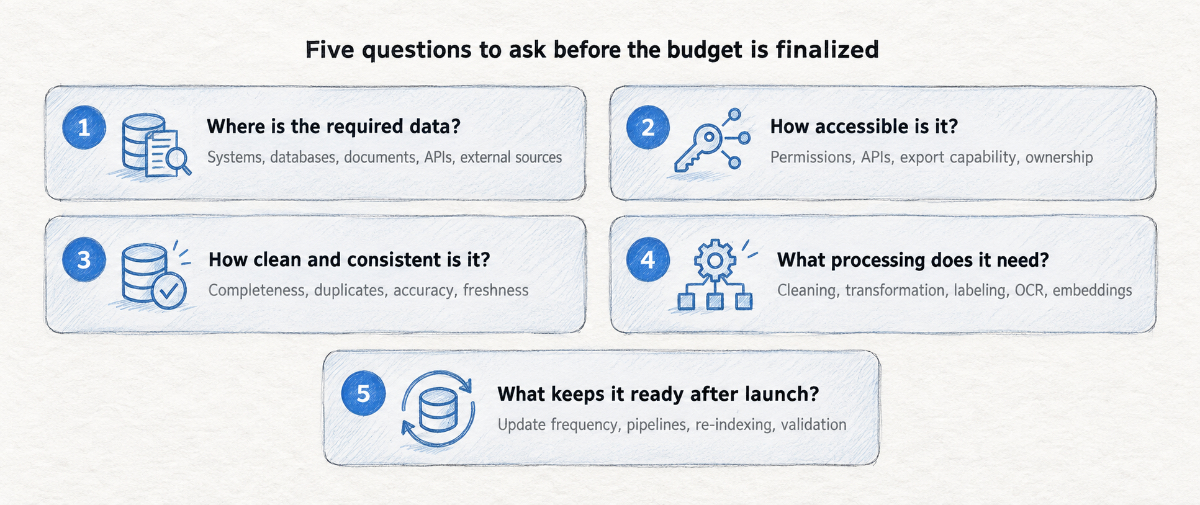
The data component of an AI project can be estimated before development begins by answering five questions, laid out in Figure 8.
Figure 8. Five Questions Before the Budget Is Final
1. Where Is the Required Data?
Map the systems, databases, documents, APIs, and external sources involved. A source nobody can name is a source nobody has priced.
2. How Accessible Is It?
Determine permissions, available APIs, export capability, and who owns each source. Access that requires negotiation takes calendar time as well as engineering time.
3. How Clean and Consistent Is It?
Assess completeness, duplicates, accuracy, consistency, and freshness against what the use case actually needs.
4. What Processing Is Required?
Estimate the cleaning, transformation, labeling, OCR, chunking, metadata, and embedding work between the raw sources and a usable input.
5. What Will It Take to Keep the Data Ready?
Consider update frequency, monitoring, data pipelines, re-indexing, and ongoing validation, priced as recurring effort rather than setup.
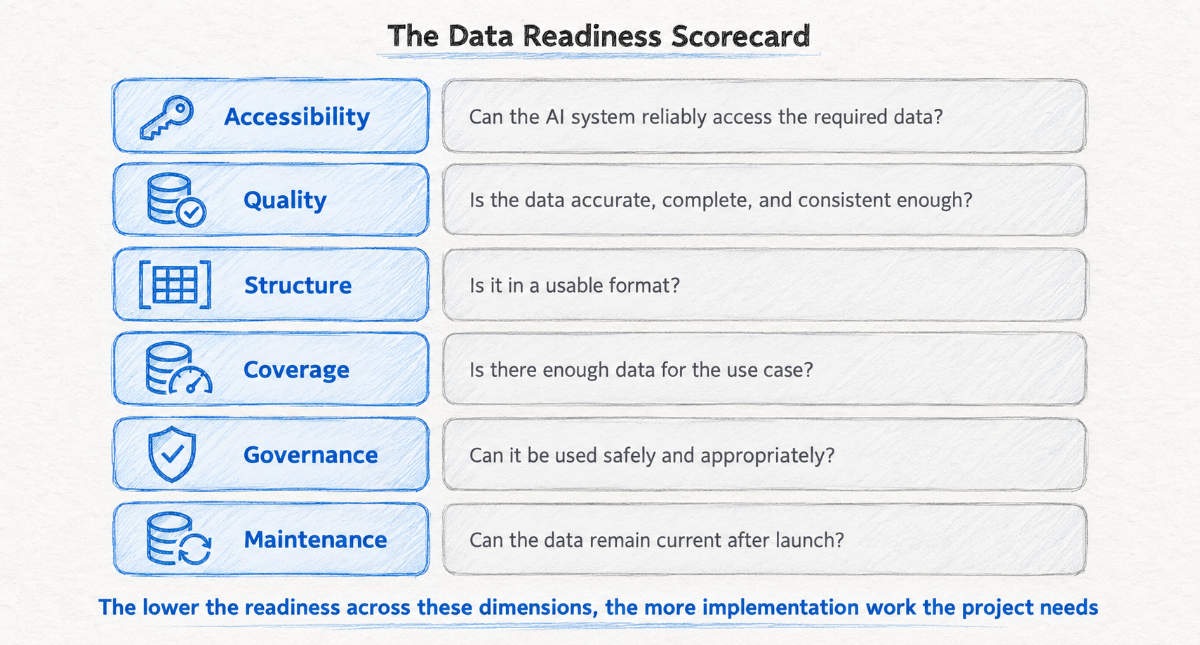
The answers roll up into the Data Readiness Scorecard in Figure 9: six dimensions, each a plain question a team can answer honestly in an afternoon. The lower the readiness across these dimensions, the more implementation work the project is likely to require. Resist assigning numerical scores unless there is a defensible methodology behind them; the scorecard’s job is to expose work, not to produce a number.
Figure 9. The Data Readiness Scorecard
How to Improve Data Readiness Before AI Development
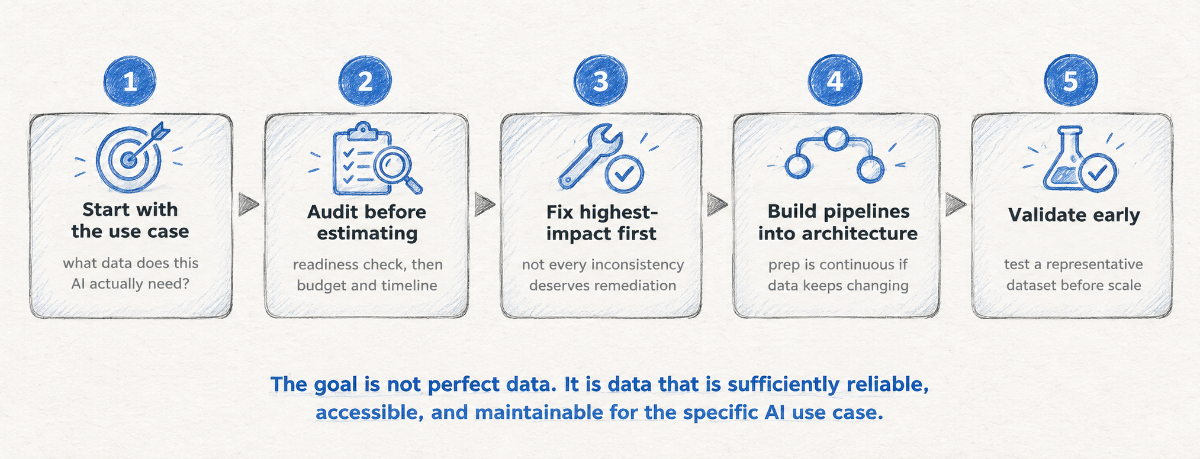
Diagnosis becomes action in a five-step sequence, shown in Figure 10.
Start With the AI Use Case
Don’t clean every piece of company data. Determine first what this specific AI application actually needs, which prevents unnecessary data-preparation spending on sources the system will never touch.
Audit the Data Before Estimating the Project
Run a lightweight readiness assessment before finalizing budget, timeline, architecture, or staffing, so the estimate reflects the data as it is.
Fix the Highest-Impact Data Problems First
Prioritize data problems by their impact on the use case. Not every inconsistency deserves immediate remediation, and many never will.
Build Data Pipelines Into the Architecture
If the system will keep consuming changing data, preparation is a continuous function of the architecture, not a one-time project phase.
Validate With a Representative Dataset Early
Before full-scale implementation, test whether the available data can actually support the desired AI behavior, while changing course is still cheap.
The goal isn’t to make all company data perfect. It is to make the data required for the AI use case sufficiently reliable, accessible, and maintainable.
Figure 10. Improving Readiness Before Development Begins
Access Specialized AI and Data Engineering Talent
Data readiness usually takes a mix of AI, data, and software engineering expertise, and organizations don’t need to build all of those capabilities internally before starting an AI project.
Omdena’s talent network provides data engineers, AI/ML engineers, LLM and RAG engineers, MLOps engineers, and software engineers for specific data and implementation requirements.
This allows teams to address the work described in this article without every specialization becoming a permanent headcount.
Conclusion
Before asking how much it will cost to build an AI system, ask how ready the data is to support it. That answer shapes development effort, project timelines, engineering rework, testing, governance, maintenance, and ultimately time-to-value, often more than the choice of model does.
None of this means spending months perfecting data before experimenting. The goal is not perfect data; it is understanding the data work the specific use case requires and putting that work in the budget from the beginning, where it is a plan rather than a surprise.
Omdena combines AI and data engineering expertise with tools such as Umaku to help organizations move from AI concepts toward production-ready systems with greater visibility into the work involved.
FAQ
What does data readiness mean for an AI project?
Data readiness means the required information is accessible, relevant, sufficient, consistent, accurate enough for the intended use, appropriately structured and governed, and maintainable over time.
How does poor data readiness increase AI project costs?
It adds work such as locating and accessing data, cleaning inconsistent records, integrating systems, creating labels and metadata, validating outputs, and fixing data-related problems that appear later as engineering rework.
Do different types of AI systems have different data requirements?
Yes. Generative AI and RAG rely on well-organized documents, metadata, permissions, and retrieval pipelines. Predictive AI needs historical examples, features, labels, and outcomes, while AI automation requires structured business data, system integrations, workflow information, and reliable access.
How can an organization estimate the cost of making its data AI-ready?
It should determine where the required data resides, how accessible and reliable it is, how much processing it needs, and what ongoing work will be required to keep it current, validated, and usable.
Does all company data need to be perfected before AI development begins?
No. The organization should focus on the data required for the specific AI use case, fix the highest-impact problems first, and validate a representative dataset early. The goal is sufficiently reliable, accessible, and maintainable data—not perfect data.
Continue with Omdena
Share this article
Share on LinkedIn, send by email, or copy the direct link.