How to Build Production-Ready AI Agents (2026 Guide)
19 min read
Prince OkonSenior Data Scientist
Here is an uncomfortable truth about the AI agent boom: almost every company can build an AI agent today, but very few can deploy one successfully into production.
According to Gartner, roughly 89% of AI agent pilots never reach production, while more than 40% of agentic AI projects are expected to be canceled by 2027 because of rising costs, unclear ROI, and governance challenges. Successful demos often fail when they encounter real-world requirements such as reliable tool execution, security, monitoring, scalability, and operational oversight.
These are not model limitations—they are engineering challenges. Building an AI agent has become relatively accessible; building one that is reliable, secure, scalable, and maintainable requires production-grade engineering practices. This guide explains what it takes to close that gap. You’ll learn the core principles behind production-ready AI agents, the engineering lifecycle used to build them, the technology stack that supports them, the mistakes that cause most deployments to fail, and how Omdena and Umaku help organizations move AI from promising prototypes to production systems that deliver lasting business value.
What Are Production-Ready AI Agents?
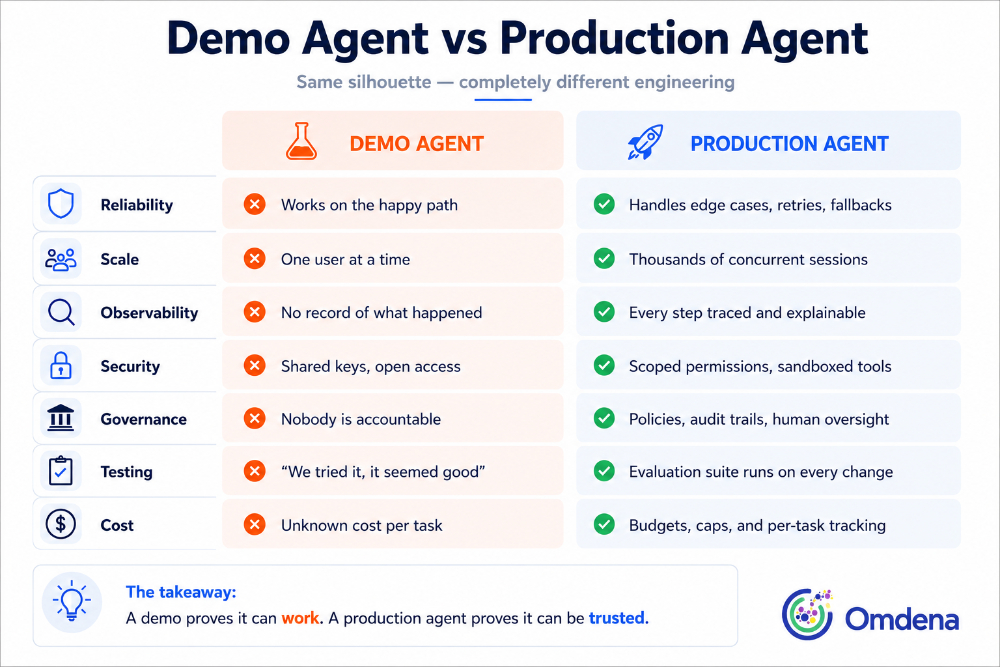
A demo agent works on the happy path, for the ten examples its builder tested, at an unknown cost, with no record of what it did or why. A production-ready AI agent behaves like production software: reliable (handles edge cases and tool failures with retries and fallbacks), scalable (supports thousands of concurrent users while keeping latency and costs predictable), observable (every decision and tool call can be traced), secure (scoped permissions and sandboxed execution), governed (policies, audit trails, and human oversight), testable (evaluated before every release), and maintainable (versioned prompts, tools, and models).
Figure 1 — Demo agent vs production agent
If a demo agent is a concept car, a production agent is the vehicle that passes crash testing and ships with diagnostics. The destination may be the same, but the engineering behind it is fundamentally different. Building an agent with these qualities isn’t a single task or a better prompt—it is an engineering process. From defining the right problem to designing architecture, connecting tools, evaluating performance, and operating the system after deployment, every stage contributes to whether an agent succeeds in production. That’s why successful teams think in terms of a lifecycle rather than a one-time build.
The Production AI Agent Lifecycle
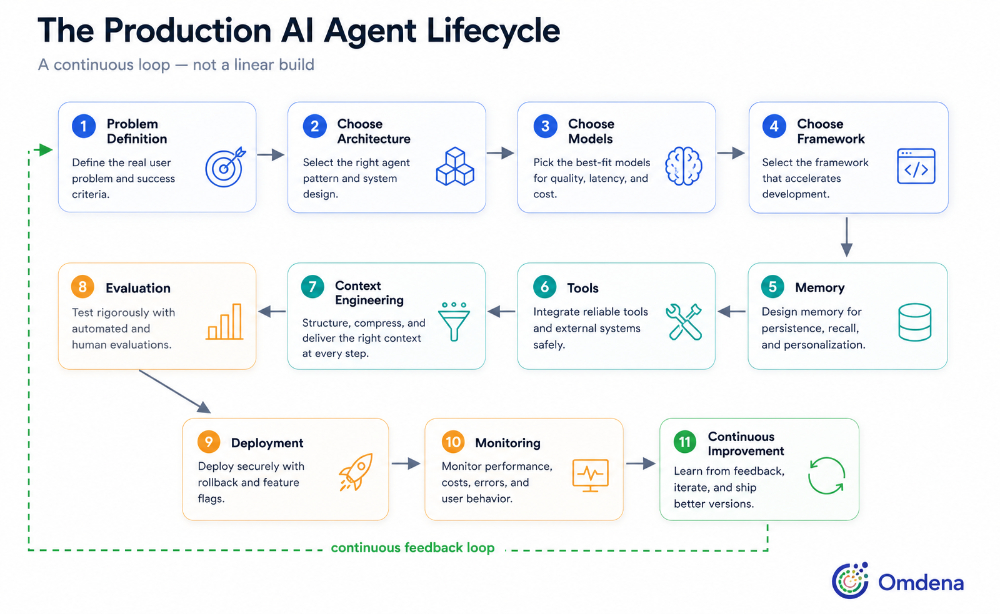
Production-ready AI agents are built through a continuous lifecycle, not a linear checklist. Teams move from problem definition to architecture, memory, tools, context engineering, evaluation, deployment, and monitoring, while continuously feeding production insights back into the next iteration. Each stage reinforces the next, creating a system that becomes more reliable and capable over time.
Figure 2 — The production AI agent lifecycle
One detail worth noticing is where prompt engineering sits in this process. Writing prompts is only one activity within a much larger engineering lifecycle. The sections that follow explore each stage of that lifecycle—and show where production success is truly won or lost.
Step 1. Define the Right Use Case
OpenAI and Anthropic both emphasize measurable, bounded agent tasks. Not every workflow should become an agent. Agents earn their complexity when work is repetitive, reasoning-based, tool-using, and multi-step. Deterministic, rule-based workflows should stay normal software. Proven fits: customer support, code review, research, document processing, and internal copilots. One filter before committing: can you define “done correctly” precisely enough to measure it? If not, you cannot evaluate the agent — and an agent you cannot evaluate is an agent you cannot ship.
Step 2. Choose How You’ll Build
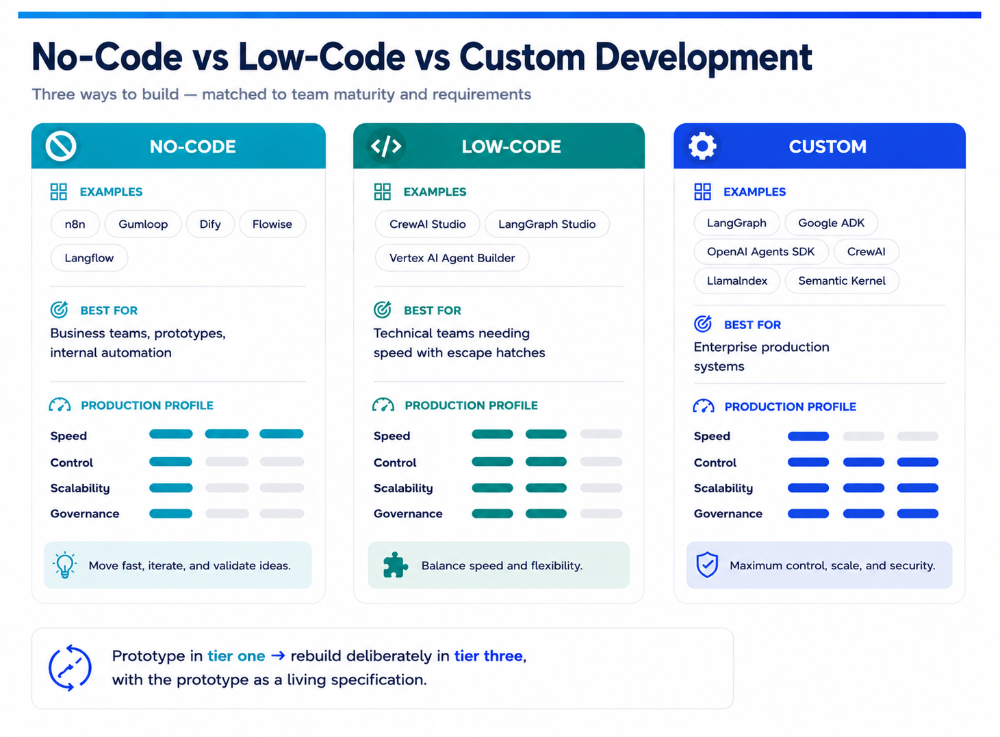
No-code platforms (n8n, Gumloop, Dify, Flowise, Langflow) suit business teams, rapid prototypes, and internal automation — fastest time to value, but limited control, shallow observability, and hard limits on scale and governance.
Custom development on agent frameworks — LangGraph (explicit graphs, checkpointing, the most battle-tested), CrewAI (role-based crews, gentlest learning curve), OpenAI Agents SDK (clean API, built-in tracing and guardrails), Google ADK (hierarchical agents; first-class MCP and A2A support), plus LlamaIndex and Semantic Kernel — is where enterprise production systems live, because it is the only tier with full control over reliability, security, and integration.
Figure 3 — No-code vs low-code vs custom development
The heuristic: prototype in tier one, ship in tier three — deliberately, with the prototype as a living specification.
Step 3. Design the Production Architecture
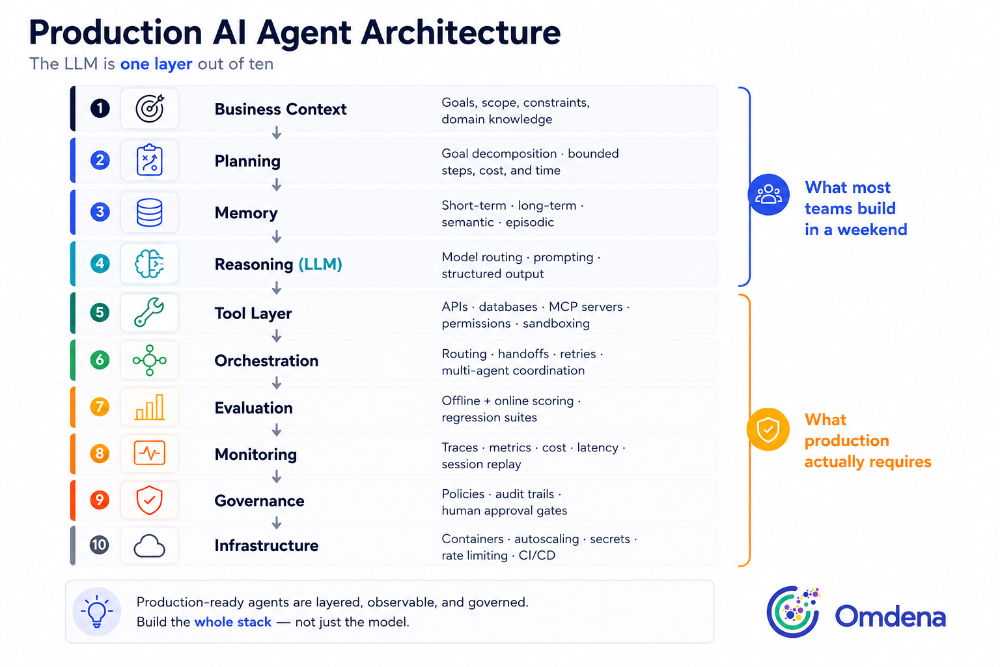
A demo agent is a prompt with tools attached. A production agent is a layered architecture in which the LLM is one component among ten: business context (what the agent is for), planning (bounded, validated decomposition), memory, reasoning (the LLM, with model routing), the tool layer, orchestration (routing, handoffs, retries, multi-agent coordination), evaluation, monitoring, governance (policies, audit trails, human approval gates), and infrastructure.
Figure 4 — Production AI agent architecture
When a team “builds an agent in a weekend,” they build the reasoning layer. The other nine are the difference between a prototype and a product. And on multi-agent architecture: start with one agent; split only when a single agent measurably fails at the combined task.
Step 4. Build the Right Memory Strategy
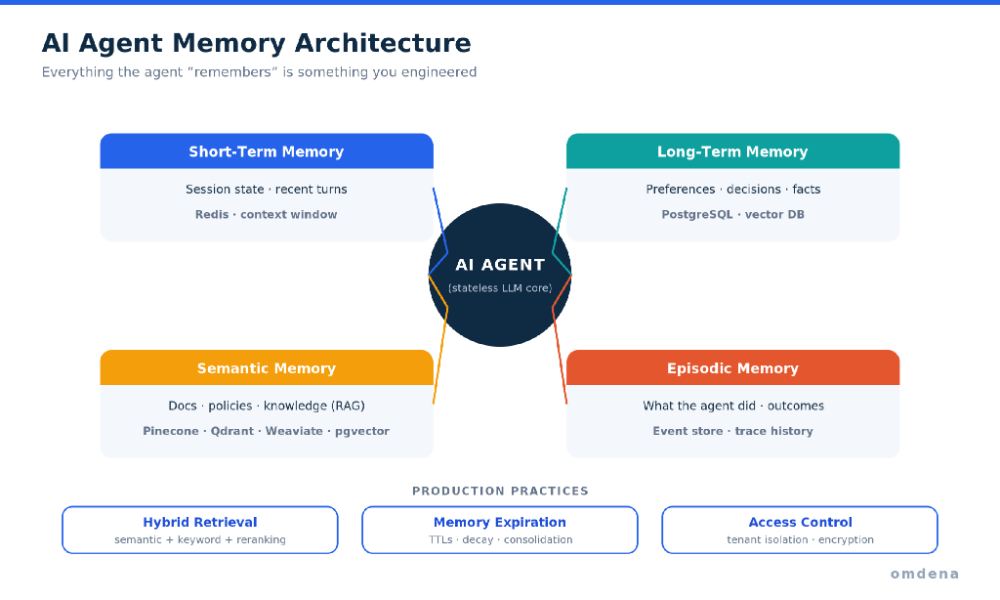
LLMs are stateless; agents must not be. Production memory has four kinds: short-term (session state — Redis, the context window), long-term (preferences and decisions — PostgreSQL, vector stores), semantic (knowledge for RAG — Pinecone, Qdrant, Weaviate, or pgvector), and episodic (what the agent did and how it turned out).
Figure 5 — AI agent memory architecture
Anthropic‘s contextual retrieval work reinforces the same principle: Three practices make memory production-grade: hybrid retrieval (semantic + keyword + reranking, via LlamaIndex or Haystack), memory expiration (TTLs and consolidation — stale facts are worse than no facts), and access control (memory is data; a leak between users is a privacy incident).
Step 5. Connect Tools Safely
Tools turn a model into an agent — and every tool is an attack surface, a failure mode, and a cost center. Treat the agent as an untrusted user of your systems.
Anthropic introduced MCP, and the Linux Foundation now hosts A2A. Two open protocols now anchor this layer: Model Context Protocol (MCP) standardizes agent-to-tool connections and has become the dominant standard across Anthropic, OpenAI, Google, and Microsoft ecosystems; Agent2Agent (A2A), now under the Linux Foundation with 150+ supporting organizations, standardizes agent-to-agent collaboration. MCP is how an agent uses its hands; A2A is how two agents shake them.
NIST’s AI Risk Management Framework and OWASP’s GenAI guidance reinforce this control-first approach. Around every tool call: authentication with the agent’s own scoped identity (never shared admin credentials), permission boundaries (read-only means read-only), sandboxing for anything executed (prompt injection makes this non-negotiable), and resilience — retries with backoff, circuit breakers, and fallbacks. The worst outcome is not an error; it is an agent silently proceeding on missing data.
Step 6. Engineer Context, Not Just Prompts
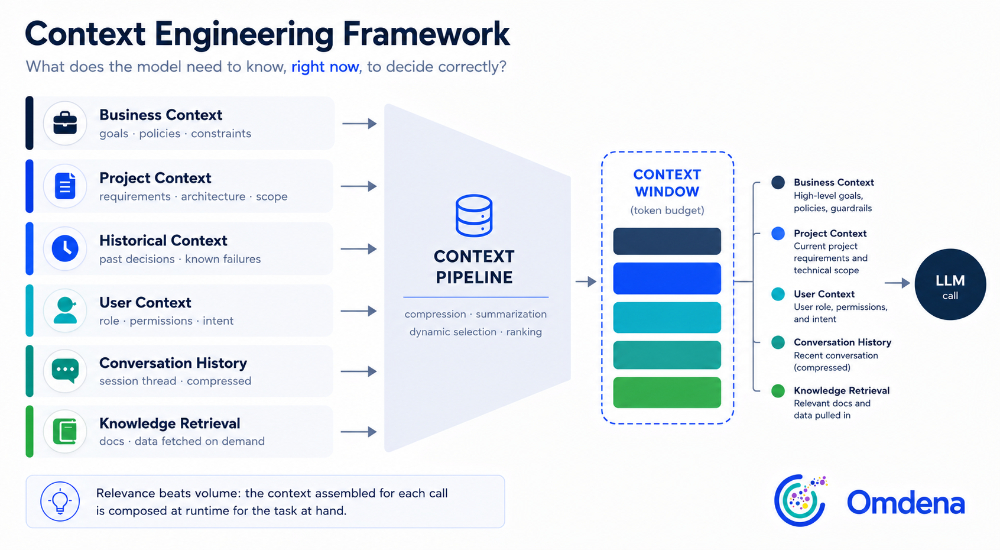
The defining shift in production practice: prompt engineering asks how do I phrase instructions? Context engineering asks what does the model need to know, right now, to decide correctly? It treats the context window as a budget, allocated deliberately on every call from six sources: business context, project context, historical context, user context, conversation history, and retrieved knowledge.
Figure 6 — Context engineering framework
Anthropic notes that retrieval quality improves when systems combine relevant context with efficient retrieval. Two techniques make it work: context compression (rolling summaries, key-fact extraction) and dynamic context selection (compose context at runtime for the task — the relevant ticket and module notes, not the entire wiki). The payoff: fewer hallucinations, lower token costs, and outputs aligned with business intent. Relevance beats volume, every time.
Step 7. Evaluate Your AI Agent
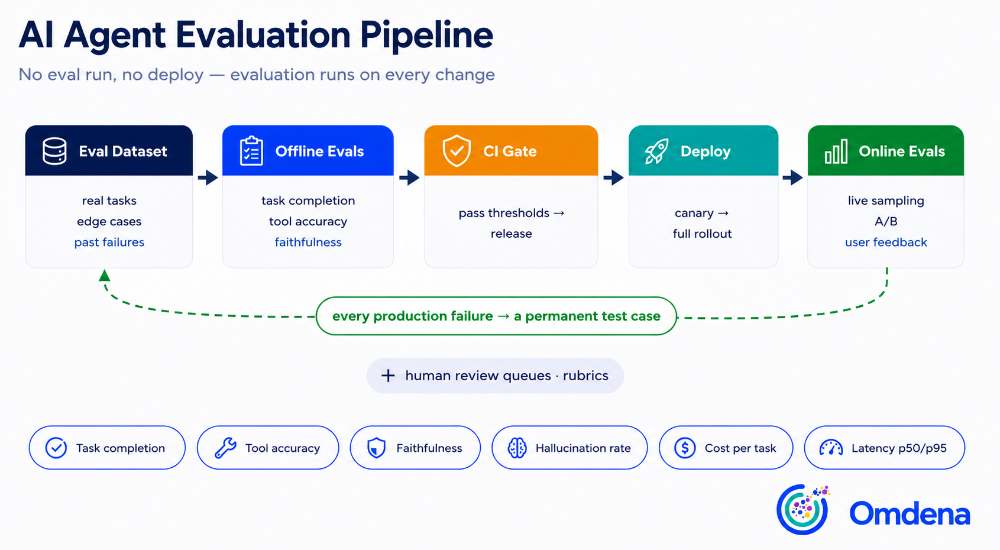
OpenAI and Anthropic both recommend evaluating agents with task-specific tests rather than relying on demos alone. “We tried it and it seemed good” is the de facto QA process for most agent pilots — and a large part of why so few survive. Production teams layer their evaluation: offline evaluation (curated test sets in CI — no eval run, no deploy), online evaluation (sampled scoring and A/B tests in production), trajectory evaluation (did it call the right tools, in a sensible order?), human evaluation (expert rubrics that calibrate automated judges), regression testing (every fixed bug becomes a permanent test case), and benchmarking on your workload, not public leaderboards.
Measure task completion, tool accuracy, faithfulness, hallucination rate, cost per task, and latency (p50/p95). Tools: DeepEval, LangSmith, OpenEvals.
Figure 7 — AI agent evaluation pipeline
Step 8. Add Production Observability
OpenTelemetry‘s guidance makes tracing especially useful here. When an agent misbehaves, the first question is what actually happened? Agent observability answers it with structured logging, tracing (the full execution tree — every model call, tool invocation, retry, token, and millisecond, ideally on OpenTelemetry), telemetry dashboards, cost and token monitoring (with alerts and hard caps — a misconfigured loop can burn thousands of dollars), latency per step, error analysis (clustering failures into fixable patterns), and session replay.
Strong 2026 options: Langfuse (open-source, self-hostable), LangSmith (deepest LangGraph integration), Arize Phoenix (50+ built-in eval metrics), MLflow, and Helicone. Instrument from day one — teams that add observability after launch spend their first production month blind.
Step 9. Deploy Securely
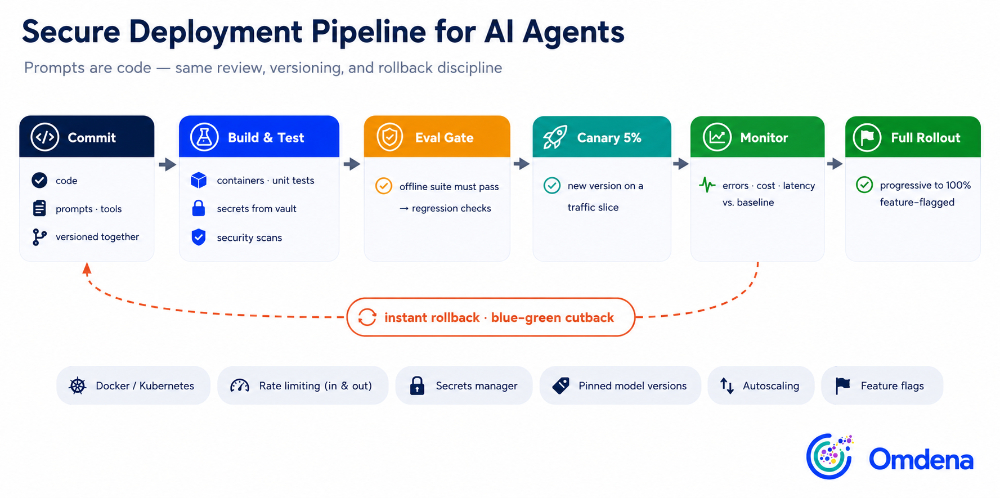
NIST’s AI Risk Management Framework treats governance as a lifecycle discipline. At deployment time, agents are software, and software discipline applies — with one addition: prompts are code. Version code, prompts, model IDs (pinned snapshots), and tool definitions together; run every change through CI/CD with evaluation gates; ship with canary deployments, blue-green environments, and feature flags; enforce rate limiting in both directions; keep secrets in a secrets manager; and run it all on Docker/Kubernetes or managed platforms like Vertex AI and Azure AI Foundry, with rollback measured in minutes.
Figure 8 — Secure deployment pipeline
Step 10. Continuously Improve
OpenAI and Anthropic both treat agent improvement as an iterative release process. Launch is the midpoint. Close the loop with feedback capture (ratings, escalations, outcomes), standing human review queues, failure analysis triaged to the responsible layer, prompt and knowledge updates validated against the eval suite, model upgrades treated as full releases (benchmark, canary, then promote — never swap on a launch announcement), and a growing evaluation pipeline where every novel failure becomes a permanent test.
Recommended Tool Stack
By this point, we’ve explored the engineering lifecycle required to build production-ready AI agents—from defining the right use case through architecture, memory, tool integration, evaluation, deployment, and continuous improvement. Those practices describe what needs to happen.
The next question is equally important: what technologies make those practices possible in production?
There is no single “best” technology stack. The right choice depends on your requirements, existing infrastructure, and engineering maturity. However, successful production AI systems consistently adopt proven infrastructure, open standards, and tools that improve reliability, observability, security, and maintainability.
The following stack maps the production practices discussed throughout this guide to the technologies most commonly used to implement them.
This solves the reviewer’s concern because it:
Connects the lifecycle (“what”) to the technology stack (“how”).
Creates a natural narrative progression instead of an abrupt topic switch.
Sets reader expectations before introducing the stack.
Removes the feeling that the tool stack was inserted as a standalone section.
I think this is a cleaner transition than simply adding one or two linking sentences, and it fits the tone used throughout the rest of the article.
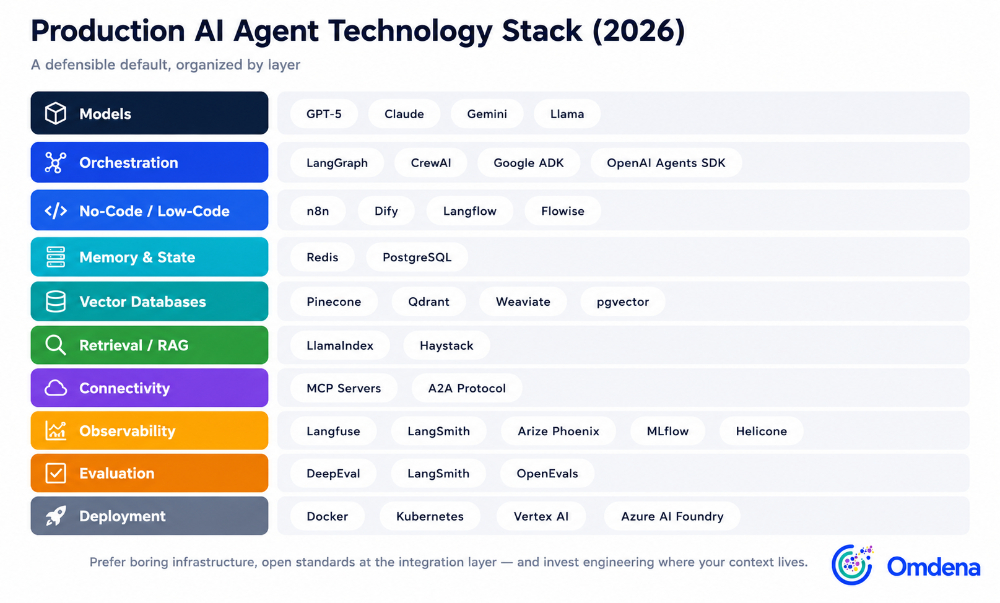
Three assembly principles: prefer boring infrastructure (PostgreSQL + pgvector over another new system), prefer open standards at the integration layer (MCP, OpenTelemetry), and buy observability but build context — your context and eval datasets encode proprietary knowledge, and that is where investment compounds.
Figure 9 — Production AI agent technology stack (2026)
Production AI Agent Technology Stack
Large Language Models (LLMs) – The reasoning engine behind the agent, powering planning, decision-making, and natural language understanding (e.g., GPT, Claude, Gemini, Llama).
Agent Frameworks – Orchestrate agent workflows, tool execution, memory, and multi-agent coordination using frameworks such as LangGraph, CrewAI, OpenAI Agents SDK, and Google ADK.
Context Engineering & Retrieval – Deliver relevant business, user, and project context using RAG pipelines, vector databases, hybrid search, and context compression techniques.
Tool Integration – Connect agents securely to APIs, databases, enterprise systems, and external services through standards like MCP (Model Context Protocol) and A2A (Agent2Agent).
Evaluation & Testing – Continuously measure task success, faithfulness, hallucinations, tool usage, latency, and regressions using platforms like DeepEval, LangSmith, and OpenEvals.
Deployment & Infrastructure – Package and deploy production agents with Docker, Kubernetes, Vertex AI, Azure AI Foundry, CI/CD pipelines, feature flags, and rollback strategies.
Security & Governance – Protect production systems through scoped permissions, secrets management, sandboxed execution, audit trails, human approval workflows, and policy enforcement.
Continuous Improvement – Improve agents over time through user feedback, failure analysis, prompt optimization, knowledge updates, model benchmarking, and continuous evaluation.
Choosing the right technologies is important, but technology alone does not determine success. Many production AI projects fail despite using state-of-the-art models and frameworks because the underlying engineering practices are missing. Understanding these recurring pitfalls is just as valuable as understanding the tools themselves.
Common Mistakes Teams Make
The failure patterns behind unsuccessful AI agent deployments are remarkably consistent. Most are not caused by poor models, but by missing engineering discipline around evaluation, observability, governance, and system design. Watch out for these common pitfalls:
Skipping evaluation – Shipping agents without structured offline and online evaluation leaves teams unable to measure accuracy, reliability, hallucination rates, or business impact. Every production deployment should be gated by repeatable evaluation benchmarks.
Treating prompts as the architecture – Many teams invest heavily in prompt engineering while neglecting orchestration, memory, context management, tool integration, and governance. Prompts are only one layer of a production AI system.
Building one “mega-agent” – Giving a single agent dozens of responsibilities and tool integrations often increases latency, cost, and error rates. Start with one focused agent and split responsibilities only when there is measurable benefit.
No memory strategy – Agents that cannot retain relevant context force users to repeat information and make inconsistent decisions. Production systems need deliberate short-term, long-term, semantic, and episodic memory strategies.
Unlimited tool access – Connecting agents to enterprise systems without scoped permissions or sandboxing creates unnecessary security risks. Every tool should follow least-privilege access with clear permission boundaries.
No monitoring or observability – Without logging, tracing, cost monitoring, and session replay, teams cannot diagnose failures or optimize performance. Production agents should expose every model call, tool invocation, retry, latency, and token cost.
Ignoring failure handling – APIs fail, tools become unavailable, and external systems experience outages. Agents should implement retries, circuit breakers, fallbacks, and graceful error handling instead of silently continuing with incomplete information.
Lack of governance – Deploying autonomous agents without approval workflows, audit trails, or policy enforcement increases operational and compliance risks. Governance becomes increasingly important as agents gain access to business-critical systems.
No human-in-the-loop for high-risk decisions – Giving agents unrestricted autonomy from day one often leads to preventable mistakes. Human review should remain part of workflows involving financial transactions, legal decisions, customer commitments, or other high-impact actions.
Treating launch as the finish line – Production deployment is the beginning of the optimization cycle, not the end. Successful teams continuously collect feedback, analyze failures, improve prompts and knowledge sources, retrain when necessary, and expand their evaluation suite over time.
If you recognize your project in several of these patterns, the solution is rarely a more capable model. More often, it is investing in the missing engineering practices that transform an impressive prototype into a reliable production system. This is precisely the challenge many organizations face. They already have promising AI prototypes but need the architecture, processes, and operational discipline to deploy them successfully at scale. That’s where Omdena’s production-first approach comes in.
How Omdena Helps Organizations Build Production-Ready AI Agents
Many organizations already have a working AI proof of concept, chatbot, or agent. The challenge begins when those early experiments need to support business-critical operations with reliable integrations, governance, observability, scalability, and long-term maintenance. That transition from prototype to production is where Omdena focuses its expertise.
Omdena’s production-first approach combines three complementary capabilities that help organizations move beyond experimentation and build AI systems that deliver measurable business value.
1. Production-First AI Delivery Methodology
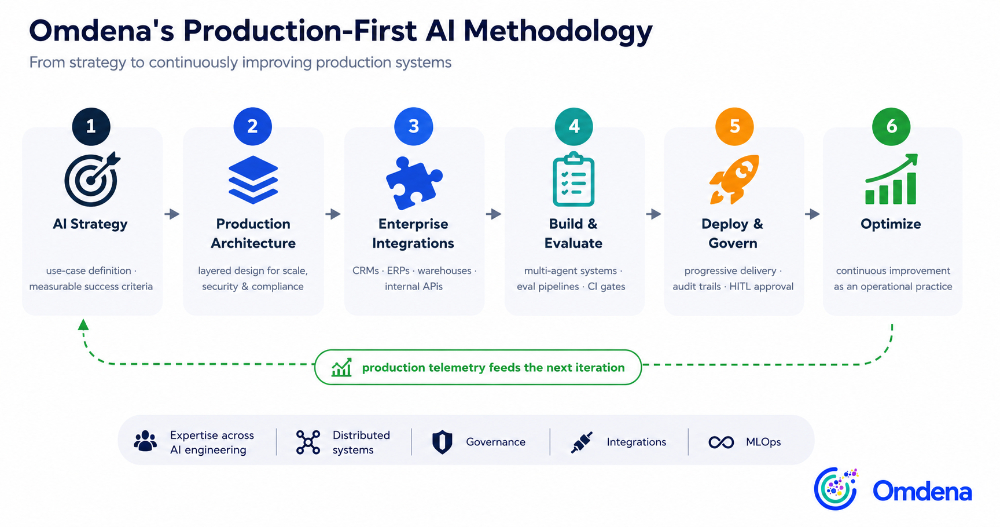
Rather than treating deployment as the final phase of an AI project, Omdena designs for production from the beginning. Every engagement follows a structured delivery methodology covering the full AI lifecycle:
AI strategy and use-case definition to align technical solutions with measurable business outcomes.
Data readiness and governance to ensure reliable, high-quality data pipelines.
Production architecture design that emphasizes scalability, resilience, and maintainability.
Continuous evaluation and testing using repeatable benchmarks before every release.
Enterprise integration with existing business systems, APIs, and operational workflows.
Deployment and MLOps practices that support monitoring, versioning, rollback, and continuous delivery.
Knowledge transfer and operational enablement so internal teams can confidently operate and evolve the system after launch.
Figure 10 — Omdena’s production-first AI methodology
This production-first methodology reduces deployment risk while ensuring AI systems remain reliable, secure, and maintainable long after they go live.
2. Umaku: Context-Aware AI Delivery Platform
Omdena complements its delivery methodology with Umaku, its proprietary agentic AI platform designed to support AI software delivery from planning through deployment.
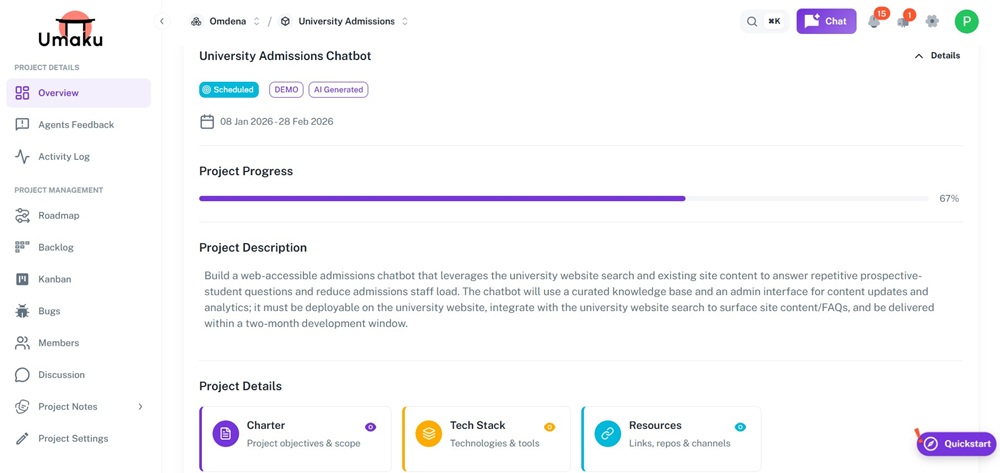
Project Overview in Umaku
Rather than acting as a standalone coding assistant, Umaku maintains project-wide context throughout the development lifecycle by bringing together:
Business goals, project charters, and success criteria.
System architecture, technical documentation, and design decisions.
GitHub repositories, APIs, tickets, sprint plans, and Kanban boards.
AI-assisted code reviews that evaluate changes against business intent rather than code alone.
Continuous analysis of sprint health, code quality, DevOps compliance, operational readiness, and potential risks.
By keeping technical, business, and project context connected, Umaku helps engineering teams reduce rework, improve collaboration, and make AI-assisted development more consistent across the entire project lifecycle.
3. Global AI Delivery Expertise
Production AI projects require expertise beyond machine learning alone. Successful deployments often involve data engineering, MLOps, software engineering, cloud infrastructure, security, governance, and domain-specific knowledge.
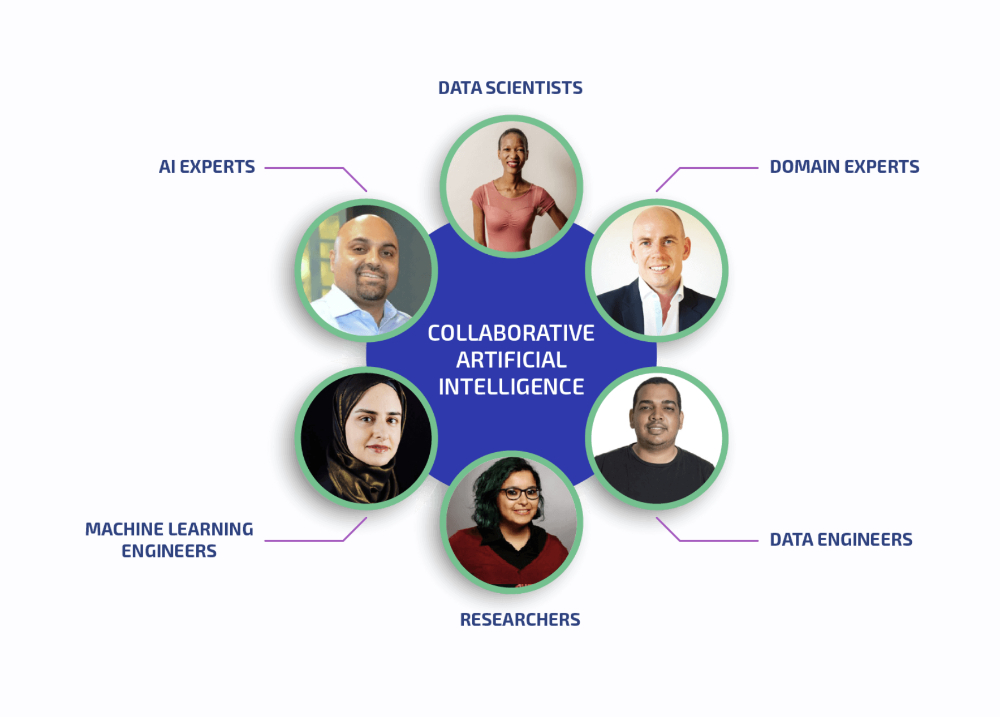
Omdena provides access to a vetted global network of AI engineers, researchers, MLOps specialists, software engineers, and domain experts who assemble around each project’s specific requirements. This enables organizations to rapidly build multidisciplinary teams without the time and cost of hiring every capability internally.
Vetted Global Talent Network
Together, Omdena’s production-first methodology, the Umaku platform,and its global AI talent network provide organizations with the people, processes, and technology needed to transform promising AI prototypes into secure, scalable, production-ready AI systems that continue delivering value long after deployment.
How Umaku Supports Production AI Development
Production-ready AI agents depend on more than code and model performance. Teams must keep business goals, architecture, project resources, implementation decisions, and delivery risks connected throughout development. Umaku provides this shared context so that AI-assisted work remains aligned with the wider project.
Connecting Business and Technical Context
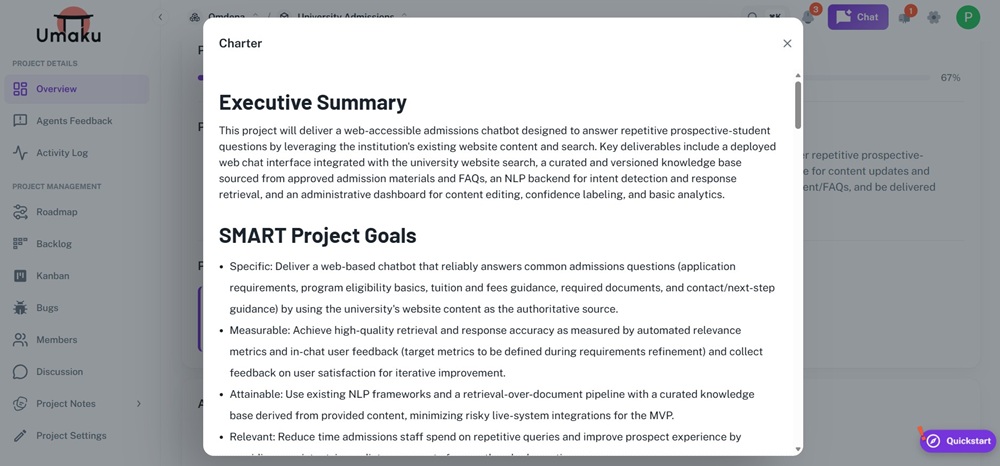
Umaku centralizes project goals, scope, success criteria, business rules, architecture decisions, frameworks, integrations, and technical constraints. This helps teams evaluate whether implementation choices support both the intended business outcome and the way the system is designed to operate.
Project Charter in Umaku
Linking Planning, Knowledge, and Implementation
Project documentation, GitHub repositories, roadmaps, sprints, tickets, and Kanban boards are brought into a shared project context. This makes it easier to trace development tasks back to their requirements, identify missing dependencies, and reduce duplicated or conflicting work.
Enabling Context-Aware Reviews and Evaluation
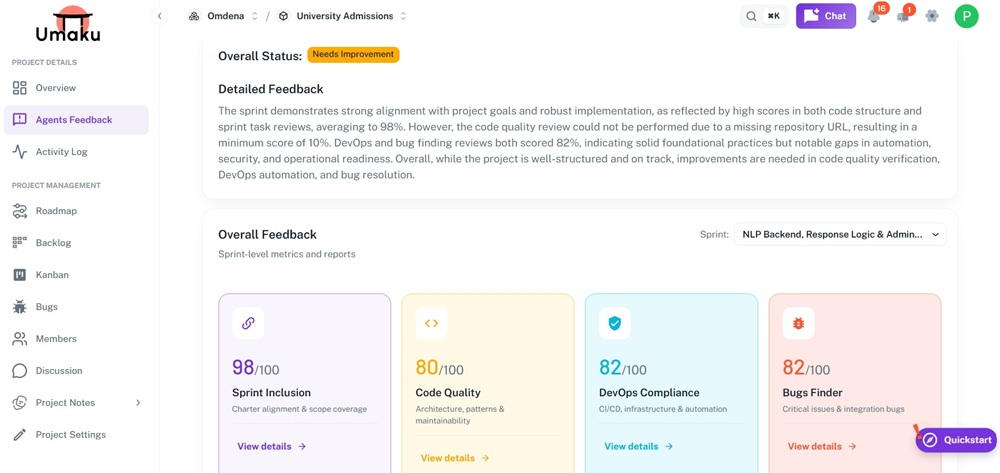
Instead of reviewing code or delivery progress in isolation, Umaku evaluates work against project goals, architecture decisions, sprint objectives, and business requirements. It also provides feedback on areas such as code quality, delivery risks, defects, DevOps practices, and operational readiness.
Agentic Feedback in Umaku
This helps teams identify implementation drift and production risks before they become expensive to correct.
Keeping Humans in the Loop
Project managers, engineers, and domain experts can validate, reject, or refine AI-generated recommendations. This preserves human accountability while allowing the system to learn from project-specific feedback and improve future evaluations.
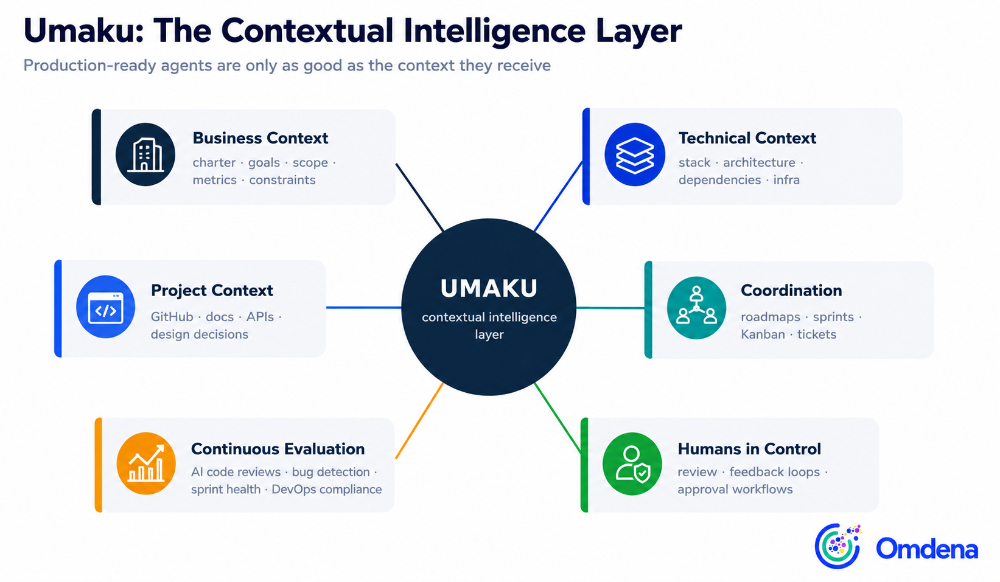
Together, these capabilities allow Umaku to function as a contextual intelligence layer across the AI delivery lifecycle. By connecting business intent, technical decisions, implementation work, evaluation, and human oversight, it helps teams build production-ready AI systems with stronger alignment, better traceability, and less avoidable rework.
Figure 11 — Umaku as the contextual intelligence layer
Umaku acts as the contextual intelligence layer supporting the entire AI delivery lifecycle — helping engineering teams build production-ready AI systems with greater consistency and less rework.
Conclusion: Treat Agents as Production Software
Building an AI agent has become accessible — which is exactly what makes the production gap so deceptive. Building a production-ready agent requires engineering discipline across architecture, context engineering, orchestration, governance, observability, testing, deployment, and continuous improvement. None of these steps is individually difficult; what is difficult is doing all of them, especially when the demo already works.
The organizations that get this right treat AI agents as production software, not experimental prompts. They define success before building, evaluate before shipping, monitor after launching, and improve continuously. They are the 11%, not the 89%.
The model is the easy part. Everything around it is the product.
FAQ
What is a production-ready AI agent?
A production-ready AI agent is an AI system designed to operate reliably in real-world environments. Unlike a prototype, it includes production-grade capabilities such as secure tool integration, memory management, observability, evaluation, governance, scalability, and continuous monitoring to ensure consistent performance over time.
Why do most AI agent projects fail to reach production?
Most AI agent projects fail because organizations focus on building a working prototype but overlook the engineering practices required for production. Common issues include poor evaluation, limited observability, weak governance, inadequate memory strategies, insecure tool integrations, and the absence of a structured deployment lifecycle.
What technologies are needed to build production-ready AI agents?
A typical production AI agent stack includes large language models (LLMs), agent frameworks, retrieval and context engineering, memory systems, secure tool integration, evaluation frameworks, observability platforms, deployment infrastructure, and governance controls. Together, these technologies support reliable, scalable, and maintainable AI systems.
What is the difference between a demo AI agent and a production AI agent?
A demo AI agent is built to showcase functionality under limited conditions. A production AI agent is engineered to handle real-world workloads with reliability, security, scalability, monitoring, governance, and continuous improvement. Production systems are designed to operate consistently, even when tools fail or conditions change.
What are the key steps for building production-ready AI agents?
Building production-ready AI agents involves defining the right use case, selecting an appropriate development approach, designing production architecture, implementing memory and context engineering, integrating tools securely, evaluating performance, adding observability, deploying with governance controls, and continuously improving the system based on production feedback.
Continue with Omdena
Share this article
Share on LinkedIn, send by email, or copy the direct link.