According to Gartner’s 2026 CIO and Technology Executive Survey, only 17% of organizations have deployed AI agents today, yet more than 60% expect to do so within the next two years, making agentic AI one of the fastest-growing enterprise technologies.
With models like GPT and Claude, along with frameworks such as LangGraph, CrewAI, and MCP servers, building AI agents has become easier than ever. The challenge begins when those agents need to operate in production. They must work reliably with business systems, APIs, databases, and human workflows while handling failures, changing data, and operational complexity.
Across hundreds of production AI projects, Omdena has found that deployment failures rarely originate from the language model itself. They usually stem from orchestration, integrations, context management, governance, monitoring, and evaluation.
In this article, we’ll explore what it actually takes to deploy agentic AI in production and the engineering principles that separate reliable AI systems from prototypes that never scale.
TL;DR (Quick Summary):
Building an AI agent is easier than ever, but deploying it reliably in production remains a major engineering challenge.
Production-ready agentic AI requires much more than an LLM. Orchestration, business context, retrieval, observability, governance, and continuous evaluation are equally important.
Infrastructure and integration failures often cause more deployment issues than the reasoning model itself.
Successful organizations treat agentic AI as an organizational capability that combines technology, people, processes, and long-term operational ownership.
Omdena helps organizations move from AI prototypes to production-ready systems through its production-first delivery methodology, proprietary Umaku platform, and global AI engineering network.
The Hidden Complexity of Production-Ready Agentic AI
Most AI agents perform well during prototyping. They operate in a controlled environment with a single engineer, one repository, clean data, and manual supervision.
Production looks very different.
Multiple APIs and databases
Existing business systems and workflows
Security and governance requirements
Network latency and system failures
Retries, edge cases, and thousands of users
Suddenly, the AI agent becomes just one component in a much larger system. The agent itself isn’t the product. The surrounding ecosystem is.
Omdena has observed this repeatedly across its internal agentic AI deployments. In many cases, infrastructure and integration issues caused more failures than the reasoning model itself. Reliable orchestration, retrieval, monitoring, and system resilience proved far more important than prompt engineering alone.
Understanding these production requirements is essential for moving beyond successful prototypes. The next section explores the five foundational layers that every production-ready agentic AI system needs.
The Five Layers of Production-Ready Agentic AI
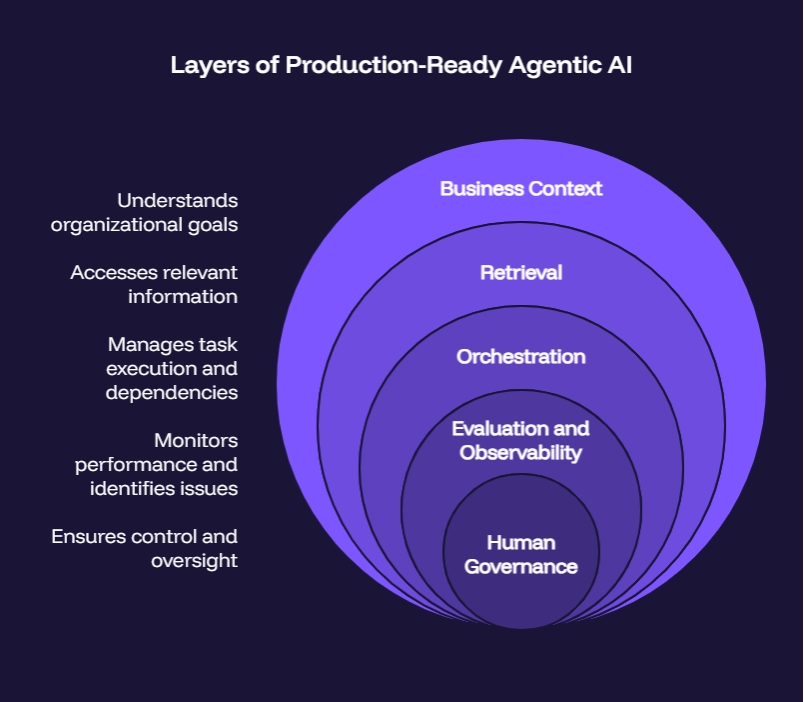
A production-ready agentic AI is much more than a language model connected to a few tools. It relies on multiple engineering layers working together to deliver reliable outcomes.
Layers of Production-Ready Agentic AI
1. Business Context
Before an agent can make decisions, it needs to understand:
Business goals
User intent
Business logic
Operational constraints
Internal documentation
Without this context, even the most advanced model can make poor decisions because it lacks an understanding of the organization’s workflows and objectives.
2. Retrieval
An agent is only as good as the information it can access. Production systems often combine multiple retrieval methods, including:
Semantic search
Keyword search
Metadata retrieval
Tickets and comments
Code repositories
Internal knowledge bases
Omdena’s deployments found that hybrid retrieval strategies consistently outperformed semantic search alone. In production, retrieval quality often determines reasoning quality.
3. Orchestration
Production AI depends on reliable orchestration rather than autonomous reasoning alone. This includes:
Request routing
Workflow execution
Dependency management
Retry mechanisms
Task ordering
Approval workflows
At scale, agentic AI behaves more like a distributed software system than a chatbot.
Without observability, teams cannot diagnose problems or improve system performance over time.
5. Human Governance
The most successful deployments keep humans in control through confidence thresholds, review workflows, approval checkpoints, exception handling, and escalation paths. AI executes routine tasks while humans supervise high-impact decisions.
Together, these five layers provide the foundation for reliable agentic AI deployment. Omdena’s production experience shows that engineering these supporting systems matters just as much as building the AI agent itself. In the next section, we’ll explore the key lessons Omdena has learned from deploying agentic AI in production.
What Omdena Learned from Deploying Agentic AI
Omdena’s internal agentic AI projects revealed that successful production deployments depend far more on engineering discipline than model sophistication. Here are some of the biggest lessons we learned:
Infrastructure matters more than prompts. Infrastructure failures often caused more issues than reasoning failures, making system reliability a top priority.
Context engineering matters as much as prompt engineering. Agents need business context, project knowledge, and workflow understanding to make reliable decisions.
Integration complexity exceeds reasoning complexity. Connecting agents with APIs, repositories, databases, and enterprise systems often requires more effort than building the agent itself.
Observability is mandatory. Without telemetry, logging, and tracing, silent failures quickly become operational failures.
Confidence gating enables practical autonomy. Human review should remain part of high-impact workflows instead of relying on fully autonomous execution.
Production AI resembles distributed systems engineering. Success depends on orchestration, retrieval, monitoring, and resilience as much as AI reasoning.
These lessons ultimately shaped Omdena’s approach to AI delivery and led to the development of Umaku, its proprietary agentic AI platform for building and managing production-ready AI projects.
Why Omdena Built Umaku
As Omdena delivered AI projects across distributed teams, it encountered the same challenge repeatedly. Engineers worked across multiple repositories, sprints, and technologies while project knowledge remained scattered across documentation, tickets, comments, and codebases.
Traditional AI coding assistants could review syntax, but they lacked the business context needed to understand project goals, sprint objectives, or implementation decisions.
This often led to inconsistent code reviews, missed business requirements, and unnecessary rework. Omdena realized that production AI delivery required more than a powerful language model. It needed a platform that could understand the complete project context and assist teams throughout the development lifecycle.
That realization led to Umaku. Rather than acting as another AI coding assistant, it was designed to support structured, context-aware AI delivery from planning to deployment. The next section explores how this works in practice.
How Umaku Supports Production-Ready Agentic AI Delivery
Rather than focusing on isolated coding tasks, Umaku supports the entire AI delivery lifecycle. It provides the context and structure needed to help distributed teams build production-ready agentic AI systems more reliably.
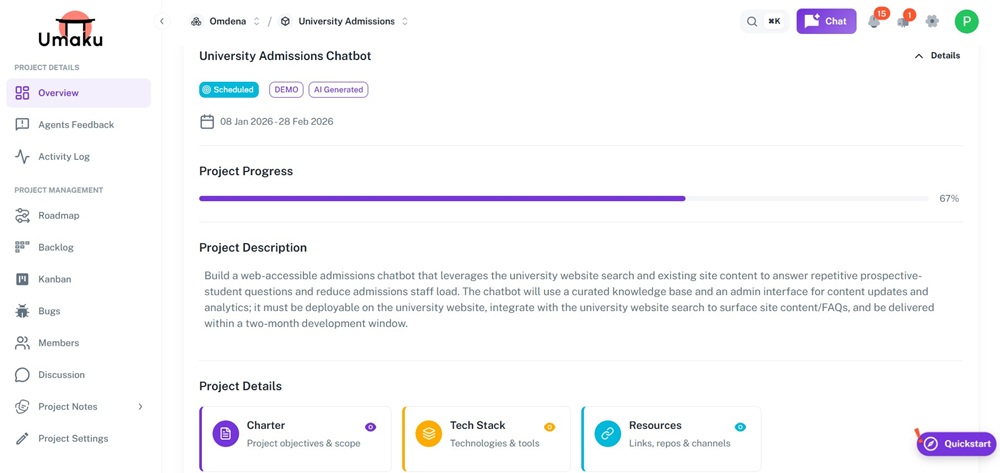
Project Overview in Umaku
Project Context: Understanding Why
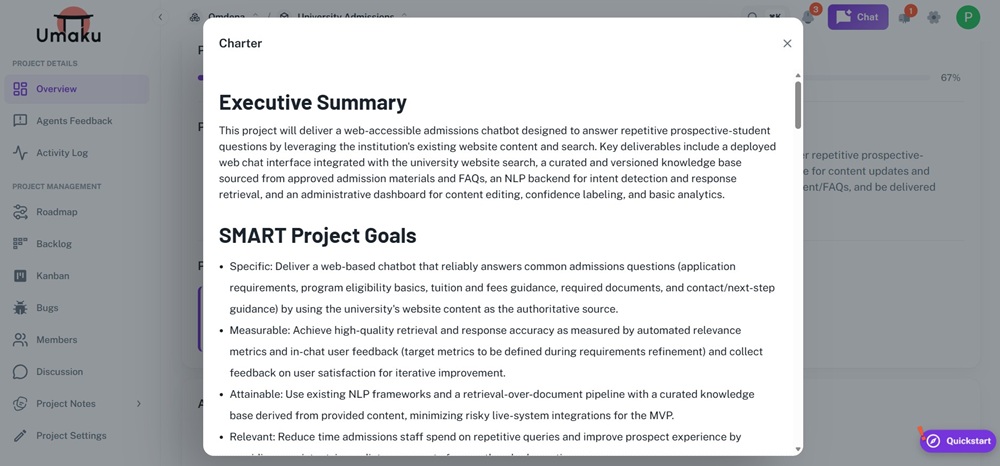
Project Charter in Umaku
Every project begins with a centralized project charter that captures business goals, project scope, success metrics, constraints, and business logic. This allows AI to understand why the project exists before analyzing implementation details.
Technical Context: Understanding How
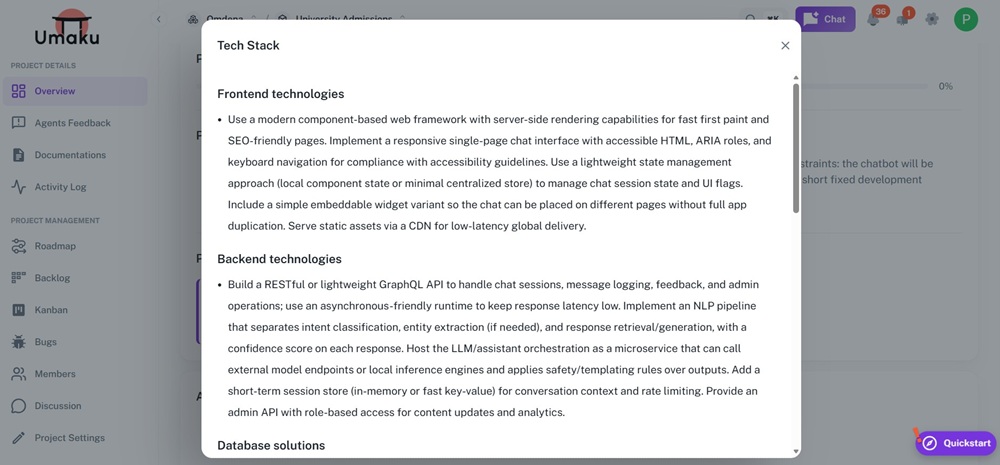
Technical Context in Umaku
Umaku also maintains technical context, including the technology stack, architecture decisions, frameworks, integrations, and dependencies. This helps AI understand how the system is designed to operate.
Resource Context: Understanding Where
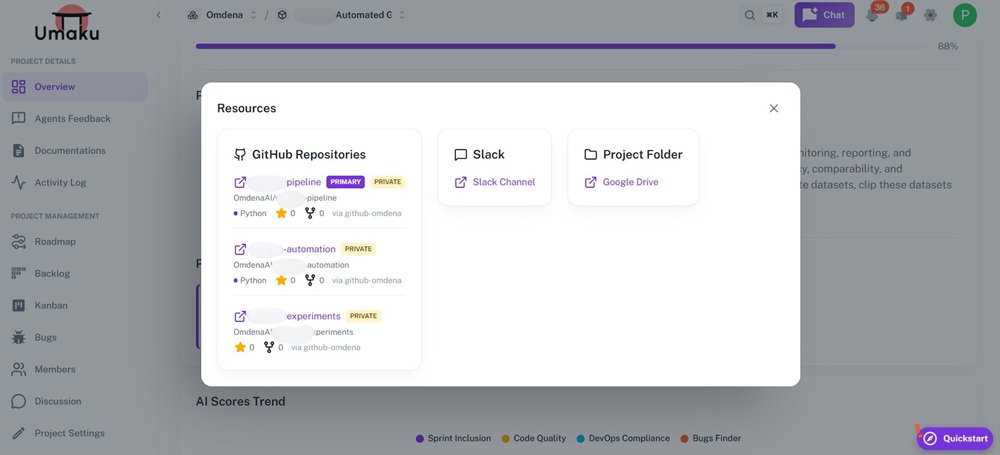
Resource Context in Umaku
GitHub repositories, documentation, and project resources are connected into a unified knowledge layer. Instead of searching across multiple systems, AI can access the information needed to understand where project knowledge resides.
Sprint Planning and Delivery
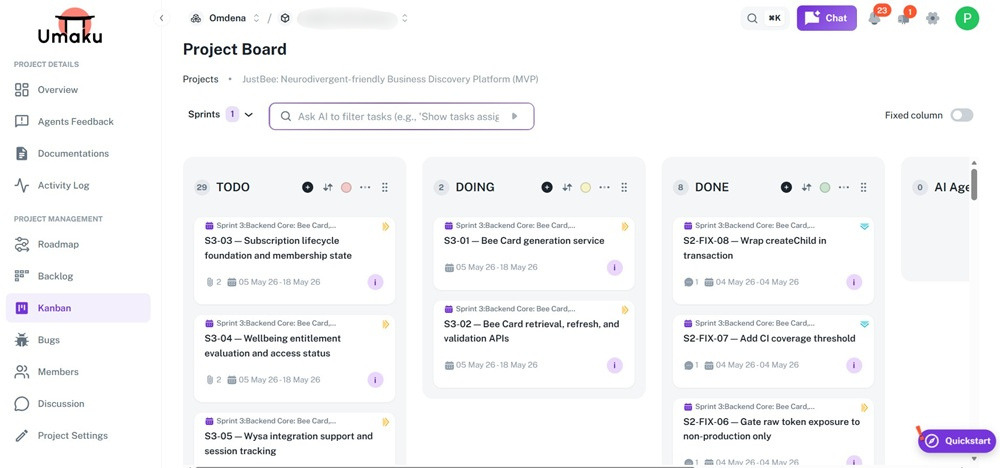
Kanban Board in Umaku
Development is organized through roadmaps, sprints, Kanban boards, tickets, and task assignments. This structured workflow helps distributed teams stay aligned throughout the implementation process.
Context-Aware Code Reviews
Unlike generic AI coding assistants that review code in isolation, Umaku evaluates code against the project charter, sprint objectives, roadmap, architecture decisions, and business requirements. This context-aware approach helps reduce implementation drift and unnecessary rework.
Multi-Agent Research and Analysis
Behind the scenes, multiple specialized AI agents perform iterative analysis, self-reflection, knowledge synthesis, and evidence-based reasoning before generating recommendations. This produces deeper project understanding than a single LLM response.
Continuous Evaluation
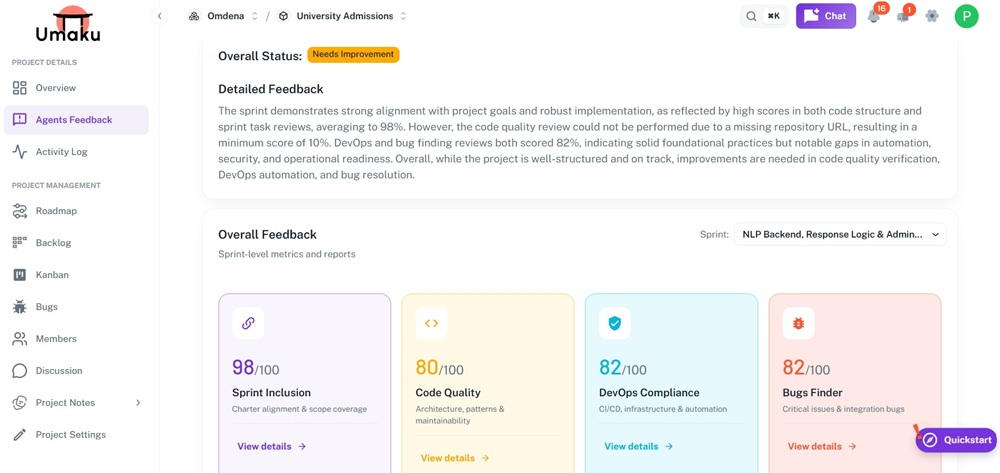
Agentic Feedback in Umaku
Throughout development, Umaku provides visibility into sprint health, code quality, bug detection, DevOps compliance, and operational readiness, helping teams identify issues before deployment.
Human Feedback Loop
Human expertise remains central to the process. Project managers and engineers can validate or challenge AI recommendations, allowing the platform to learn from project-specific feedback and continuously improve future evaluations.
This combination of structured delivery, context-aware AI, and human oversight extends beyond the platform itself and forms the foundation of Omdena’s production-first AI delivery methodology.
Omdena’s Production-First AI Delivery Methodology
Many organizations treat AI deployment as the final phase of a project. They build a prototype first and only begin thinking about governance, integrations, monitoring, and scalability when preparing for launch. By that point, expensive redesigns and deployment delays have often become unavoidable.
Omdena takes a different approach by designing for production from the very beginning. Instead of treating deployment as a handoff between development and operations, every stage of the project is built around long-term reliability, maintainability, and operational readiness.
Its production-first delivery methodology spans the entire AI lifecycle, including:
Problem framing and stakeholder alignment to define business objectives and success metrics.
Data readiness and governance to ensure high-quality, compliant, and accessible data.
Architecture selection based on business requirements, performance needs, and deployment constraints.
Continuous evaluation and testing throughout development rather than only before launch.
Integration with existing business systems and workflows to ensure seamless adoption.
Deployment, monitoring, and MLOps to maintain reliability, performance, and operational visibility.
Knowledge transfer and operational ownership so internal teams can confidently manage and extend the solution over time.
This methodology is supported by Umaku, which keeps project context, sprint execution, documentation, code quality, evaluation, and collaboration connected throughout the delivery lifecycle.
By combining a production-first methodology, context-aware AI execution through Umaku, and a global network of AI specialists, Omdena helps organizations move beyond AI prototypes and build agentic AI systems that operate reliably in production environments.
Production-Ready Agentic AI Is an Organizational Challenge
Deploying agentic AI is not simply a technology initiative. It requires organizations to rethink how teams collaborate, how decisions are governed, and how agentic AI fits into existing business processes. Success depends on cross-functional coordination between AI engineers, software developers, domain experts, operations teams, and business stakeholders.
Long-term ownership is equally important. Production-grade agentic AI systems require continuous monitoring, maintenance, governance, change management, and operational support as business requirements evolve. Without clear accountability and structured processes, even technically sound agentic AI systems can struggle after deployment.
In other words, production-ready agentic AI is not just an LLM deployment. It is an organizational capability that combines technology, people, and processes to deliver reliable business outcomes over the long term.
The Path from Prototype to Production
Building an AI agent is becoming increasingly accessible, but deploying one successfully in production remains a significant engineering challenge. Long-term success depends on reliable orchestration, business context, retrieval pipelines, infrastructure, observability, governance, and continuous evaluation working together as a unified system.
Organizations that invest in these capabilities move beyond prototypes and build AI systems that deliver consistent business value over time. Those that overlook them often find their prototypes struggling to scale.
If your organization is preparing to move an AI agent, copilot, or automation workflow into production, Omdena can help. Through its production-first delivery methodology, proprietary Umaku platform, and global network of AI experts, Omdena helps organizations build reliable, production-ready AI systems. Book an exploration call with Omdena to discuss the right deployment strategy for your next AI initiative.
FAQ
What is the biggest challenge in deploying agentic AI in production?
The biggest challenge is not building the AI agent itself but integrating it into a reliable production environment. Successful deployments require orchestration, business context, retrieval pipelines, governance, observability, continuous evaluation, and human oversight working together to support business operations.
Why do many agentic AI projects fail after the prototype stage?
Many projects perform well during prototyping but struggle in production because they underestimate integration complexity. Connecting AI agents with APIs, databases, enterprise systems, security policies, and existing workflows introduces operational challenges that simple prototypes do not encounter.
What makes an agentic AI system production-ready?
A production-ready agentic AI system combines accurate reasoning with strong engineering foundations. This includes business context management, hybrid retrieval, workflow orchestration, monitoring, governance, continuous evaluation, and structured human review processes that ensure reliable long-term operation.
Why is human oversight important for agentic AI deployments?
Even highly capable AI agents can make incorrect decisions when faced with unexpected inputs or changing business conditions. Human review, confidence thresholds, approval workflows, and escalation paths help reduce risk while allowing AI to automate routine tasks safely.
How can Omdena help organizations deploy agentic AI in production?
Omdena helps organizations move from AI prototypes to production-ready systems through its production-first delivery methodology, proprietary Umaku platform, and global network of AI engineers and domain experts. This approach helps organizations build reliable, scalable, and well-governed agentic AI solutions that deliver long-term business value.
Continue with Omdena
Share this article
Share on LinkedIn, send by email, or copy the direct link.