How to Reduce AI Operating Costs Without Sacrificing Performance
10 min readUpdated October 5, 2026
Okon PrinceSenior Data Scientist / Forward deployed Engineer
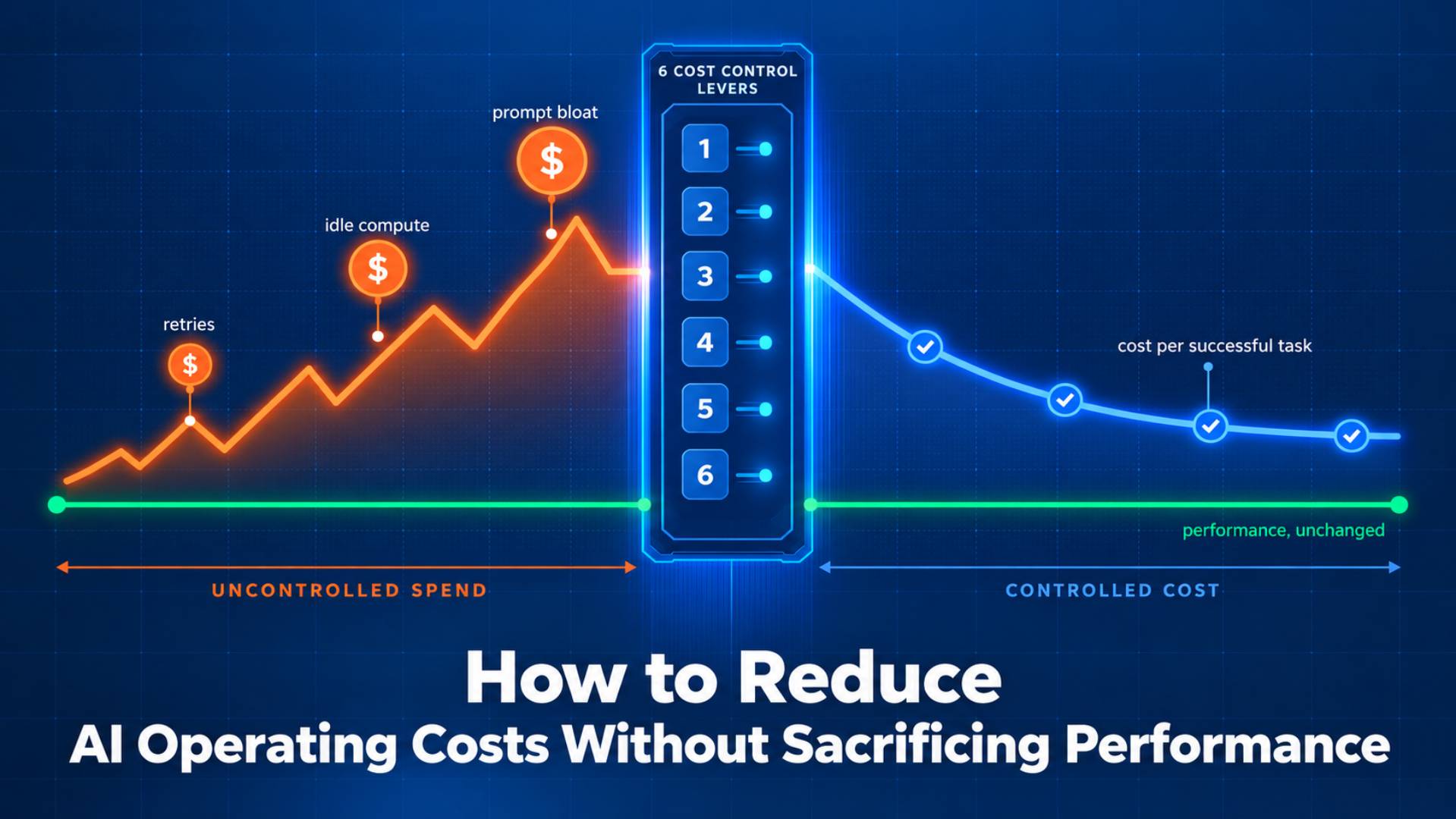
An AI application can be inexpensive to prototype but surprisingly expensive to operate. During development, usage is small and the bill stays manageable. Once real users arrive, every request can trigger model inference, retrieval, tool calls, and supporting infrastructure, and a few inefficient architectural decisions become a fast-growing monthly cost.
The operating bill is not simply the model’s API price. Architecture, token consumption, model selection, context size, caching, tool calls, and traffic patterns all shape what production AI actually costs, and the challenge is controlling them without degrading the quality, latency, or user experience the application depends on.
This article explains what drives AI operating costs, why they rise after launch, and six practical ways to reduce them, closing with how to build cost discipline into the architecture itself rather than discovering it on the invoice.
Why AI Operating Costs Increase After Launch
Prototype economics and production economics are different regimes. A demo serves a handful of forgiving users a few times a day; production serves everyone, continuously, with an availability target.
The consequences are documented: According to Gartner, escalating costs is one of the leading causes of AI project abandonment. Several drivers are simultaneously responsible for the incidence of escalating cost:
More users, more requests, and longer conversations with larger prompts
More output tokens per response as tasks get more useful
Retrieval (RAG) adding context to every call
Multiple model calls per task, and agentic workflows multiplying tool calls
Bigger infrastructure, plus monitoring and logging for all of it
Retries, failed requests, and scaling for availability
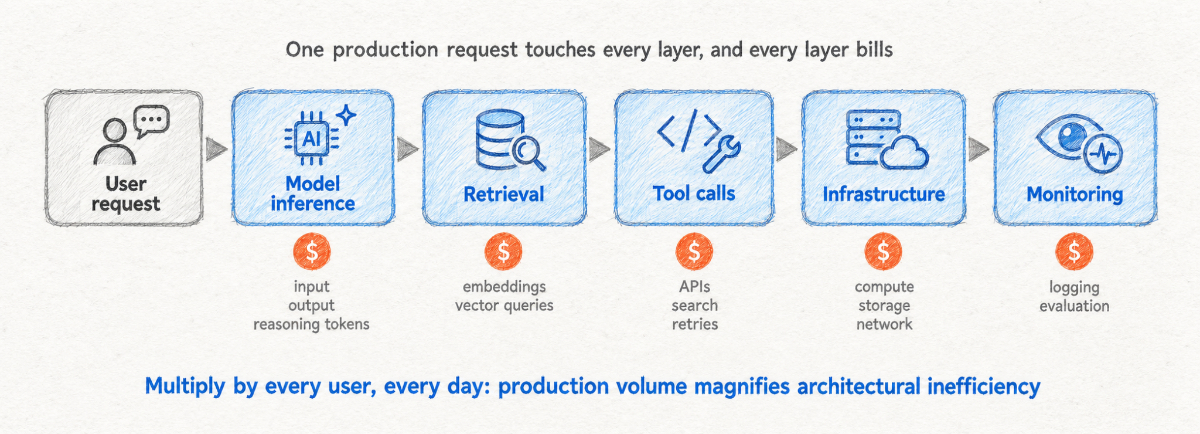
Here is the core idea. Production volume magnifies architectural inefficiency. Deloitte’s Tech Trends 2026 describes frequent API calls, rising usage intensity, and always-on applications driving significant and often unpredictable cost escalation, with some organizations facing monthly AI compute costs in the tens of millions.
Figure 1 shows how a single request accumulates cost across layers.
Figure 1. How AI Operating Costs Accumulate in Production
What Makes Up the Operating Cost of an AI Application?
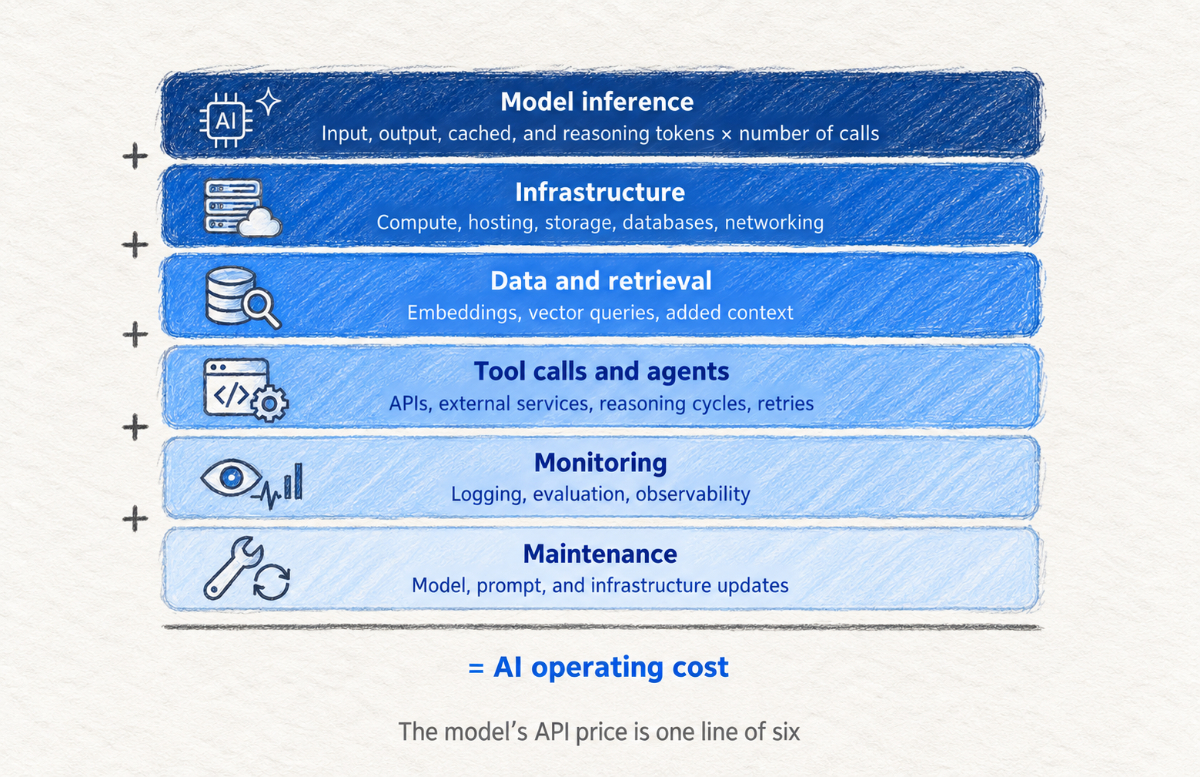
A simple framework covers the whole bill, summarized in Figure 2: AI operating cost equals inference plus infrastructure plus data and retrieval plus tool calls plus monitoring plus maintenance.
Figure 2. What Makes Up AI Operating Cost
Model Inference
The most visible component. OpenAI’s documentation distinguishes input, output, cached, and reasoning tokens as separate usage components, and the number of model calls multiplies all of them.
A task that quietly makes three model calls costs three times what its prompt suggests, and reasoning models spend additional tokens before producing a visible answer.
Infrastructure
GPU and CPU compute, hosting, storage, databases, vector databases, and networking. Much of it bills whether or not requests arrive, which is what makes idle capacity expensive. This layer deserves its own article; for now, keep the categories in view when budgeting.
Retrieval and Data
RAG is not a free context. It adds embedding generation, vector database queries, retrieval infrastructure, and additional tokens sent to the model on every request. As the knowledge base grows, so does everything downstream of it.
Tool Calls and Agent Execution
Agentic systems add API calls, search, database queries, external services, multiple reasoning cycles, and retries. AWS’s Agentic AI Lens specifically warns that excessive tool calls and retry storms create unpredictable cost spikes.
Monitoring and Maintenance
Logging, evaluation, and observability, plus the ongoing work of model updates, prompt updates, and infrastructure management. These are recurring engineering costs, not one-time setup costs, and they are the components most often left out of the original estimate.
6 Ways to Reduce AI Operating Costs Without Sacrificing Performance
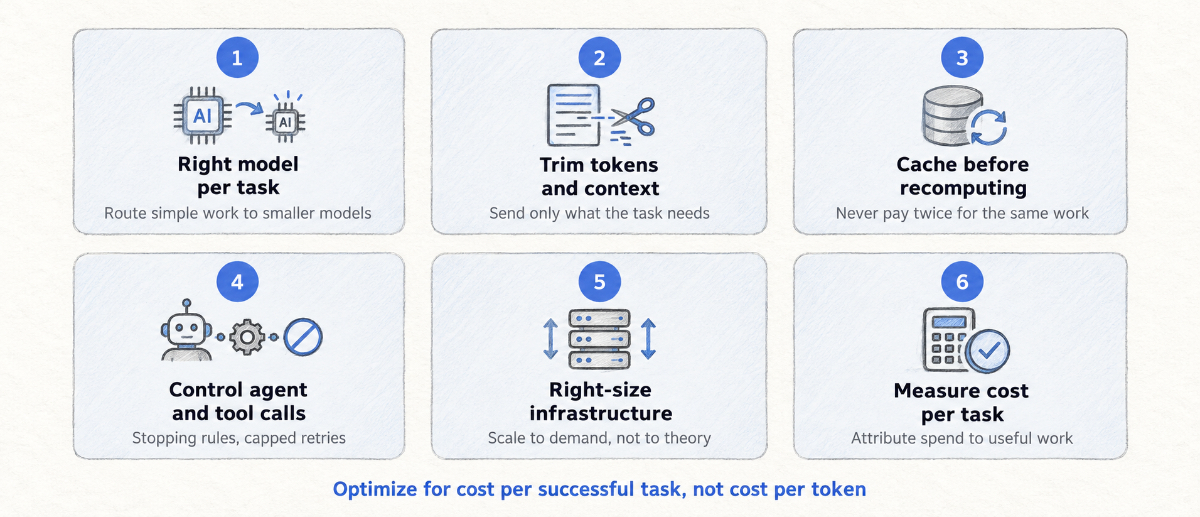
The six levers below, summarized in Figure 3, target unnecessary computation rather than quality.
Figure 3. Six Levers for Reducing AI Operating Costs
1. Use the Right Model for Each Task
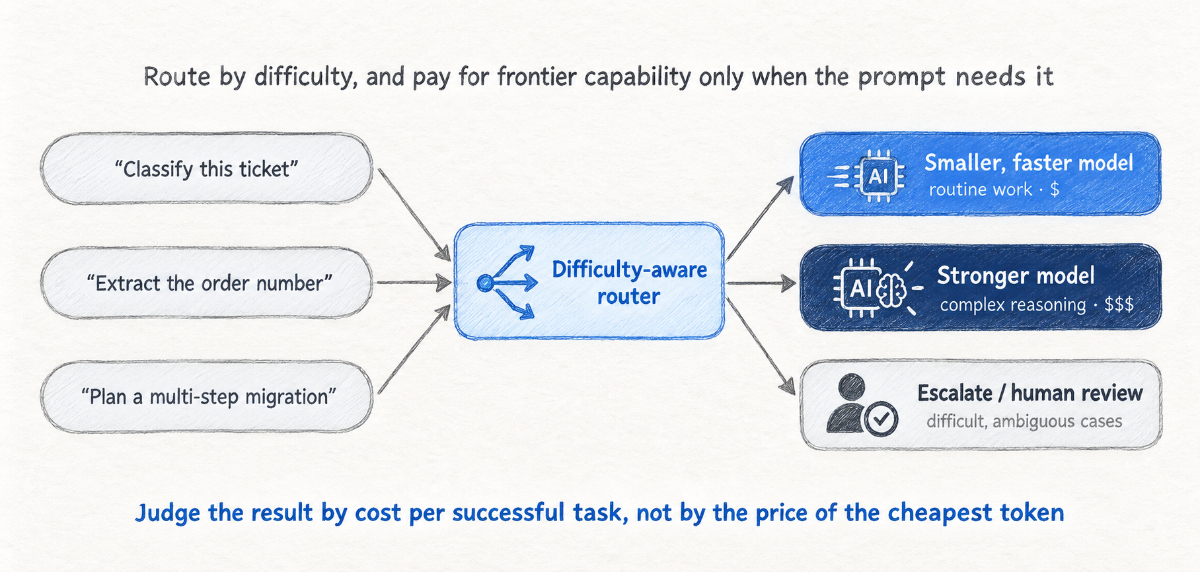
Don’t send every request to the most powerful, most expensive model. Route by difficulty, as Figure 4 shows:
Simple classification, extraction, and FAQ responses go to smaller, faster models
Complex reasoning goes to a stronger model
Difficult or ambiguous cases escalate when necessary
Microsoft’s model router guidance frames this as difficulty-aware routing: pay for frontier-level capability only when the prompt genuinely needs it. The measure that matters is cost per successful task, not cost per token; a cheap model that fails and triggers a retry or a human escalation is not cheap. Smaller models are not automatically equal in quality, so test them against representative workloads before routing production traffic.
Figure 4. Difficulty-Aware Model Routing
2. Reduce Unnecessary Token and Context Usage
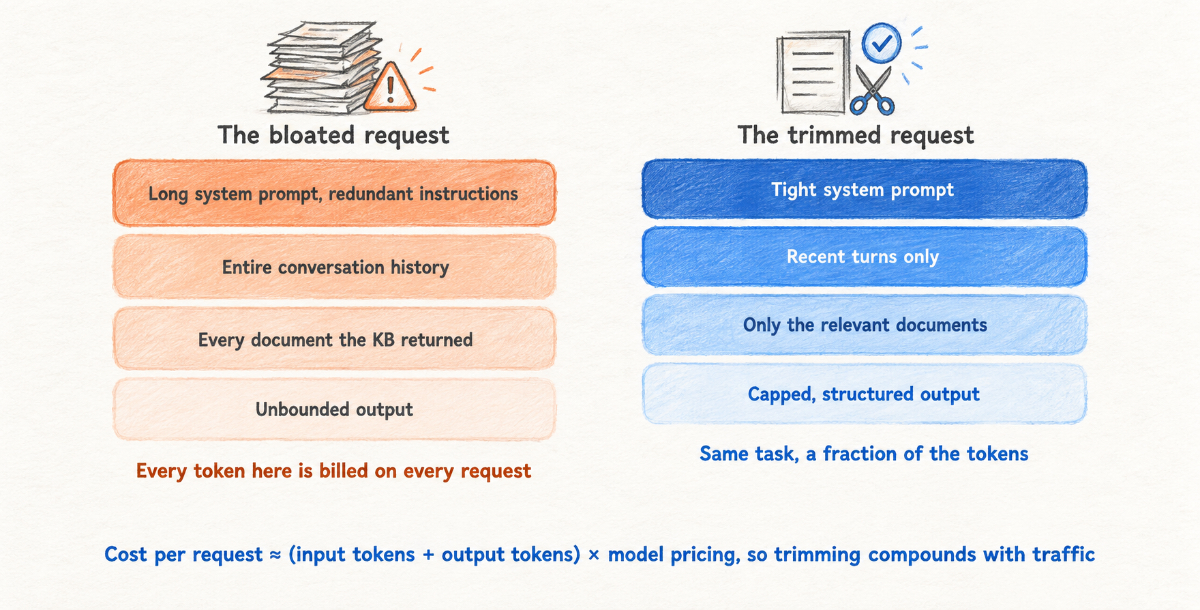
Cost per request is roughly input tokens plus output tokens, multiplied by model pricing, so waste compounds with traffic. AWS notes that every token in a system prompt is paid for on every invocation, which makes prompt bloat an operating-cost problem, not just a prompt-engineering one. Practical trims:
Shorten system prompts and remove unnecessary instructions
Avoid sending entire conversation histories
Retrieve only relevant documents, not everything available
Limit output length and structure prompts efficiently
The same applies to retrieval: RAG should fetch the context a task needs, not everything the knowledge base holds. Figure 5 contrasts a bloated request with a trimmed one doing the same job.
Figure 5. Trimming the Tokens a Request Carries
3. Use Caching Before Recomputing
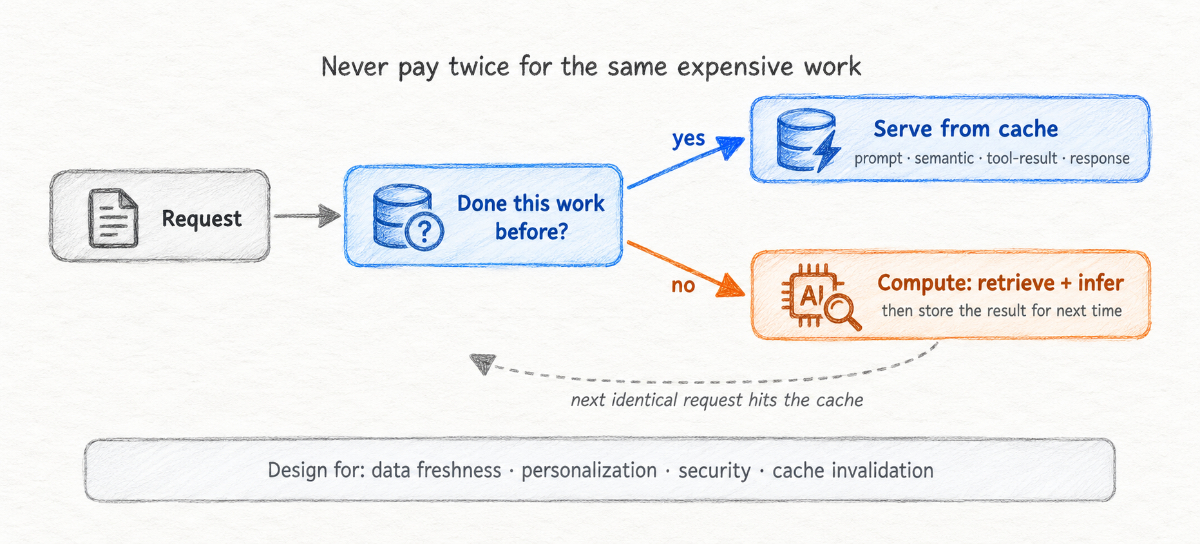
If the system has already performed expensive work, don’t pay to perform it again. Apply prompt caching, semantic caching, tool-result caching, and response caching where appropriate. A customer-support application, for example, repeatedly retrieves the same policy documents; caching those results for a defined period removes a recurring cost.
Caching is not free of judgment: it requires attention to data freshness, personalization, security, and cache invalidation before it is safe to rely on. Figure 6 shows the decision every request should pass through.
Figure 6. The Caching Decision
4. Control Agent and Tool-Call Costs
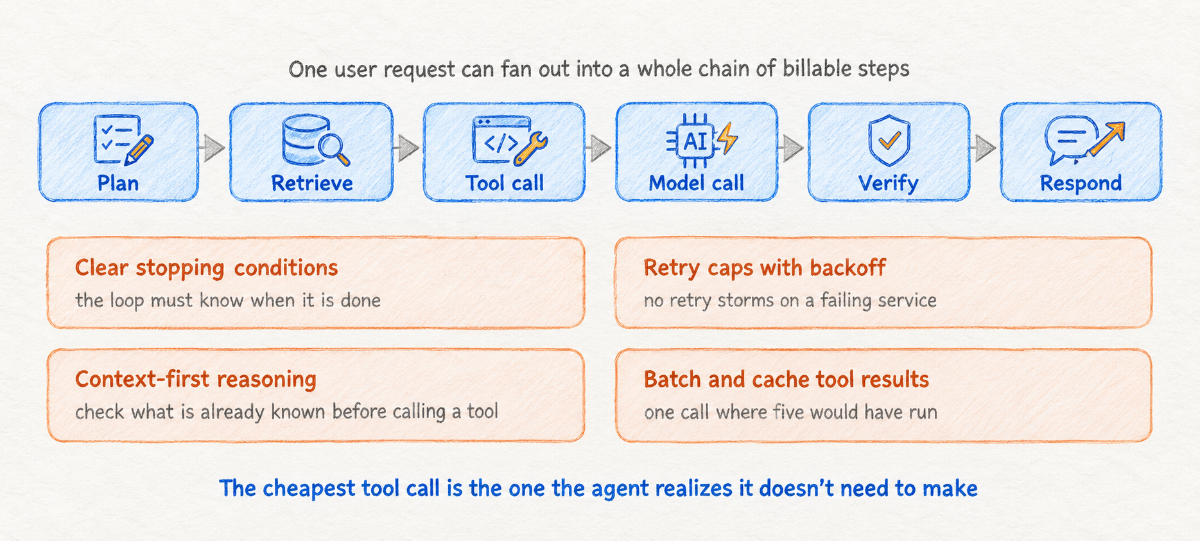
One user request to an agent can become planning, retrieval, a tool call, a model call, a second tool call, verification, and a response. Figure 7 shows the chain and the guardrails that keep it deliberate:
Give agents clear stopping conditions; never allow unlimited retries
Check existing context before calling a tool
Batch calls where possible and cache repeated tool results
Monitor tool-call frequency per session, and alert when it drifts upward
AWS recommends context-first reasoning, batching, caching, and automatic cutoffs for exactly this reason. The cheapest tool call is the one the agent realizes it doesn’t need to make.
Figure 7. An Agent Chain and Its Cost Guardrails
5. Optimize Infrastructure for Actual Demand
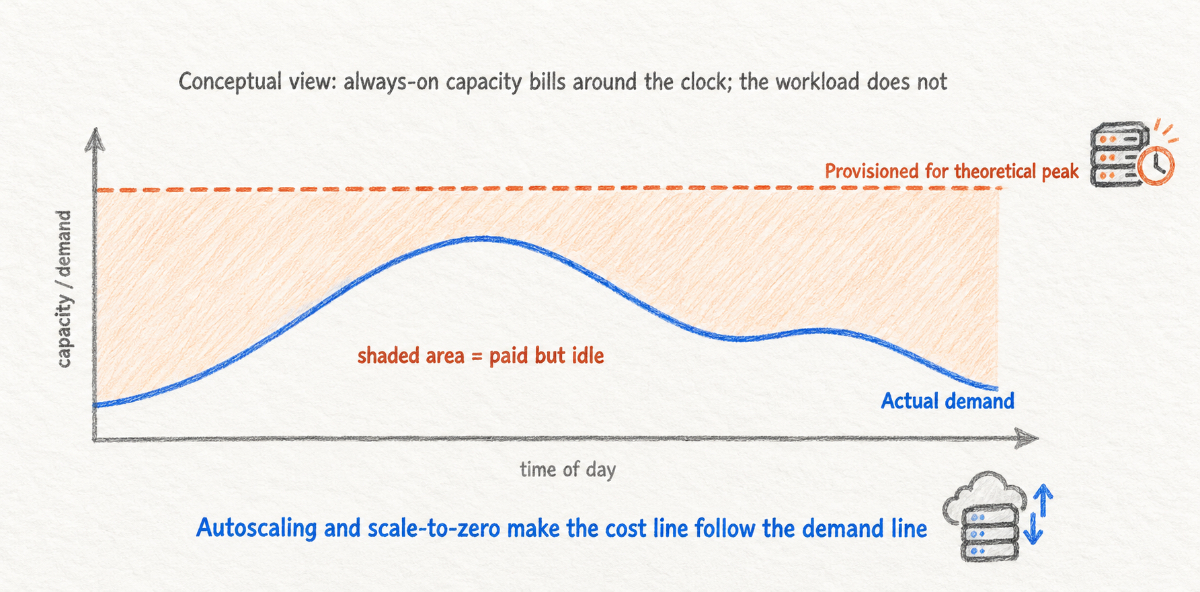
Don’t provision for peak theoretical demand when the workload doesn’t require it continuously; Figure 8 shows what that habit quietly costs:
Right-size compute and review GPU/CPU utilization
Use autoscaling, and scale-to-zero for intermittent or bursty workloads
Avoid always-on resources that idle between requests
Separate development, staging, and production workloads
Deloitte’s inference analysis makes the larger point: recurring, always-on AI workloads force organizations to reconsider whether their infrastructure strategy matches production demand at all, rather than matching the experimentation phase it was set up for.
Figure 8. Capacity Provisioned for Peak Versus Actual Demand
6. Measure Cost per Task, Not Just the Monthly Bill
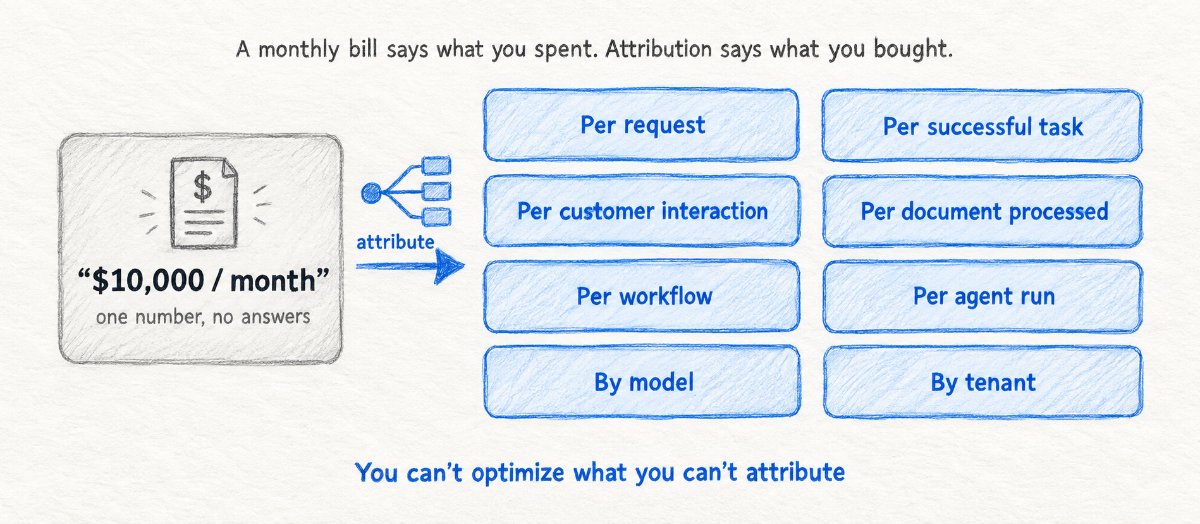
Knowing that AI infrastructure costs $10,000 per month says nothing about whether the system is efficient. Attribute spend to the units that drive it, as Figure 9 illustrates:
Cost per request, per successful task, and per customer interaction
Cost per document processed, per workflow, and per agent run
Cost by model, and by customer or tenant where relevant
Figure 9. From a Monthly Bill to Attributed Cost
You can’t optimize what you can’t attribute. Per-task numbers reveal which workflow, model, or tenant actually drives spend, and whether an optimization changed anything.
A well-run support agent shows how all six levers combine: a small model classifies intent, retrieval fetches only relevant policy documents, an account-status tool is called only when needed, frequent answers are cached, complex cases escalate to a stronger model, and the whole thing is measured per resolved conversation.
Build Cost Optimization Into the AI Architecture
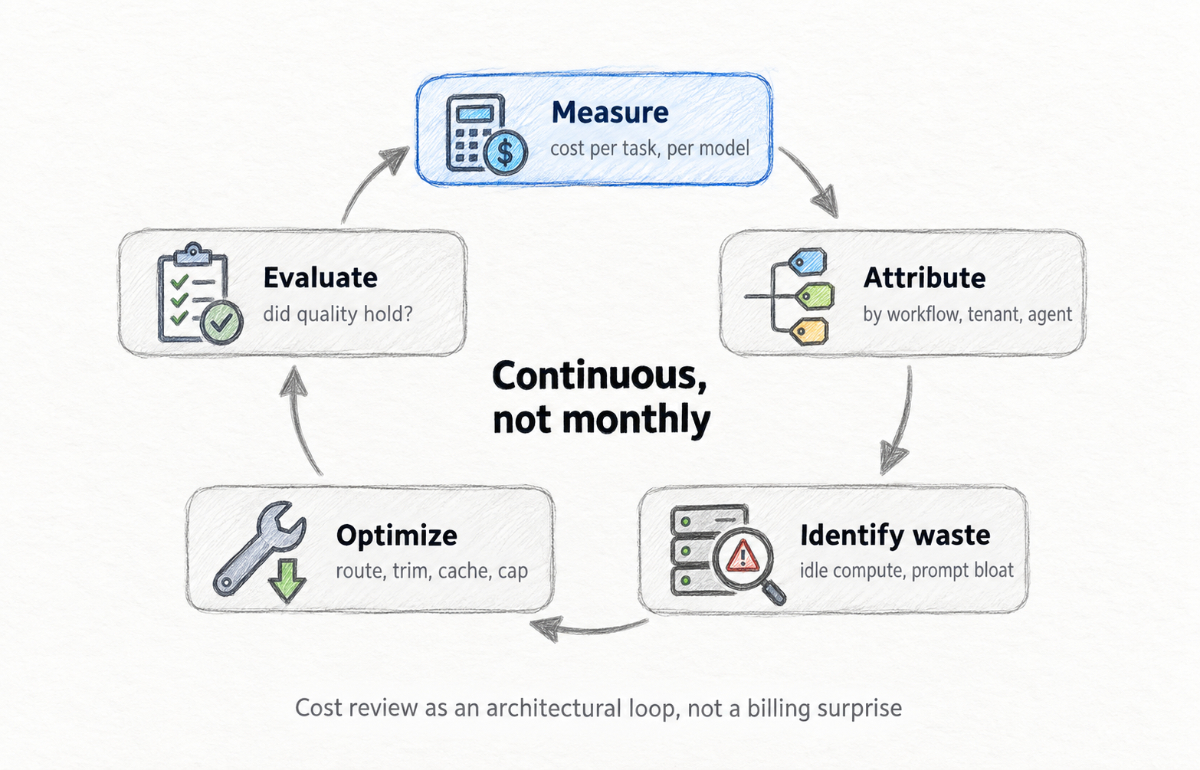
Cost optimization should not be a monthly exercise where someone opens the cloud bill and asks what went wrong. The teams that control operating costs treat them as an architectural property, established before production with a cost model covering:
Expected request volume and peak traffic
Average input and output tokens, and model selection
Retrieval volume, tool-call frequency, and infrastructure requirements
Monitoring requirements
AWS’s Well-Architected guidance treats this production cost model as a living document, updated continuously as the application is tested rather than filed away after approval. Each round of testing replaces an assumption with a measurement, so the model gets more accurate as launch approaches instead of less.
The working rhythm is simple. Before launch: estimate, test, measure, optimize. After launch: monitor, attribute, identify waste, optimize, and re-evaluate, as the loop in Figure 10 shows. Give the loop an owner, because a review nobody is responsible for running quietly stops running. Costs reviewed this way get caught as engineering issues; costs reviewed monthly get discovered as billing surprises.
Figure 10. The AI Cost Optimization Loop
How Umaku Can Help Reduce Unnecessary AI Delivery and Operating Costs
Operating-cost optimization is not only about the cloud bill. Rework, quality issues, integration problems, and technical debt also drain the economics of running an AI system, and that is the layer Umaku, Omdena’s delivery platform, addresses.
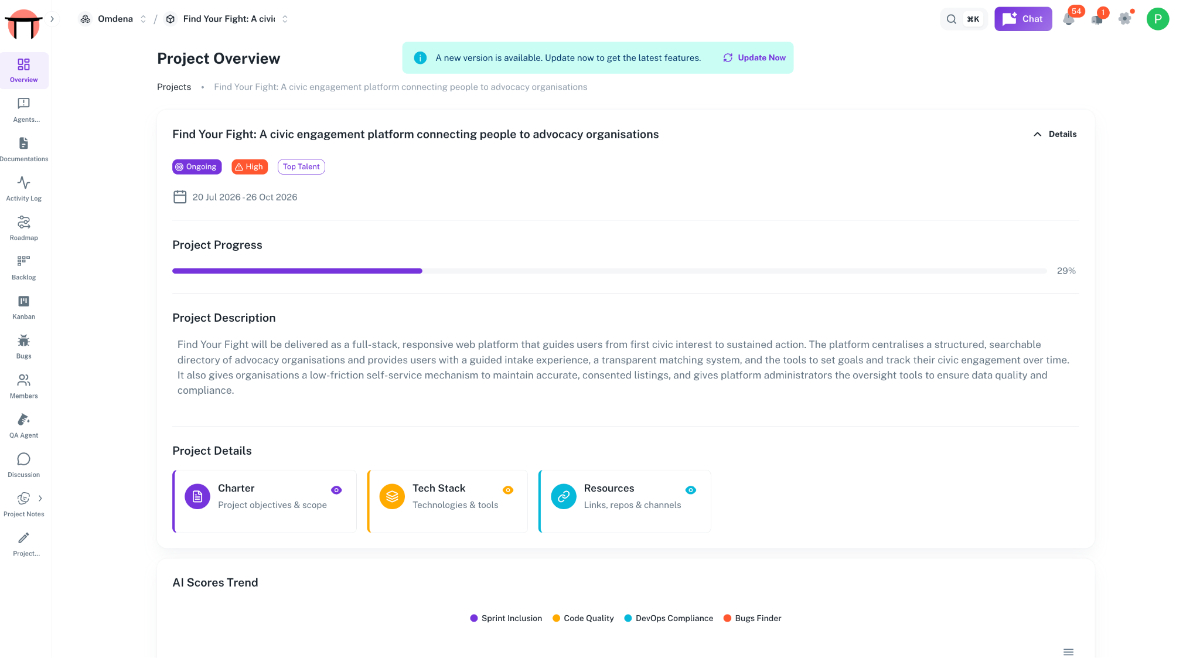
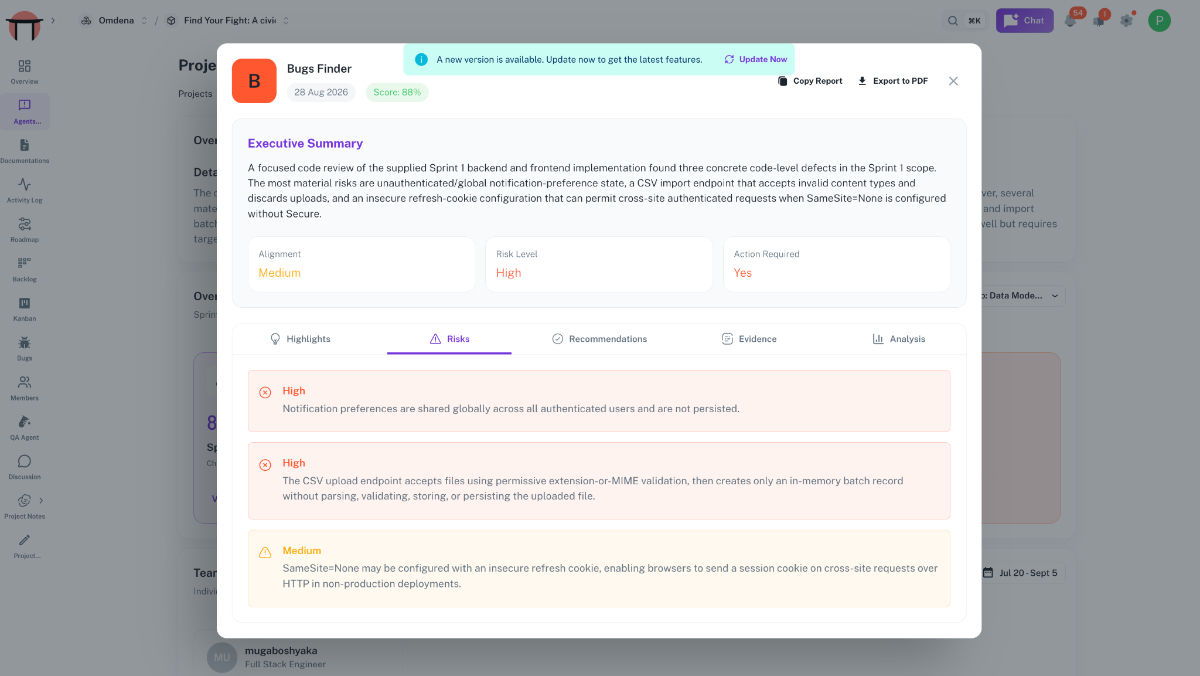
It connects business context, technical context, roadmaps, sprints, tickets, and repositories, then analyzes completed work across Sprint Inclusion, Code Quality, DevOps Compliance, and Bug Finder while development is still underway.
Figure 12. Umakus Bugs Finder Feature can Identify Bugs within the codebase
Umaku does not lower token prices or GPU rates. What it protects is the engineering side of the operating equation: problems found while work is active cost less to fix than problems found in production, and fewer late surprises means the optimization work described above actually gets engineering time.
Access Specialized AI Talent Without Building Every Capability In-House
AI operating costs are not only infrastructure costs; someone has to design the routing, tune the caching, and right-size the infrastructure on an ongoing basis, and that expertise is scarce. Companies don’t necessarily need every one of those specializations as permanent internal headcount.
Omdena’s global talent network provides AI/ML, LLM and RAG, data, MLOps, and cloud engineers for specific production challenges, so teams can work through the optimization problems in this article without building every capability in-house.
Conclusion
Three ideas are worth keeping. AI operating cost is broader than model pricing; it spans inference, infrastructure, retrieval, tools, monitoring, and maintenance. The biggest savings come from architecture, by eliminating unnecessary computation rather than buying cheaper answers. And cost and performance are not opposing goals when optimization targets waste instead of quality.
The goal is not to make AI as cheap as possible. It is to make every dollar of AI infrastructure and engineering spend produce useful work.
Omdena combines production AI expertise, specialized engineering talent, and Umaku’s context-aware delivery platform to help organizations run AI systems more efficiently. If you’re evaluating the operating economics of an AI system, we can help assess where the largest cost drivers are and where optimization is possible.
FAQ
Why do AI operating costs rise after launch?
Production introduces more users, longer conversations, retrieval, tool calls, retries, monitoring, and always-on infrastructure. At scale, even small architectural inefficiencies multiply into significant recurring costs.
What are the main components of AI operating cost?
AI operating costs include model inference, compute and hosting, storage and databases, retrieval and embeddings, external tool calls, monitoring, and ongoing maintenance. Model API pricing is only one part of the total bill.
How can model routing reduce AI costs without lowering quality?
Difficulty-aware routing sends routine tasks such as classification, extraction, and FAQs to smaller models while reserving stronger models for complex or ambiguous cases. Test each model on representative workloads and optimize for cost per successful task, not merely cost per token.
How do token reduction and caching lower AI operating costs?
Shorter prompts, limited conversation history, focused retrieval, and controlled output length reduce paid token usage. Prompt, semantic, response, and tool-result caching also prevent repeated computation, provided freshness, personalization, security, and invalidation are handled carefully.
Which metrics should teams track to control AI spending?
Track cost per request, successful task, customer interaction, document, workflow, and agent run. Break costs down by model and, where relevant, by customer or tenant to reveal which workloads drive spending and whether optimizations work.
Continue with Omdena
Share this article
Share on LinkedIn, send by email, or copy the direct link.