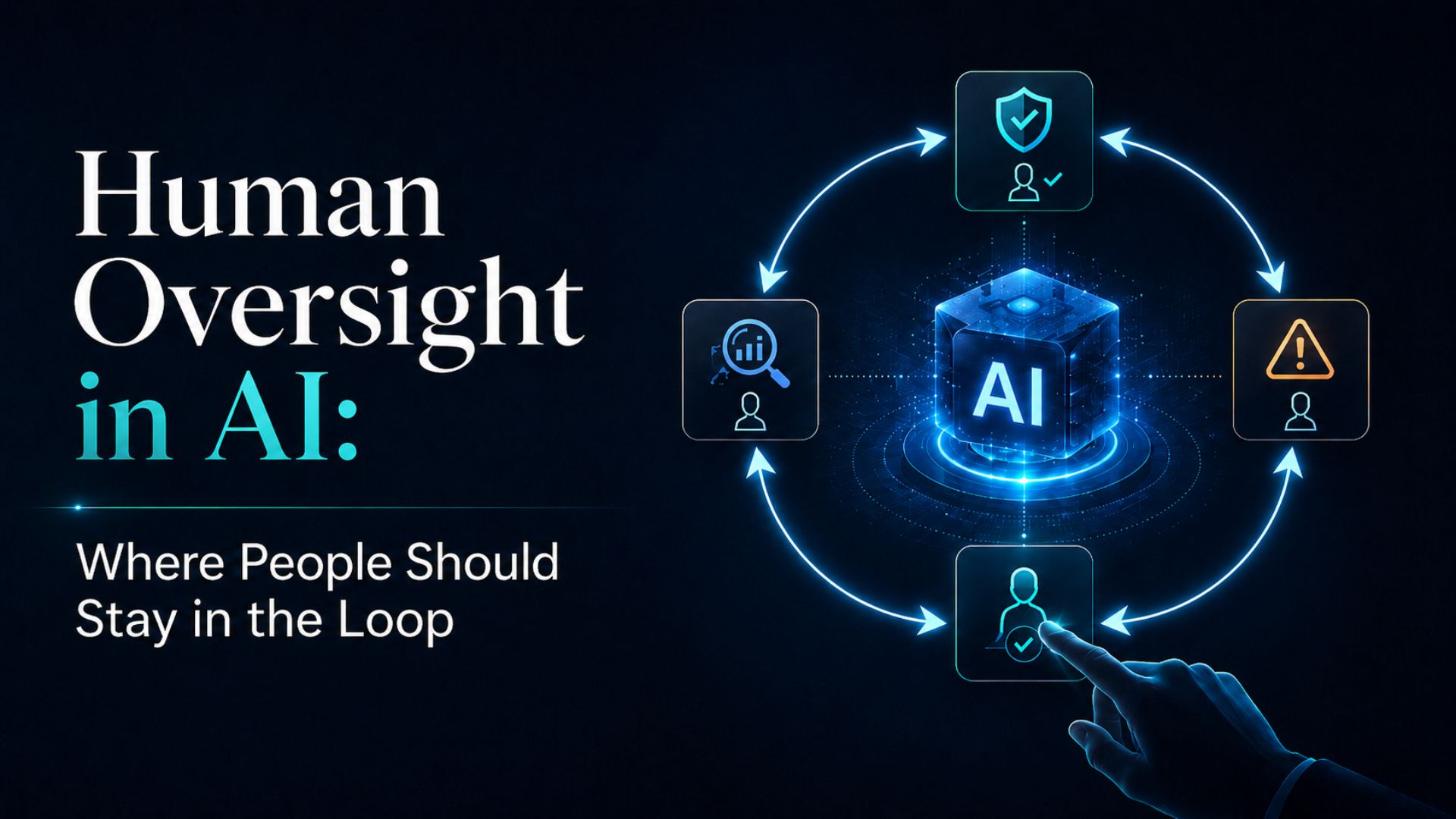
Human Oversight in AI: Where People Should Stay in the Loop (2026 Guide)
16 min readUpdated August 11, 2026
Prince OkonSenior Data Scientist
The challenge isn’t whether humans should oversee AI. It’s deciding where people remain in control, without slowing automation down.
An AI support agent resolves 95% of customer requests on its own. An underwriting model wants to approve a million-dollar claim. An AI agent is one API call away from moving real money. Which of these needs a human, and at what moment?
That question now separates AI programs that scale from those that stall. Too much review, and automation dies in a queue of approvals. Too little, and a single unchecked action becomes a security incident, a regulatory fine, or a headline.
This guide treats human oversight as a design problem, not a philosophy debate. You will learn the three oversight modes and when each fits, the six lifecycle stages where people must stay involved, when AI should act alone, six principles for meaningful intervention, and how to oversee autonomous agents. By the end, you will know exactly where people belong in your AI systems, and why that placement decides how fast you can automate.
What Is Human Oversight in AI?
Human oversight in AI is the deliberate design of processes, controls, and decision points that allow people to monitor, validate, intervene in, or override AI systems when human judgment is necessary.
Every word of that definition pushes against the naive picture of a person watching an AI work. Oversight is designed, not improvised. It consists of decision points, not constant attention. And it activates when judgment is necessary, not everywhere.
The goal is meaningful accountability, not micromanagement. Well-designed systems preserve the AI’s operative agency, its ability to plan and execute, while strengthening the human’s evaluative agency: the ability to judge, correct, and stop. Research presented at FAccT 2024 adds a sharp test: overseers are only effective when they have the knowledge to understand the system, the authority to act, and the practical means to do so. A reviewer with a button but no understanding is oversight theater.
Why Oversight Matters More as AI Becomes More Autonomous
If oversight is a set of designed decision points, the next question is how many your systems need. The answer scales with autonomy. Traditional ML predicted, and a person still acted on the prediction. Generative AI creates content that flows straight to customers, wrong or not. Agents execute actions across business systems, and multi-agent setups delegate to each other.
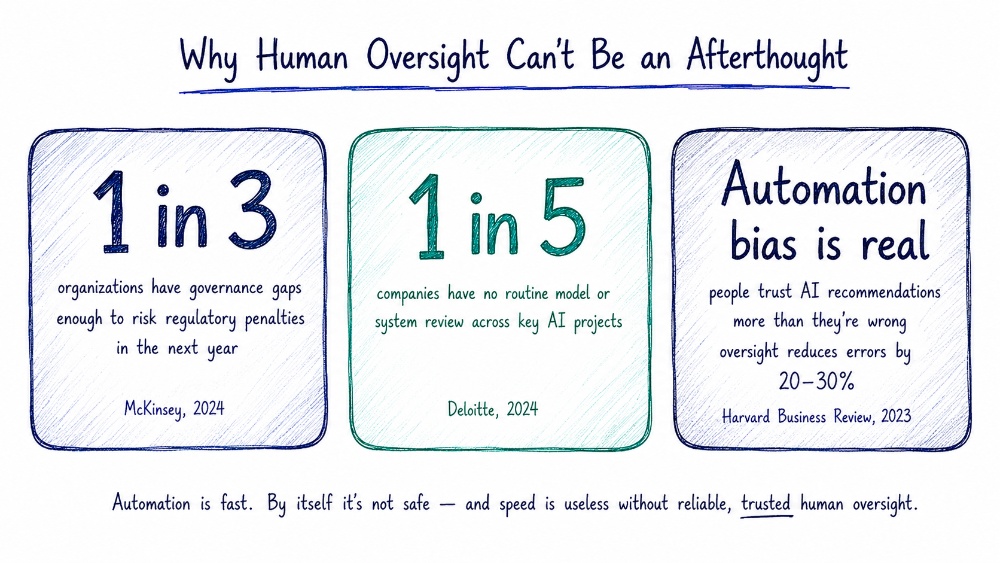
At each step, errors stop being bad outputs someone reads and become bad actions someone must undo. Most organizations are behind this curve: McKinsey finds only about one in three has governance mature enough for the agents it already deploys, and Deloitte puts mature agentic oversight at roughly one in five. Oversight design, not model quality, has become the limit on how much autonomy an enterprise can safely grant.
Figure 1. Autonomy is scaling faster than oversight.
Human-in-the-Loop vs. Human-on-the-Loop vs. Human-in-Command
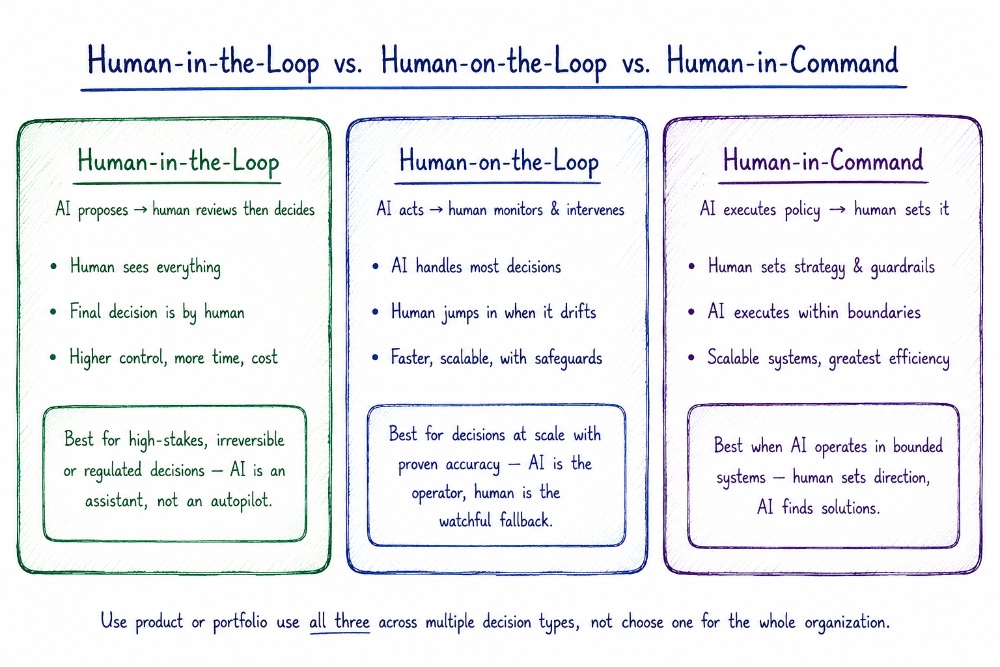
Closing that gap starts with a vocabulary. Three oversight modes cover the practical spectrum, and each fits a different kind of decision:
Human-in-the-loop. A person approves every decision before it executes. Highest control, lowest throughput. Right for high-stakes, irreversible, or regulated decisions, and for new systems still earning trust.
Human-on-the-loop. The AI acts within set boundaries while people supervise through dashboards and alerts, with authority to pause, override, or roll back. The workable mode for routine decisions at volume.
Human-in-command. Humans govern the system rather than its individual decisions. They set policy, autonomy boundaries, and intervention rules, and retain authority to reconfigure or shut down.
Human-in-command is where agentic AI pushes organizations, and it demands the most design maturity. The boundaries do the overseeing, so the boundaries must be right. Mature portfolios use all three modes at once, assigned per decision type rather than chosen once for the whole company.
Figure 2. Three oversight modes, assigned per decision type.
Human Oversight Across the AI Lifecycle
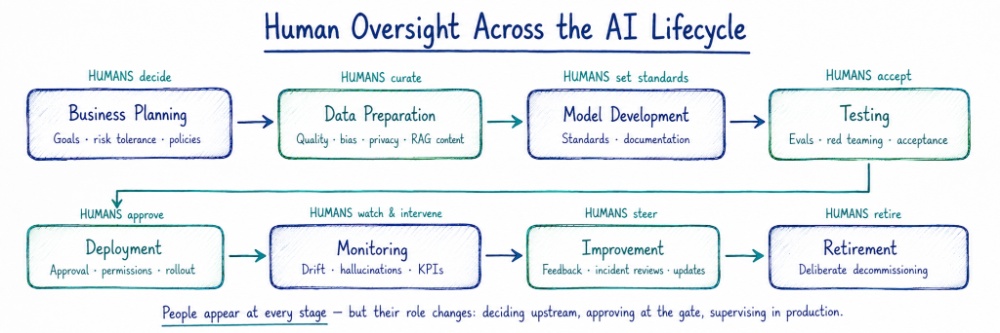
Whichever mode a system runs in, oversight starts long before deployment. People shape AI at every stage of its life, and their role changes as it progresses: deciding in planning, curating in data preparation, setting standards in development, accepting in testing, approving at deployment, supervising in production, steering improvement, and deliberately retiring systems at the end.
Figure 3. People appear at every stage, but their role changes.
Where Humans Should Stay in the Loop: Six Stages
The lifecycle view becomes practical when you name what humans actually own at each stage. Six stages carry the weight.
Stage 1: Problem Definition
Humans decide what the AI is for. People set the business goals, define success metrics, establish risk tolerance, and write the policies the system must operate within. The most consequential oversight decision happens here: which class of decisions the system will be allowed to touch at all.
Stage 2: Data
Humans oversee what the AI learns from and retrieves. That means data quality standards, bias review of training sets, and privacy verification. For LLM systems it also means curating knowledge sources and RAG content. An AI grounded in outdated policies will fail confidently, faster than any monitor can catch.
Stage 3: Model Development & Testing
Humans set the bar the system must clear. Engineers follow development and documentation standards, evaluators design tests that reflect real conditions, and red teams probe the failure modes that matter in the domain. A person then makes the acceptance decision against explicit thresholds, with the evidence recorded.
Stage 4: Deployment
Humans control the gate to production. A named owner grants approval based on evaluation evidence, risk reviews confirm the controls match the system’s tier, and access permissions are scoped to what it actually needs. Rollout is staged, from shadow mode to limited users to full production, with a human authorizing each expansion.
Stage 5: Production
Humans supervise what no one can individually read. At production volume, oversight becomes monitoring: hallucination and quality metrics, model drift, security signals, performance, business KPIs, and customer impact. The human role is to watch aggregates, respond to alerts, and intervene with real authority to constrain, pause, or halt.
Stage 6: Continuous Learning
Humans close the loop. Feedback and reviewer corrections drive improvement, incident reviews convert failures into better boundaries, and model updates pass through the same approval discipline as the original release. Governance itself gets tuned as production evidence accumulates. Oversight that never updates its own rules is decoration.
When AI Should Make Decisions Independently
A guide about keeping humans in the loop should be honest about the opposite case: much of AI’s value depends on humans staying out of the way. Some decisions are low-stakes, high-volume, and reversible. Requiring approval for them adds queues, not safety. Typical examples include:
Email classification and routing
Meeting summaries and draft generation
Internal search and knowledge retrieval
Routine workflow automation with easy undo
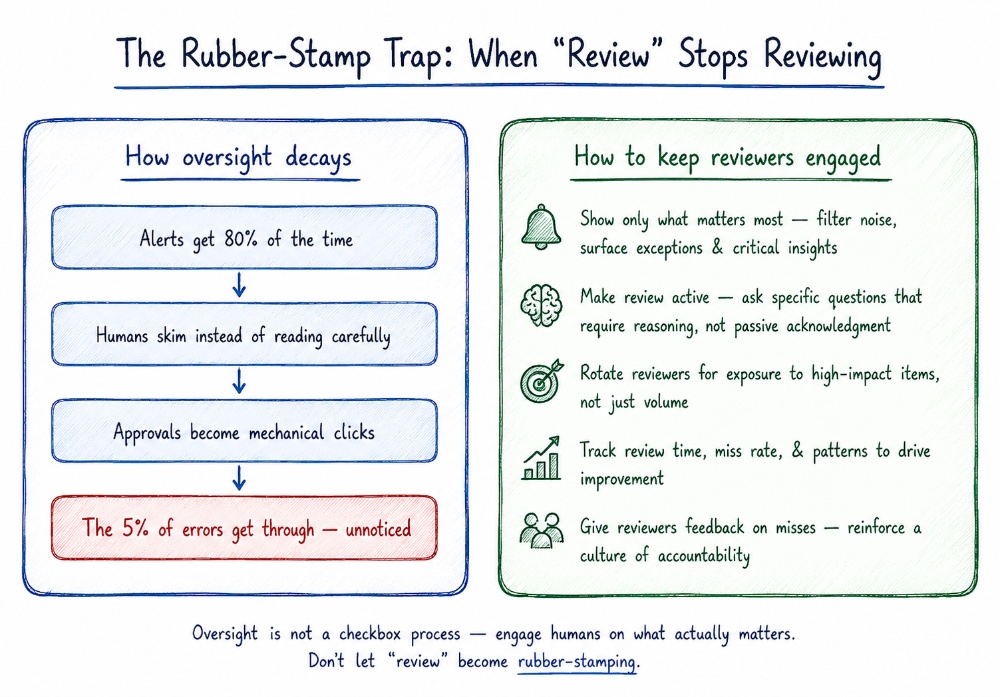
Excessive review also destroys the oversight you actually need. Reviewers drowning in trivial approvals develop rubber-stamp habits that let consequential errors through. Automation bias research in AI & Society is blunt on this: vigilance is a scarce resource. Spending it on meeting summaries means not having it for credit decisions.
When Humans Must Intervene
The mirror image is just as clear. Whatever the industry, four situations make human judgment non-negotiable:
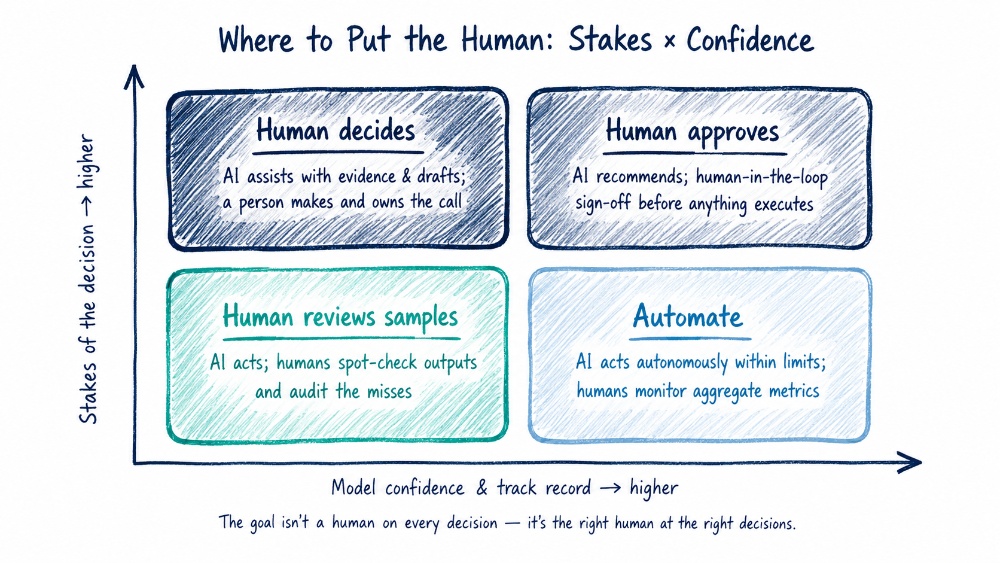
High-value and irreversible actions, including large transactions, financial approvals, payments, and contractual commitments.
Consequential domains such as healthcare, hiring, legal documents, identity verification, security actions, and compliance judgments.
AI uncertainty: low confidence scores, conflicting evidence, novel situations outside training data, and exceptions the rules never anticipated.
Escalations, both cases the AI itself flags and users who ask for a person. The request is itself a signal.
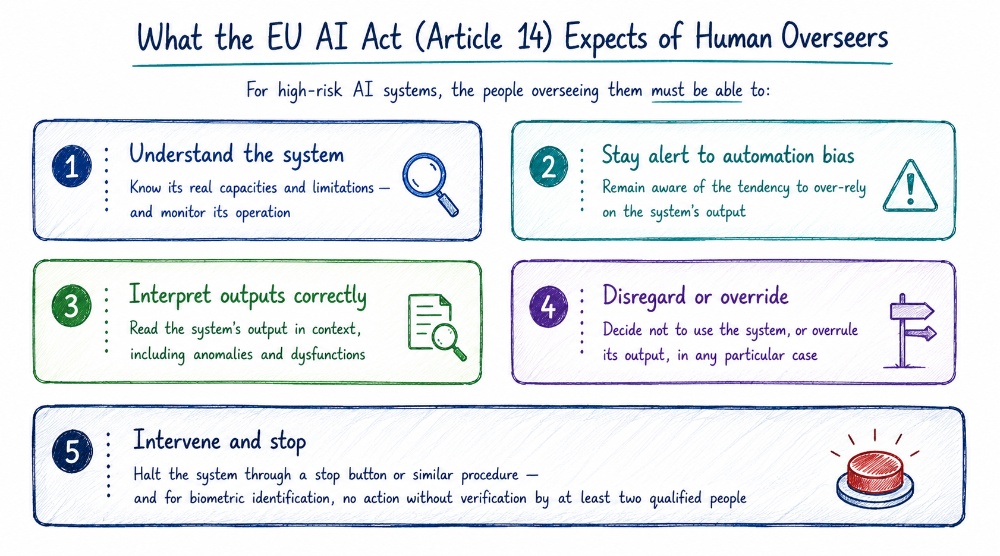
Regulation increasingly mandates the same list. Under Article 14 of the EU AI Act, overseers of high-risk systems must understand the system’s limits, stay alert to automation bias, interpret outputs correctly, and be able to override or stop it. The regulatory bar and the operational one converge on one standard: oversight counts only when the human can actually say no.
Figure 4. Score stakes against demonstrated confidence to place each decision type.Figure 5. EU AI Act Article 14: five capabilities every overseer of high-risk AI must have.
Designing Meaningful Human Oversight: Six Principles
Knowing where humans belong is half the problem. The other half is designing their involvement so it works at production scale. Six principles do most of that work.
Principle 1: Risk-Based Oversight
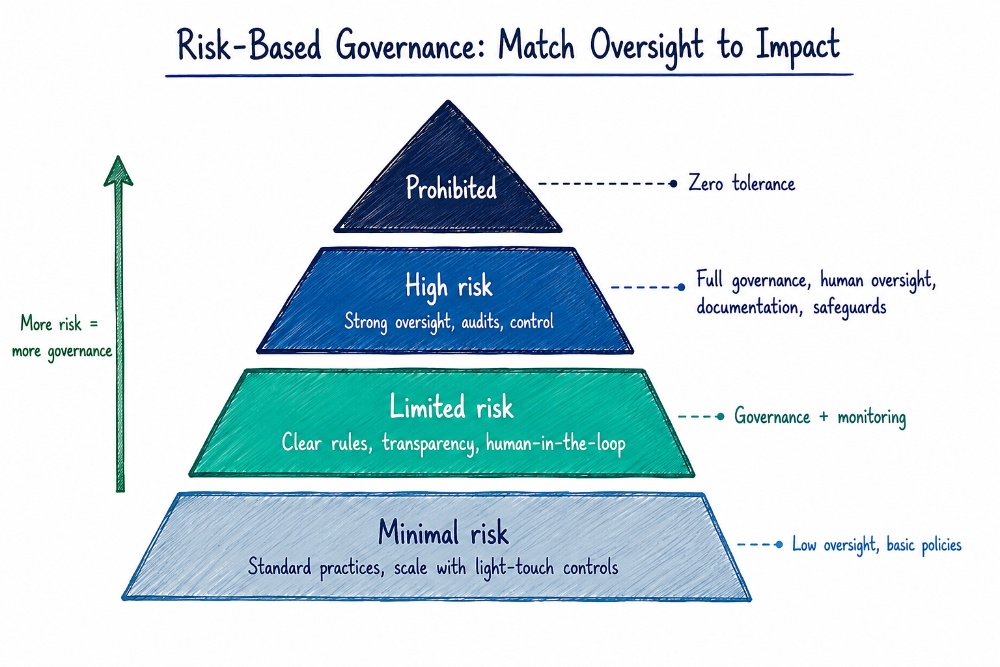
Not every workflow needs identical review. Classify decisions into tiers by impact and reversibility, then scale the oversight mode to the tier. Full approval at the top, supervision in the middle, spot-checks and aggregate monitoring below. Proportionality keeps oversight sustainable as volume grows.
Figure 6. Match the weight of oversight to the impact of the decision.
Principle 2: Confidence-Based Escalation
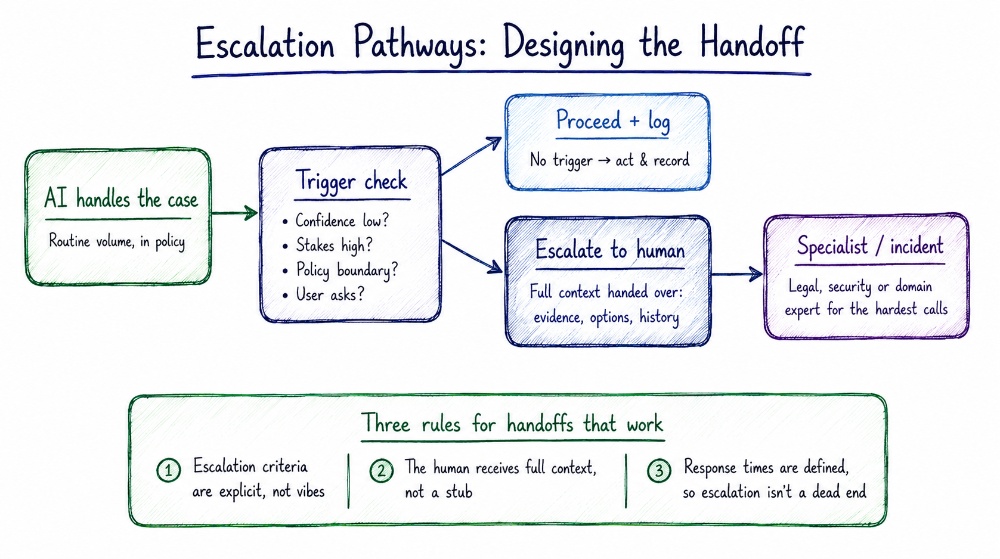
Within each tier, route by certainty. High-confidence cases execute automatically while low-confidence cases go to a human, using the model’s own uncertainty as the triage mechanism. This only works if escalation is engineered: explicit triggers, full context handed to the reviewer, and defined response times.
Figure 7. Confidence-based escalation: designing the handoff.
Principle 3: Approval Thresholds
Some actions require approval regardless of confidence. Payments above a limit, customer refunds, anything resembling medical diagnosis, and legal documents leaving the building all qualify. Thresholds encode risk appetite as an enforceable rule rather than a judgment call made under pressure, which makes them the easiest control to defend.
Principle 4: Explainability
Reviewers can only exercise judgment on what they can interrogate. They need evidence, a confidence signal, sources, and reasoning. Note what they do not need: internal model weights. Externally understandable reasoning that lets a human verify the decision matters more, enough context to check the work without a neuroscience lecture.
Principle 5: Observability
Intervention requires visibility. Humans need logs of inputs and outputs, metrics for quality and drift, alerts wired to thresholds, and records of failures. For agents, add traces of behavior and tool usage. Observability is the difference between oversight on a diagram and oversight a person can perform at 2 a.m.
Principle 6: Continuous Feedback
Every human interaction with the system is training signal. Approvals, corrections, overrides, and escalation outcomes should feed back into prompts, models, retrieval content, and the oversight rules themselves. Override tracking also doubles as a health check on the humans: Scientific Reports shows people accept AI recommendations even when wrong, and a reviewer who never disagrees has stopped reviewing. Encouragingly, Cognitive Research finds that simply warning reviewers about error rates measurably reduces blind acceptance.
Figure 8. The rubber-stamp trap, and how to keep reviewers engaged.
Human Oversight for AI Agents
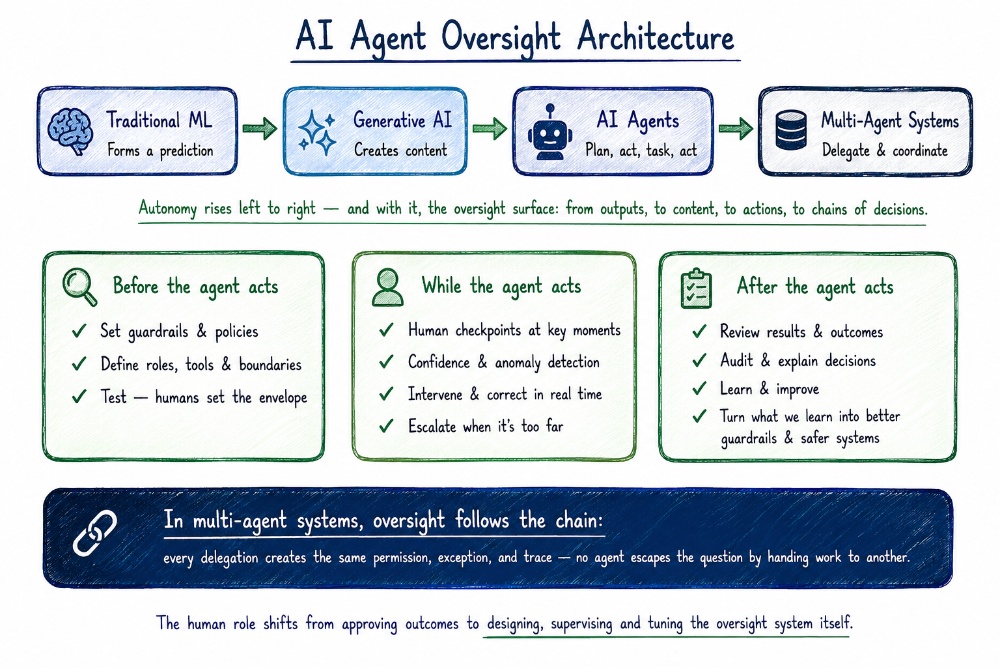
These six principles apply to every AI system, but agents raise the stakes on all of them at once. Each generation has widened the oversight surface. Traditional ML produced predictions a person still acted on. Generative AI produced content a person might forward unread. Agents plan, hold memory, use tools, and act, while multi-agent systems delegate work to each other.
The oversight question shifts from “is the answer right?” to “was the action allowed, and can we see the chain that led to it?” Practical agent oversight wraps autonomy in an envelope that humans design and tune, in three phases:
Before the agent acts: scoped permissions and identity, tool allow-lists, action boundaries, and memory rules.
While it acts: human checkpoints for irreversible steps, confidence-based escalation, and live traces of every step and tool call.
After it acts: sampled run reviews, audit trails, and incident analysis that tunes the boundaries.
In multi-agent systems, the envelope must follow the chain. Every delegation inherits the same permissions, checkpoints, and traces, so no agent escapes oversight by handing work to another. The human role becomes designing and supervising the envelope rather than approving each action: human-in-command, applied to agents.
Figure 9. Agent oversight: humans design, supervise, and tune the envelope.
Production Oversight in Practice: From Signal to Intervention
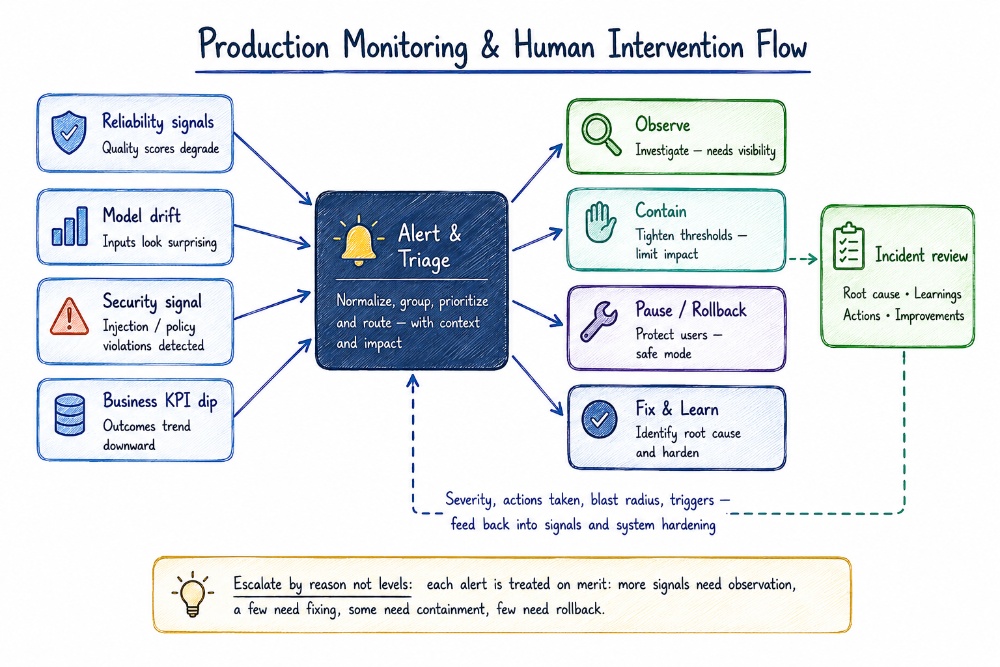
Envelope or not, something will eventually go wrong, and production oversight runs as a monitoring-and-response loop when it does. Signals such as hallucination spikes, drift, security anomalies, and KPI dips flow into alerting that pages a named on-call owner with full context.
The owner then chooses from escalating responses: observe, constrain, pause and roll back, or halt entirely via kill switch. Every intervention feeds an incident review that tunes boundaries and evaluations. Most signals need only observation. A few will someday need the kill switch, which is why it must exist, tested, before it is needed.
Figure 10. From monitoring signal to human intervention, with escalating response levels.
The Enterprise Oversight Operating Model
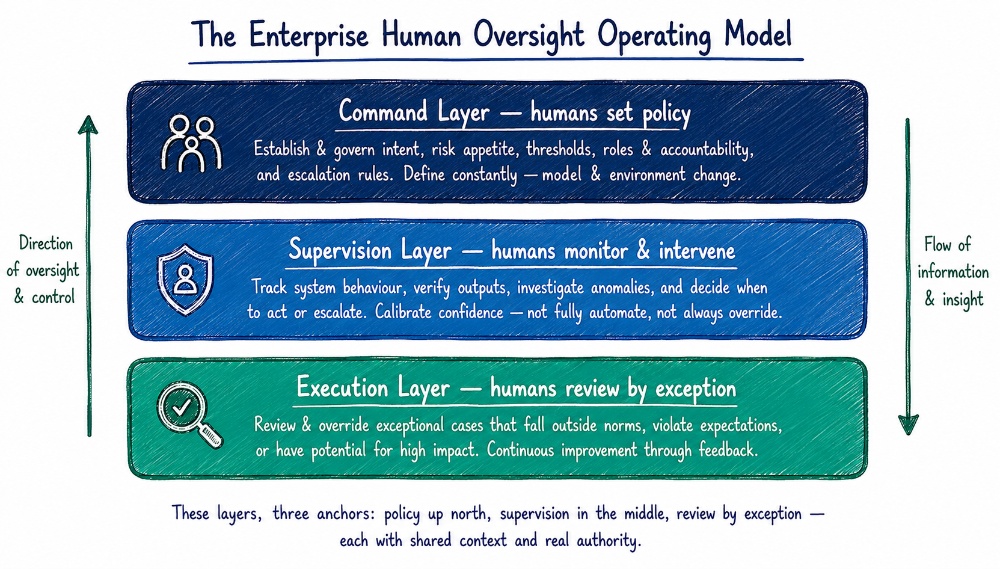
Command layer — executives and the governance committee: Sets the organization’s risk appetite approval thresholds, and autonomy boundaries. This layer also reviews these decisions quarterly or whenever new evidence requires changes.
Supervision layer — system owners and on-call teams: Monitors systems continuously. Holds the authority to intervene when risks, failures, or exceptions arise.
Execution layer — reviewers and domain experts: Handles judgment at the individual-decision level. Steps in when routing rules require human review or specialist input.
Information and accountability flow: Policy flows downward from the command layer. Evidence and operational feedback flow upward. Every layer must have clearly named owners with genuine decision-making authority.
The most common failure (missing middle): Organizations often have policies at the top and reviewers at the execution level. However, no one owns the supervision layer where day-to-day production oversight actually occurs.
Figure 11. Three layers, three cadences: policy quarterly, supervision continuous, review by exception.
Common Human Oversight Mistakes
Even organizations that build all three layers tend to repeat the same mistakes. The most common:
Reviewing everything until reviewers burn out and rubber-stamp
Reviewing nothing because the demo went well
Approvals that are clicks rather than judgments
No escalation paths, so edge cases get guessed at
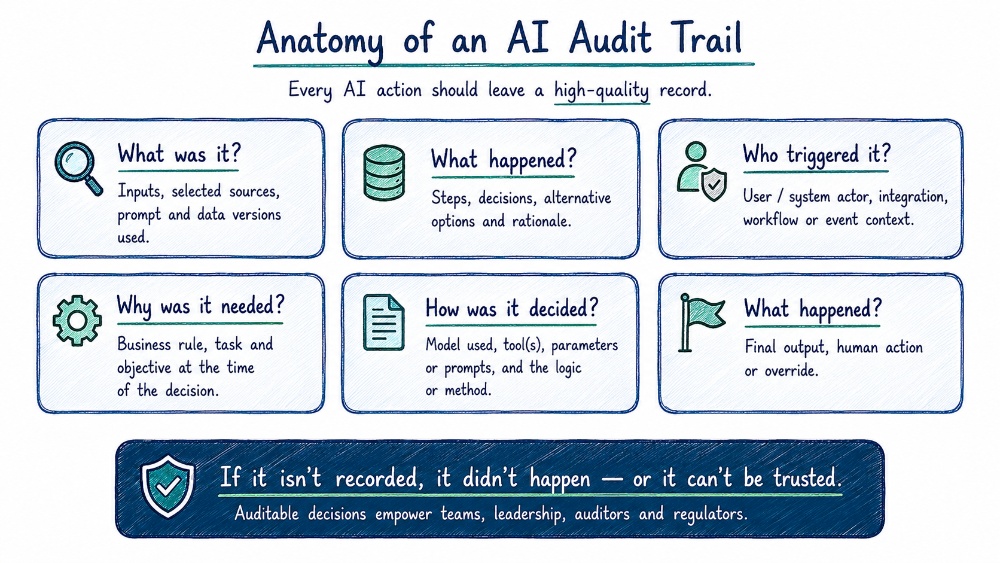
No audit trails, so decisions cannot be reconstructed
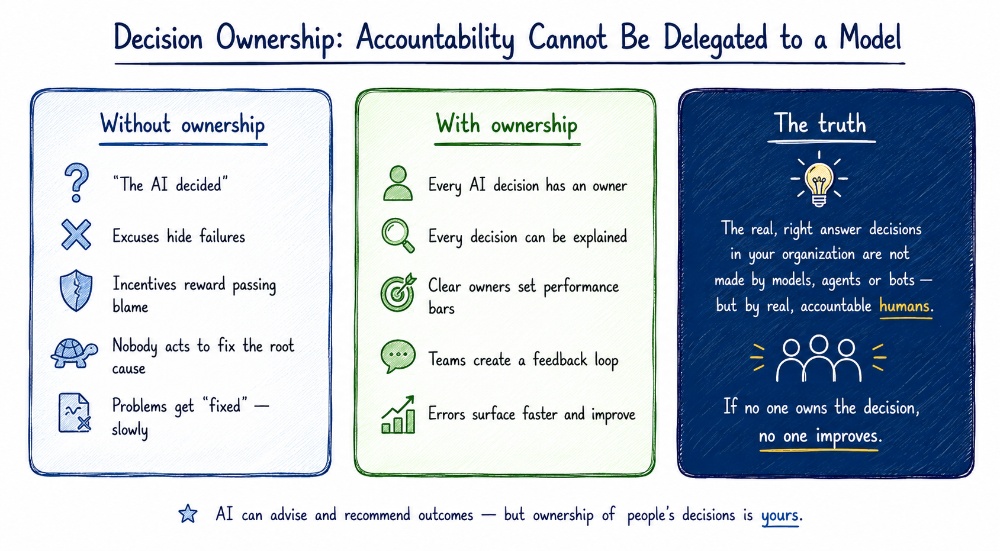
No ownership, so systems run with nobody accountable
No monitoring, so the first alert is a customer complaint
Overriding AI without understanding it
Ignoring the feedback that overrides and corrections generate
Figure 12. The ownership test: accountability cannot be delegated to a model.
Best Practices for Enterprise AI Oversight
The programs that avoid those mistakes share a familiar toolkit:
Risk-based reviews rather than uniform ones
Role-based permissions for humans and AI systems alike
Human override authority that is technically real, not just documented
Audit trails recorded at decision time
Continuous evaluation on live traffic
Incident response with runbooks and on-call rotations
Monitoring and observability as the shared foundation
Training that builds calibrated trust in reviewers
Documentation maintained as systems evolve
Cross-functional governance across legal, security, engineering, and the business
Figure 13. If it isn’t recorded, it didn’t happen: the anatomy of an AI audit trail.
How Omdena Helps Organizations Build Human-Centered AI
Everything above has to be designed and built, not declared, and that is where most organizations struggle. Not because their AI lacks intelligence, but because production AI requires operational processes that balance autonomy with human accountability.
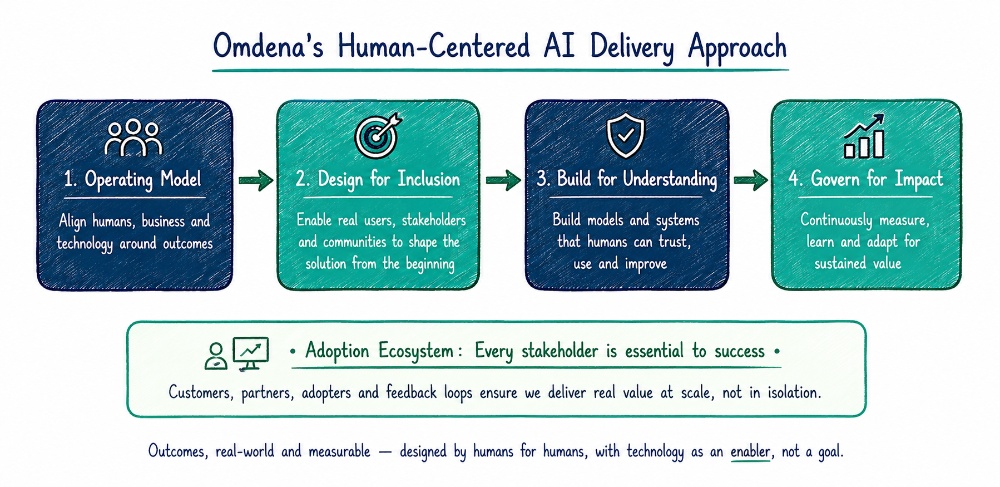
Omdena works on exactly that. It helps organizations design AI operating models that define where autonomy is allowed, build production systems with review workflows and escalation as architecture, implement human review workflows and governance processes, and deploy the monitoring and evaluation pipelines that tell humans when to look. Its adoption programs then train teams to supervise AI well, because calibrated oversight is a skill, not just a workflow.
Figure 14. Omdena’s human-centered AI delivery approach.
How Umaku Enables Context-Aware Human Oversight
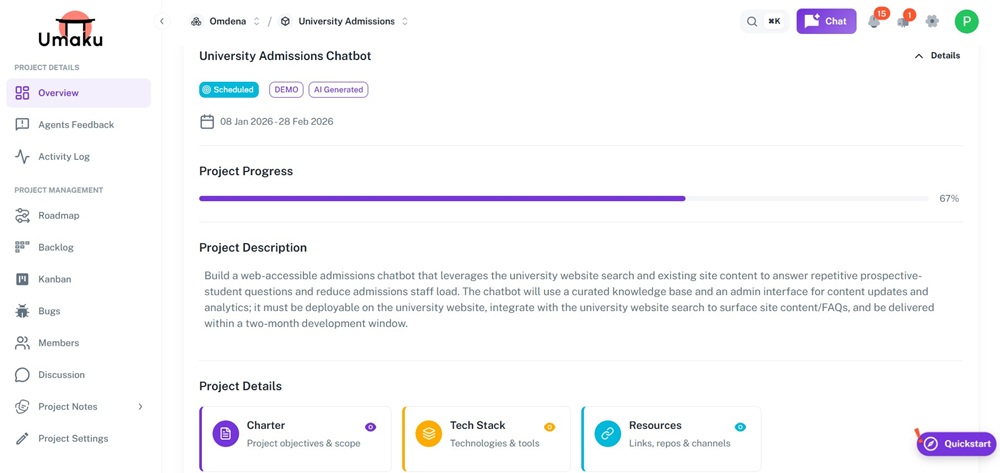
Skills and processes still need a place to live. Oversight becomes burdensome for one reason above all: missing context. Reviewers are asked to judge work without the goals, rules, and history needed to judge it quickly. Umaku attacks that problem directly, making oversight practical rather than constant:
Figure 15. Umaku: context-aware oversight built into the way work flows.
Shared business context. Project goals, policies, business rules, and success metrics live alongside the work, so every review starts from what the system should achieve.
Technical context. Architecture, repositories, dependencies, and standards stay connected to delivery, so reviewers see the real system rather than a stale diagram.
Delivery oversight. Roadmaps, sprints, tasks, and approval checkpoints run in one tracked flow, making control points steps that work passes through.
AI-assisted reviews. Context-aware code reviews, sprint validation, bug detection, and risk identification do the first pass, surfacing what deserves human attention.
Continuous monitoring. Code quality, delivery health, operational readiness, and compliance checks generate the oversight telemetry humans act on.
Human collaboration. Engineers validate AI recommendations instead of reviewing every line of code, and teams intervene where their expertise matters most.
That last point is the model this whole guide argues for: oversight that is selective and informed by context, not constant manual inspection.
The Future of Human Oversight
Oversight is heading from static to adaptive. Fixed approval chains, the same sign-offs for every case, are already straining under agentic volume. The emerging pattern is adaptive autonomy: systems earn wider boundaries as their track record accumulates and lose them when performance degrades.
Dynamic approval workflows will route each case by risk, confidence, and context rather than by org chart. AI supervisors, models that monitor other models and agents, will flag anomalies for human attention, extending human evaluative capacity rather than replacing it. Humans stay in command of the policies those supervisors enforce.
The direction of travel is clear. Organizations will move from fixed approval chains to risk-aware, context-aware oversight, treating human attention as the scarce, high-value resource it is and spending it exactly where it changes outcomes.
Conclusion
Human oversight should not be measured by how often people intervene, but by how effectively organizations design systems that know when human judgment is required. As AI grows more autonomous, competitive advantage comes from balancing automation with accountability, not from choosing one.
The evidence backs both halves of that claim: oversight maturity now gates agent adoption, and passive review reliably fails exactly when it matters. Organizations that embed risk-based intervention, confidence-driven escalation, agent envelopes, observability, and continuous feedback will scale faster and earn more trust than those relying on either excessive manual review or unchecked autonomy. Build systems that know when to ask for a human, and humans who are ready when asked.
FAQ
What is human oversight in AI?
Human oversight in AI is the deliberate design of processes, controls, and decision points that allow people to monitor, validate, intervene in, or override AI systems when human judgment is necessary.
Why is human oversight important in AI?
Human oversight helps organizations reduce the risks of incorrect decisions, security incidents, compliance violations, and unintended AI actions while ensuring AI systems remain accountable, reliable, and safe as they become more autonomous.
What are the different types of human oversight in AI?
There are three primary oversight modes: human-in-the-loop, where people approve every decision before execution; human-on-the-loop, where AI operates autonomously under human supervision; and human-in-command, where people define policies, autonomy boundaries, and intervention rules while retaining overall control.
When should humans intervene in AI systems?
Humans should intervene when AI makes high-value or irreversible decisions, operates in regulated or high-risk domains, encounters uncertainty or unfamiliar situations, or when users or the AI system itself request human review.
What are the best practices for implementing human oversight in AI?
Effective human oversight relies on risk-based reviews, confidence-based escalation, approval thresholds, explainability, observability, continuous feedback, and clearly defined ownership to balance automation with accountability.
Continue with Omdena
Share this article
Share on LinkedIn, send by email, or copy the direct link.