Responsible AI Adoption in NGOs: How Trust, Governance, and Ethics Decide What Works
10 min read
Okon PrinceSenior Data Scientist / Forward Deployed Engineer
A field officer is behind on a donor report. To save time, she pastes a week of case notes into a free AI tool and asks for a summary. The summary is good. But nobody knows where the notes went, whether they included names, or whether the people described would ever have agreed.
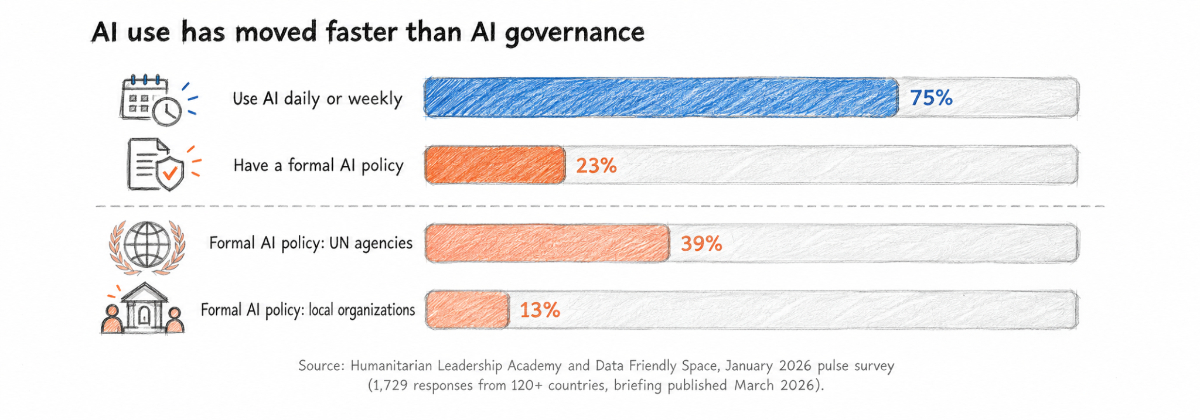
Scenes like this are now routine. In a January 2026 pulse survey by the Humanitarian Leadership Academy (HLA) and Data Friendly Space, 75% of respondents used AI daily or weekly, but only 23% had a formal AI policy.
For NGOs, that gap is a trust problem, because trust is what the whole organization runs on. This article covers why trust decides adoption, how far governance lags behind use, six ethical risks to govern, what proportionate governance looks like, and a practical roadmap for responsible AI for NGOs.
Why Trust Decides AI Adoption in the NGO Sector
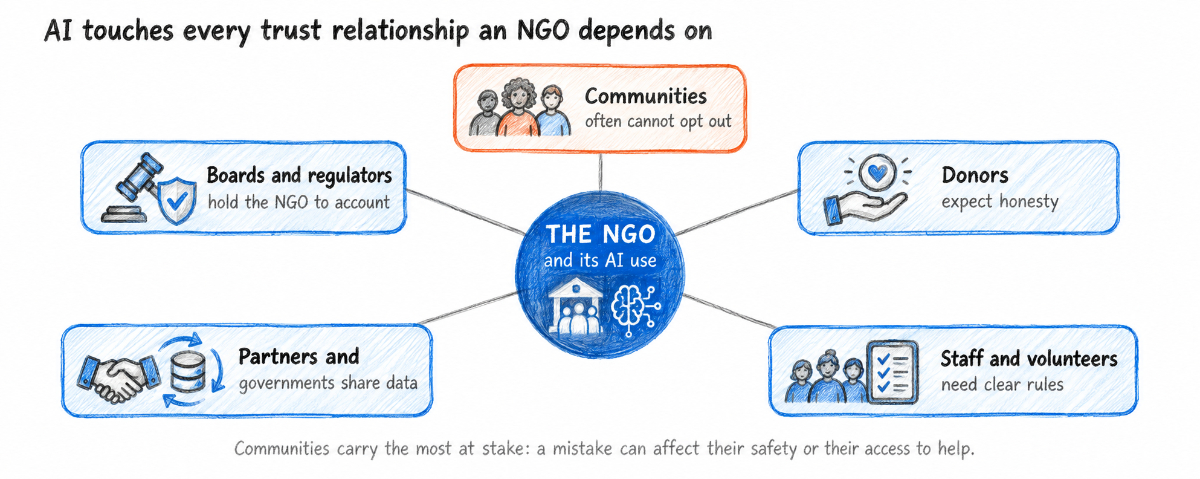
An NGO depends on trust in several directions at once, and AI touches every one of them (Figure 1):
Communities, who often cannot refuse a service or opt out of data collection
Donors, who expect honesty about how their money and data are used
Staff and volunteers, who need to know what they may do with AI tools
Partners and governments, who share data and expect it to be protected
Boards and regulators, who hold the organization accountable
Figure 1. AI Touches Every Trust Relationship an NGO Depends On
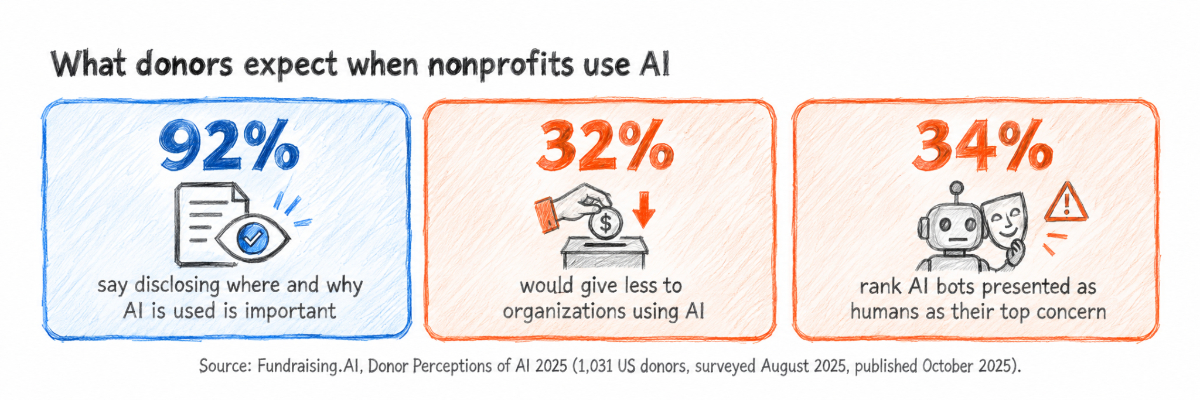
Donors are paying attention. In Fundraising.AI’s Donor Perceptions of AI study , 92% said it was important for nonprofits to disclose where and why they use AI, and 32% said they would give less to organizations using it (Figure 2).
Figure 2. What Donors Expect When Nonprofits Use AI
Source: Fundraising.AI, Donor Perceptions of AI 2025
Communities have even more at stake. A data leak or a biased decision can affect their safety or their access to help, and they rarely have anywhere else to turn.
For an NGO, lost trust is more than a reputation problem. It can cut funding, weaken community participation, and put people at risk.
The Gap Between AI Use and AI Governance in NGOs
The survey figures in the introduction are not an outlier. Across the sector, use has moved faster than the rules around it (Figure 3):
Local organizations are among the most frequent AI users, yet only 13% have a formal AI policy, compared with 39% of UN agencies (HLA and Data Friendly Space, January 2026).
Nonprofit executives: in the 2026 State of Nonprofit AI report by NTEN and The Bridgespan Group , only 38% of 404 executives had written guidance on responsible AI use, and only 40% had rules on what data can go into AI tools.
Figure 3. AI Use Has Moved Faster than AI Governance
Source: Humanitarian Leadership Academy and Data Friendly Space, January 2026 pulse survey
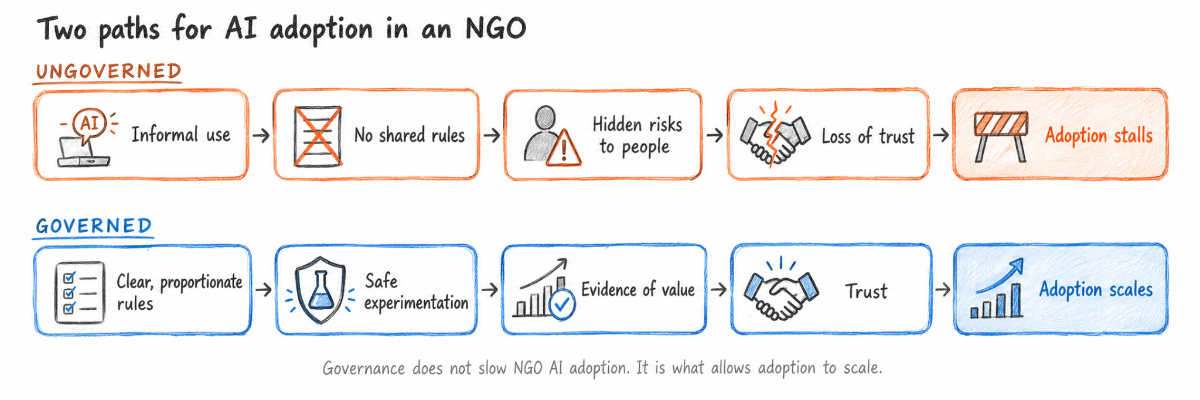
The practical result is shadow AI: staff using public tools with no shared rules, while leaders cannot see what data leaves the organization. That is rarely carelessness. It is what happens when busy people find a useful tool and nobody has explained how to use it safely. Figure 4 shows where each path leads.
Figure 4. Two Paths for AI Adoption in an NGO
Six Ethical Risks NGOs Need to Govern
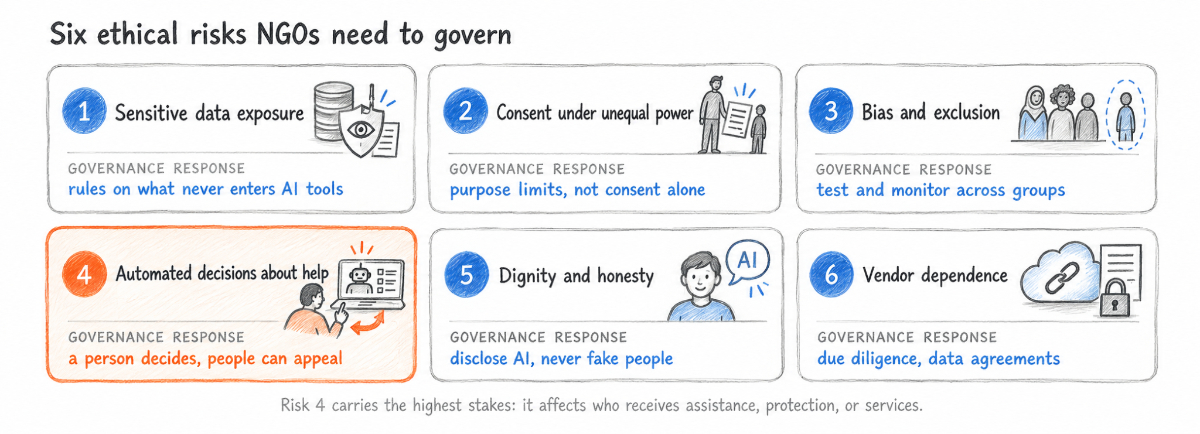
These risks are practical, not abstract. Each one affects real people, and each has a clear governance response. Figure 5 summarizes all six.
Figure 5. Six Ethical Risks NGOs Need to Govern
1. Exposure of Sensitive Personal Data
Case notes, protection records, health data, and the locations of vulnerable people can end up in public AI tools or with vendors whose data practices nobody has reviewed. Once shared, that data may be impossible to recall. Staff rarely mean harm. They are usually trying to save time on reporting or translation.
Governance response: set clear rules on data that must never enter AI tools, approve a short list of tools, and require a data protection review before any new use. Explain the rules to staff in plain language.
2. Consent under Unequal Power
When aid depends on registration, consent is rarely free. People may agree to anything to receive help, and few are in a position to ask how an AI system will use their data. In humanitarian settings, that power imbalance is built into the relationship, not a sign of bad practice.
Models trained on incomplete data can overlook people who are already underrepresented: remote communities, minority language speakers, people without phones, and people with disabilities. A tool that works well on average can still fail the people who need it most. Language is a common failure point: a chatbot that only works in the main national language quietly excludes everyone else.
Governance response: test for representation gaps before deployment, and monitor outcomes across groups after launch, including by language and location.
4. Automated Decisions about Access to Help
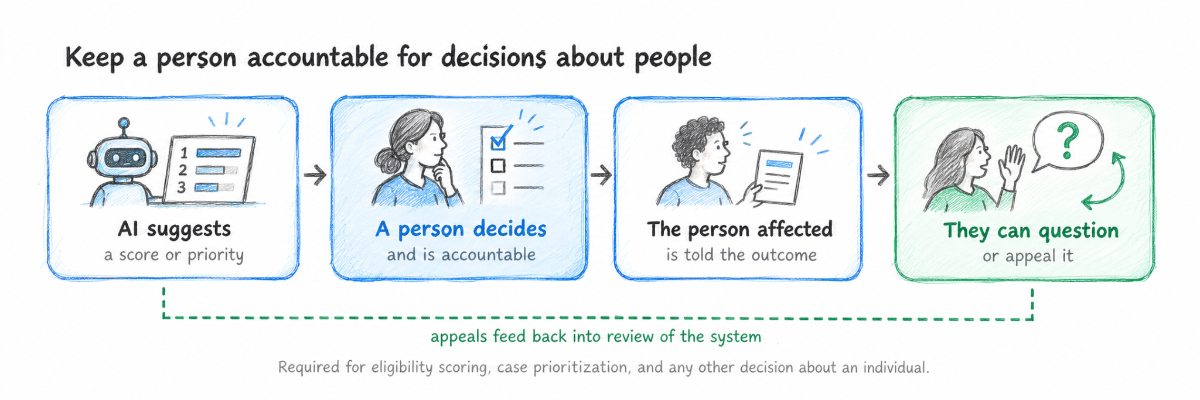
The highest-risk uses affect who receives assistance, protection, or services, such as eligibility scoring or case prioritization. An error here is not an inconvenience. It can mean a whole family goes without support. Automation can also make errors harder to see, because a score looks objective even when the data behind it is incomplete.
Governance response: keep a person accountable for every decision about an individual, and give people a clear way to question or appeal the outcome (Figure 6).
Figure 6. Keep a Person Accountable for Decisions about People
5. Dignity and Honesty in Communications
AI-generated images of people in need, synthetic testimonials, and chatbots that do not say they are AI can mislead donors and misrepresent communities. Donors notice: in the Fundraising.AI study, 34% ranked AI bots presented as humans as their single greatest concern. Staff under pressure to produce compelling campaigns may not see the line until a donor or journalist points it out.
Governance response: disclose AI use in communications, and never present AI-generated people or stories as real.
6. Vendor Dependence and Data Sovereignty
Many NGOs rely on free or donated AI tools. Terms can change, data may be stored in another jurisdiction, and local partners can lose control over data about their own communities. Smaller local organizations are often the most exposed, because they have the least capacity to negotiate terms.
Governance response: carry out basic vendor due diligence, sign clear data-sharing agreements, and know where data is stored and who can reach it. Plan in advance how you would switch tools if terms change.
The closer an AI system gets to deciding who receives help, the stronger the governance around it must be.
What Proportionate AI Governance Looks Like for an NGO
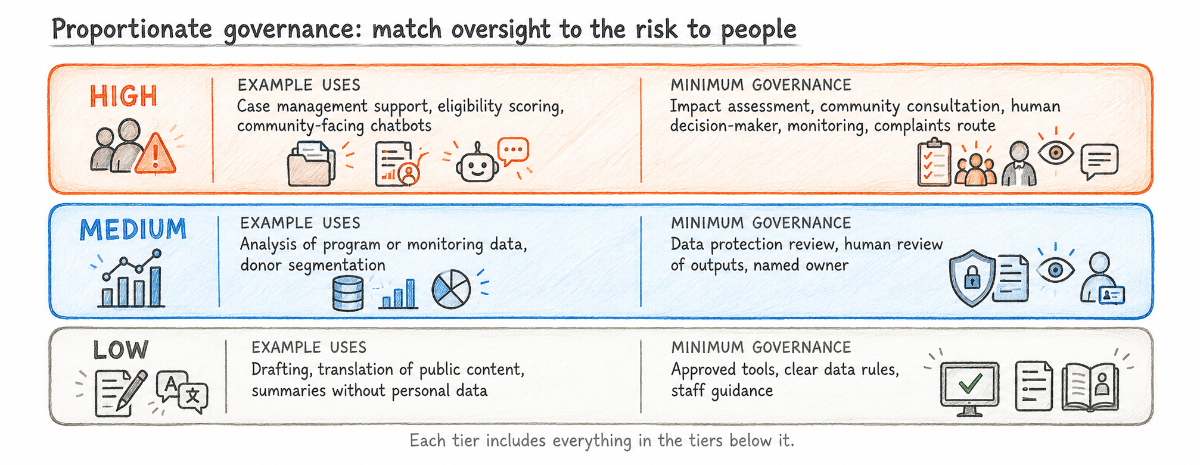
None of this requires a large compliance team. The principle is proportionate governance: oversight should match the risk to people, not the novelty of the tool. Figure 7 shows three tiers, and each includes everything below it. Most NGO AI use falls into the low tier, which is good news: the first steps are cheap.
Figure 7. Proportionate Governance: Match Oversight to the Risk to People
Low risk, such as drafting or summarizing documents without personal data, needs approved tools, clear data rules, and staff guidance.
Medium risk, such as analyzing program or monitoring data, adds a data protection review, human review of outputs, and a named owner.
High risk, such as eligibility scoring or community-facing chatbots, adds an impact assessment, community consultation, a human decision-maker, ongoing monitoring, and a complaints route.
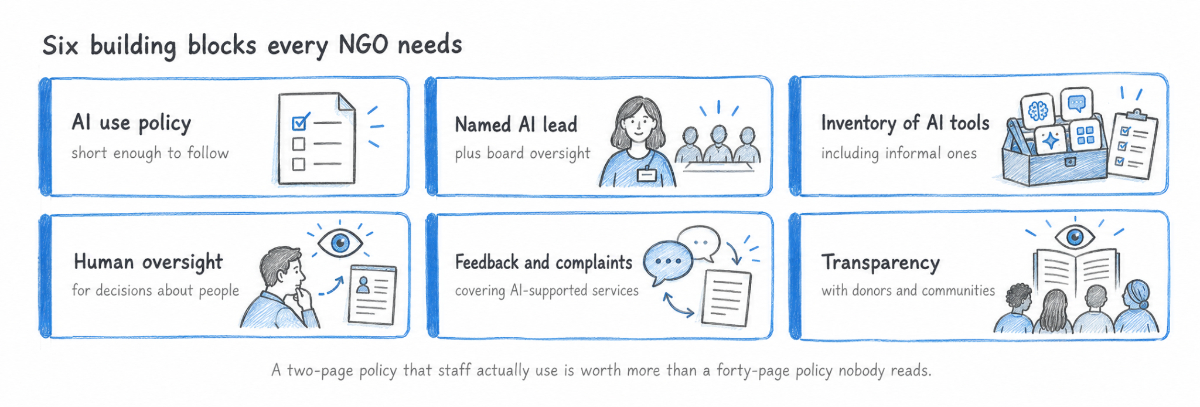
The SAFE AI framework from the CDAC Network, The Alan Turing Institute, and the Humanitarian AI Alliance uses a similar three-tier model and is the most relevant sector reference. The NIST AI Risk Management Framework and UNESCO’s Recommendation on the Ethics of AI add broader principles. Reuse these frameworks rather than writing your own from scratch. Every NGO also needs the building blocks in Figure 8.
Figure 8. Six Building Blocks Every NGO Needs
A two-page policy that staff actually use is worth more than a forty-page policy nobody reads.
A Practical Roadmap for Responsible AI in NGOs
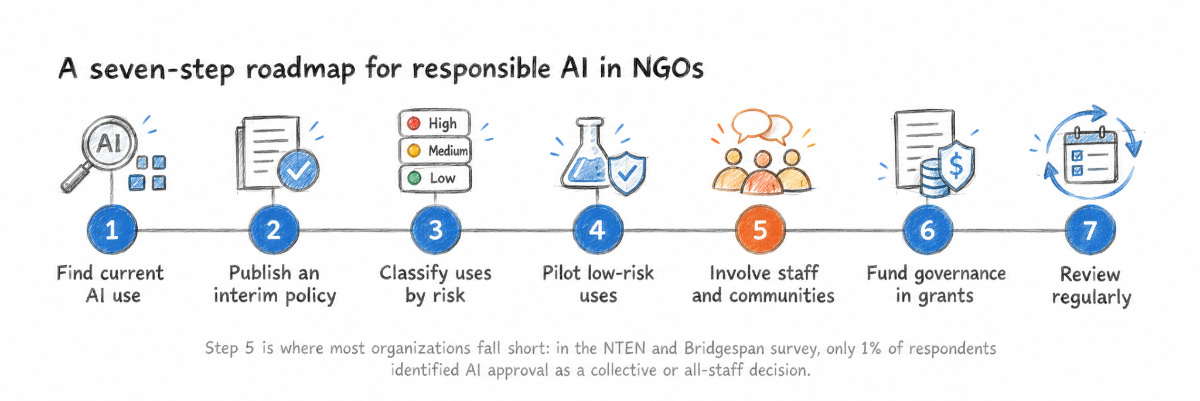
Responsible adoption is a sequence, not a single policy launch. These seven steps work for organizations of most sizes (Figure 9):
Find out how AI is already used, including informal use, without blaming staff.
Publish an interim policy naming approved tools and data that must never be shared.
Classify current and planned uses by risk to people.
Pilot low-risk uses first and measure whether they save time or improve quality.
Involve staff and communities before introducing any high-risk use.
Build governance costs into grant proposals, so oversight is funded.
Review the policy regularly, because tools and risks change quickly.
Figure 9. A Seven-Step Roadmap for Responsible AI in NGOs
Step 5 matters more than it looks. In the NTEN and Bridgespan survey, just 1% of respondents identified AI approval as a collective or all-staff decision. Staff know where AI already helps, and communities know where it could cause harm. Both perspectives are needed before a high-risk system goes live.
How Omdena Can Help NGOs Adopt AI Responsibly
Omdena helps NGOs assess planned AI uses against the risk to people, then design systems with human oversight, privacy, and fairness built in from the start. That includes evaluating models for bias and representation gaps before launch.
Omdena’s global community of AI engineers includes local talent who understand the communities involved, which matters when a system must work across languages, cultures, and uneven connectivity. The approach is practical: start with the use cases staff already rely on, then add safeguards in proportion to the risk.
How Umaku Supports Accountable AI Delivery
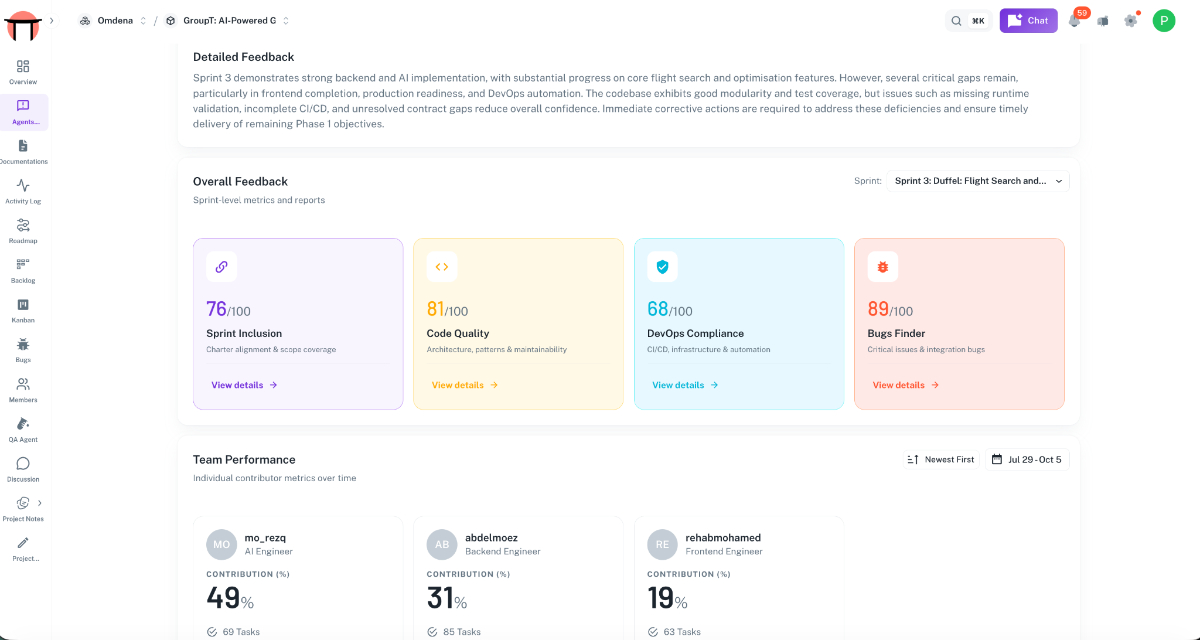
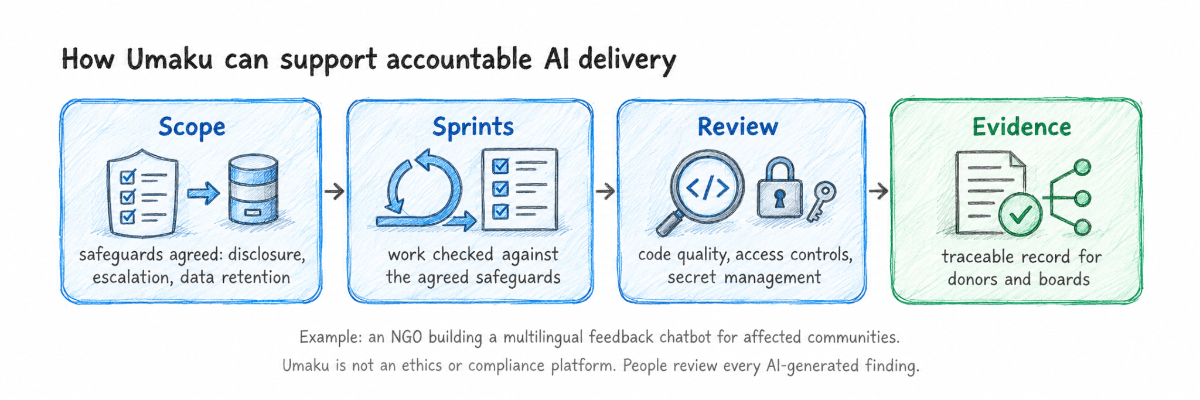
NGOs often have to show donors and boards what was built and how. Umaku, Omdena’s agentic AI delivery platform, supports that accountability during development. An NGO building a multilingual feedback chatbot for affected communities could use it to:
Figure 10. Umaku Showing the AI Feedback Feature
Record agreed safeguards, such as AI disclosure, human escalation, and data retention limits, in the project scope
Check that sprint work implements those safeguards
Review code quality and DevOps practices, including access controls and secrets management
Keep a traceable record of what was built, reviewed, and corrected
Figure 11 How Umaku Can Support Accountable AI Delivery
Umaku is not an ethics or compliance platform, and its AI-generated findings still need human review.
Trust Is What Lets NGO AI Scale
NGOs are already using AI. The real choice is between governed and ungoverned use, not between using AI and avoiding it.
Ungoverned use puts the most important things at risk: sensitive data, fair treatment, honest communication, and the trust of communities and donors. Proportionate governance protects them without slowing teams down. It gives staff clear rules, keeps people accountable for decisions about people, and makes AI use visible to those it affects. For NGOs, responsible AI is simply how “do no harm” applies to AI.
If your organization is planning or already using AI, talk to Omdena about assessing the risks to the people you serve and designing the right safeguards from the start.
FAQ
Why is responsible AI adoption important for NGOs?
NGOs depend on the trust of communities, donors, staff, partners, and regulators. Responsible adoption protects sensitive data, promotes fair treatment, ensures honest communication, and keeps people accountable for decisions made with AI.
What are the main ethical risks of using AI in NGOs?
The primary risks are exposure of personal data, weak consent, bias and exclusion, automated decisions about access to assistance, misleading AI-generated communications, and dependence on vendors with unclear data practices.
What does proportionate AI governance mean?
Proportionate governance means matching oversight to the potential harm an AI system could cause. Low-risk tasks need approved tools and clear data rules, while high-risk uses require impact assessments, community consultation, human decision-makers, ongoing monitoring, and an appeals process.
How can an NGO begin using AI responsibly?
An NGO should first identify how staff already use AI, publish clear interim rules, define prohibited data, approve suitable tools, classify use cases by risk, and pilot low-risk applications before introducing higher-risk systems.
Should AI make decisions about who receives aid or services?
AI may support analysis, but it should not make final decisions about an individual’s access to assistance, protection, or services. A named person should remain accountable, and affected people must have a clear way to question or appeal the outcome.
Share this article
Share on LinkedIn, send by email, or copy the direct link.