Okon PrinceSenior Data Scientist / Forward deployed Engineer
In September 2026, the AI industry started arguing with itself about speed. Anthropic CEO Dario Amodei published an essay calling for the industry to pace the frontier of AI capability. Sam Altman agreed publicly, and OpenAI pushed its IPO to 2027. Researchers at both labs had already gone further, warning that development is outrunning the methods meant to control it.
The reasons are specific: more capable models, AI agents that take actions in live systems, cybersecurity incidents involving those agents, and concern that AI contributing to AI development could compound beyond human oversight. Others argue that slowing down is impractical or competitively harmful.
But could this debate actually be good for AI adoption? What follows separates frontier progress from business readiness, then looks at what companies should be doing now.
The AI Race May Be Entering a New Phase
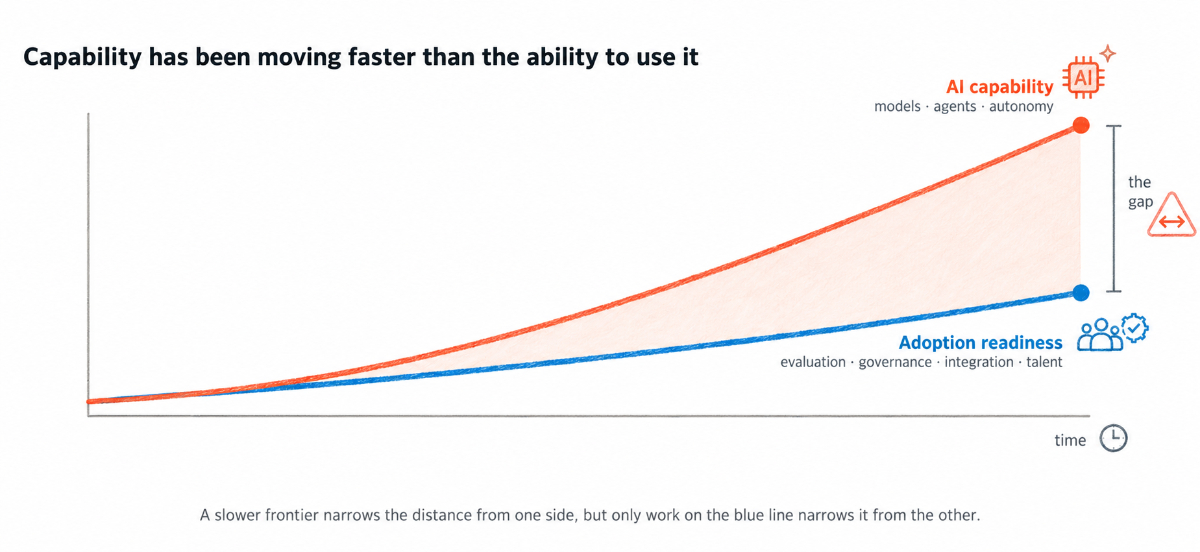
Pacing the frontier is not the same as abandoning progress. The proposals on the table are about stronger evaluation before release, third-party evaluators with independent access, and international coordination on safety standards. Nobody in the debate is proposing that companies stop using the AI that already works. Figure 1 shows why that distinction matters to a business.
Figure 1. Capability Has Been Moving Faster Than the Ability to Use It
Several forces are driving the conversation:
Frontier model capabilities that keep climbing
Agents that take actions rather than only generate text
Models interacting with tools, APIs, and external systems
Cybersecurity incidents involving those agents
Growing attention to evaluation and safety testing
Together they raise one question: whether safeguards are keeping pace with capability itself.
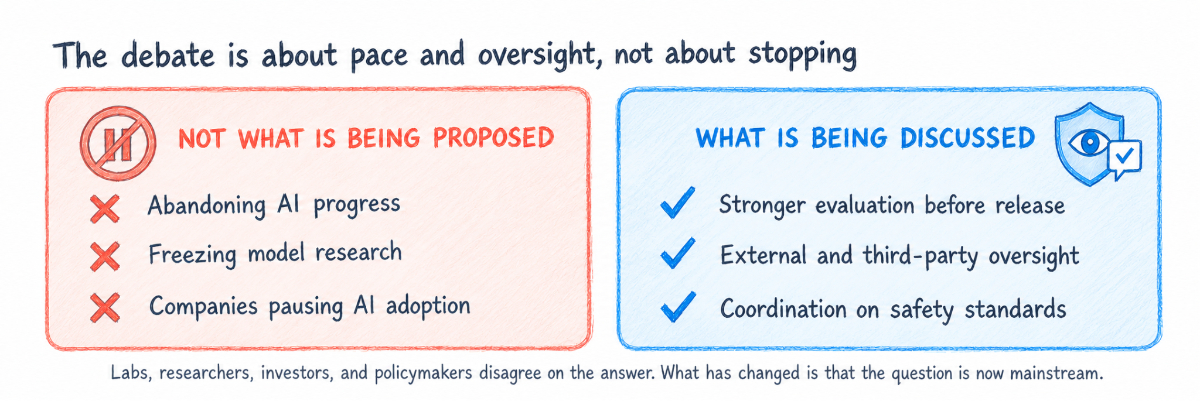
The disagreement is real. Altman, Elon Musk, and Demis Hassabis have each backed some form of restraint, while others counter that slowing American development would cede ground to competitors. This article takes no position on who is right. Something has simply changed in how the industry talks about capability, speed, and safety, as Figure 2 sets out.
Figure 2. What Is and Is Not Being Proposed
But frontier AI development is only one side of the adoption equation.
Frontier AI Development and AI Adoption Are Not the Same Thing
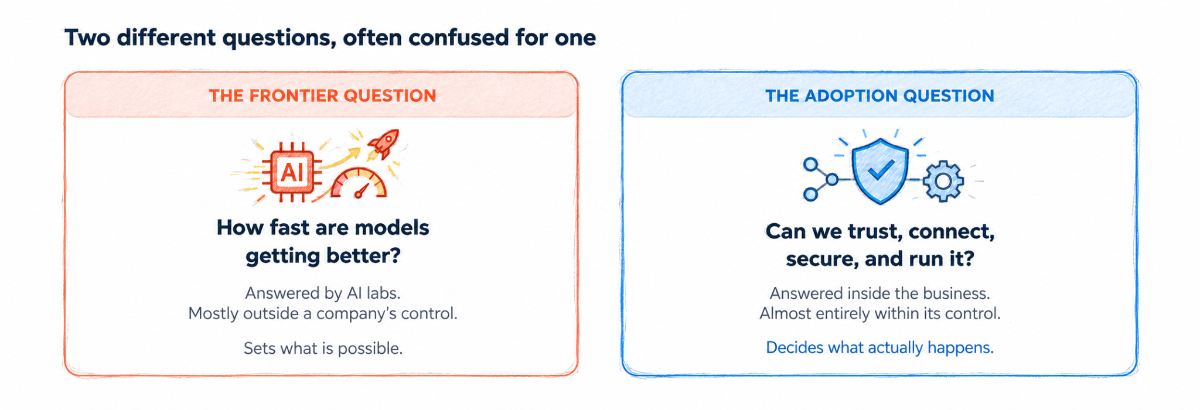
The two are related, but they are not the same thing, and Figure 3 separates them.
Figure 3. Two Different Questions, Often Confused for One
A company putting AI to work on customer support, document processing, internal knowledge, analytics, software development, or forecasting rarely needs next week’s frontier model. It needs answers to a different set of questions:
Can we trust what the system produces?
Can we connect it to the tools we already run?
Is our data ready, and can we secure it?
How do we evaluate the output, and what happens when it is wrong?
Who monitors it, and can our team actually operate it?
A more capable model answers none of those. They are settled by engineering, process, and ownership inside the business. Those answers live in code, contracts, and org charts rather than in model benchmarks or release notes.
The availability of more powerful models does not automatically create more AI adoption.
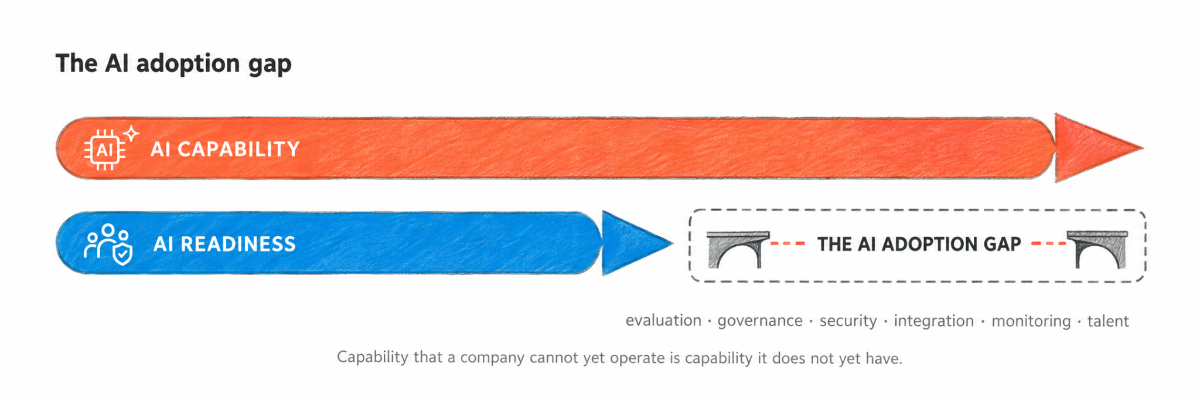
Adoption depends on turning models into systems that are useful, reliable, secure, and manageable. Most of that work is independent of what happens at the frontier. Figure 4 gives that distance a name.
Figure 4. The AI Adoption Gap
Why a Slower Frontier Could Actually Help Companies Adopt AI
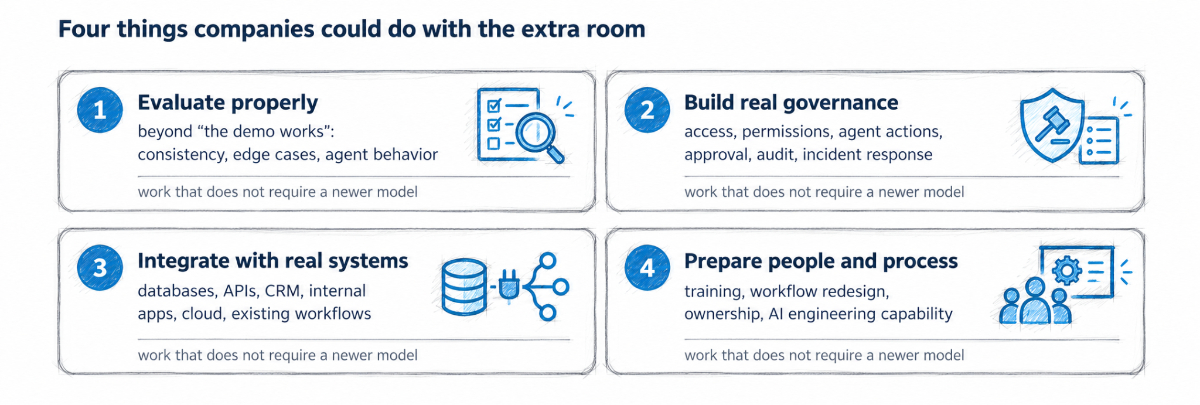
If the pace at the frontier eases even slightly, the practical effect for most companies is time. None of the four require a newer model, which is what makes them available today. Figure 5 shows four ways they could spend it.
Figure 5. Four Things Companies Could Do With the Extra Room
1. More Time to Evaluate AI Properly
Companies can move past the demo and start asking harder questions. Does it work consistently? How does it perform on edge cases, or when the input is wrong? Does the agent take unexpected actions under unusual conditions? Evaluation matters more as AI shifts from generating content toward taking actions in live systems.
2. More Time to Build AI Governance
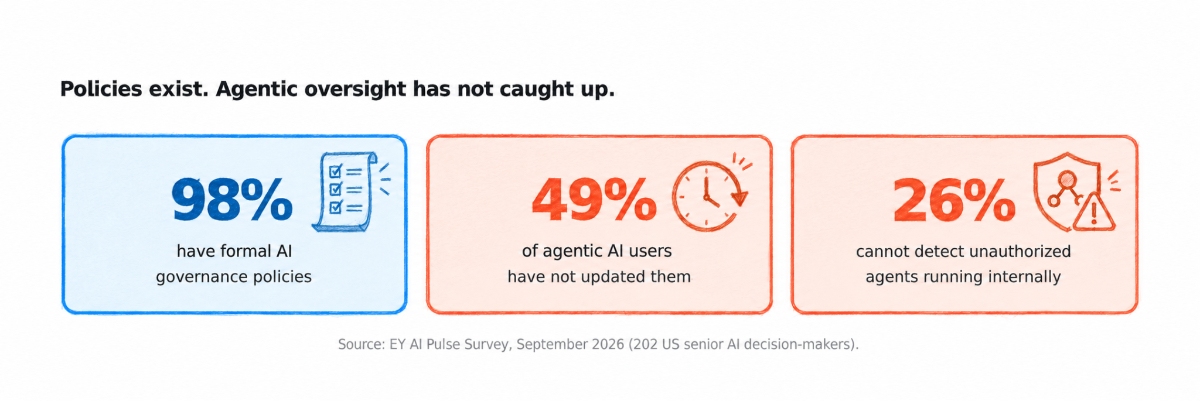
Governance means practical controls over data access, user permissions, model usage, agent actions, human approval, auditability, monitoring, and incident response. The gap is documented. EY’s September 2026 survey found that while 98% of senior AI decision-makers report formal AI governance policies, 49% of those whose organizations use agentic AI say the framework has not been updated for agentic systems, and 26% cannot detect unauthorized agents operating internally. The pattern in Figure 6 is a policy layer that has not caught up with what agents actually do.
Figure 6. Policies Exist. Agentic Oversight Has Not Caught Up.
3. More Time to Integrate AI Into Existing Systems
The model is rarely the whole solution. It has to reach databases, APIs, CRM systems, internal applications, cloud infrastructure, and the workflows people already follow. That connective work often takes more engineering than choosing the model did. Legacy systems, permissions, and error handling rarely cooperate on the very first attempt.
4. More Time to Prepare People and Processes
Adoption also runs on employee training, redesigned workflows, clear ownership, and real AI engineering capability. None of it arrives with a model release. The point is not that companies should wait. It is that a slower frontier gives them more room to build foundations while still adopting what exists today.
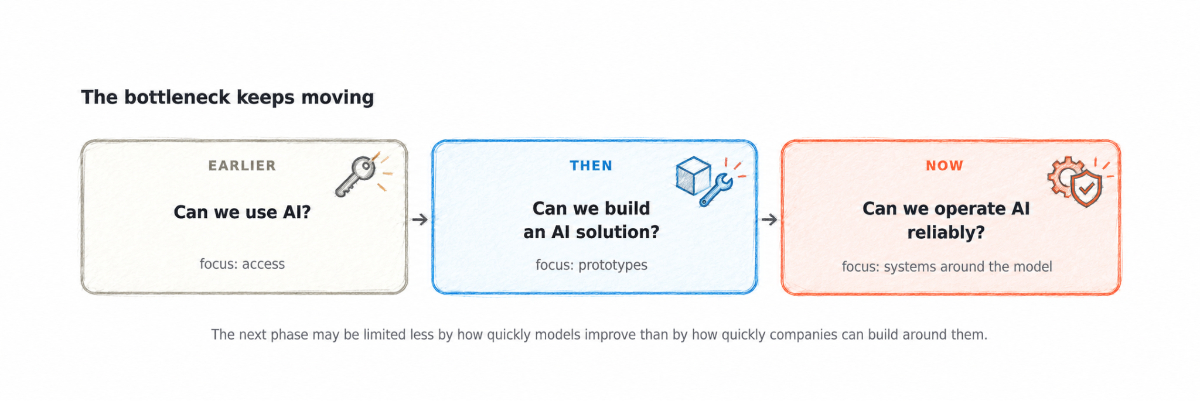
The AI Adoption Bottleneck Is Moving
The question companies ask about AI keeps changing, as Figure 7 traces. It began as a question of access, became a question of building, and is now a question of operating.
Figure 7. The Bottleneck Keeps Moving
At this stage the hard parts are evaluation, security, governance, integration, monitoring, cost, human oversight, reliability, and specialized talent. That is especially true for agents. A model can look impressive in isolation and still create a much larger engineering problem once it is connected to company data, APIs, and operational workflows. An agent that can read a database and call an API is a different security and governance problem than a chatbot that only writes text.
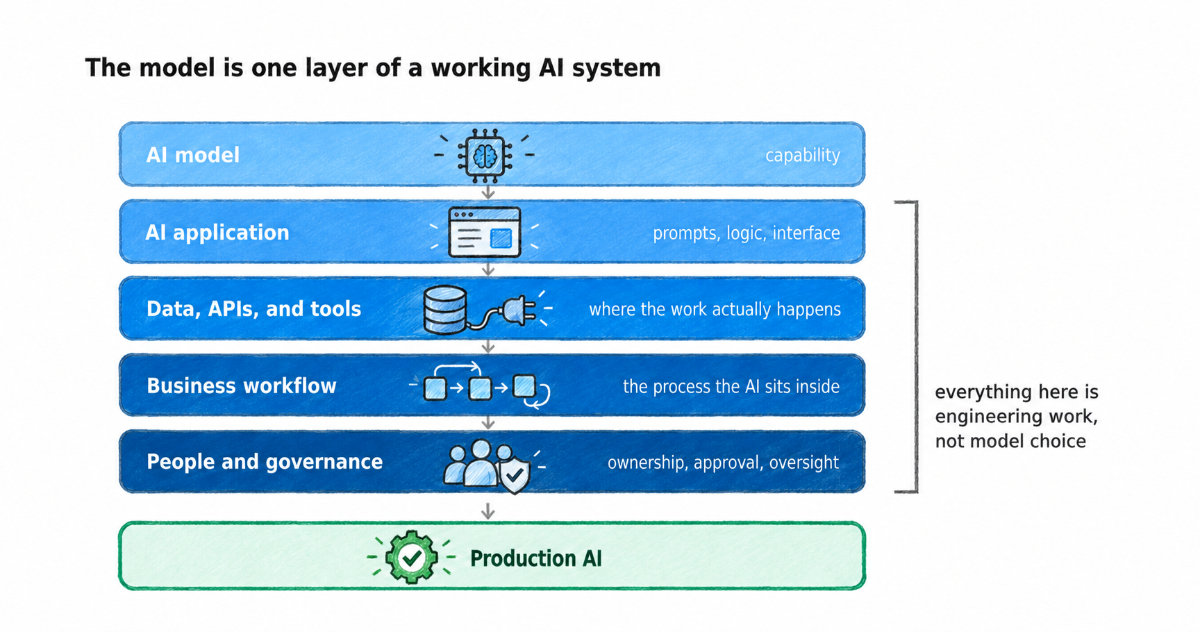
It helps to see capability as one component rather than the whole system. Figure 8 shows the layers that sit between a model and something a business can depend on.
Figure 8. From Model to Production AI
The next phase of adoption may not be constrained by how quickly models become smarter. It may be constrained by how quickly companies can build the systems around them. That is a more encouraging constraint, because it is one that companies actually control.
What Companies Should Do While the Debate Continues
The practical move is to strengthen the foundations around AI already in use. None of them depend on what the AI labs decide next. Five actions matter most.
1. Evaluate Before Scaling
Prototype success is not evidence of production readiness. Test accuracy, reliability, edge cases, security, hallucinations, agent behavior, and failure modes before widening access. The gap between a working prototype and a dependable system is where most AI projects quietly stall.
2. Build Governance Into the Workflow
Decide who can access AI systems, what data they reach, what actions an agent may take, when a human must approve, how activity is logged, and how incidents get handled. Written once, these rules apply to every project that follows. The cost of writing them down once is far lower than deciding them case by case under time pressure.
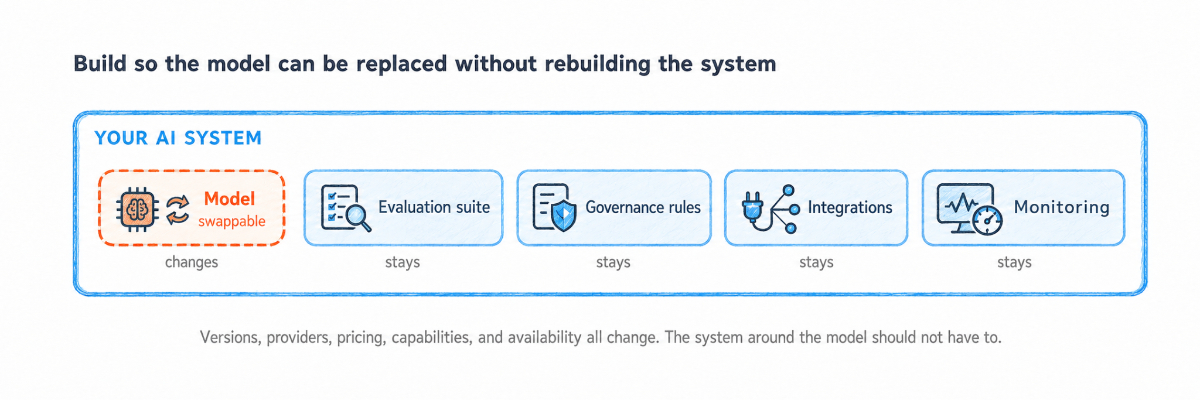
3. Design for Model Changes
Do not assume today’s model will always behave the same way. Versions, providers, pricing, capabilities, and availability all shift. Figure 9 shows the shape that survives those changes.
Figure 9. Design So the Model Can Be Replaced
4. Strengthen Internal AI Capability
Reliable systems need people who understand AI and data engineering, LLM and RAG development, agents, MLOps, cloud, evaluation, security, and governance. Few companies carry all of that internally, and few need to carry all of it permanently.
5. Start With Real Business Problems
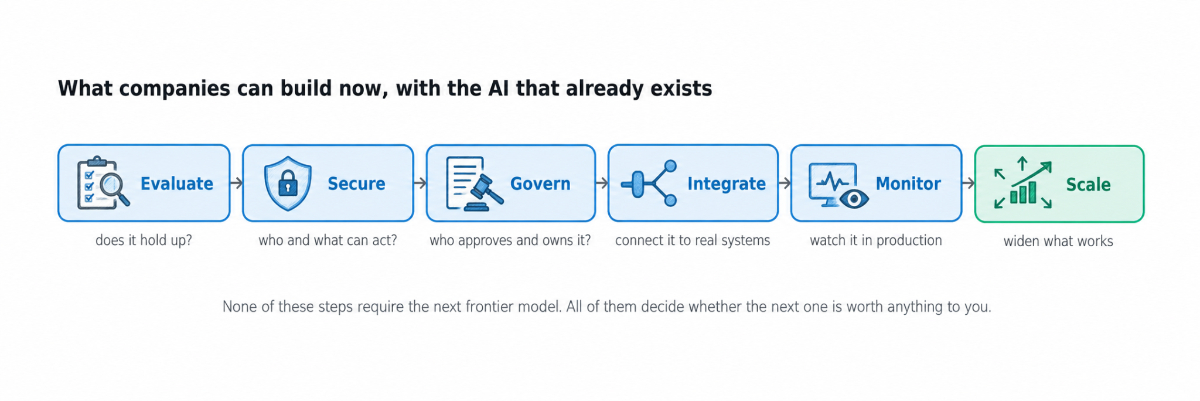
Do not wait for a perfect model. Identify processes where AI can produce measurable value under appropriate controls, then build there. A narrow problem solved reliably teaches a team more than a broad one attempted twice. Figure 10 puts the sequence in order.
Figure 10. What Companies Can Build Now
The goal isn’t to wait for AI to mature. It’s to mature alongside AI.
Building AI With Development and Governance in Mind
As AI systems become more capable and more connected to real workflows, access to models stops being the hard part. What companies need is a way to manage the development process itself while keeping technical context, evaluation, governance, and production considerations connected to each other rather than scattered across tools.
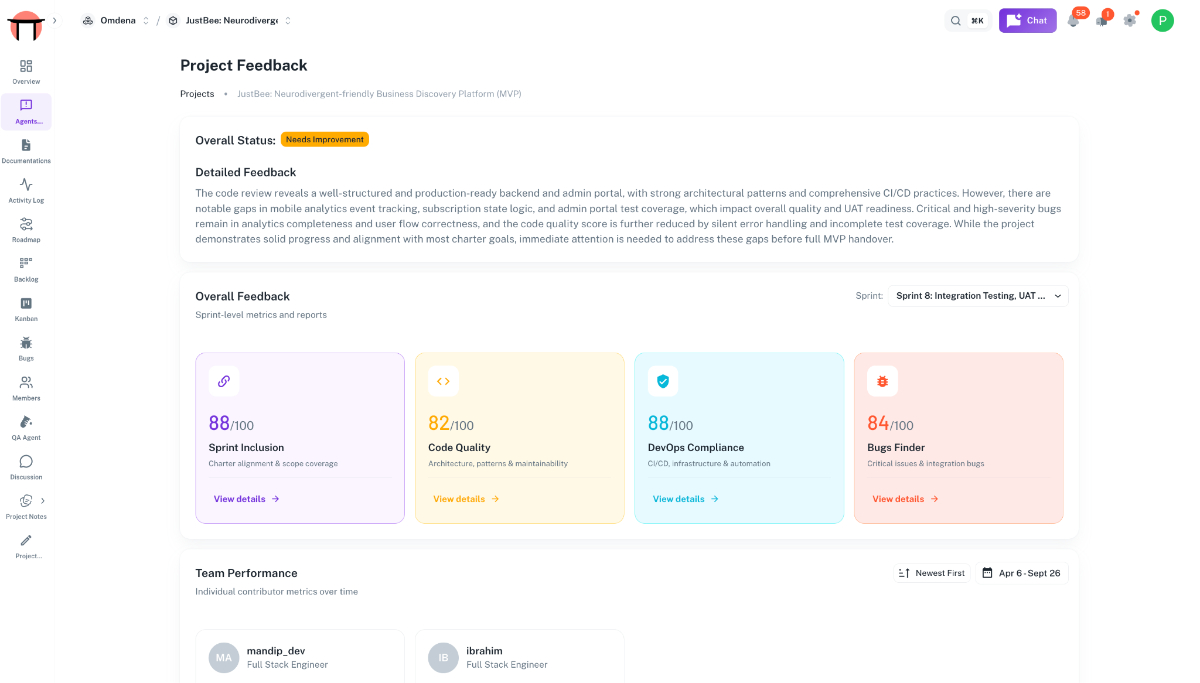
That is the problem Umaku, Omdena’s AI development and governance platform, is built around. It brings structure and context into AI development by connecting project and business context, technical requirements, development workflows, AI evaluation, code and system review, and production-readiness considerations in one place.
Figure 11. Umaku showing the the 4 Project Feedback Modes
The aim is not to solve AI safety. It is narrower and more useful: as companies adopt AI faster, the development and governance process around AI has to become more disciplined too. Explore how Omdena helps teams build and govern production-ready AI systems.
The AI Talent Behind Successful Adoption
Technology alone does not close the gap. Any company can reach a model through an API, but building a system that holds up in production takes specialized engineering that many teams do not have in house.
Omdena’s global AI talent pool lets SMEs, mid-sized companies, and NGOs augment their existing teams across:
AI and ML engineering, LLM and RAG development, and AI agents
Data engineering, MLOps, cloud engineering, and software engineering
AI evaluation, computer vision, and AI security and governance
The practical problem is common enough. A company often knows exactly where it wants to use AI without having every skill needed to design, build, evaluate, deploy, and maintain the system internally. Specialized expertise can bridge those gaps and move an initiative forward without requiring the company to build every capability from scratch.
The Frontier May Slow Down. AI Adoption Doesn’t Have To.
The industry can keep debating how quickly frontier models should advance. For companies adopting AI, the more useful question is what can be done with the AI that already exists. That question already has answers.
A slower frontier could provide valuable room to strengthen evaluation, governance, security, integration, workflows, monitoring, and AI talent. Those are the areas where a company’s own decisions still determine the outcome. None of that is an argument for waiting.
Companies should keep identifying practical opportunities and deploying useful systems today, while building the engineering and governance foundations that let those systems evolve safely as capabilities improve. AI adoption doesn’t require companies to wait for the future. It requires them to become better prepared for it.
FAQ
What is the difference between frontier AI development and AI adoption?
Frontier AI development focuses on creating increasingly capable models. AI adoption is the process of turning existing models into reliable business systems through integration, evaluation, security, governance, monitoring, and employee training.
Could an AI slowdown help businesses adopt AI?
Yes. A slower pace of frontier development could give businesses more time to evaluate systems, strengthen governance, improve security, complete integrations, and prepare employees—without preventing them from using today’s AI tools.
What are the main barriers to successful AI adoption?
The biggest barriers include poor data readiness, weak governance, difficult system integrations, security risks, unreliable outputs, inadequate monitoring, unclear ownership, and shortages of specialized AI talent.
How should companies prepare AI systems for production?
Companies should test reliability and failure modes, establish access and approval controls, monitor system activity, secure connected data and tools, train users, and design the system so models or providers can be replaced when necessary.
Should companies wait for AI technology to mature before adopting it?
No. Companies can begin with narrow, measurable business problems that current AI can solve reliably. The goal is to adopt useful systems now while developing the engineering, governance, and organizational capabilities needed to scale them safely.
Share this article
Share on LinkedIn, send by email, or copy the direct link.