The Hidden Cost of AI: What Your AI Budget Doesn’t Include
11 min readUpdated October 5, 2026
Okon PrinceSenior Data Scientist / Forward Deployed Engineer
A company decides to build an AI application. The estimate covers development hours, model or API fees, and cloud infrastructure. Then implementation begins, and work that nobody priced starts to appear:
Data needs cleaning before the system can use it
Existing systems need integration
Outputs need evaluation before anyone can rely on them
Security requirements emerge, and employees need training
Someone has to monitor and maintain the system after launch
None of this means the project was a bad idea. It means the estimate described the cost of building the AI, not the cost of getting it to work reliably inside the business. This article explains why estimates fall short, the eight overlooked expenses to add to your AI budget, a six-stage budgeting framework, and four principles that prevent budget surprises.
Why AI Budgets Are Often Lower Than the Real Cost
Initial estimates focus on visible costs because those are the ones with invoices attached. A typical AI project estimate covers three lines: development, model or API fees, and cloud infrastructure. Each is real, each is easy to price, and together they feel like a complete number. Figure 1 shows why they aren’t: the estimate describes the top layer of the budget.
Figure 1. The Difference Between Visible AI Costs and True AI Costs
Production AI adds layers the demo never shows. A useful way to see it is the progression in Figure 2: build, integrate, validate, secure, deploy, operate, maintain. Each stage after the build can create work the original estimate never included, which is why AI projects tend to feel more expensive the closer they get to production.
Figure 2. Where Unbudgeted Work Appears in the Delivery Sequence
The Difference Between Project Cost and Total Cost
The initial development budget answers one question: how much will it cost us to build this? A more useful question is: how much will it cost us to successfully deploy, operate, maintain, and improve this system over time? The gap between those two questions is where budget surprises live. The rest of this article walks through that gap, one overlooked expense at a time.
8 Hidden Costs to Include in Your AI Budget
The overview is in Figure 3; the eight categories below are the detail. Each is priced in the same currency: paid hours the original estimate never mentioned.
Figure 3. The 8 Hidden Costs of AI
1. Data Preparation and Data Quality
Almost every serious AI project depends on data, so it comes first. Before the system can work reliably, teams typically pay for:
Extraction, cleaning, deduplication, and formatting
Labeling and validation
Data pipelines, data access, and data governance
RAG systems add document processing, chunking, embedding, metadata, and periodic re-indexing, the chain in Figure 4. AI can’t eliminate the cost of preparing the data it needs to work with; skipping the work moves the spend downstream, where it reappears as inaccurate outputs, rework, and additional human review. Gartner estimates that poor data quality costs organizations an average of $12.9 million per year.
Figure 4. The Data Work an AI Budget Has to Carry
2. Integration with Existing Systems
An AI application rarely operates in isolation. It may need to connect to the CRM, the ERP, internal databases, customer-support systems, document repositories, APIs, authentication, and business workflows, the map in Figure 5.
The demo often works precisely because it skips those connections. Wiring it into the company’s systems can require substantial engineering:
Working around API limitations and legacy systems
Keeping data synchronized between systems
Authentication, error handling, and integration testing
The cost of AI isn’t just building the AI. It’s making the AI work with everything the business already uses, and each connection is unbudgeted until someone prices it.
Figure 5. Every Connection Is an Engineering Cost
3. Testing, Evaluation, and Quality Assurance
Traditional software can often be tested against deterministic expected outputs. AI systems can’t: the same input can produce different answers, and quality is a matter of degree. Teams therefore need to evaluate accuracy, hallucinations, relevance, consistency, retrieval quality, prompt performance, edge cases, and model regressions.
That evaluation carries its own price tag:
Evaluation datasets and test cases
Agreed evaluation criteria
Automated evaluation pipelines
Human review of outputs
A successful demo proves that something works. Evaluation determines whether it works reliably enough for the business to depend on it, and as Figure 6 shows, every later model or prompt change re-enters that loop as regression testing.
Figure 6. Evaluation Separates a Demo from a Dependable System
4. Security and Governance
AI introduces security and governance work that rarely appears in a first estimate:
Access controls and sensitive-data handling
Data protection and audit logging
Security testing, including prompt injection defenses
Output controls
Compliance reviews, documentation, and risk assessments
This varies significantly by industry and use case, so there is no universal fixed cost; a healthcare workflow carries obligations an internal marketing tool does not. What doesn’t vary is the direction of the price: security and governance are much cheaper to design into an AI system than to retrofit after deployment, when controls have to be forced into an architecture that never expected them.
5. Human Oversight and Exception Handling
A common budgeting assumption is that once AI handles the workflow, the people drop out of it. Production systems rarely work that way. Someone still has to review uncertain outputs, handle exceptions, approve high-impact decisions, correct mistakes, escalate unusual cases, and monitor quality.
An AI support system might resolve 80% of requests automatically while routing the remaining 20% to human agents, the split in Figure 7. That human layer has a recurring cost, and the budget needs to carry it. The distinction that matters: oversight isn’t a failure of the AI. It is often part of a responsible production architecture.
Figure 7. The Human Layer Is a Budget Line
6. Deployment, Monitoring, and Maintenance
Launching AI and keeping AI working are different budgets, as Figure 8 lays out. After go-live, the system still needs:
Deployment pipelines, monitoring, observability, and alerting
Ongoing model evaluation and regression testing
Prompt updates, model changes, and dependency updates
Data updates and troubleshooting
AI is not a set-it-and-forget-it software feature. Models change, data changes, user behavior changes, and business requirements change; each change is work somebody pays for. Reducing those recurring running costs, from tokens to infrastructure, is a separate optimization discussion; the budgeting point here is simply that the line exists and continues for as long as the system does.
Figure 8. Maintenance Is a Recurring Cost, Not an Event
7. Employee Training and AI Adoption
This expense is overlooked because it never appears in the engineering budget. An AI system can work technically and still fail to deliver value if employees don’t know when to use it, how to use it, when to trust it, when to verify outputs, how to handle exceptions, or how their workflows change.
The budget lines that follow:
Training and documentation
Change management and internal support
Workflow redesign and adoption measurement
An AI system that nobody uses is an expensive software project, regardless of how good the model is. Adoption is what converts the engineering spend into business value.
8. Failed Experiments, Rework, and Opportunity Cost
The most strategic of these expenses is money spent on AI that never ships. Organizations pay for proofs of concept that don’t reach production, abandoned experiments, wrong architecture, rebuilt prototypes, and reworked integrations. Gartner predicted that at least 30% of generative AI projects would be abandoned after proof of concept by the end of 2025.
Then there’s opportunity cost. An engineering team that spends three months rescuing an unsuitable AI implementation isn’t building another product or serving another client. The failed project is paid for twice: in cash, and in what the team didn’t build instead.
The cheapest AI project isn’t necessarily the one with the lowest initial quote. It is the one that reaches useful production value without excessive rework.
How to Build a More Realistic AI Budget
A list of overlooked expenses is useful; a budgeting structure is more useful. The six-stage frame in Figure 9 turns the list into something a finance team can work with. For each stage, ask what work your specific project requires and who pays for it:
Build: development, architecture, model selection
Prepare: data, integration, evaluation
Secure: security, governance, access controls
Deploy: infrastructure, deployment, monitoring
Operate: human oversight, maintenance, support, optimization
Improve: model updates, prompt changes, evaluation, workflow improvements
Figure 9. A More Complete AI Budget Framework
Rolled together, this gives a working definition of AI Total Cost of Ownership (TCO): initial build plus hidden implementation costs plus recurring operating costs plus maintenance plus human costs plus opportunity costs. The formula doesn’t need to be more sophisticated than that. Its value is that every term forces a conversation the first estimate skipped. A stage with no number usually means nobody has looked yet.
Two practical notes. First, the prepare, secure, deploy, and operate stages are where most budget surprises concentrate, so estimate them before development starts rather than during it. Second, treat operate and improve as recurring budget, not one-time spend; both continue for as long as the system does.
How to Avoid Hidden AI Costs Before They Become Expensive
Knowing where unbudgeted work comes from is half the answer. The other half is process: four principles, summarized in Figure 10, that make the costs visible while they are still cheap to address.
Figure 10. Four Principles That Prevent Budget Surprises
Define the Business Outcome Before Building
Don’t build an AI system simply because a model can perform a task. Define the business problem, the expected outcome, the success metrics, and the required quality level first; each of those choices changes what the project costs.
Prototype the Riskiest Assumptions
Before committing to full development, validate data availability, model performance, integration feasibility, and expected user behavior. A small prototype that kills a bad assumption early is the cheapest money the project will ever spend.
Design for Production Early
Consider security, evaluation, monitoring, human oversight, and maintenance before launch rather than afterward. Retrofitting any of them costs more than designing for them from the start, usually at the worst possible moment.
Use a Cross-Functional Cost Model
Engineering shouldn’t be the only team estimating cost. Product, engineering, data, security, operations, and business stakeholders each see expenses the others miss. The best way to control unbudgeted work is to make it visible before development begins.
How Umaku Can Help Reduce Hidden Delivery Costs
Some overlooked costs originate before an AI system ever reaches production: scope misalignment, undetected bugs, integration issues, and technical debt all convert into expensive downstream rework, the eighth category above.
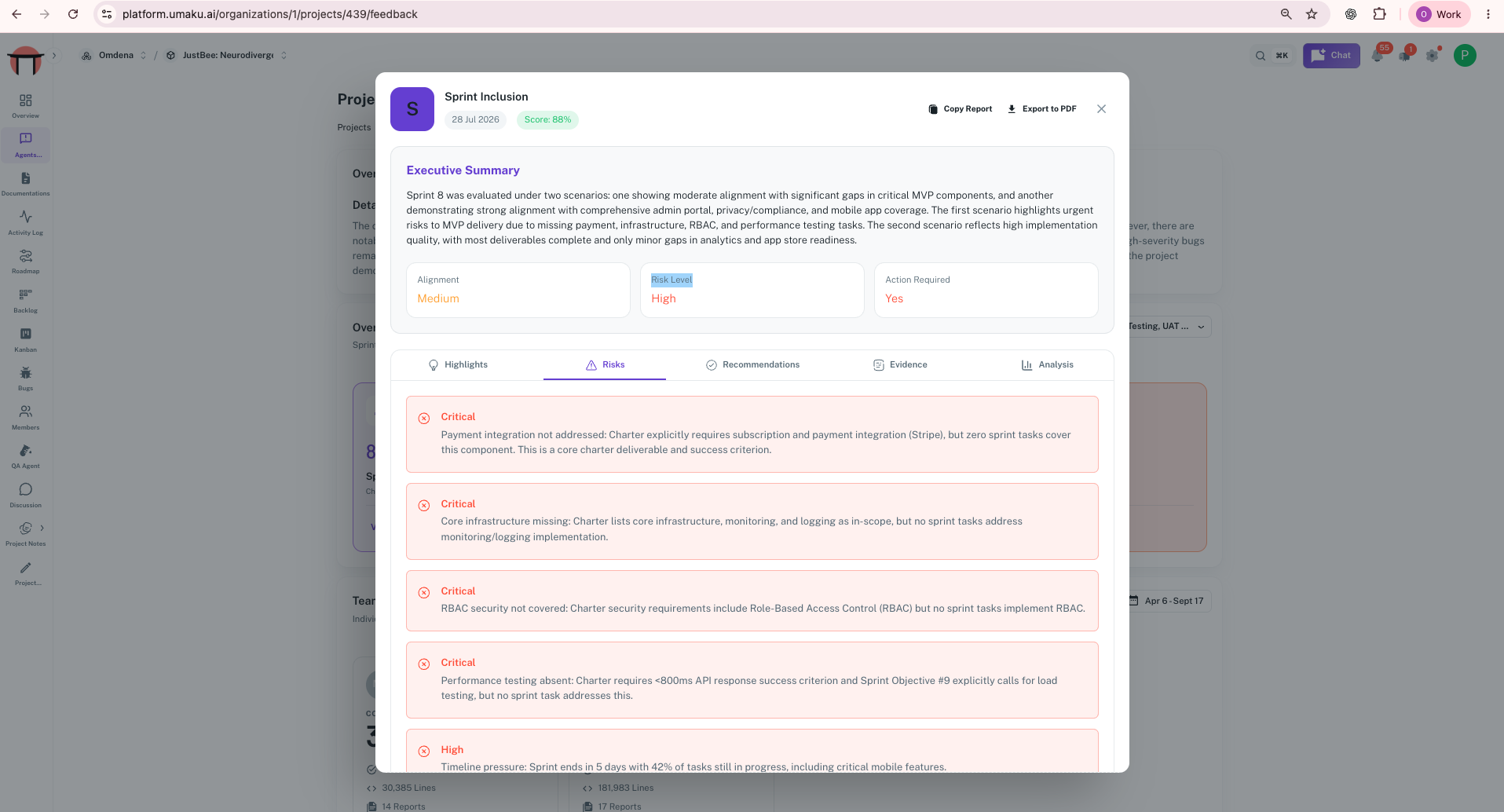
Umaku, Omdena’s AI delivery platform, adds a context-aware quality layer during development, connecting the project charter, technical context, sprint objectives, tickets, and repositories and running AI analysis across Sprint Inclusion, Code Quality, DevOps Compliance, and Bug Finder to surface issues early.
Figure 11. Sprint Inclusion in Umaku showing flagged risks
In July, 11 paid sprint analyses surfaced roughly 48 bugs and four scope risks, with an estimated $10.6K in avoided rework under stated assumptions, an estimate, not cash already recovered.
Access Specialized AI Talent Without Building Every Capability In-House
Unbudgeted work also appears when organizations underestimate the range of expertise production AI requires. Omdena provides access to specialists across AI and ML engineering, LLM and RAG development, data engineering, MLOps, software engineering, and cloud infrastructure.
Companies don’t need to build every AI capability internally before starting a project. Targeted expertise applied to specific technical challenges can close the gap without adding permanent headcount the budget was never designed to carry.
Conclusion
The initial AI quote is not the true cost of AI. A realistic budget also accounts for data, integration, evaluation, security, human oversight, maintenance, adoption, and rework, the layers priced above.
That is not an argument against AI. AI isn’t necessarily expensive; unexpected AI costs are expensive, and every one of them becomes manageable the moment it appears in the plan. AI becomes easier to budget when organizations stop treating it as a model or software-development purchase and start treating it as an ongoing business system.
Omdena helps organizations navigate that journey with production AI expertise, specialized talent, and Umaku’s context-aware delivery platform. If you’re evaluating an AI project and want to understand the full cost before development begins, talk to an Omdena solutions architect.
FAQ
What costs are commonly missing from an initial AI project estimate?
Initial estimates often cover development, model or API fees, and cloud infrastructure but omit data preparation, system integration, testing, security, human oversight, maintenance, employee training, and the cost of failed experiments or rework.
Why does data preparation increase the true cost of AI?
AI systems depend on usable, reliable data. Extracting, cleaning, deduplicating, formatting, labeling, validating, governing, and maintaining that data requires paid work. Skipping it usually shifts the expense downstream into inaccurate outputs, extra review, and engineering rework.
Why can an AI demo cost much less than a production system?
A demo can work without full integration, security controls, monitoring, evaluation, exception handling, or maintenance. A production system must connect to business workflows and operate reliably over time, so each of those additional stages adds cost.
How should organizations calculate the total cost of ownership of AI?
AI total cost of ownership should include the initial build, data and integration work, security and deployment, recurring operations and maintenance, human oversight and training, continuous improvements, and the opportunity cost of unsuccessful experiments.
How can businesses avoid unexpected AI costs?
Define the business outcome and success criteria first, test the riskiest assumptions with a small prototype, design for production requirements early, and build the estimate with input from product, engineering, data, security, operations, and business stakeholders.
Continue with Omdena
Share this article
Share on LinkedIn, send by email, or copy the direct link.