A consultant sits with a client, opens Claude, and within days has a working interface, functioning logic, and a demonstration that proves the idea has value. This speed is increasingly common. Anthropic’s analysis of 500,000 coding interactions found that 79% of Claude Code conversations involved automation, while UI/UX and web or mobile application development represented 20% of coding conversations.
Claude can dramatically compress the journey from idea to prototype. The danger begins when a convincing demonstration is mistaken for a dependable system. Production is not simply cleaner code and a deployment button. It requires architecture, integration, security, testing, failure handling, and long-term ownership—most of which remains invisible during a demo.
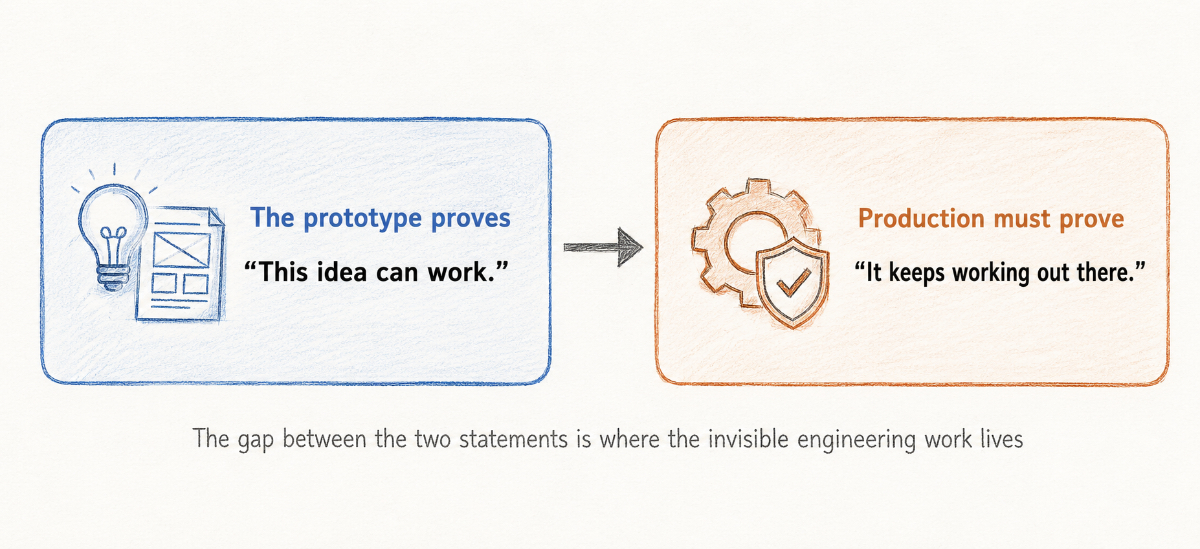
A prototype answers, “Can this work?” Production engineering answers the harder question: “Can people rely on it when the data, users, systems, and operating conditions change?”
What a Claude Prototype Actually Proves
A working prototype is valuable because it can:
Demonstrate the use case and its potential value to stakeholders.
Collect early feedback before the organization makes a major investment.
Test proposed workflows against real operational needs.
Expose incorrect assumptions while changes remain inexpensive.
Reduce uncertainty about what the team should build.
It does not prove production readiness. A prototype reduces uncertainty about whether an idea is valuable. Production engineering reduces uncertainty about whether the resulting system can be trusted.
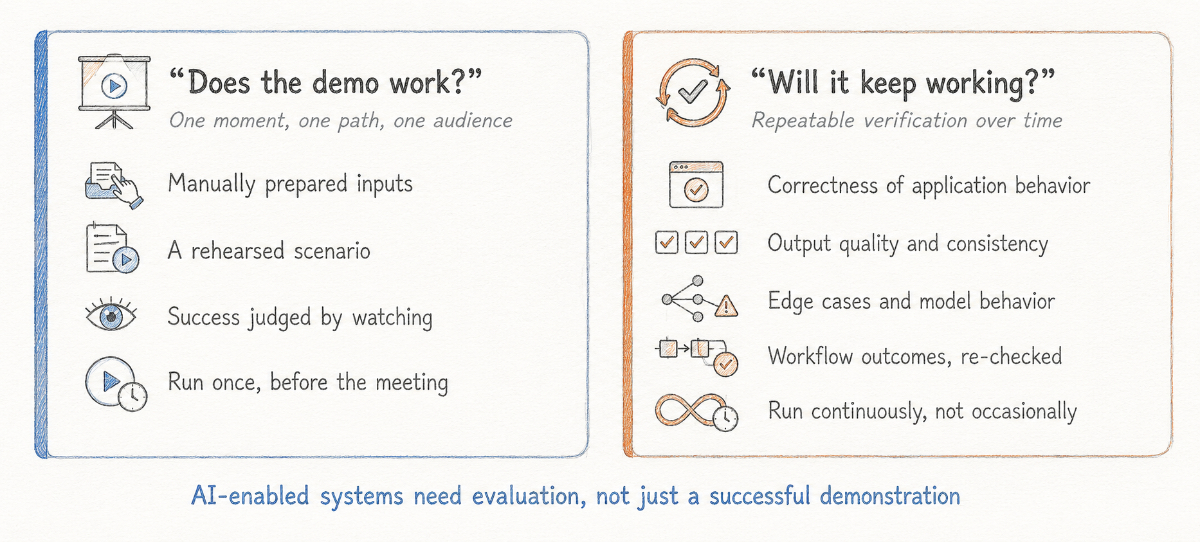
Figure 1. Two Different Kinds of Proof
The Production Engineering Work Nobody Sees
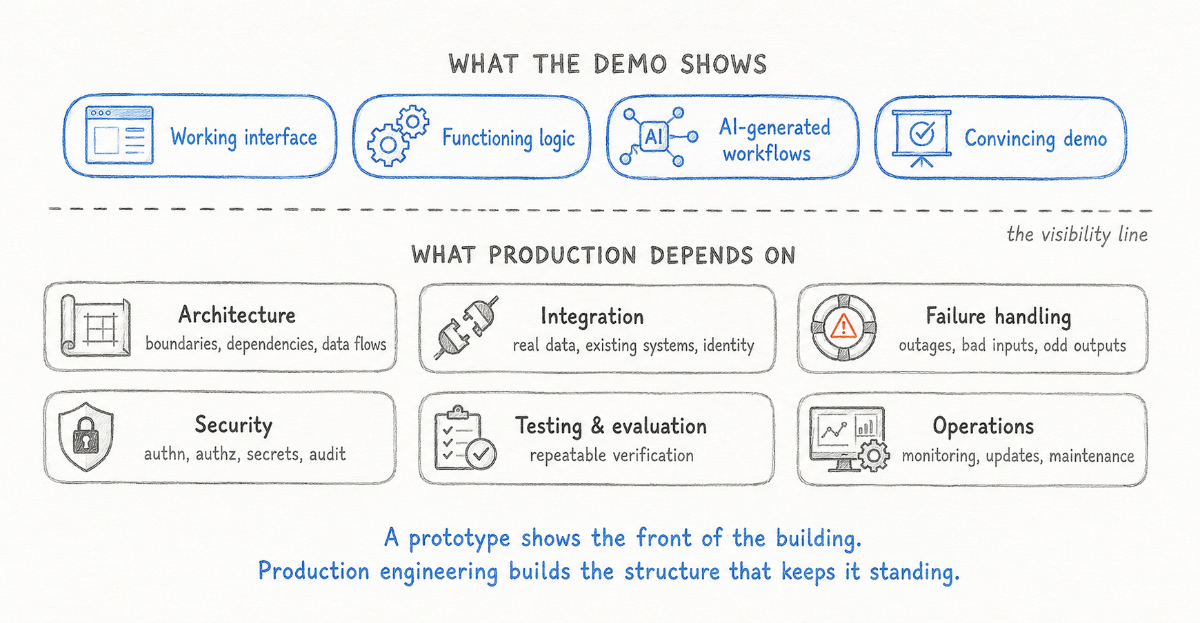
Between a convincing demonstration and a dependable system sit six areas of engineering work that rarely appear in the demo.
Turning a Prototype Into an Architecture
Prototype reality: The first version may be one script, one prepared file, and one model call.
Production requirement: Define system boundaries, services, databases, APIs, dependencies, data flows, and ownership.
Engineering goal: Build a service that other systems can depend on and that can accommodate future business requirements.
Production architecture optimizes for the system’s ability to change, scale, and operate reliably over time—not merely for speed of creation.
Figure 2. What the Demo Shows Versus What Production Depends On
Production requirement: Integration with live databases, enterprise applications, identity providers, external APIs, and existing business processes.
Delivery risk: Access approvals, data contracts, legacy-system behaviour, and dependencies on teams outside the project’s control.
The AI model is often not the hardest part of production. The greater challenge is making the AI-enabled system work reliably inside an existing software environment.
Designing for Failure, Not Just Success
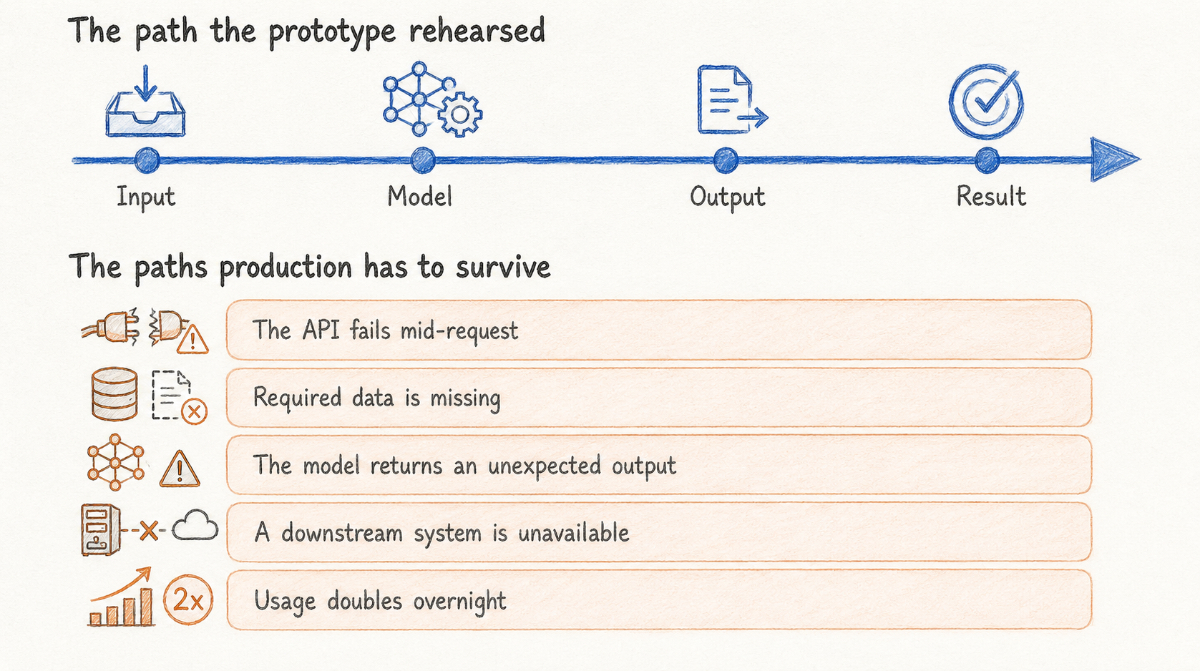
A production system must:
Respond safely when an API fails or a downstream system becomes unavailable.
Handle missing, malformed, delayed, or contradictory data.
Detect and contain unexpected model outputs.
Provide retries, fallbacks, and graceful degradation.
Remain stable when usage increases unexpectedly.
Give operators enough information to diagnose failures.
A live system is defined as much by how it fails as by how it succeeds.
Figure 3. The Happy Path and Everything Outside It
Security and Access Control
Production readiness requires teams to:
Authenticate users and services.
Apply authorization and least-privilege access.
Protect credentials, API keys, and other secrets.
Control access to sensitive business and customer data.
Record important actions for auditing and incident response.
Establish procedures for security reviews and vulnerability management.
These controls may not change what stakeholders see in a demonstration, but they often determine whether the system can be deployed at all.
Testing, Evaluation, and Verification
Teams need repeatable ways to verify both the software and its AI-enabled behaviour:
Use conventional tests to validate application logic and integrations.
Evaluate output quality, consistency, edge cases, and workflow outcomes.
Create representative evaluation datasets.
Define measurable acceptance thresholds.
Test adversarial, ambiguous, and incomplete inputs.
Re-run evaluations when prompts, models, data, dependencies, or requirements change.
The standard cannot be “the demo worked once.” The team must be able to prove that the system still works when conditions change.
Figure 4. From a Successful Demo to Repeatable Evaluation
Operating and Maintaining the System
After deployment, teams must:
Monitor availability, latency, errors, costs, and output quality.
Update dependencies, models, prompts, and integrations safely.
Respond to bugs and previously unanticipated user behaviour.
Detect changes in input data and model performance.
Maintain documentation and operational procedures.
Assign clear ownership for support, incidents, and ongoing improvement.
Deployment begins the operational lifecycle; it does not end development.
Why This Work Is Often Underestimated
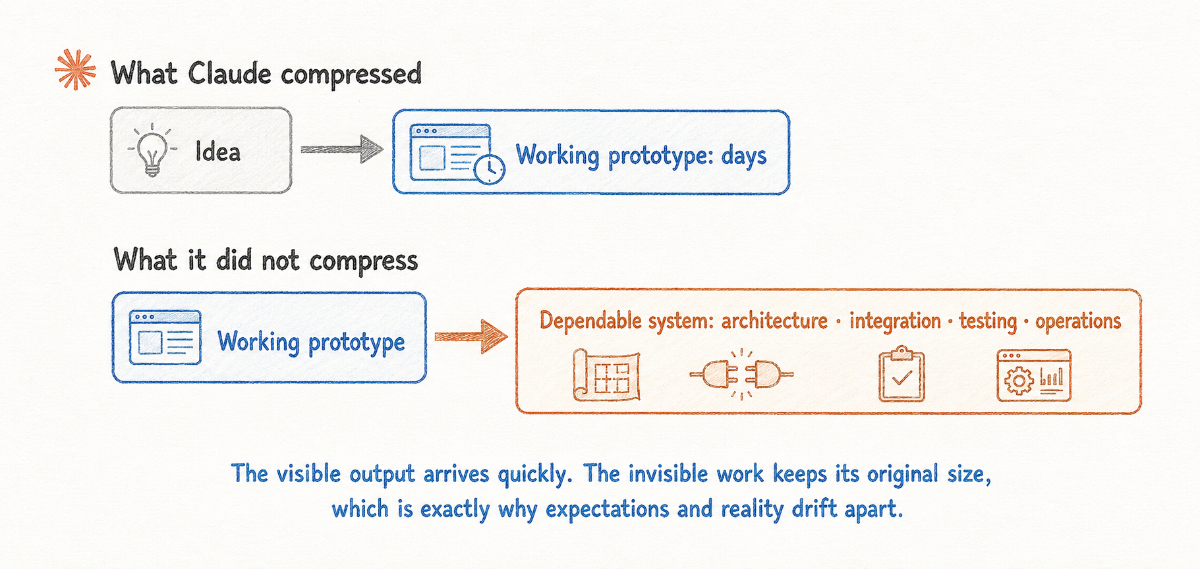
Visible progress arrives quickly. Screens, features, and working workflows make the project appear nearly complete.
Invisible work retains its original size. Architecture, integration, security, testing, verification, and operations still require deliberate engineering.
Expectations follow the speed of the demo. After a four-day prototype, a six-week integration and hardening phase can sound like failure—even when it is exactly what the system requires.
Prepared inputs conceal production complexity. Real data is incomplete, inconsistent, delayed, and governed by access controls.
The prototype changes what looks easy. It proves value quickly, but it does not remove the work required to make the system dependable.
Claude compresses the distance from an idea to working software. It does not automatically compress the distance from working software to a reliable production system.
Figure 5. What AI Compressed and What It Did Not
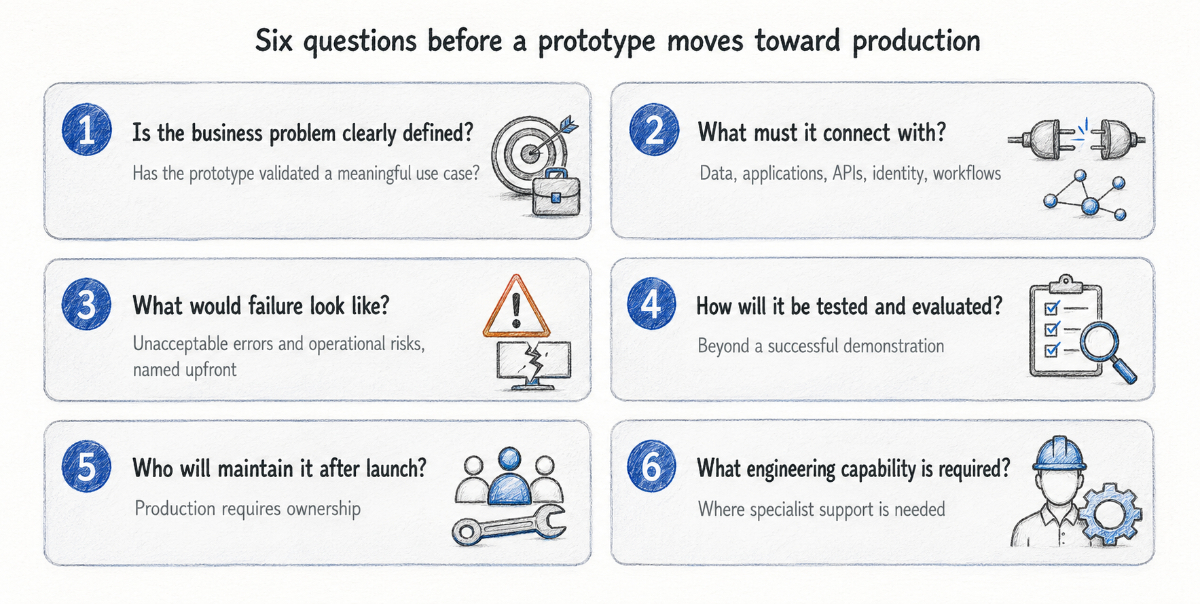
What Tech Consultants Should Look for Before Moving a Prototype Forward
1. What business problem has the prototype validated?
Confirm that the use case matters, the intended users are clear, and the prototype has demonstrated more than technical novelty. Identify the measurable outcome that would justify production investment.
2. What systems, data, APIs, and workflows must it connect with?
Map the production environment, system owners, access requirements, data contracts, integration points, and external dependencies before estimating the delivery effort.
3. What would failure look like?
Define unacceptable errors, security incidents, service interruptions, incorrect AI outputs, and operational consequences in concrete terms. The seriousness of failure should determine the required safeguards.
4. How will the system be tested and evaluated?
Specify functional tests, AI-quality evaluations, edge cases, acceptance thresholds, representative datasets, and regression checks. Decide who has authority to approve the system for release.
5. Who will own and maintain it after launch?
Name the teams responsible for monitoring, incidents, updates, model changes, user support, documentation, and ongoing improvement. A system without a clear owner is not production-ready.
6. What engineering capabilities does the work require?
Identify the architecture, data, security, platform, QA, AI-evaluation, and operations expertise the project needs. Determine where the current team requires specialist support.
A prototype that can answer these six questions may be ready to move forward. One that cannot is showing the consultant where the remaining engineering work lives.
Figure 6. A Production-Readiness Checklist for Consultants
Production Readiness Is an Engineering Discipline
None of this argues for slowing prototyping down. It argues for recognizing the moment when the project changes character.
During prototyping, speed is the priority. During production, reliability becomes equally important, and the delivery process must change accordingly.
The best teams continue using AI-assisted development while adding three disciplines:
Context: A maintained understanding of the business requirements, technical constraints, and intended behaviour.
Visibility: A clear view of what is being planned, built, reviewed, tested, and released.
Verification: Continuous evidence that the implementation still matches the requirements.
Production readiness also broadens the team. Architecture, data, security, QA, and operations perspectives become part of delivery. Knowing when to introduce those capabilities is itself an engineering decision.
How Umaku Supports the Move From Prototype to Production
Moving a Claude prototype into production requires engineers to understand far more than the code in front of them. They need reliable context about the business problem, system architecture, approved technologies, project resources, delivery scope, and operational constraints. When this information is scattered across documents, tickets, repositories, and conversations, important requirements can be missed as the system evolves.
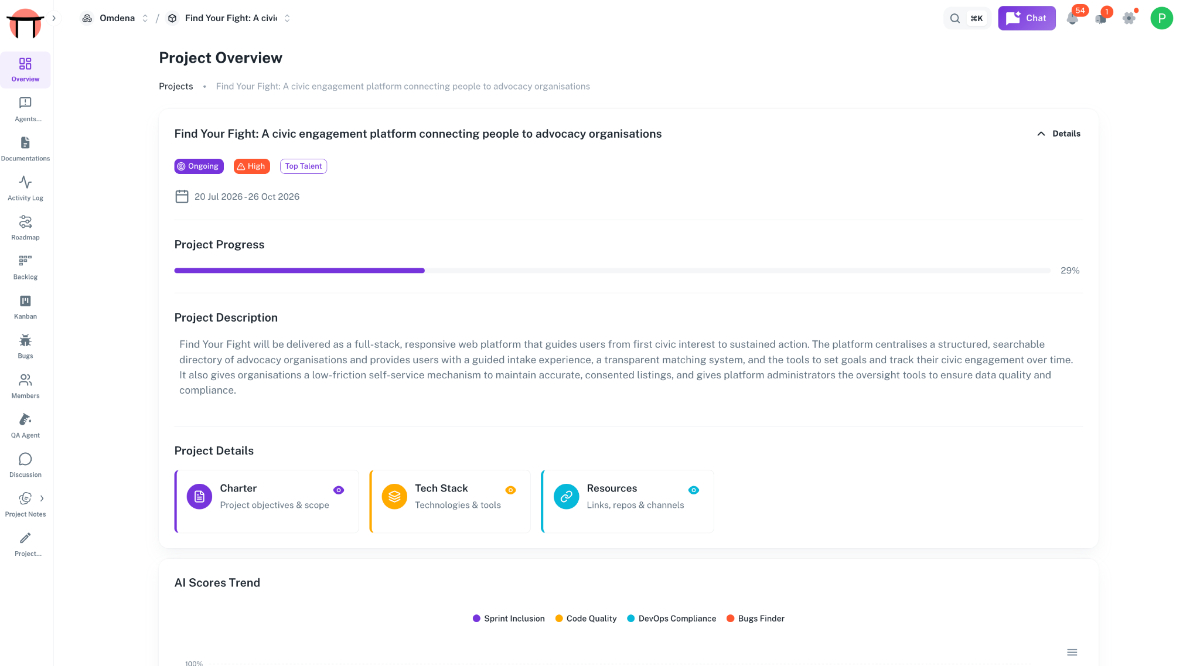
Umaku brings this production context into one connected environment. The project charter defines what the system must achieve, the technical stack records how it should be built, and the project resources give engineers access to the supporting information they need. Together, these elements provide a shared frame of reference for architecture, implementation, testing, and release decisions.
Figure 7. Production context in Umaku
The project charter, technical stack, and resources give engineers a connected view of the business objectives, technical constraints, and supporting knowledge required to move a prototype towards production.
Context alone is not enough. Production engineering also requires continuous verification that implementation decisions still match the project’s requirements. Umaku analyses active engineering work against the wider project context so teams can identify concrete delivery risks before they become expensive production problems.
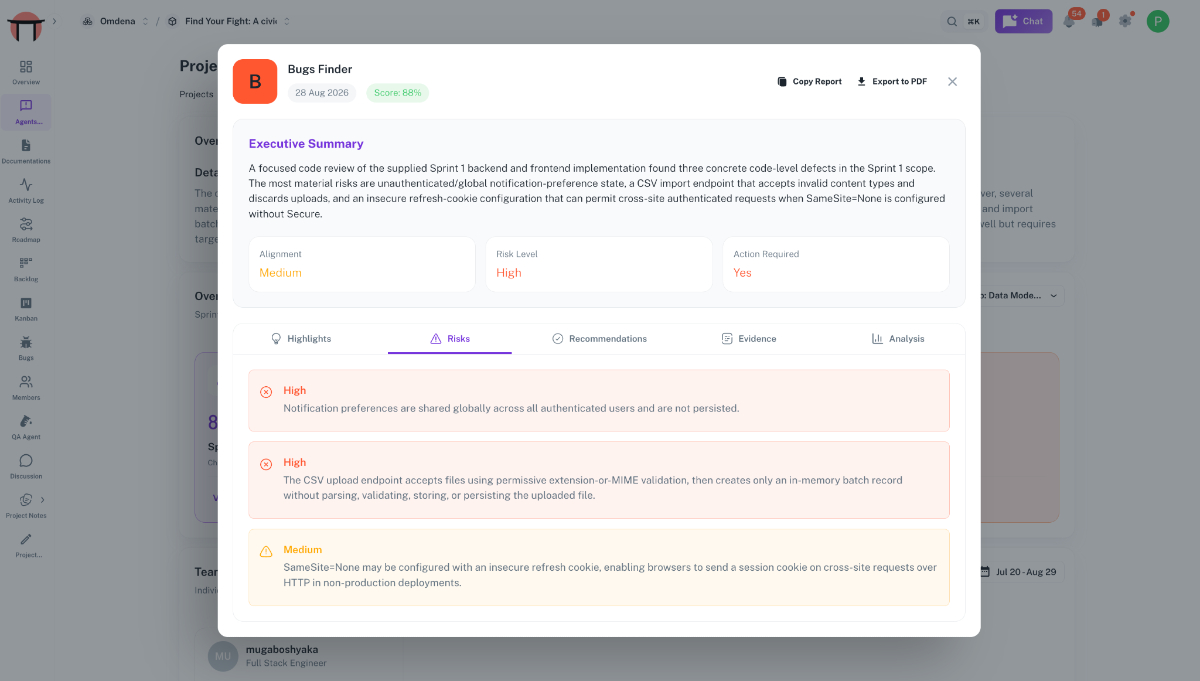
For example, Sprint Inclusion can flag planned work that is incomplete, inconsistent with the approved scope, or missing important production requirements. Bug Finder can identify implementation defects and surface the business or operational consequences associated with them. These findings allow engineers to correct problems while the relevant work is still active rather than waiting until QA or deployment.
Figure 8. Production risk identified during delivery
A concrete Bug Finder finding shows the affected work, why it creates a production risk, and what the engineering team needs to address.
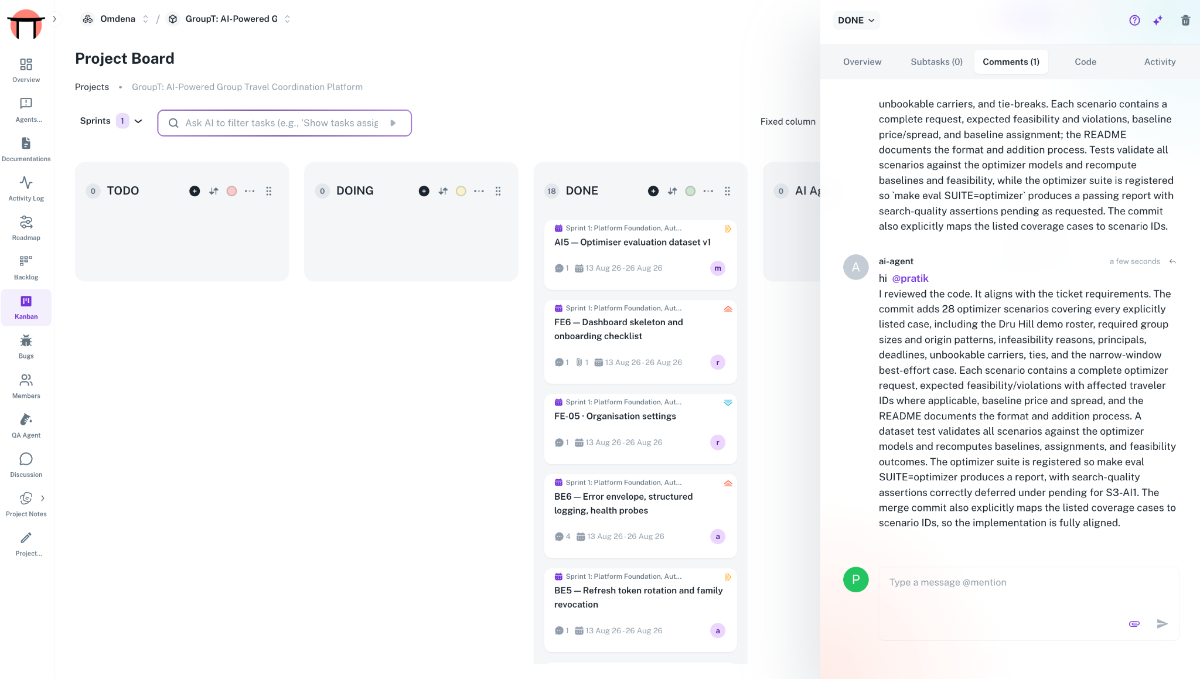
Figure 9. AI Reviews: In this case, we have the AI agent presenting a code review
Figure 9. AI Reviews: In this case, we have the AI agent presenting a code review
AI Reviews assess completed engineering work against project requirements and development standards, highlighting issues such as unclear logic, missing tests, security risks, and architectural inconsistencies. They provide contextual, actionable recommendations so engineers can correct problems before they reach QA or production.
This is how Umaku supports the transition from a Claude prototype to production: it preserves the context behind the system, connects that context to active engineering work, and helps teams detect gaps before they reach users. It does not replace engineering judgment; it gives engineers the visibility and evidence needed to apply that judgment more effectively.
The Prototype Is the Beginning, Not the Finish Line
Claude has changed what is possible at the prototype stage. A working application that once took months can now exist in days, helping teams validate ideas, earn stakeholder support, and decide what deserves investment.
But proving that software can work is not the same as making it dependable. Claude accelerates the journey from idea to prototype. Production engineering takes the system from a convincing demonstration to something people can rely on.
If you have a prototype that needs to make that journey, talk to Omdena about assessing its production requirements and engineering it for the real world.
Source for the Claude usage statistics: Anthropic Economic Index, “AI’s Impact on Software Development,” based on an analysis of 500,000 coding-related interactions.
FAQ
What does a Claude prototype actually prove?
A Claude prototype demonstrates that an idea is technically feasible and potentially valuable. It helps teams test workflows, gather stakeholder feedback, and uncover flawed assumptions early. However, it does not prove that the system is secure, scalable, reliable, or ready for production.
What engineering work is required to move a Claude prototype into production?
The transition typically requires production architecture, integration with real data and systems, failure handling, security controls, repeatable testing, monitoring, and long-term operational ownership. Much of this work is invisible in the original demonstration.
Why is moving from prototype to production often underestimated?
AI can make visible progress—such as interfaces and working features—happen very quickly. Meanwhile, architecture, integrations, security, testing, and operations still require deliberate engineering. This creates the misleading impression that a functional prototype is almost finished.
How should an AI-enabled production system be tested?
Teams should combine conventional software tests with AI-specific evaluations. This includes testing output quality, consistency, edge cases, incomplete or adversarial inputs, and workflow outcomes. Representative datasets, measurable acceptance thresholds, and regression testing are also essential whenever models, prompts, data, or dependencies change.
How does Umaku support the transition from prototype to production?
Umaku connects business requirements, technical constraints, project resources, and active engineering work in one environment. Features such as Sprint Inclusion, Bug Finder, and AI Reviews help teams identify scope gaps, defects, missing tests, security risks, and architectural inconsistencies before they reach users.
Share this article
Share on LinkedIn, send by email, or copy the direct link.