The Real Cost of AI Governance: What Businesses Often Miss
11 min read
Okon PrinceSenior Data Scientist / Forward Deployed Engineer
Governance and compliance are often the last lines added to an AI budget, if they are added at all. A typical AI project estimate covers development, model or API usage, and cloud infrastructure. Then deployment approaches, and new questions appear:
Can the system access sensitive data?
Who is accountable for its decisions?
How are outputs tested, and what happens when the model makes an error?
Which regulations apply, and what documentation is required?
Each question introduces governance work the original estimate may never have priced. AI governance isn’t just about complying with regulations; it’s about creating the systems, processes, and accountability required to use AI responsibly at scale.
This article explains what governance includes, what it costs directly, seven ways weak governance raises costs, and how to budget for it proportionately.
What Is AI Governance and Why Does It Cost Money?
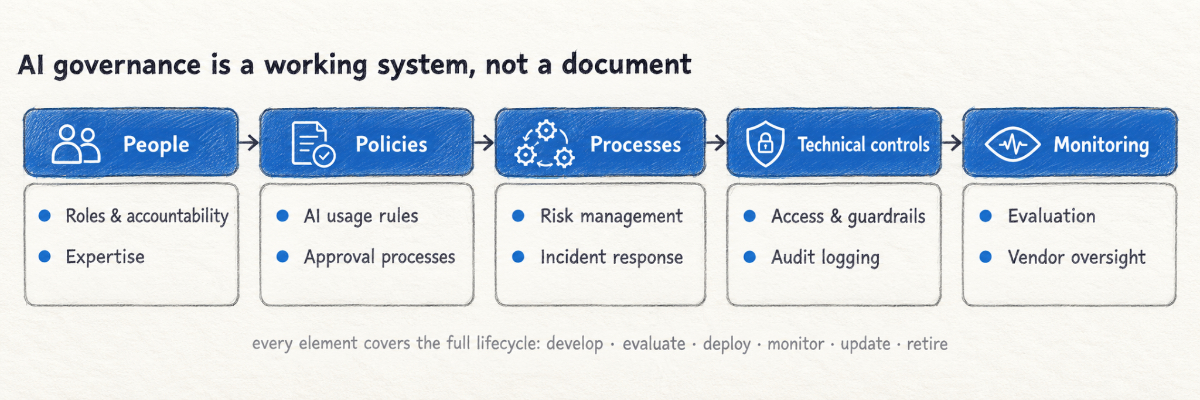
AI governance is the framework an organization uses to manage how AI systems are developed, evaluated, deployed, monitored, updated, and retired. As Figure 1 shows, it includes more than regulatory compliance:
Policies, roles, and responsibilities
Risk management and model evaluation
Data governance and security controls
Documentation, monitoring, incident management, and vendor oversight
Each element is a working activity with hours attached, not a shelf document, which is why the definition already implies a budget.
Figure 1. What AI Governance Includes
AI Governance vs. AI Compliance
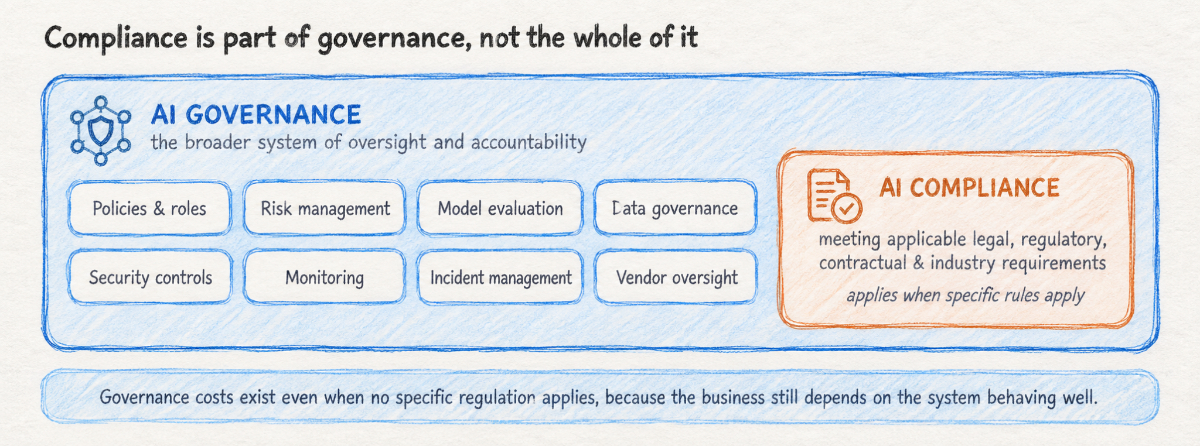
The distinction matters, and Figure 2 draws it. Governance is the broader system of oversight and accountability. Compliance means meeting applicable legal, regulatory, contractual, and industry requirements. Governance costs exist even when no specific regulation applies: an AI customer-support assistant may face no dedicated AI law, yet the business still needs internal policies, testing, monitoring, and accountability for it.
Governance costs money because responsible AI requires people, processes, and technical controls, not just a policy document. The gap is common: IBM’s 2025 Cost of a Data Breach research found that 63% of breached organizations lacked AI governance policies. The policy is the cheap part; the operating system around it is the actual budget.
Figure 2. AI Governance vs. AI Compliance
The Direct Costs of AI Governance and Compliance
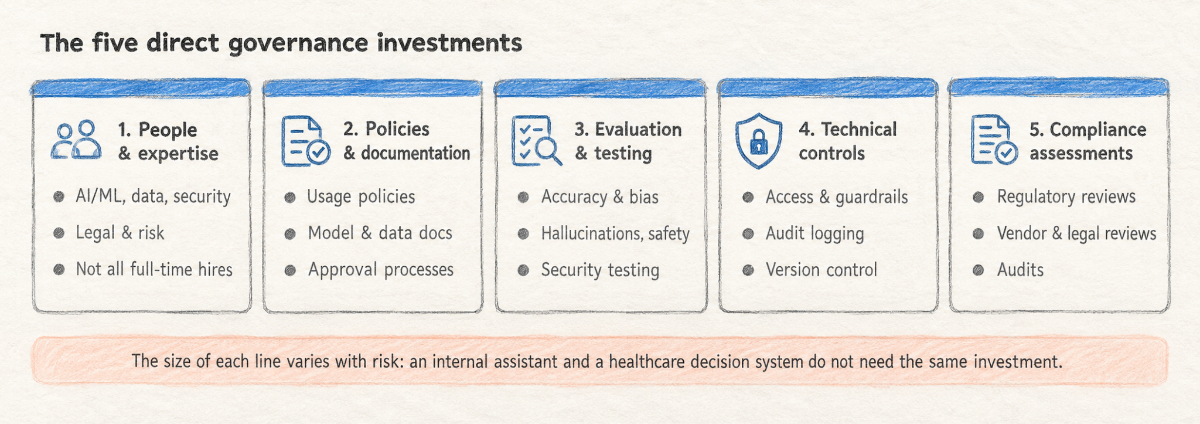
Before turning to the risk-related costs, it helps to start with the visible, direct investments. Figure 3 groups them into five categories.
Figure 3. The Five Direct Governance Investments
People and Expertise
Organizations may need expertise across AI and ML, data governance, security, legal and compliance, risk management, and software engineering. Not every company needs all of these as full-time hires, but the expertise must exist somewhere, and it bills either way. For an SME, this often means a fraction of several people rather than a governance department.
Policies and Documentation
AI usage policies, model documentation, data lineage records, risk assessments, approval processes, and incident response procedures all take paid time to create and keep current. The first project carries most of this cost; later projects reuse it.
Evaluation and Testing
AI systems may require ongoing testing for accuracy, bias, hallucinations, safety, reliability, and security vulnerabilities, along with the evaluation datasets and pipelines that make the testing repeatable.
Technical Controls
Access controls, audit logging, monitoring, guardrails, version control, and data protection: engineering work that exists only because the AI system does, and that is cheapest when designed in from the start.
Compliance Assessments
Depending on industry and geography: regulatory reviews, vendor assessments, legal reviews, documentation requirements, and audits.
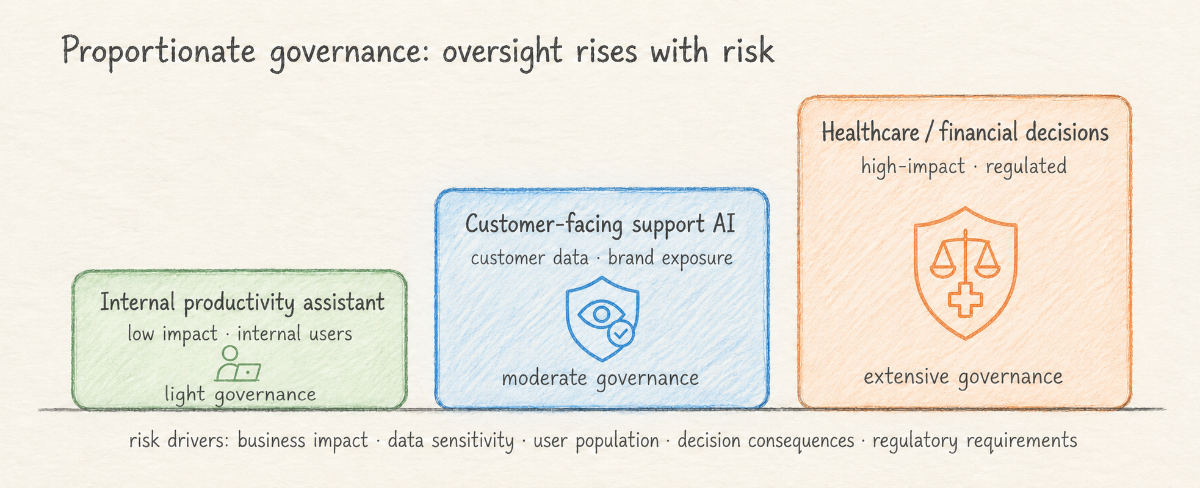
One caveat matters more than any single line item: governance costs vary significantly with the use case. A low-risk internal productivity assistant does not need the same investment as an AI system supporting healthcare, financial, or employment decisions. Estimate against the riskiest workflow the system touches.
How Poor AI Governance Increases Business Costs
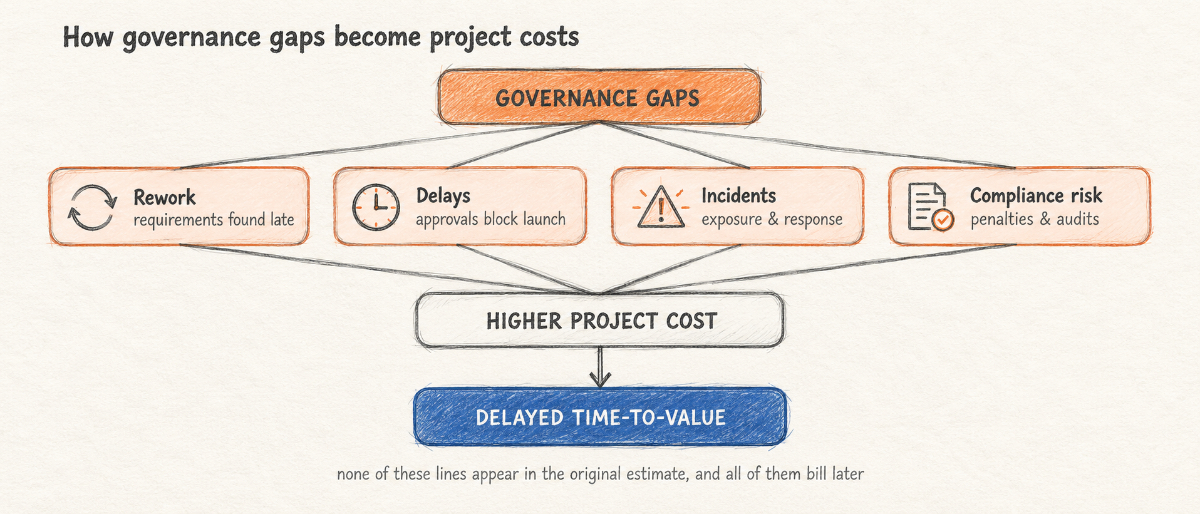
The direct costs are only half the ledger. The larger, less visible half is what weak governance does to project economics, the flow in Figure 4. Seven cost mechanisms follow.
Figure 4. The Cost of Poor AI Governance
1. Rework When Compliance Requirements Are Discovered Late
This is the mechanism that connects governance most directly to development cost. An organization builds the AI system first and discovers the constraints later:
Sensitive data can’t be used as originally planned
Certain decisions require human oversight
Outputs need additional logging, or stronger access controls
A different deployment architecture is required
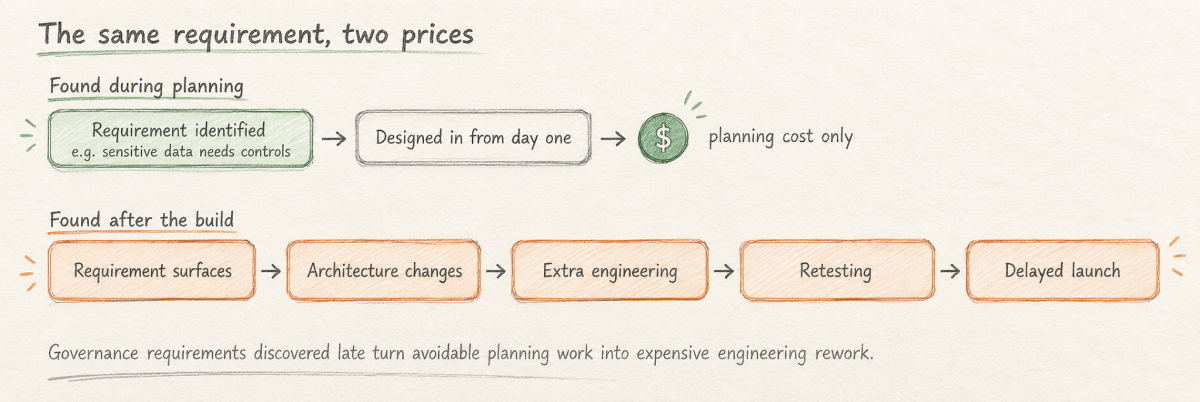
Each late discovery triggers the same chain: architecture changes, additional engineering, retesting, and a delayed launch. Figure 5 prices the difference: governance requirements discovered late turn avoidable planning work into expensive engineering rework.
Figure 5. Late Discovery Turns Planning Work into Rework
2. Delayed AI Deployment and Time-to-Value
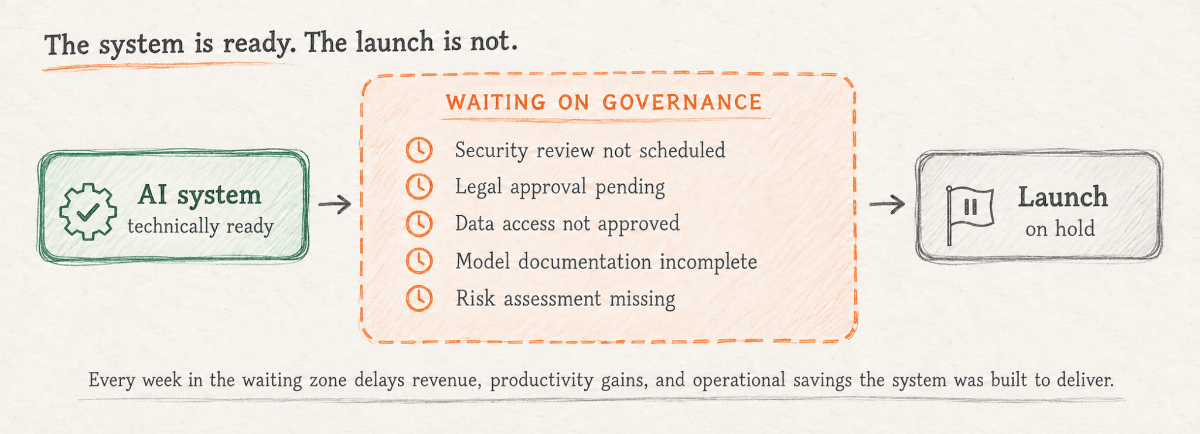
Governance becomes a bottleneck when processes are established late. Security reviews happen at the end, legal approval stalls, data access sits unapproved, model documentation is incomplete, risk assessments are missing. The system is technically ready but unable to launch, the waiting zone in Figure 6.
Every additional week in that zone delays revenue opportunities, productivity gains, customer improvements, and operational savings. Governance isn’t only a compliance cost; delayed governance becomes an opportunity cost. The fix here is scheduling rather than spending: the same reviews cost the same hours early, and hold nothing up.
Figure 6. Technically Ready, Unable to Launch
3. Regulatory Penalties and Legal Exposure
When AI systems violate applicable requirements, contractual obligations, or data protection rules, the consequences can include fines and penalties, legal expenses, remediation costs, compensation claims, additional audits, and business restrictions.
How much exposure a company carries depends on jurisdiction, industry, use case, and risk classification; the EU AI Act, for example, applies obligations by risk category rather than uniformly. The budgeting point is not fear of any single regulation. It is that legal review belongs in the plan, where it is cheap, rather than in the incident response, where it is not.
4. Security Incidents and Data Exposure
AI systems create new pathways through which data can be accessed and exposed: sensitive information entering prompts, unauthorized access to AI tools, insecure integrations, misconfigured permissions, prompt injection, and leakage through outputs.
The governance gap is measurable: among organizations that suffered AI-related breaches, IBM found that 97% lacked proper AI access controls, and shadow AI incidents added as much as $670K to the average breach cost. Incidents then bill for response, investigation, remediation, downtime, and customer notification. The point isn’t that incidents are inevitable; it is that governance is what reduces the exposure.
5. Uncontrolled AI Usage Creates Shadow AI Costs
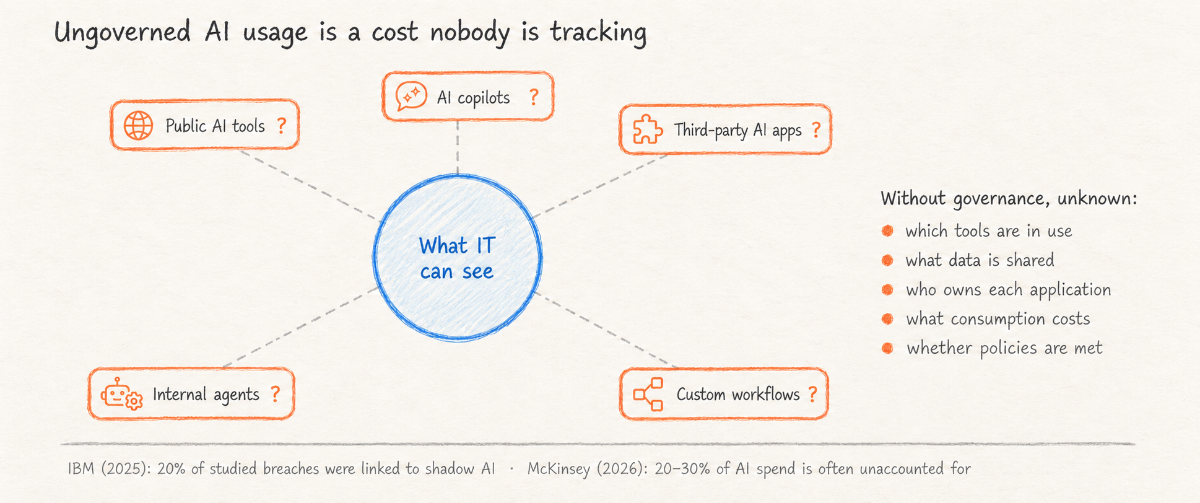
Employees adopt public AI tools, copilots, third-party applications, internal agents, and custom workflows faster than any approval process. Without governance, the organization may not know which tools are in use, what data is being shared, who owns each application, what consumption costs, or whether tools meet company policy, the blind spots in Figure 7.
The spend side is documented: McKinsey reports that 20 to 30% of AI spend is often unaccounted for because investments fragment across vendors, tools, and commercial models. Governance controls not only risk but also AI sprawl and uncontrolled technology spending.
Figure 7. Shadow AI: Usage the Organization Can’t See
6. Poor Accountability Increases Operational and Reputation Costs
When an AI system misbehaves, the organization needs answers quickly: what happened, which model was used, what data influenced the output, who approved deployment, and who owns remediation. Without clear accountability, investigation is slower and more expensive, and the bill grows through operational disruption, customer dissatisfaction, and reputation damage.
Governance creates those accountability structures before problems occur. The value of governance becomes most visible on the day an AI system behaves unexpectedly, and by then it is either in place or expensive.
7. Vendor Lock-In and Compliance Rework
Most AI stacks now depend on several external parties: foundation model providers, cloud platforms, AI SaaS vendors, and data infrastructure providers. When a vendor changes models, policies, or pricing, the governance work returns: reassessing vendors, updating contracts, reviewing data residency, revalidating models, and rebuilding controls, sometimes migrating systems entirely.
Governance should account for the AI ecosystem, not just the individual model, because dependency risk is a recurring cost rather than a one-time procurement question. A vendor inventory and an exit plan are cheap insurance against repricing you don’t control.
What Should an AI Governance Budget Include?
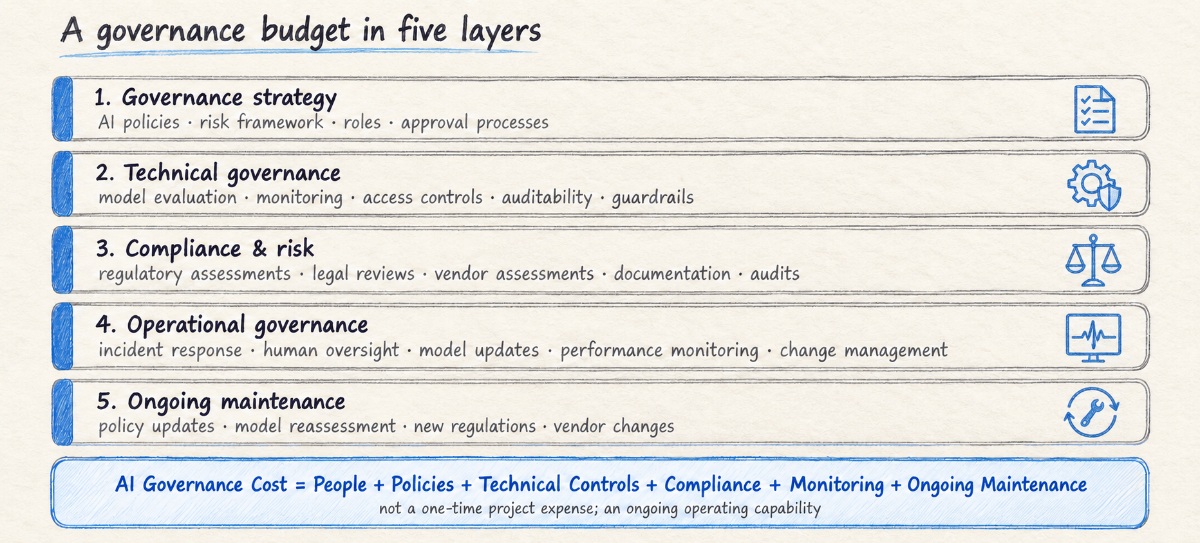
A governance budget becomes manageable when it is organized into layers. Figure 8 shows five:
Governance strategy: AI policies, risk framework, roles, approval processes
Technical governance: model evaluation, monitoring, access controls, auditability, guardrails
Operational governance: incident response, human oversight, model updates, performance monitoring, change management
Ongoing maintenance: policy updates, model reassessment, new regulations, vendor changes
Figure 8. The AI Governance Budget Framework
A simple equation keeps the conversation honest:
AI governance cost = People + Policies + Technical controls + Compliance + Monitoring + Ongoing maintenance
For each layer, the useful questions are the same: what does this project require, who owns it, and is it funded once or annually? None of the terms need to be large, and several can be shared across projects; the equation’s job is completeness, not size.
The last two layers carry the distinction that matters most: governance isn’t a one-time project expense. It is an ongoing operating capability. Policies age, models get reassessed, regulations arrive, and vendors change, so the budget line persists after launch. Small organizations can keep every layer light; the point is that no layer is accidentally zero. A useful test: a governance budget that ends at launch is a project plan, not a governance plan.
How to Control AI Governance Costs Without Reducing Oversight
Governance does not have to be expensive to be real. The objective isn’t bureaucracy; it’s proportionate oversight, built on five principles.
Match Governance to Risk
Not every AI application needs the same oversight. Calibrate to business impact, data sensitivity, user population, decision consequences, and regulatory requirements, the ladder in Figure 9.
Figure 9. Proportionate Governance: Oversight Rises with Risk
Build Governance into the Architecture
Logging, monitoring, access controls, evaluation, and documentation cost far less designed in early than bolted on after development.
Reuse Governance Frameworks
Create reusable templates for risk assessments, model documentation, evaluation, and approval workflows, and anchor them in established frameworks such as the NIST AI Risk Management Framework and ISO/IEC 42001 rather than inventing structure from scratch. Reuse turns the first project’s governance spend into every later project’s discount.
Automate Where Possible
Automated monitoring, policy enforcement, model inventory, audit trails, and alerts replace recurring manual hours with one-time setup.
Establish Clear Ownership
Avoid the situation where everyone assumes someone else is responsible. Named owners are what make every other principle enforceable.
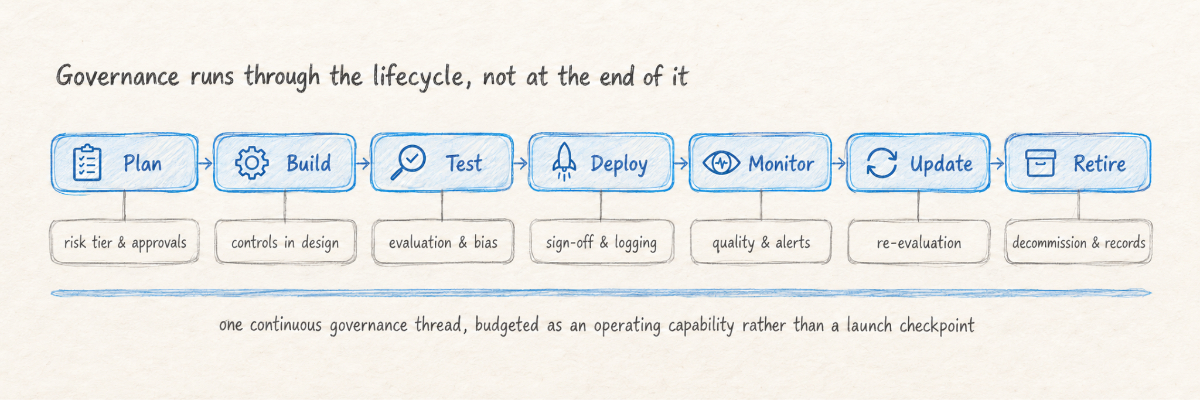
The most cost-effective governance strategy is usually proportionate, reusable, and built into the AI lifecycle from the beginning, the thread Figure 10 traces from planning to retirement.
Figure 10. Governance Across the AI Lifecycle
How Umaku Can Help Reduce Governance-Related Development Rework
Part of the governance bill originates inside development itself: when technical requirements, quality controls, or project expectations are not aligned early, the cost surfaces later as rework, the first mechanism above.
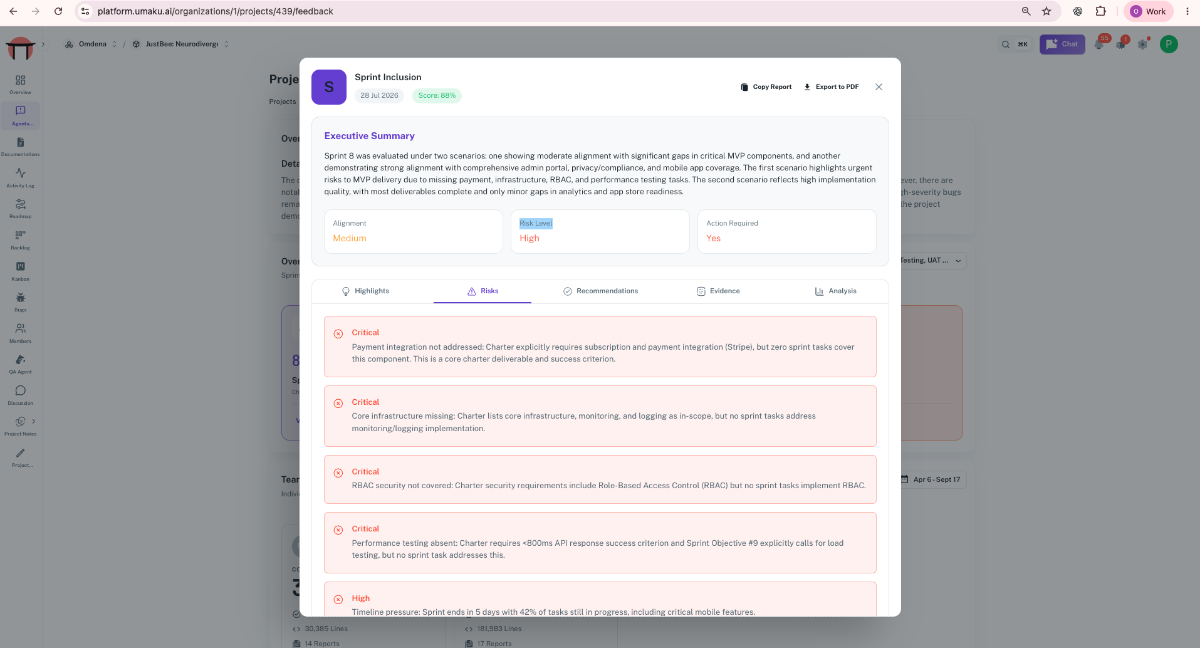
Umaku, Omdena’s AI development governance platform, works on exactly that layer. It connects project context, business requirements, sprint objectives, tickets, and repositories, and analyzes execution across Sprint Inclusion, Code Quality, DevOps Compliance, and Bug Finder, giving teams earlier visibility into issues that would otherwise become downstream rework.
Figure 11. Sprint Inclusion in Umaku showing flagged risks
Umaku is not a regulatory compliance platform, and it doesn’t replace legal or compliance teams. It is a context-aware engineering quality layer that helps reduce rework and improve visibility during AI and software development.
Access Specialized AI Governance and Engineering Expertise
AI governance needs cross-functional expertise that many SMEs don’t carry internally. Omdena provides access to specialists across AI and ML engineering, data engineering, MLOps, cloud architecture, and software engineering, along with AI governance and responsible AI expertise where available within the talent network.
Organizations don’t need a large permanent governance team before starting AI. Targeted expertise can establish appropriate processes and technical controls for a specific project, then step away once the structures are running.
Conclusion
AI governance and compliance are often treated as expenses that slow innovation down. The real question isn’t whether governance costs money. It does. The question is whether an organization can afford to build AI without it. Effective governance helps organizations:
Reduce avoidable rework and identify risks earlier
Improve accountability and control AI usage and spending
Protect sensitive data and scale AI with greater confidence
The cost of governance is easier to plan for than the cost of recovering from unmanaged AI risks.
Omdena combines AI engineering expertise, specialized talent, and Umaku to help organizations build and scale AI with greater visibility into the technical and operational work required. If you’re planning an AI initiative, Omdena can help assess the governance requirements on the path from concept to production.
FAQ
What is AI governance?
AI governance is the framework of policies, roles, processes, and technical controls used to manage AI systems throughout their lifecycle—from development and deployment to monitoring, updating, and retirement.
Why does AI governance increase project costs?
AI governance requires investment in specialized expertise, documentation, model testing, security controls, compliance reviews, monitoring, incident response, and ongoing maintenance. These are operational activities, not one-time policy exercises.
What are the hidden costs of weak AI governance?
Weak governance can lead to costly engineering rework, delayed deployment, regulatory penalties, security incidents, uncontrolled AI spending, reputational damage, and vendor-related compliance work.
What should an AI governance budget include?
A complete budget should cover people and expertise, policies, technical controls, compliance assessments, model monitoring, incident management, human oversight, vendor reviews, and ongoing maintenance after deployment.
How can businesses control AI governance costs?
Businesses can reduce costs by matching oversight to each system’s risk, building governance into the architecture early, reusing established frameworks and templates, automating monitoring, and assigning clear ownership.
Share this article
Share on LinkedIn, send by email, or copy the direct link.