Building an AI prototype has never been easier. With tools like Claude, GPT, n8n, LangChain, and low-code AI platforms, organizations can create chatbots, AI agents, and automated workflows in just a few days.
As a result, AI adoption has surged. According to McKinsey’s 2025 State of AI report, 88% of organizations now use AI in at least one business function. Yet only a small percentage successfully turn those experiments into production-ready systems.
The reason is simple: building an AI prototype is very different from deploying AI in production. Production-grade AI must handle messy data, existing software systems, security requirements, and changing business processes. Based on Omdena’s deployment experience, the AI model is rarely the primary obstacle. Infrastructure, integrations, monitoring, and deployment processes are often what hold projects back.
If your AI prototype works well during testing but struggles in day-to-day business operations, you’re not alone. In this article, we’ll explore why most AI prototypes never reach production and what successful AI teams do differently.
TL;DR (Quick Summary):
Building an AI prototype is easy. Building production-ready AI is much harder. Successful deployment requires reliable data pipelines, system integrations, monitoring, governance, and scalable infrastructure.
Most AI projects fail because organizations underestimate the hidden engineering and operational work required after the MVP stage. The AI model is rarely the primary bottleneck.
Successful AI teams design for production from day one. They invest in continuous validation, observability, automation, governance, and human oversight instead of focusing only on model accuracy.
Production AI is an engineering systems challenge as much as an AI challenge. Long-term success depends on reliability, maintenance, and organization-wide adoption.
Omdena helps organizations move from AI prototypes to production-ready systems through its proprietary Umaku platform, structured AI delivery methodology, and vetted global AI talent network
The Hidden Gap Between AI Prototypes and Production-Ready Systems
Most AI prototypes succeed because they operate in a controlled environment. They are typically built around a single use case, tested by a small internal team, and run on clean, well-prepared data with manual supervision whenever something goes wrong.
In contrast, production AI operates in a far more complex environment. It must handle:
Thousands of users and unpredictable workloads
Messy, incomplete, and constantly changing data
API failures and system latency
Integrations with existing business applications
Security, governance, and compliance requirements
Continuous monitoring and evolving business rules
Prototype environments also hide many production requirements that are often overlooked during development, such as reliable data storage, system configuration, error handling, monitoring, deployment processes, and infrastructure stability. This is why building the model is often the easiest part of an AI project. The challenge begins when that prototype needs to become a reliable business system that teams can trust every day.
Understanding this gap is the first step toward successful AI deployment. So, why do so many promising AI prototypes break when they reach production?
Why Most AI Prototypes Break in Production
The gap between a successful prototype and a production-grade AI system is larger than most organizations expect. Based on Omdena’s deployment experience, five challenges appear repeatedly as AI projects move beyond the MVP stage.
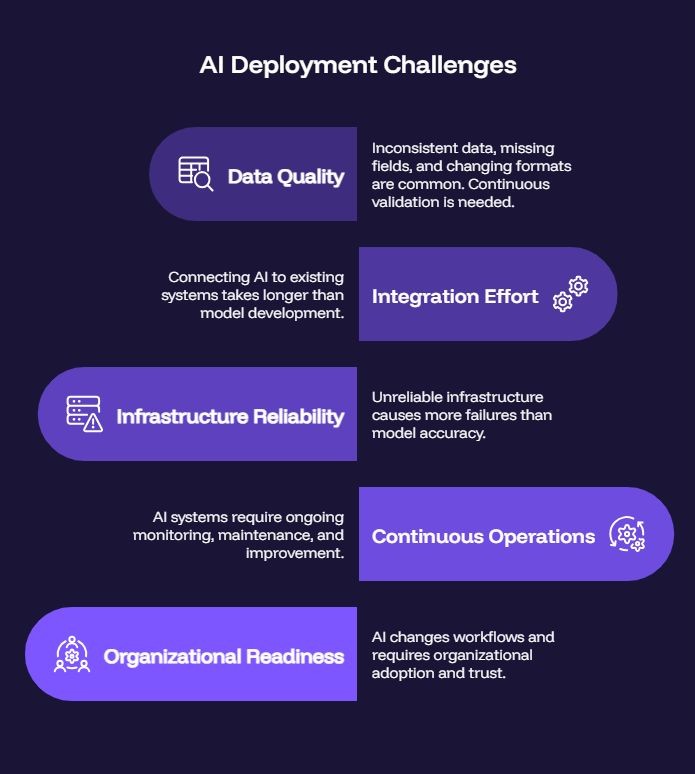
AI Deployment Challenges
1. Data Quality Becomes a Continuous Challenge
AI prototypes are usually trained and tested on clean, well-structured datasets. In production, those assumptions rarely hold true.
Organizations often encounter:
Incomplete or inconsistent data
Missing fields and duplicate records
Changing data formats over time
Unexpected data quality issues
Instead of one-time data preparation, production AI requires continuous data validation, monitoring, and quality checks to maintain performance.
2. Integration Often Takes Longer Than Model Development
Generating the right answer is only part of the job. AI systems must also connect with existing business systems and workflows.
This often includes:
CRM and ERP platforms
Internal databases
Ticketing systems
Business applications
Human approval workflows
Across Omdena deployments, integration work routinely consumed more engineering effort than model development itself, making it one of the most underestimated deployment challenges.
3. Infrastructure Reliability Matters More Than Model Accuracy
A highly accurate model can still fail if the supporting infrastructure is unreliable. API failures, latency issues, networking problems, and unstable services can quickly disrupt AI workflows.
One Omdena deployment found that 94.3% of observed failures originated from infrastructure instability rather than AI reasoning logic.
This highlights an important lesson: production AI depends as much on reliable engineering systems as it does on model performance.
4. AI Systems Require Continuous Operations
Production AI is never “finished.” Models evolve as data changes, prompts are updated, APIs change, and business requirements shift.
Successful AI teams invest in:
Continuous monitoring
Model and experiment tracking
Performance evaluation
System telemetry
Ongoing maintenance and governance
Long-term success depends on continuous improvement rather than a one-time deployment.
5. Organizational Readiness Matters as Much as Technology
The final challenge is often organizational rather than technical. AI changes workflows, decision-making processes, and team responsibilities.
Successful deployments typically include:
Human review for high-risk decisions
Confidence thresholds for automation
Clear governance processes
Well-defined ownership across teams
Without organization-wide adoption and trust, even technically successful AI systems struggle to deliver lasting business value.
The reason many teams underestimate these challenges is simple: AI prototypes hide much of the engineering and operational work required for production deployment.
What AI Prototypes Don’t Show
A working prototype often creates the impression that an AI system is ready for deployment. In reality, many of the engineering and operational requirements only become visible as the system moves into production.
Prototype Stage
Production Reality
One AI model
Multiple AI providers with backup systems
Clean test data
Continuous data validation and monitoring
Manual testing
Automated testing and quality checks
Standalone application
Integration with business systems and workflows
Simple prompt or workflow
Version control and ongoing optimization
Manual execution
Automated scheduling and orchestration
Local storage
Reliable and scalable data infrastructure
Basic configuration
Environment and configuration management
Optional logging
Continuous monitoring and observability
Small internal team
Cross-functional teams managing deployment, operations, and governance
The hidden work behind production AI often takes more time and engineering effort than building the model itself. Teams that recognize this early are far more likely to move successfully from prototype to production.
What Successful AI Teams Do Differently
Organizations that successfully deploy AI treat it as an engineering and operational challenge rather than just a machine learning project. Instead of focusing only on model accuracy, they build the systems and processes needed to keep AI reliable over time.
Based on Omdena’s deployment experience, successful AI teams consistently:
Design for production from day one instead of treating deployment as the final step.
Continuously validate incoming data rather than assuming it will remain clean.
Build monitoring and observability into the system before scaling to production.
Design backup and fallback mechanisms for external APIs and AI providers.
Automate testing and deployment to reduce manual errors and improve consistency.
Track model versions and experiments to simplify debugging and future improvements.
Establish clear governance and human review processes for high-risk decisions.
Most importantly, they think beyond the MVP. The goal is not to build an impressive prototype but to create an AI system that operates reliably, adapts to change, and delivers measurable business value over the long term.
This is exactly the gap that many organizations struggle to bridge and where a structured AI delivery partner like Omdena can make a significant difference.
How Omdena Helps Organizations Move Beyond the Prototype Stage
Many organizations already have a working AI MVP, chatbot, AI agent, or proof of concept. The challenge begins when those early experiments need to support business-critical operations with reliable integrations, governance, monitoring, scalability, and long-term maintenance.
Omdena addresses this challenge through a production-focused delivery model built on three core pillars.
1. Umaku: A Proprietary Agentic AI Platform Built for AI Delivery
Traditional AI development often struggles with fragmented documentation, inconsistent code reviews, and a lack of project-wide context. These challenges become even more difficult when distributed AI teams collaborate across multiple time zones and technologies.
To solve this, Omdena developed Umaku, its proprietary agentic AI platform that keeps project context, sprint planning, architecture decisions, documentation, and delivery workflows in one place.
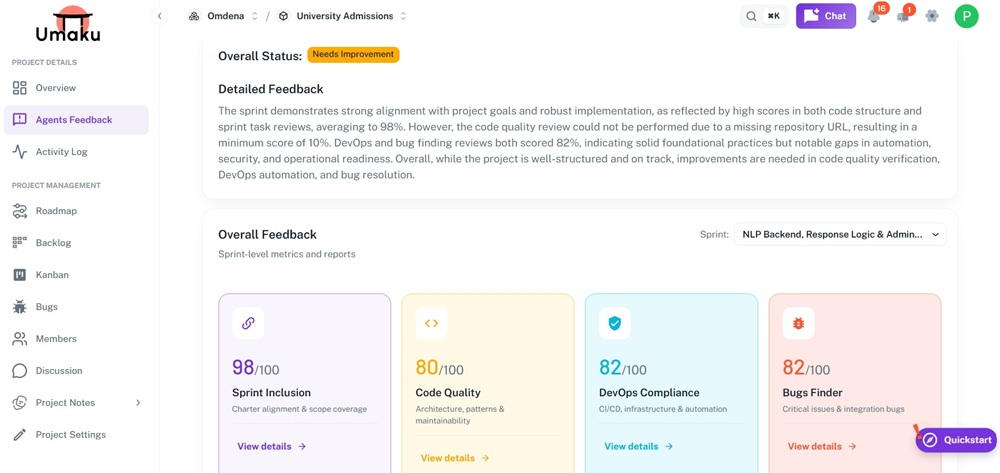
Agents Feedback Dashboard in Umaku
Key capabilities include:
Centralized project charters that capture business goals and technical context
Sprint planning and Kanban-based project management
Context-aware AI code reviews that understand project requirements
AI agents that analyze sprint health, code quality, DevOps compliance, and potential bugs
Built-in documentation and knowledge management throughout the project lifecycle
By combining human expertise with AI-assisted project execution, Umaku helps teams maintain consistency, reduce rework, and improve delivery quality as projects scale.
2. A Structured AI Delivery Methodology
Many AI initiatives treat deployment as the final phase of development. Omdena takes a different approach by designing for production from the beginning.
Its structured delivery methodology covers the entire AI lifecycle, including:
Problem framing and stakeholder alignment
Data readiness and governance
Architecture selection
Continuous evaluation and testing
Integration with existing business systems
Deployment and MLOps
Knowledge transfer and operational ownership
This production-first approach helps reduce deployment risk while ensuring AI systems remain reliable long after launch.
3. A Vetted Global AI Talent Network
Successful AI deployment requires more than data scientists alone. Production AI projects often need expertise across machine learning, MLOps, data engineering, software engineering, DevOps, domain knowledge, and AI governance.
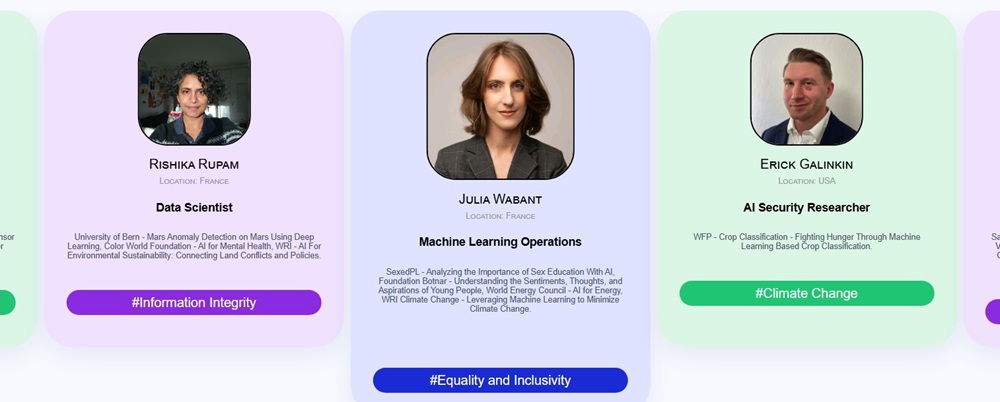
Omdena provides access to a vetted global network of more than 30,000 AI engineers, researchers, MLOps specialists, and domain experts across 80+ countries. Teams are assembled based on project requirements, allowing organizations to access specialized expertise without the complexity of building large in-house AI teams.
Vetted AI Talent Network
By combining specialized talent with a structured delivery methodology and the Umaku platform, Omdena helps organizations move beyond AI prototypes and build systems that operate reliably in production environments.
Move Your AI Prototype into Production
Building an AI prototype is easier than ever. Turning that prototype into a reliable production system that integrates with business processes, scales with demand, and delivers consistent results is where the real challenge begins.
Organizations that plan for deployment from the start by investing in data pipelines, integrations, monitoring, governance, and operational readiness are far more likely to realize long-term business value from AI.
If your team already has an AI prototype and is now preparing for production deployment, Omdena can help you bridge that gap. Our production-focused AI delivery approach is designed to help organizations move beyond experimentation and build AI systems that work in real-world environments.
Book an exploration call with Omdena to discuss the right roadmap for moving your AI prototype into production.
FAQ
Why do most AI prototypes never reach production?
Most AI prototypes are built in controlled environments using clean data and limited workflows. When deployed in actual business environments, they must handle messy data, system integrations, security requirements, monitoring, scalability, and changing business processes, making production significantly more complex than prototyping.
What is the difference between an AI prototype and a production-ready AI system?
An AI prototype is designed to validate an idea or use case, while a production-ready AI system is built for reliability, scalability, governance, monitoring, and seamless integration with existing business applications and workflows.
What are the biggest challenges in moving AI from prototype to production?
The biggest challenges include poor data quality, integration with existing systems, reliability under real-world conditions, continuous monitoring and maintenance, governance requirements, and organizational adoption across business teams.
How can organizations improve the chances of successful AI deployment?
Organizations should define business outcomes early, design for production from the start, build reliable data pipelines, implement monitoring and governance, integrate AI into existing workflows, and maintain human oversight for critical decisions.
Can Omdena help move an existing AI prototype into production?
Yes. Omdena helps organizations transform AI prototypes, MVPs, chatbots, and AI agents into production-ready systems through its proprietary agentic AI platform, structured delivery workflows, deployment expertise, MLOps practices, and a global network of AI specialists.
Continue with Omdena
Share this article
Share on LinkedIn, send by email, or copy the direct link.