Why Vibe-Coded Prototypes Get Expensive in Production
10 min readUpdated October 5, 2026
Okon PrinceSenior Data Scientist / Forward deployed Engineer
A founder opens an AI coding tool and has a working internal application within days. The interface works, stakeholders can test a real product, and the cost looks close to zero. Compared with a traditional development quote, it is easy to assume that production will require only minor polishing.
Then production work begins. Edge cases appear, integrations fail, security needs a proper review, and new changes quietly break existing features. Engineers spend time understanding and cleaning up generated code, and parts of the prototype may need to be rewritten.
This gap is becoming increasingly important. In Loop Studio’s 2026 Developer Survey, 84% of respondents said they use or plan to use AI tools, yet more developers distrusted their accuracy than trusted it—46% compared with 33%. AI reduces the cost of generating the first version. It does not remove the cost of verifying, integrating, securing, maintaining, and evolving it.
Why Vibe Coding Makes the Initial Cost Look So Low
The savings at the beginning are real. AI coding tools can:
Collapse the time required to build a first prototype.
Remove boilerplate and repetitive coding work.
Make early experiments inexpensive.
Reduce manual coding for simple functionality.
For validating an idea quickly, these are meaningful advantages.
The problem begins when teams substitute one question for another:
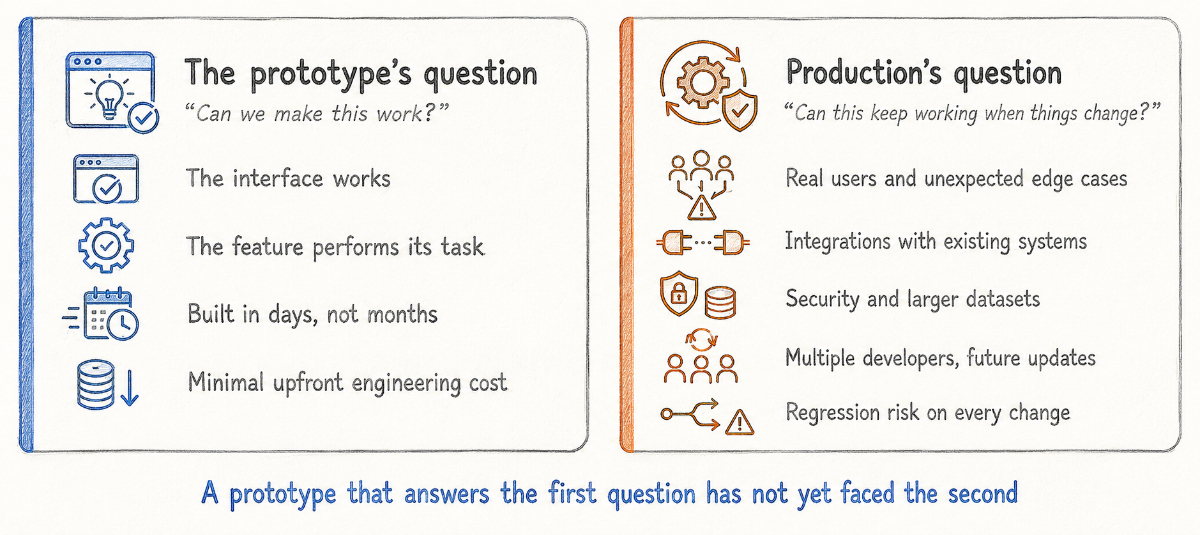
Prototype: Can we make this work?
Production: Can it continue working as users, data, dependencies, and requirements change?
Creating software is not the same as operating and maintaining it. Figure 1 shows why passing the prototype test says little about whether a system is ready for its full lifecycle.
Figure 1. The Prototype’s Question Versus Production’s Question
The Hidden Engineering Costs of Vibe Coding
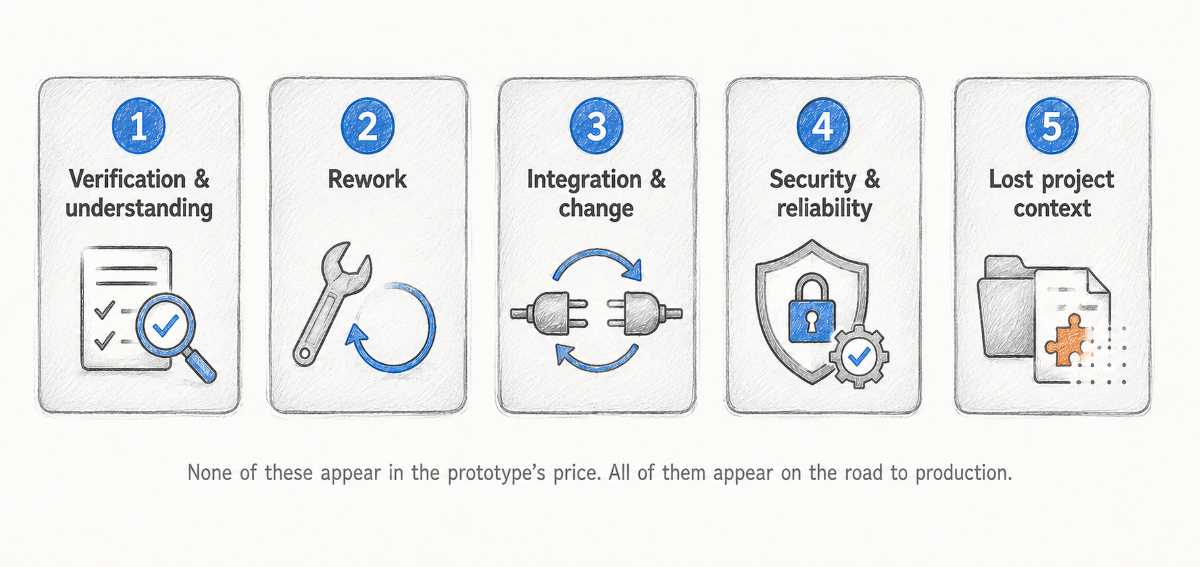
When a vibe-coded prototype heads toward production, five costs surface that never appeared in the prototype’s price. Figure 2 previews them; the sections below take them in turn.
Figure 2. Five Hidden Costs on the Road to Production
Hidden Cost 1: Verification and Understanding
AI can generate code faster than a human can review it, but someone still has to establish whether that code can be trusted:
Is the implementation correct?
Does it meet the business requirement?
What happens in unusual situations?
How does it interact with the rest of the system?
A working output is not necessarily a correct implementation. The faster code is generated, the more important a reliable verification process becomes.
The burden also scales with volume. A team that generates ten times more code has not made verification ten times cheaper; it has made verification ten times more necessary. Without a deliberate way to check generated work against requirements, review quietly becomes the bottleneck the prototype’s speed was hiding.
Hidden Cost 2: Rework
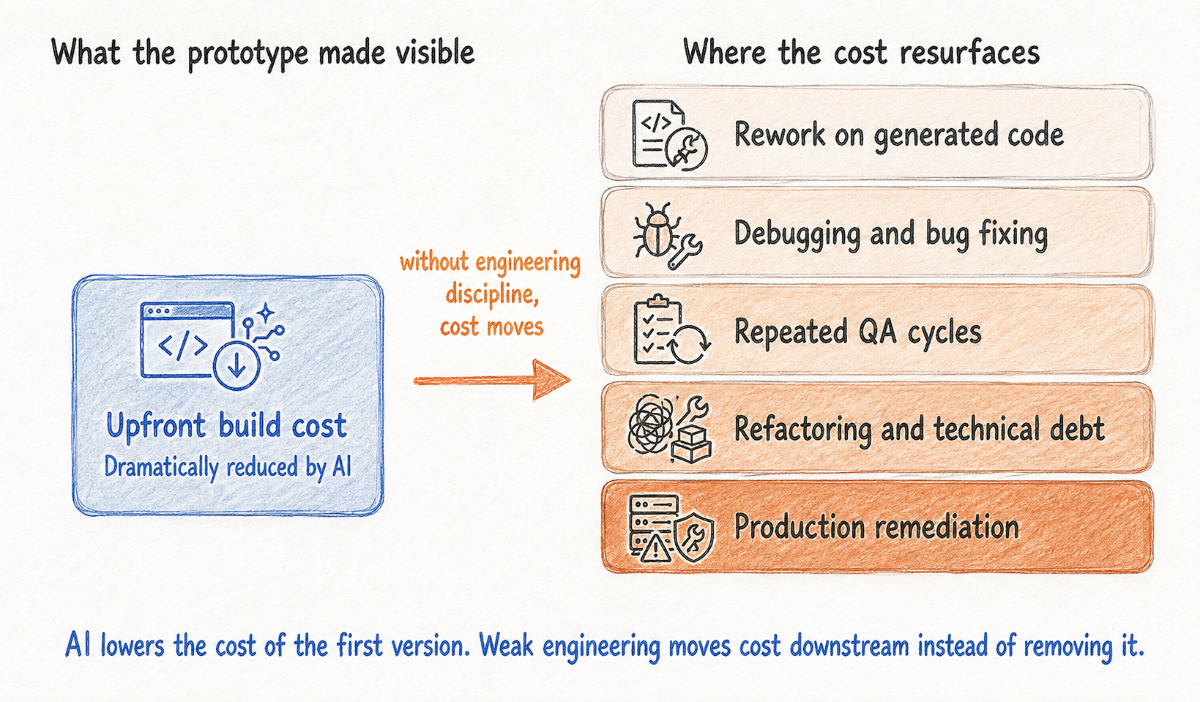
Development cost has layers: the initial build, the rework, and the downstream remediation and opportunity cost that follow problems discovered late. A cheap prototype becomes expensive when engineers must rewrite generated code, fix bugs, resolve scope mismatches, redesign integrations, and pay down accumulated technical debt.
The same problem also grows more expensive the longer it survives, so rework deferred is rework multiplied. Figure 3 shows where the cost that vanished from the upfront build tends to reappear.
Figure 3. Where the Prototype’s Missing Costs Resurface
Hidden Cost 3: Integration and Change
Software does not stay still. A system that works today must eventually absorb changes such as:
Billing-system updates
Database schema migrations
New or modified APIs
Dependency upgrades
Features that rely on old assumptions
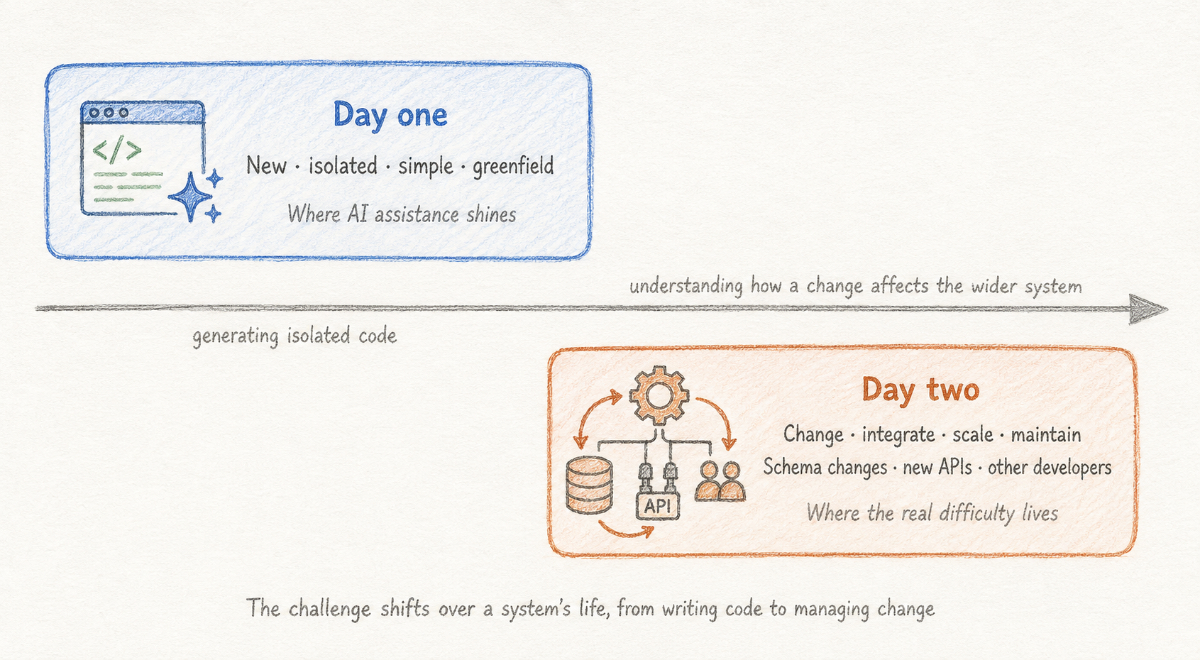
At that point, the challenge is no longer generating isolated code. It is understanding how each change affects the wider system.
This is the “day two” problem illustrated in Figure 4. AI-generated software is easiest to build when a project is new, simple, and isolated. The difficulty appears when the system must integrate, scale, change, and remain maintainable over time—the work a prototype never rehearses.
Figure 4. The Day Two Problem
For founders and consultants this cost is rarely hypothetical, because they so often inherit it. Taking over a system that someone assembled quickly, with no record of why it is built the way it is, means paying for day two decisions that day one never documented.
Hidden Cost 4: Security and Production Reliability
Production also raises the bar on what the code must withstand: authentication and authorization, failure handling, protection of sensitive data, dependency risks, and unexpected user behavior.
None of this means AI-generated code is inherently insecure. It means the speed of generation does not remove the need to verify whether the resulting system meets the security and reliability requirements of its production environment.
Hidden Cost 5: Lost Project Context
The deepest cost is not imperfect code; it is missing context. Code can be technically correct and still wrong for the project: it may not satisfy the business requirement, may conflict with the original scope or the architecture, or may quietly create problems for a later sprint or another component.
A code-generation tool knows what the prompt asked it to build. It does not automatically understand the project’s history, business logic, roadmap, architecture, sprint objectives, tickets, and repository context. That gap between prompt context and project context is where the most expensive mistakes hide, and it is the problem the rest of this article turns to.
Coding Has Become Cheaper. Engineering Has Not Disappeared.
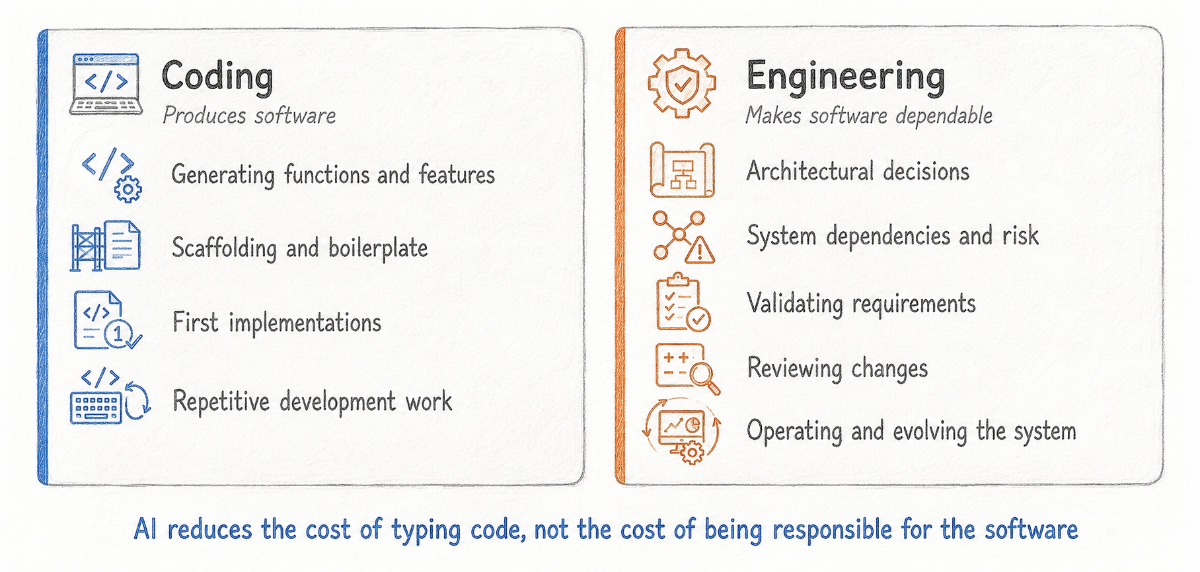
The pattern behind all five costs is one distinction: coding and engineering are not the same activity. Coding produces software. Engineering makes software dependable enough to operate and evolve: choosing architecture, understanding system dependencies, managing risk, validating requirements, reviewing changes, and handling production failures over time. AI is driving the cost of the first activity down; the second still has to be done by someone. Figure 5 draws the line.
Figure 5. Coding Produces Software. Engineering Makes It Dependable.
Put plainly: AI can reduce the cost of typing code without reducing the cost of being responsible for the software. The conclusion is not to reject AI-assisted development. It is to use AI to accelerate development while strengthening the engineering and quality processes around it, so the speed gain is kept rather than repaid downstream.
How to Prevent the Hidden Costs From Moving Downstream
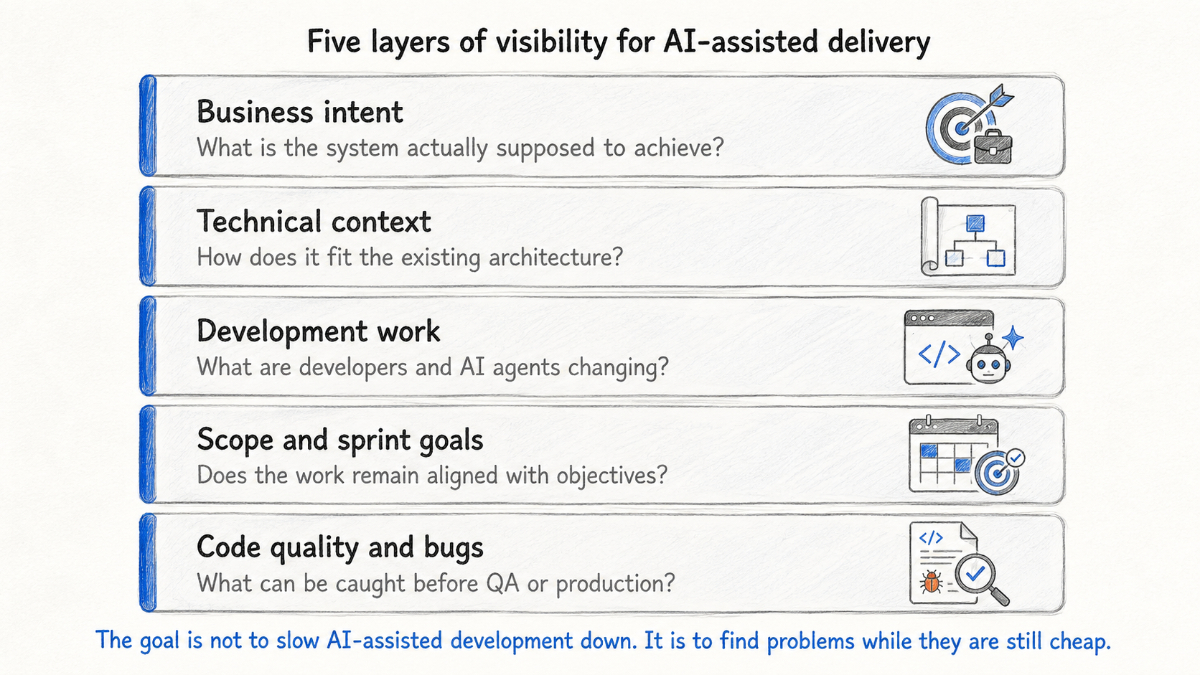
The practical countermeasure is visibility across five layers while development is still underway:
Business intent: The user need, expected outcome, and business requirement the system must satisfy.
Technical context: The architecture, technology stack, dependencies, and constraints the implementation must fit.
Code changes: What developers and AI agents are actually adding, removing, or modifying.
Delivery alignment: Whether the work matches the agreed scope, roadmap, sprint objectives, and tickets.
Quality signals: Defects, security risks, compliance gaps, and scope misalignment caught before QA or production.
Figure 6 shows how these layers connect.
The goal is not to slow AI-assisted development. It is to catch problems early enough that faster coding does not become faster production of downstream rework. The same defect becomes more expensive at every later stage.
Figure 6. Five Layers of Visibility for AI-Assisted Delivery
The principle matters more than any tool: the goal is not to slow AI-assisted development down. It is to find problems early enough that faster development does not simply become faster production of downstream rework, because the same defect only gets more expensive at each later stage it reaches.
Umaku: Adding Context and Early Visibility to AI-Assisted Development
Faster code generation increases the number of changes a team must understand, verify, and connect to its wider project. Reviewing the code in isolation is not enough. Teams also need to know what the software is supposed to achieve, how it should be built, and where the work belongs in the delivery plan.
Umaku, Omdena’s delivery platform, brings these different layers of project context together.
Connecting Business and Technical Context
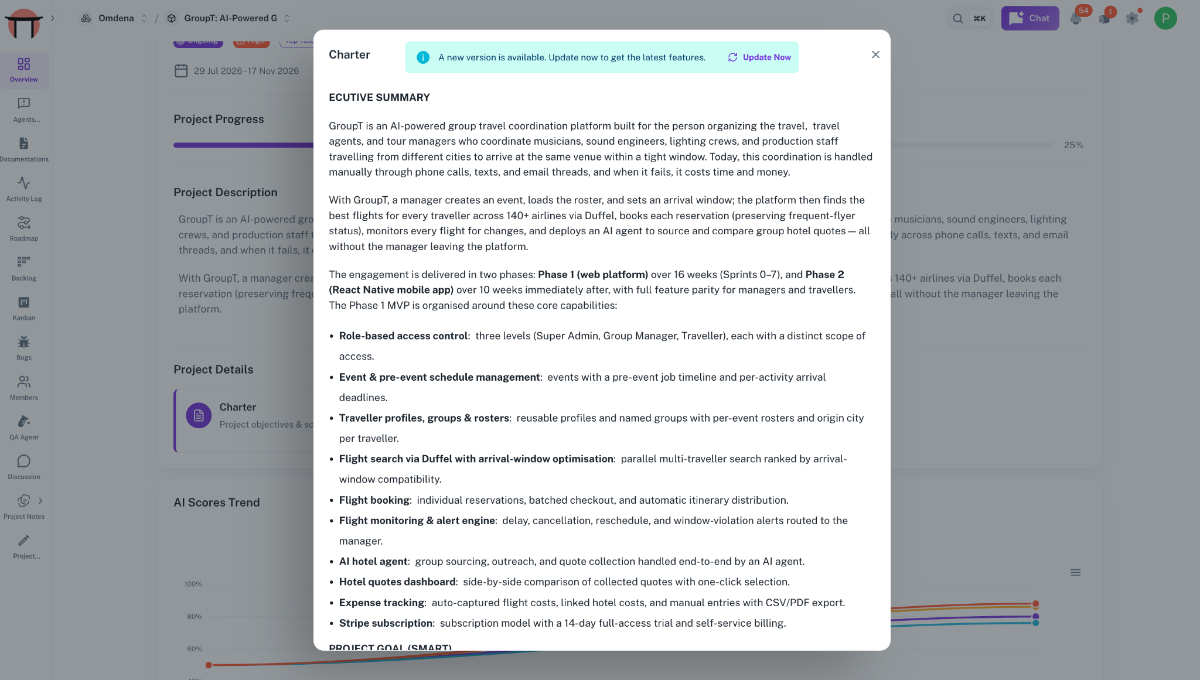
Every project begins with an intended outcome. Umaku captures this through the Project Charter, which defines the business problem, objectives, scope, requirements, and expected results.
Figure 7. The project charter provides clear insight into the projects goals and objectives
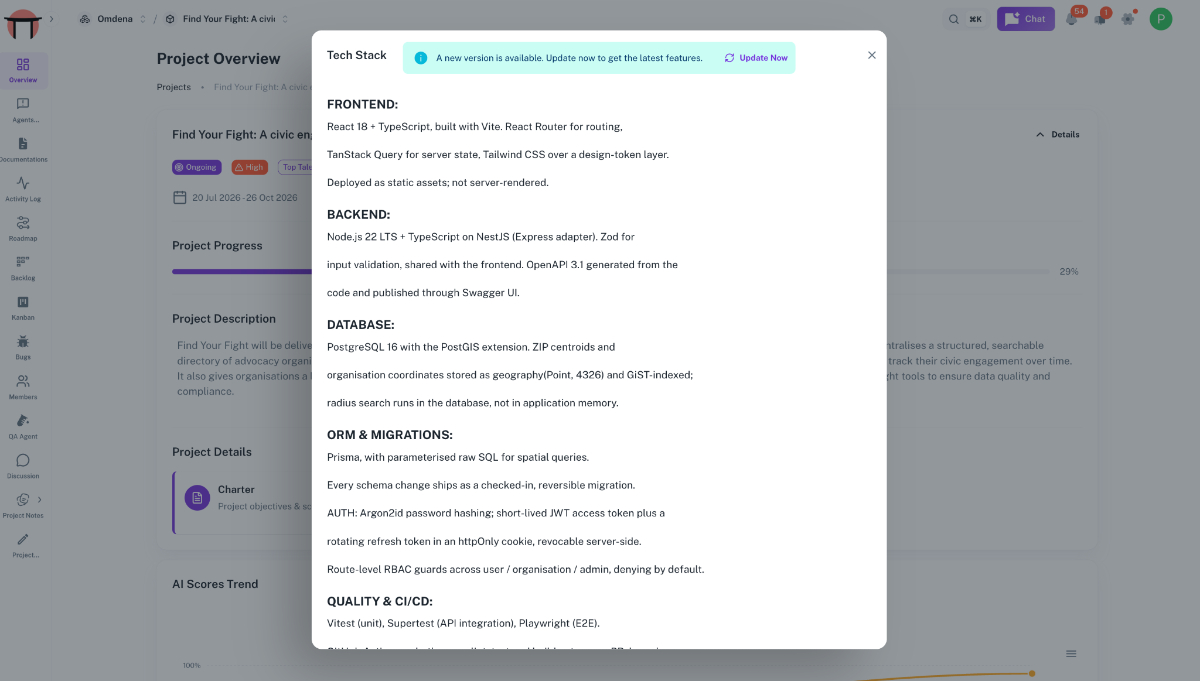
It connects this business context to the project’s technical foundation, including its technology stack, repositories, resources, and architectural decisions. This gives developers and AI agents a clearer frame for evaluating whether an implementation fits the project—not merely whether the code runs.
Figure 8. Umaku tech stack showing the tools used in the project
Connecting Code to the Delivery Plan
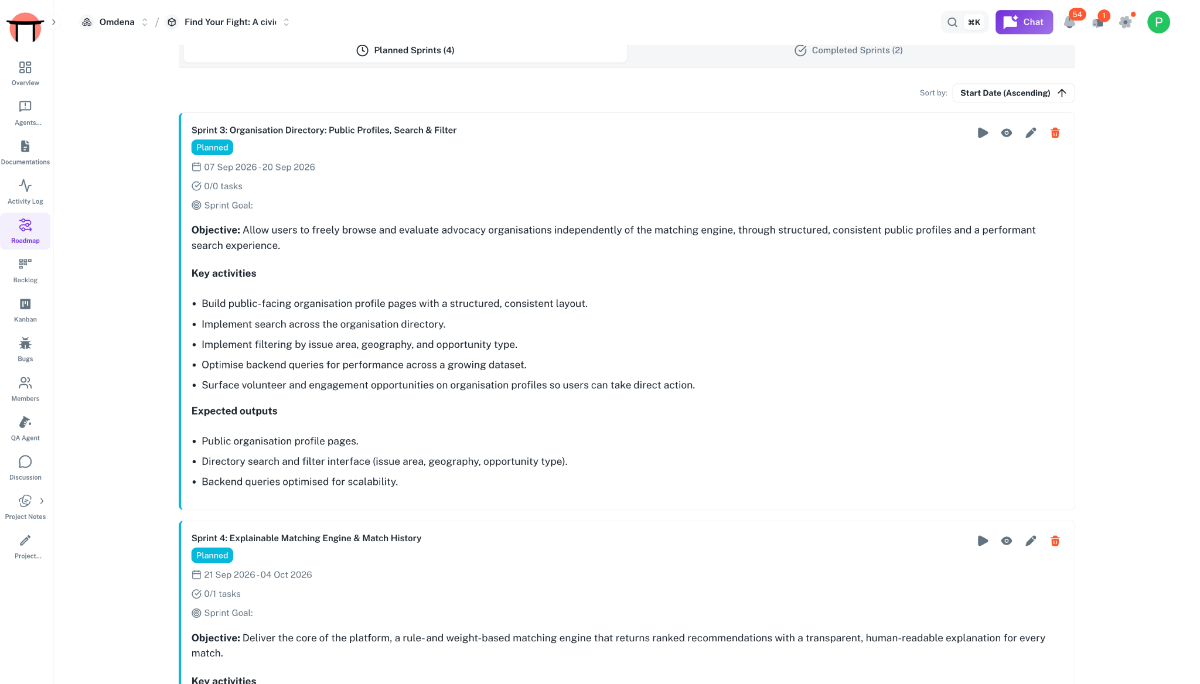
Technical correctness is only one part of successful delivery. A change can work as intended and still be wrong for the current sprint, outside the agreed scope, or disconnected from the project roadmap.
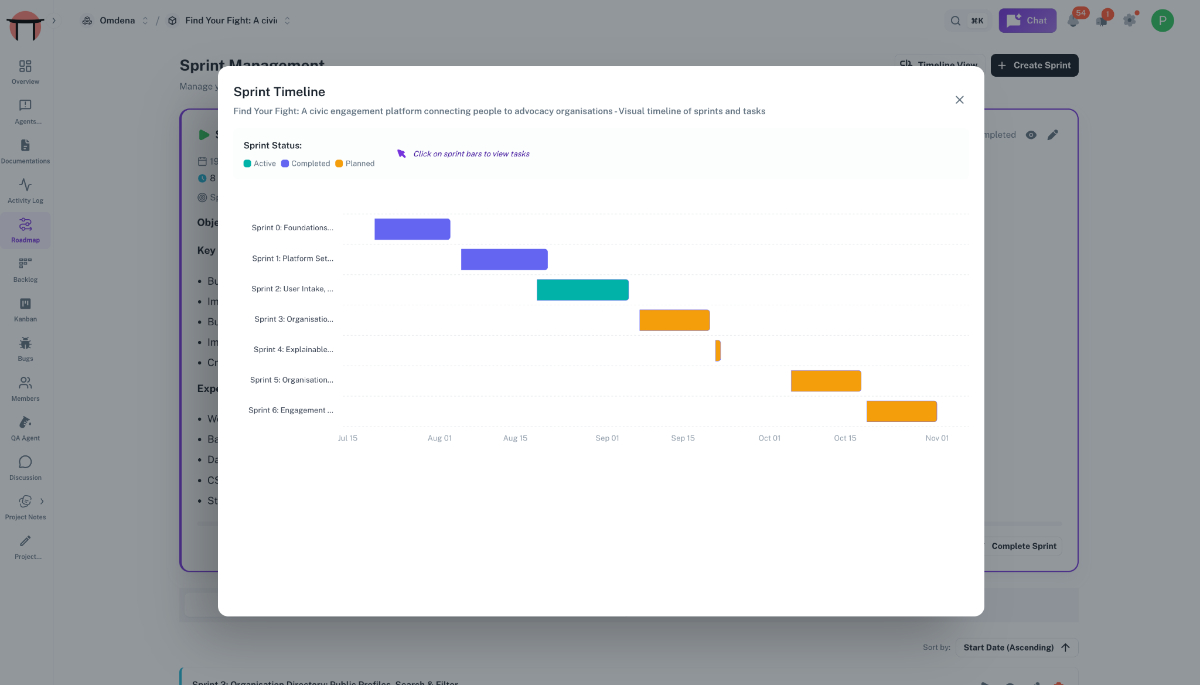
Figure 9. Umaku helps to organize projects into sprints with measurable goals, objectives and priorities
Umaku connects development activity to:
Roadmap priorities
Sprint objectives
Assigned tickets
Expected deliverables
Project milestones
This makes it easier to see where a piece of work belongs, why it is being developed, and whether it supports the team’s current commitments.
Figure 10. Umaku connects development work to roadmap priorities, sprint objectives, and planned deliverables.
Turning Context into Actionable Feedback
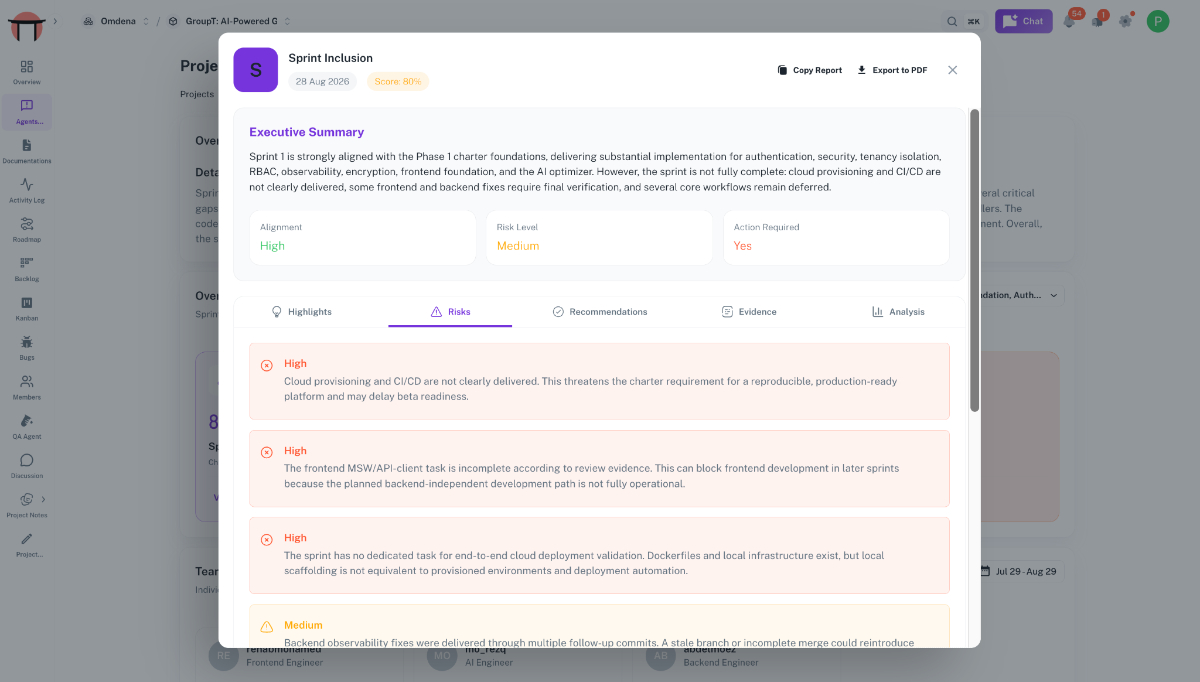
Once work is completed, Umaku evaluates it using the project context already captured in the platform. The analysis covers four dimensions:
Sprint Inclusion: Does the completed work belong to the sprint, and does it satisfy the relevant objectives and tickets?
Code Quality: Is the implementation maintainable, understandable, and consistent with sound engineering practices?
DevOps Compliance: Does the work follow the project’s delivery, repository, and operational requirements?
Bug Finder: Are there defects, edge cases, or reliability problems that should be addressed?
The findings are presented in a feedback dashboard and converted into actionable tickets. Developers can therefore address problems while the work is still recent, rather than allowing them to move into QA, integration, or production.
Figure 11. Umaku turns context-aware analysis into feedback and actionable development tickets.
The Difference Context Makes
A generic review tool asks whether code is technically well written. A context-aware platform asks a broader set of questions:
Is this the right implementation for the business requirement?
Does it fit the project’s technical architecture?
Does it satisfy the relevant ticket and sprint objective?
Could it create problems for another component or a later stage of delivery?
What should the developer address next?
These are the questions that isolated AI prompts frequently cannot answer because the necessary information lives across charters, repositories, roadmaps, sprints, and tickets.
Umaku does not make AI-generated code perfect or replace engineering judgment. It provides an additional visibility and accountability layer that helps teams detect mistakes, risks, and misalignment earlier—while those problems are still less expensive to correct.
Conclusion
Vibe coding changes the economics of the first version of software. It makes experimentation and prototyping dramatically faster and cheaper, and that value is real. But the first version is only one part of the total cost of delivery, and a cheap prototype can still create expensive downstream work when verification, integration, security, and context are left for later.
Faster code generation raises, rather than lowers, the value of verification and project context. The goal is not less AI-assisted development; it is better engineering around AI-assisted development. The companies that benefit most from AI coding will not necessarily be the ones that generate code the fastest, but the ones that detect mistakes, misalignment, and risk before those problems become expensive. To see what that looks like in practice, explore how Umaku supports context-aware software delivery.
FAQ
Why do vibe-coded prototypes become expensive in production?
Although AI tools make initial development faster and cheaper, production introduces costs such as verification, integration, security reviews, maintenance, and rework. These responsibilities remain even when code generation is automated.
What hidden costs arise when moving an AI-generated prototype into production?
The five main hidden costs are: Verification and understanding, Rework and technical debt, Integration and ongoing change, Security and production reliability, Lost project context
What is the difference between coding and engineering?
Coding produces software, while engineering ensures that software is dependable, secure, maintainable, and able to evolve. AI reduces the effort needed to write code, but it does not eliminate architecture decisions, risk management, requirement validation, or production support.
How can teams prevent these costs from moving downstream?
Teams should maintain visibility across business intent, technical context, code changes, delivery alignment, and quality signals. Detecting defects and misalignment during development is considerably cheaper than correcting them during integration, QA, or production.
How does Umaku support AI-assisted software development?
Umaku connects business requirements and technical architecture with repositories, roadmaps, sprints, and tickets. It evaluates completed work for sprint alignment, code quality, DevOps compliance, and potential defects, then converts its findings into actionable tickets so teams can address problems earlier.
Continue with Omdena
Share this article
Share on LinkedIn, send by email, or copy the direct link.