AI is no longer experimental, but most implementations still fail to deliver real business value. Today, 87% of large enterprises use AI to improve operations, yet research shows that up to 95% of generative AI pilots never make it to production. The problem is rarely the technology itself. It comes from a mismatch between AI systems and real business workflows, data, and constraints.
This leads to a more important question than “What is AI?” Should your organization invest in custom AI development, or will off-the-shelf tools be enough? For many teams, this decision determines whether AI becomes a competitive advantage or just another failed initiative.
In this guide, I explain what custom AI development actually means, when it is worth the investment, how much it typically costs, and which approach best fits your use case. I also show how organizations move from pilots to production using structured, real-world systems.
TL;DR (Quick Summary):
What is custom AI development: Building AI systems tailored to your workflows, data, and business goals instead of using generic tools.
When you need it: Use custom AI when workflows are complex, data is proprietary, compliance is strict, or high accuracy is critical.
Custom vs off-the-shelf: Off-the-shelf AI is faster and cheaper for simple use cases, while custom AI offers control, scalability, and better long-term performance.
Key benefits: Improves efficiency, increases accuracy, creates a competitive advantage, and gives full control over data and systems.
Main challenges: Requires high-quality data, upfront investment, skilled talent, and careful integration and governance.
Approach options: Range from prompt-based systems and RAG to fine-tuned models and agentic AI, depending on complexity and goals.
Cost range: Typically $10k–$500k+, depending on data readiness, integrations, model complexity, and deployment requirements.
ROI perspective: Higher upfront cost but better long-term value compared to SaaS tools due to ownership and scalability.
Execution matters: Success depends on structured planning, evaluation, and aligning AI systems with real business workflows.
What Is Custom AI Development
Custom AI development is the process of building AI systems tailored to a company’s specific workflows, data, and business goals. Unlike off-the-shelf tools, these systems are designed to fit how an organization actually operates rather than forcing teams to adapt to generic software.
In simple terms, custom AI means creating solutions that work with your data, your processes, and your constraints. It goes beyond choosing a model. It includes designing the right architecture, preparing data, integrating with existing systems, and ensuring security, compliance, and long-term reliability.
When implemented well, custom AI improves decision-making, automates complex workflows, and unlocks insights from proprietary data that generic tools cannot access. However, custom AI is not always necessary. The key is understanding when it truly adds value.
When Do You Actually Need Custom AI?
Not every AI use case requires a fully custom solution. However, custom AI becomes essential when standard tools fail to align with how your business actually operates or the level of control you need.
You should consider custom AI development when:
Your workflows are complex or unique and cannot be handled by generic tools.
You rely on proprietary or sensitive data that requires full control and security.
You operate in regulated environments where compliance, auditability, and governance are critical.
High accuracy and reliability are required, especially in high-stakes use cases like finance or healthcare.
In these scenarios, custom AI provides better performance, control, and long-term value. But how does it compare to ready-made solutions?
Custom AI vs Off-the-Shelf AI
Off-the-shelf AI tools are ready-made solutions that deploy quickly with low upfront cost. They work well for basic use cases like chatbots and automation, but often struggle with complex workflows, proprietary data, deep integrations, and strict compliance requirements as usage scales.
Custom AI becomes necessary when needs are specific and risks are higher. It offers full control over data, models, and workflows, making it better suited for mission-critical use cases.
The table below compares both approaches:
Aspect
Off-the-Shelf AI
Custom AI
Setup speed
Very fast
Slower, requires planning
Upfront cost
Low
Higher initial investment
Fit to workflows
Generic
Built for specific workflows
Data usage
Limited control
Full control
Integration
Basic
Deep integration
Compliance & privacy
Limited
Fully customizable
Performance at scale
Can degrade
Optimized
Flexibility
Vendor-dependent
Fully owned
When to choose what:
Use off-the-shelf AI when your use case is simple, speed matters, and customization is not critical.
Use custom AI when workflows are complex, data is proprietary, or performance and compliance are essential.
Use a hybrid approach when you want to combine speed with customization, such as using foundation models with tailored workflows.
Understanding this distinction helps avoid costly misalignment. Next, let’s look at the key benefits of custom AI development and why organizations invest in it.
Benefits of Custom AI Development
Custom AI development delivers value when systems are built around real workflows, not generic use cases. The impact shows up in measurable business outcomes, from efficiency gains to revenue growth.
Operational efficiency and cost savings: Automates repetitive tasks, reduces manual errors, and streamlines workflows, leading to faster execution and lower operational costs.
Higher accuracy and better decision-making: Models trained on business-specific data produce more precise outputs, improving forecasting, risk analysis, and overall decision quality.
Sustainable competitive advantage: Custom AI builds proprietary intelligence that competitors cannot replicate, creating long-term differentiation.
Full data ownership and control: Keeps sensitive data within your systems, improving security, compliance, and governance flexibility.
While these benefits are compelling, custom AI also comes with trade-offs. Let’s look at the key challenges in custom AI development.
Challenges in Custom AI Development
Custom AI development offers strong advantages, but it also introduces practical challenges that teams must plan for upfront.
Data readiness and quality: Many AI projects fail due to poor data quality, siloed systems, or a lack of AI-ready infrastructure, making data preparation a major bottleneck.
High upfront cost and uncertain ROI: Custom solutions require investment in development, integration, and ongoing maintenance, with hidden costs in data preparation and change management.
Talent and skill gaps: Organizations often struggle to find skilled AI engineers and domain experts, slowing implementation and scaling.
Deployment and integration complexity: Integrating AI into existing systems and workflows is often harder than building the model itself.
Governance, compliance, and risk management: AI systems must meet strict requirements around privacy, explainability, and security, increasing operational complexity.
Understanding these challenges helps set realistic expectations and avoid costly failures. Next, let’s explore the different approaches to custom AI development.
The Spectrum of Approaches to Custom AI Development
Custom AI development is not a single method or architecture. It exists on a spectrum. Different problems require different levels of customization, control, and investment. In practice, many teams combine multiple approaches rather than committing to just one. The goal is not to chase sophistication, but to match the approach to the problem.
Approach 1: Configure an Existing AI Product
This is the lightest form of customization. Teams start with an existing AI product—such as a customer support copilot or analytics assistant—and configure it using rules, templates, or predefined integrations.
Example: A customer support team configures an AI chatbot using a SaaS platform to answer FAQs and route tickets.
Pros: Fast setup, low effort, quick time to value.
Limits: Little control over behavior, data handling, or deeper workflow integration.
Approach 2: Prompt and Workflow Engineering on Top of a Foundation Model
Here, teams build custom prompts and logic on top of large foundation models like GPT or Claude. This approach is common for pilots and internal tools.
Example: An internal HR tool uses structured prompts to summarize employee feedback and flag recurring issues.
Pros: Flexible and fast to iterate.
Limits: Reliability depends heavily on prompt design, guardrails, and evaluation. Outputs can vary in production.
Approach 3: Rag-Based Systems (Enterprise Knowledge + LLM)
Retrieval-Augmented Generation combines a language model with private knowledge sources. Instead of retraining the model, the system retrieves relevant documents at query time. This makes data preparation and structuring critical, especially when working with unstructured files. For a deeper look at this, see our guide on document parsing for RAG.
Example: A legal team builds an AI assistant that answers questions using internal contracts and policy documents.
Pros: Fresh data, better traceability, no need to retrain models.
Trade-offs: Retrieval quality, latency, and governance design directly affect performance.
Approach 4: Fine-Tuning Small Language Models
Fine-tuning small language models involves adjusting a model’s behavior to match a specific domain or task. This approach is most effective when outputs must be consistent.
Example: A healthcare provider fine-tunes a small model to generate structured clinical summaries using domain-specific terminology.
Pros: More consistent outputs, better domain alignment.
Trade-offs: Requires high-quality labeled data, retraining plans, and drift monitoring.
Approach 5: Custom Models (Generative AI Development)
Some problems require building models from scratch or deeply customizing existing ones. This is common when performance, privacy, or deployment constraints are strict.
Example: A manufacturing company builds a custom vision language model to detect defects on a production line in real time.
Pros: Maximum control and performance.
Trade-offs: Longer timelines, higher cost, and strong MLOps requirements.
Approach 6: Agentic AI Development
Agentic AI systems plan, act, and interact with multiple tools to complete multi-step workflows.
Example: An AI agent automatically triages support tickets, queries CRM data, drafts responses, and escalates complex cases to humans.
Pros: Powerful automation across systems.
Trade-offs: Reliability, safety boundaries, and observability must be carefully managed.
Approach 7: The Hybrid Approach
Most real-world systems combine approaches. A common pattern is a RAG system for knowledge access, light fine-tuning for consistency, and agents for orchestration. Hybrid designs balance flexibility, control, and scalability.
With these options in mind, the key question becomes how to choose the right approach—or combination—for your specific goals, data, and constraints. The next section focuses on making that decision clearly and confidently.
Choosing the Right Custom AI Development Approach
Once teams decide to build custom AI, the challenge shifts from what is possible to what is appropriate. The right approach depends on speed, risk, data maturity, and long-term ownership—not just technical ambition. The comparison table below helps you narrow that choice.
Dimension
Configure Existing Product
Prompt + Workflow
RAG-Based Systems
Fine-Tuning
Custom / Agentic Systems
Time to value
Very fast
Fast
Medium
Medium
Slow
Data requirements
Minimal
Low
Medium (clean docs)
High (labeled data)
High
Performance control
Low
Medium
Medium–High
High
Very high
Explainability
Limited
Limited
Strong (citations)
Medium
Varies by design
Cost trajectory
Low upfront, rising over time
Low–medium
Medium
Medium–high
High
Maintenance effort
Low
Medium
Medium
High
Very high
Compliance readiness
Fixed by vendor
Limited
Strong if designed well
Strong
Strong
Deployment flexibility
Vendor-controlled
Cloud-focused
Flexible
Flexible
Fully flexible
This comparison highlights a key pattern: faster approaches trade control for speed, while deeper customization increases ownership, reliability, and long-term value at the cost of time and complexity.
Recommended Approaches by Context
First AI initiative: Start with prompt-based workflows or configured AI tools for fast experimentation, low risk, and quick validation.
Scaling pilots to production: Use RAG-based systems to improve reliability, enable private data usage, and add traceability without full retraining.
Regulated or high-risk domains: Choose fine-tuning, hybrid, or custom systems to ensure control, auditability, and compliance.
AI-first products and platforms: Use hybrid or agentic systems to achieve scalability, performance, and long-term ownership.
Choosing the right approach is not about using the most advanced technology. It is about aligning AI with your risk level, data, and business goals. These choices also have a direct impact on cost, timelines, and long-term ROI. Next, let’s break down the cost of custom AI development.
Cost of Custom AI Development
Custom AI development can vary widely in cost depending on scope, complexity, and business requirements. Across the industry, most projects typically range from $50,000 to $500,000+, while smaller, focused implementations can start from $10,000–$50,000.
Key Cost Drivers
Data readiness and quality: Cleaning, structuring, and preparing data often takes the most effort and directly impacts cost.
Integration complexity: Connecting AI systems with existing tools like CRMs, ERPs, or internal databases increases development effort.
Model type and architecture: Simple prompt-based systems cost less, while fine-tuned or agentic systems require more resources.
Deployment and infrastructure: Cloud, on-prem, or hybrid setups affect scalability, maintenance, and long-term costs.
Cost by Use Case
AI chatbot or assistant → Lower cost, faster to deploy
RAG-based system → Medium cost due to data pipelines and retrieval design
Agentic AI system → Higher cost due to orchestration, automation, and integration
ROI Perspective
While custom AI has a higher upfront investment than SaaS tools, it often delivers better long-term ROI. Instead of recurring subscription costs and vendor limitations, businesses gain a scalable, owned system that improves over time and aligns closely with their operations.
Understanding cost is only one part of the equation. The real value comes from how the system is designed and executed. Next, let’s look at how Omdena approaches custom AI development from strategy to deployment.
Omdena’s Approach to Custom AI Development
Omdena’s approach to custom AI development focuses on systems that work in real environments, not just in demos. It follows a human-centered AI approach that puts people, workflows, and decisions first. Human expertise is combined with AI-assisted execution through Umaku to keep projects structured and focused.
Custom AI Development Process
Every step, from problem framing to deployment, supports real users and clear decision-making. Technology choices reflect organizational realities, not ideal assumptions. This results in strong governance, long-term ownership, and AI systems that perform reliably in production.
Step 1: Problem Framing & Team Allocation
Every project starts with a clear problem definition. Omdena works closely with stakeholders to identify the real user, the job-to-be-done, and the ways a system could fail. Operational constraints, ethical risks, and success criteria are addressed early, before any technical decisions are locked in.
How Umaku Supports This Step
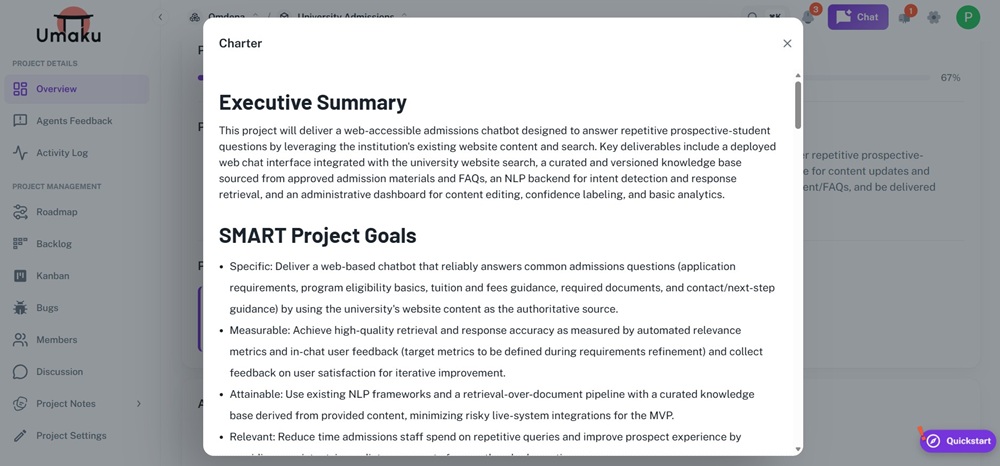
Umaku translates these early workshops into a structured project charter. It captures goals, metrics, assumptions, constraints, and risks in one shared system. This creates a single source of truth that aligns distributed contributors from the start.
Project Charter in Umaku
Umaku also matches the top talent from its database of 30,000+ AI engineers and helps project owners assign a team based on project requirements.
AI Talent Matching in Umaku
Step 2: Data Readiness and Governance Baseline
Once the problem is clear, Omdena evaluates data readiness. This includes mapping available data sources, identifying gaps, and defining how data can be accessed and used. Privacy, retention, consent, and regulatory requirements are addressed upfront. For high-risk use cases, human review and oversight are built into the design.
How Umaku Supports This Step
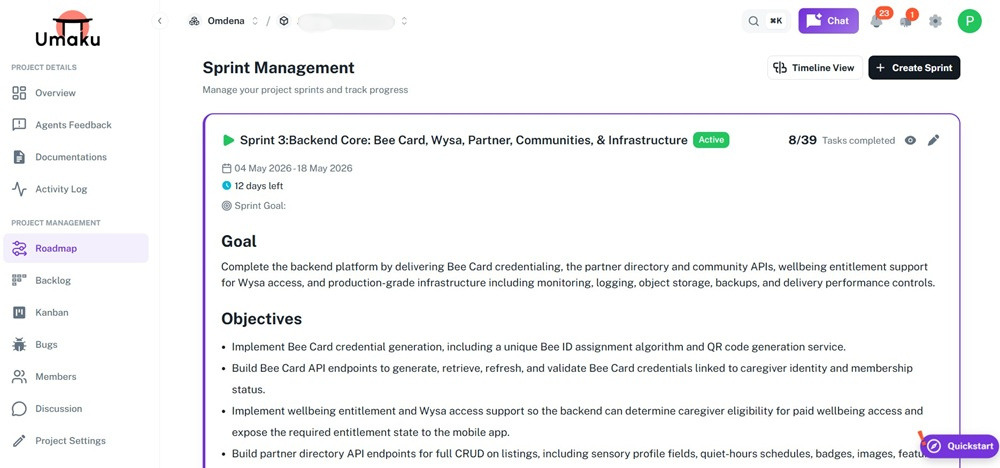
Umaku documents data dependencies and governance rules directly inside the project roadmap. Compliance and review checkpoints remain visible throughout delivery. This ensures governance decisions stay connected to implementation work instead of becoming side documents that teams ignore.
Project Roadmap in Umaku
Step 3: Architecture Choice
With goals and data defined, Omdena selects the right architecture. This may include configured tools, prompt-based workflows, RAG systems, fine-tuned models, agentic architectures, or a hybrid approach. The choice depends on data availability, performance needs, latency constraints, risk level, and deployment environment.
How Umaku Supports This Step
Umaku tracks architectural decisions alongside delivery milestones. It helps teams understand trade-offs and keeps the chosen design aligned with project goals as constraints evolve. This reduces late-stage rework caused by unrealistic early assumptions.
Step 4: Evaluation from Day One
Evaluation is not treated as a final step. Omdena defines golden datasets and baseline performance early. Offline evaluation runs before systems reach users. Human feedback loops and red-teaming help surface edge cases, bias, and failure modes that automated metrics often miss.
How Umaku Supports This Step
Umaku embeds evaluation tasks directly into sprint planning. Testing and validation checkpoints cannot be skipped under delivery pressure. Project teams gain continuous visibility into quality, risk, and performance signals as the system evolves.
Step 5: Build and Integration
During development, Omdena focuses on building AI components that fit real workflows. Systems integrate with existing tools, databases, and processes instead of operating as isolated demos. User experience design emphasizes trust through citations, confidence indicators, and clear escalation paths to humans.
How Umaku Supports This Step
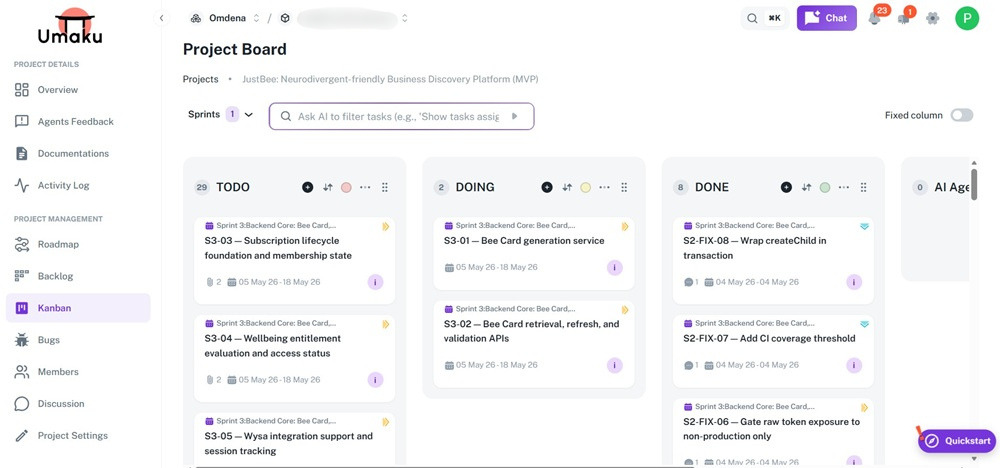
Umaku organizes development through a unified Kanban board.
Kanban Board in Umaku
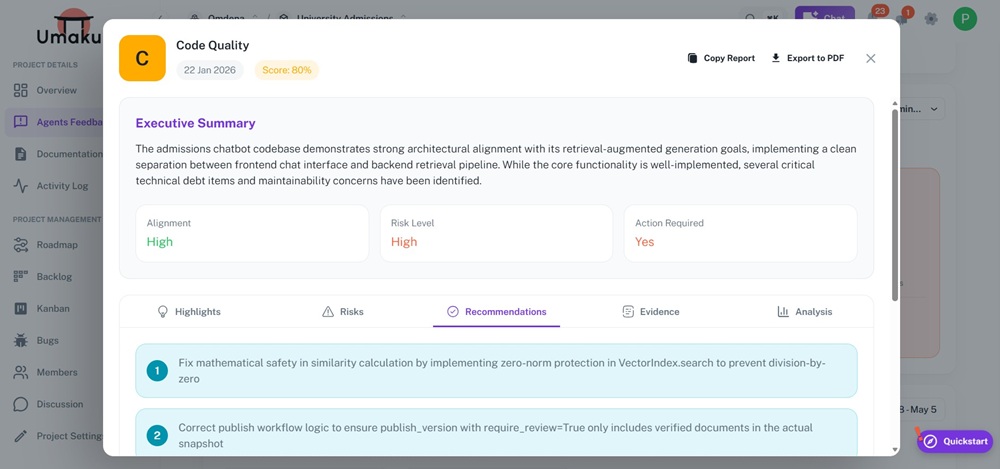
AI agents verify sprint alignment and enforce code quality and DevOps standards.
Code Quality Report in Umaku
This combination of human collaboration and automated oversight helps distributed teams deliver consistently without losing execution discipline.
Step 6: Deployment and MLOps
Deployment choices depend on privacy, latency, and infrastructure needs. Omdena supports cloud, on-prem, edge, and hybrid setups. Monitoring covers performance, drift, cost, and compliance. Rollout and user adoption are planned intentionally, not treated as afterthoughts.
How Umaku Supports This Step
Umaku provides a unified view of deployment tasks and dependencies. Monitoring and quality agents flag drift, anomalies, and risks early. Operational readiness is tracked alongside development progress. This reduces surprises at launch.
Step 7: Knowledge Transfer and Operational Ownership
The final step focuses on long-term sustainability. Omdena delivers documentation, code repositories, and operational playbooks. Internal teams are enabled to monitor, retrain, and extend the system with confidence.
How Umaku Supports This Step
Umaku centralizes documentation and operational guidelines. It preserves institutional knowledge beyond the initial build and reduces long-term dependency on external vendors.
This structured approach helps reduce risk, improve reliability, and ensure systems deliver value in production. By combining human expertise with Umaku-powered execution, Omdena ensures that AI systems are designed for real constraints, users, and long-term ownership. But how does this actually work in practice? Let’s look at real-world examples of custom AI development.
Real-World Examples of Custom AI Development
Custom AI delivers the most value when applied to real-world problems. Here are examples of how tailored AI systems are used across industries:
Misinformation detection and public opinion analysis: Omdena’s team built NLP models to detect misinformation and analyze political sentiment using scalable cloud infrastructure and API-driven architecture.
AI-powered fake news detection platform: Developed an end-to-end pipeline using LLMs, Flask APIs, and Streamlit UI for real-time detection and flexible deployment.
Satellite-based building detection: Combined YOLO and segmentation models to detect buildings from satellite imagery with GPU-optimized workflows.
Child protection AI system: Used NER, LLM-based anonymization, and multi-agent systems to process sensitive documents securely.
Credit scoring AI: Built predictive models using alternative data to assess loan capacity and financial risk via APIs and dashboards.
Climate risk prediction system: Applied deep learning and data fusion to forecast floods and environmental risks.
These examples show how custom AI adapts to different domains, data types, and business needs.
Build Your Custom AI Project with Omdena
Custom AI systems succeed when they reflect real organizational constraints and objectives. Solutions must be built with a deep understanding of workflows, data realities, operational risk, and user needs. Most teams find that hybrid architectures combining retrieval, fine-tuning, and orchestration deliver the best balance of performance, control, and scalability.
Strong execution discipline is key. Structured planning, continuous evaluation, and governance reduce surprises and speed up time to value. By pairing human expertise with Uamku-powered delivery, Omdena helps teams build AI that works in production and continues to improve.
If you want to build your custom AI system with Omdena, feel free to book an exploration call today to discuss your project requirements.
FAQ
What is custom AI development?
Custom AI development is the process of building AI systems tailored to a company’s specific workflows, data, and business goals. Unlike off-the-shelf tools, these systems are designed to fit existing operations, integrate with internal systems, and deliver more accurate, domain-specific results.
How much does custom AI development cost?
The cost of custom AI development typically ranges from $10,000 to $50,000+, depending on the complexity of the project. Key factors include data readiness, system integrations, model type, and deployment requirements. Smaller solutions like chatbots cost less, while advanced systems such as agentic AI or custom models require higher investment.
How long does it take to build custom AI?
Timelines vary based on scope and complexity. A simple AI solution can take 4–8 weeks, while more advanced systems may take 3–9 months or longer. Many teams start with a minimum viable product (MVP) to validate results before scaling to full production.
Is custom AI development worth the investment?
Custom AI development is worth the investment when AI directly impacts business outcomes such as revenue, efficiency, or decision-making. While it has a higher upfront cost than SaaS tools, it often delivers better long-term ROI through ownership, scalability, and alignment with business needs.
When should I choose custom AI?
You should choose custom AI when your workflows are complex, your data is proprietary or sensitive, compliance requirements are strict, or high accuracy is critical. It is especially valuable when AI needs to integrate deeply into core business operations.
What industries use custom AI?
Custom AI is widely used across industries such as healthcare, finance, manufacturing, retail, logistics, energy, and agriculture. It is most valuable in industries where data is complex, processes are unique, and decision accuracy has a significant business impact.
Continue with Omdena
Share this article
Share on LinkedIn, send by email, or copy the direct link.