How to Reduce AI Project Costs by Catching Delivery Risks Early
10 min readUpdated October 5, 2026
Okon PrinceSenior Data Scientist / Forward deployed Engineer
An AI Project Rarely Blows Its Budget in One Place
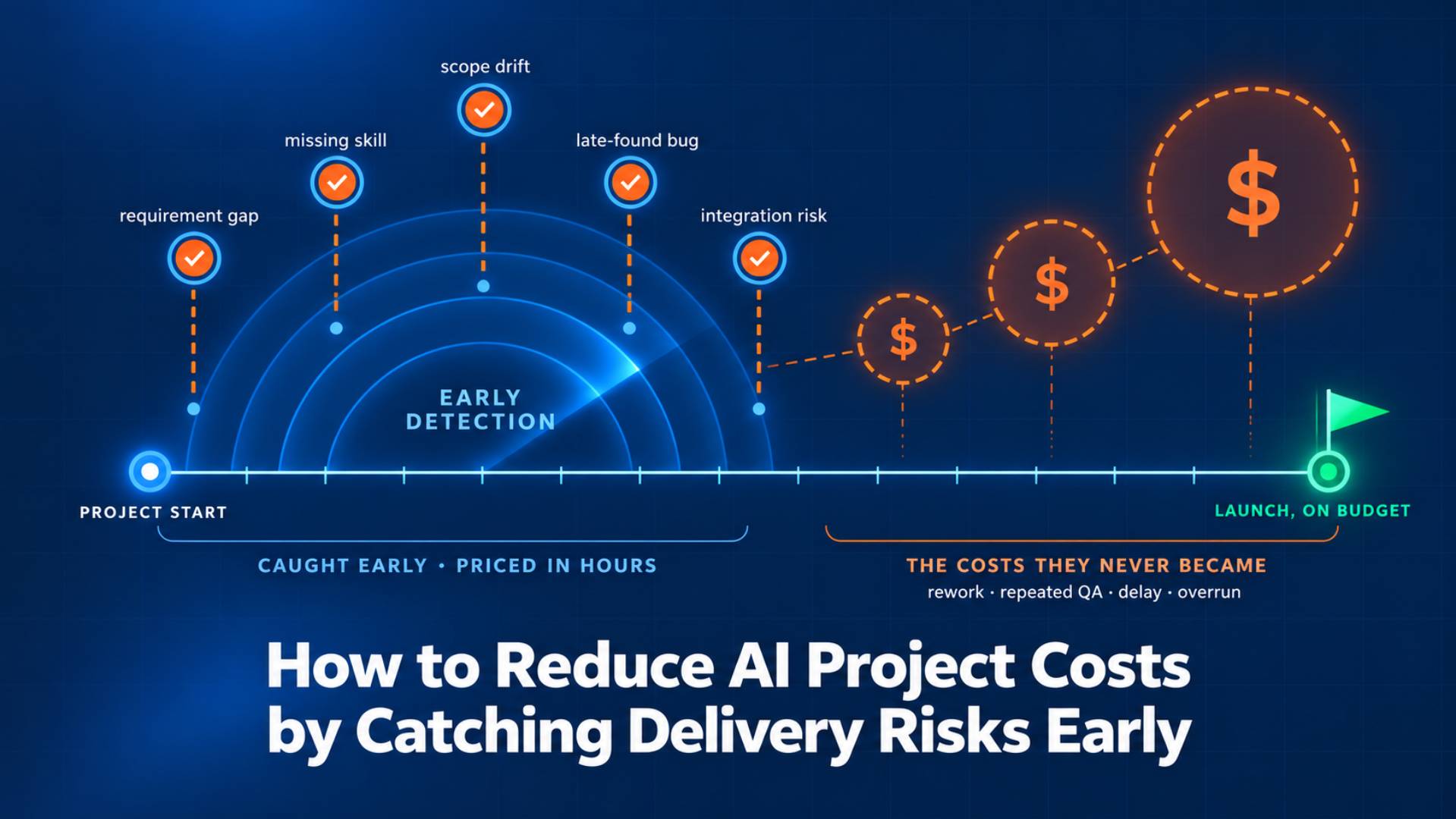
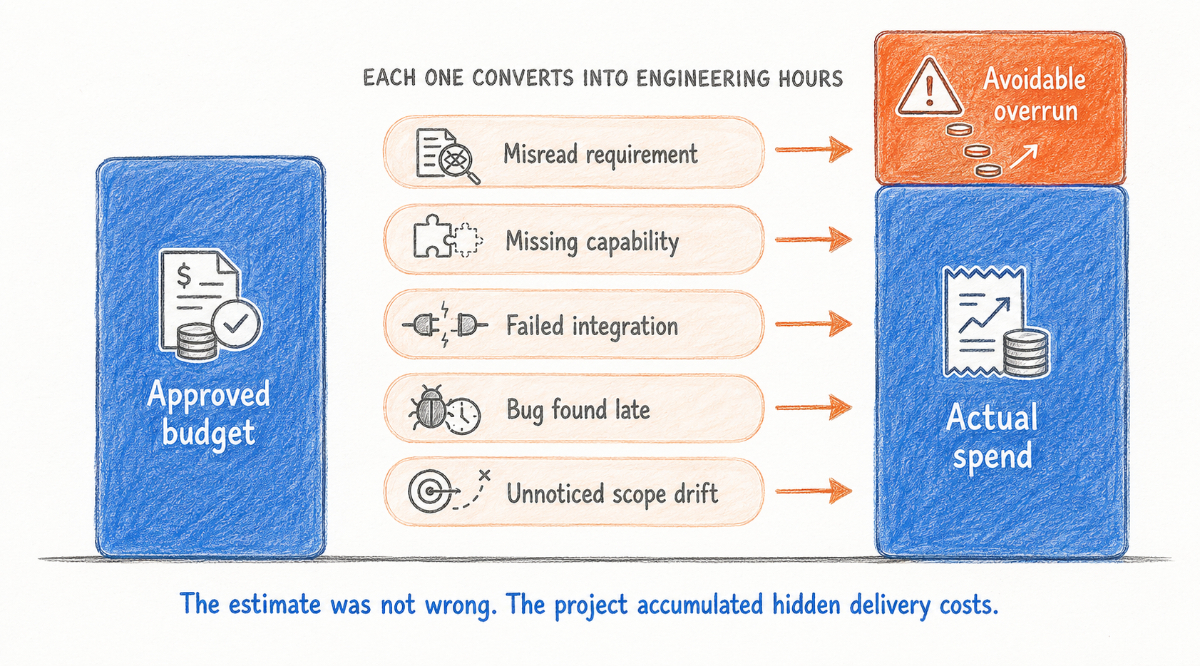
The development budget for an AI project usually looks reasonable on the day it is approved. Then something happens. A requirement was misunderstood. A specialised skill wasn’t available. An integration doesn’t work as expected. A bug survives until QA.
None of this proves the original estimate wrong. But every one of these events converts into the same currency: additional engineering hours. Two extra weeks here, a repeated QA cycle there, and a correctly priced project overruns anyway. Figure 1 shows the pattern.
Figure 1. Where a Reasonable AI Budget Leaks
The numbers say this is the norm, not the exception. In a February 2026 survey of 500 enterprise finance leaders, 79% reported AI cost overruns in the previous twelve months, and only 15% could calculate AI ROI without significant obstacles. Gartner now predicts that at least half of all generative AI projects will overrun their budgets, citing poor architectural choices and a lack of operational know-how.
For tech consultants, reducing delivery risk isn’t just about protecting timelines. It’s about preventing avoidable costs from accumulating throughout the project. In this article, you’ll learn:
why AI projects become more expensive than expected
the five delivery risks that turn into real costs
five practices consultants can use to contain them
how Omdena’s global talent network and Umaku address the two biggest sources of avoidable cost
Let’s get started.
Why AI Projects Become More Expensive Than Expected
AI projects carry more delivery uncertainty than conventional software. Teams are often working with:
unfamiliar data
emerging technologies
uncertain model performance
complex integrations
evolving requirements
new AI infrastructure
Estimates made at the start are made with the least information the project will ever have. Prototypes then add a layer of false comfort. A team that built a working demonstration in a week can start to believe production is a week away too, when the engineering behind the prototype has not yet been priced at all.
The useful correction is an equation:
Total project cost = initial development + rework + downstream remediation + delay + opportunity cost
Initial development is the only term most estimates cover. The other four are where AI budgets actually fail, and each of the five risks below feeds at least one of them.
Five Delivery Risks That Turn Into Real Costs
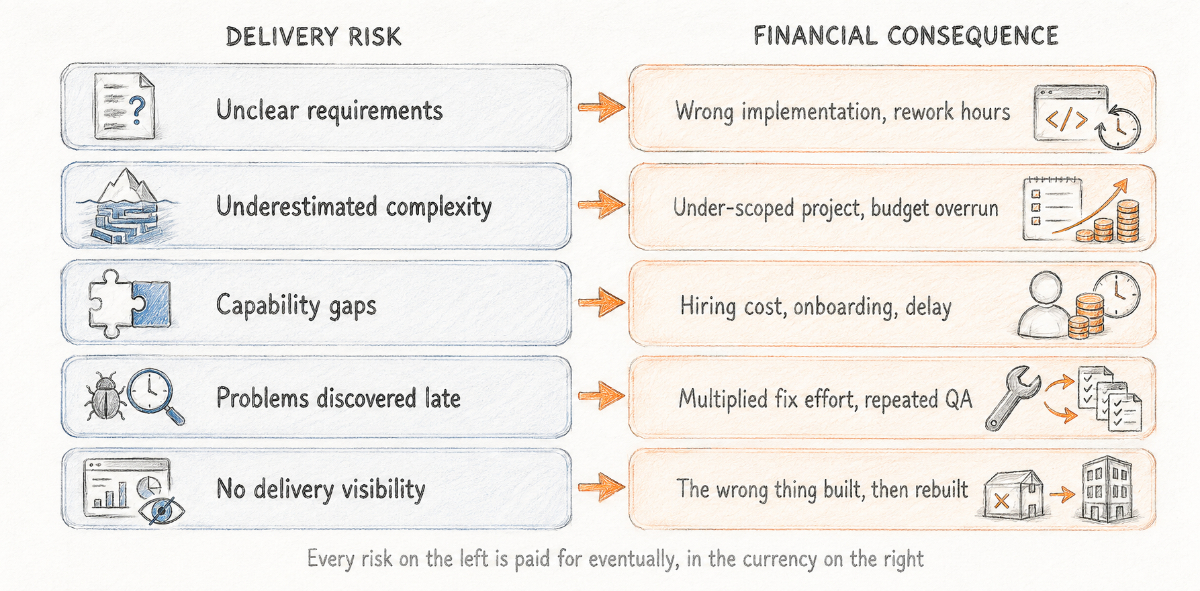
Figure 2 maps the five risks to the line items they eventually become. The sections that follow take each in turn.
Figure 2. Five Delivery Risks and What They Cost
Risk 1: Unclear Requirements
A misunderstood requirement rarely announces itself. It shows up as a wrong implementation, and the chain from there is short:
Consultants reduce this risk by defining, before the work is estimated:
business objectives
expected outcomes
scope
acceptance criteria
Acceptance criteria deserve particular attention on AI projects. “The model answers questions about our documents” and “the model answers with at least this accuracy, on these document types, within this response time” are two very different builds. Only the second can be tested, estimated, and signed off.
The earlier the ambiguity is discovered, the cheaper it is to correct.
Risk 2: Underestimated Technical Complexity
A working prototype hides most of what production requires:
integrations
data pipelines
security
deployment
monitoring
scaling
When those surface after the estimate is committed, the financial consequence is predictable:
Consultants protect themselves by evaluating production requirements before committing to a delivery estimate, not after.
Risk 3: Capability Gaps
AI projects have a habit of suddenly requiring specialists:
AI and ML engineers
data engineers
MLOps expertise
computer vision specialists
LLM/RAG expertise
cloud and platform engineers
The obvious response is hiring. But hiring carries its own bill:
recruiting costs
delays while the search runs
onboarding time
limited availability
long-term headcount commitments for what may be a three-month need
For a consultancy the gap is paid for twice. The client-facing timeline slips, which costs trust, while the rest of the team idles or improvises around the missing skill, which costs margin.
Risk 4: Problems Discovered Too Late
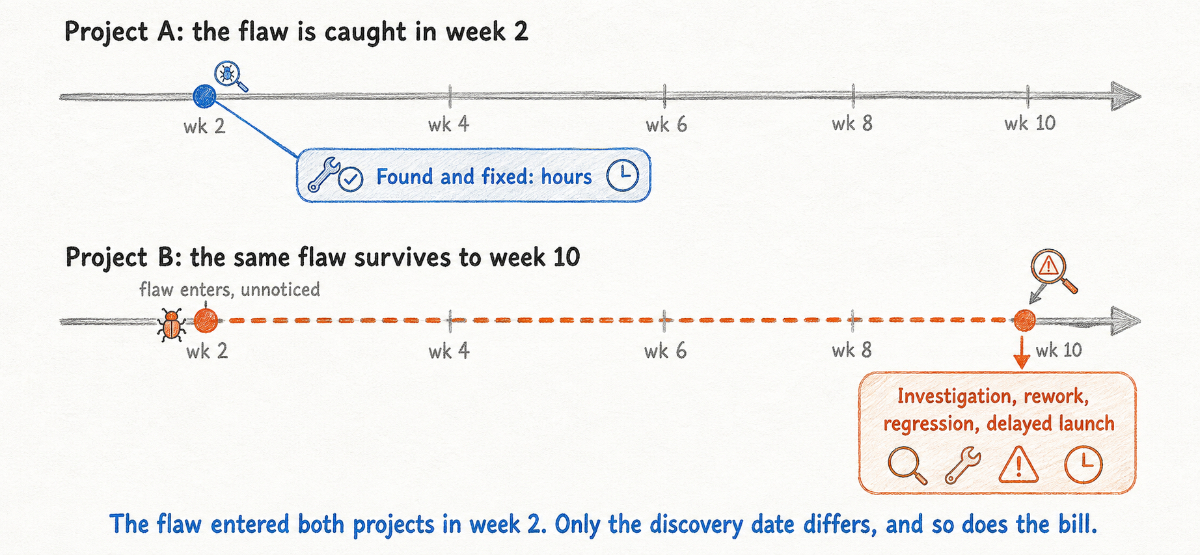
The same defect has very different prices depending on when it is found. Caught during development, it is a small fix. Caught later, it means investigation, rework, and regression testing, because other work now stands on top of it. The cost climbs at each stage:
QA: the fix, plus a repeated test cycle
Integration: the fix, plus every component that depended on the flawed one
Pre-release: the fix, plus a delayed launch
Production: the fix, plus customer impact and emergency response
Figure 3 makes the point as two projects. The flaw entered both in week 2; only the discovery date differs, and the discovery date is what sets the cost.
Figure 3. The Same Flaw, Two Discovery Dates, Two Bills
This is measurable. Umaku’s July analysis, covered later in this article, estimated avoided rework purely from finding bugs and scope risks while sprints were still active. The principle for consultants to internalise:
The earlier a problem is discovered, the less expensive it is to fix.
Risk 5: Lack of Delivery Visibility
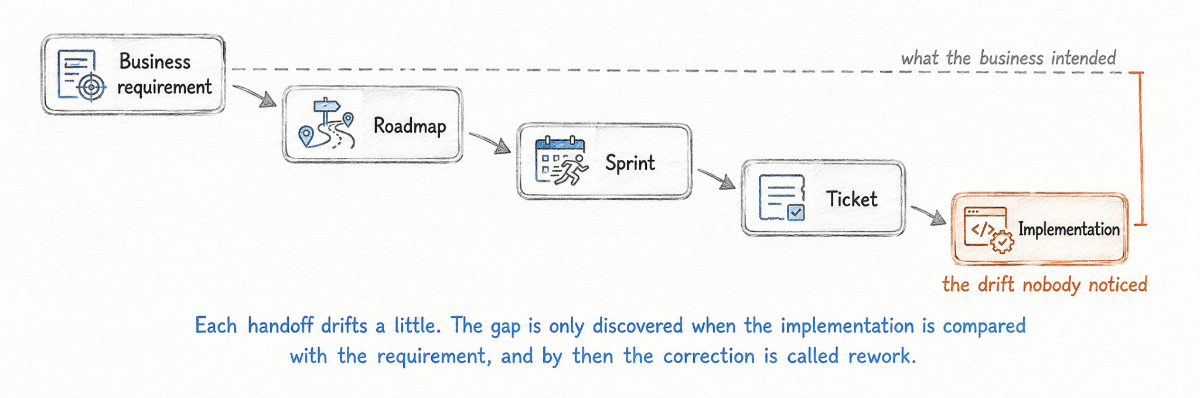
Projects drift. Each handoff bends the meaning slightly, and nobody notices in the moment because each step looked reasonable from the step before:
Business requirement → roadmap → sprint → ticket → implementation
The discovery comes late, and it usually takes one of four forms:
the wrong thing was built
something important was missed
scope has quietly expanded
technical debt has accumulated
Figure 4 shows the mechanics. Whatever form the discovery takes, the invoice reads the same way: rework.
Figure 4. How Delivery Drift Becomes Rework
How Consultants Can Reduce These Costs
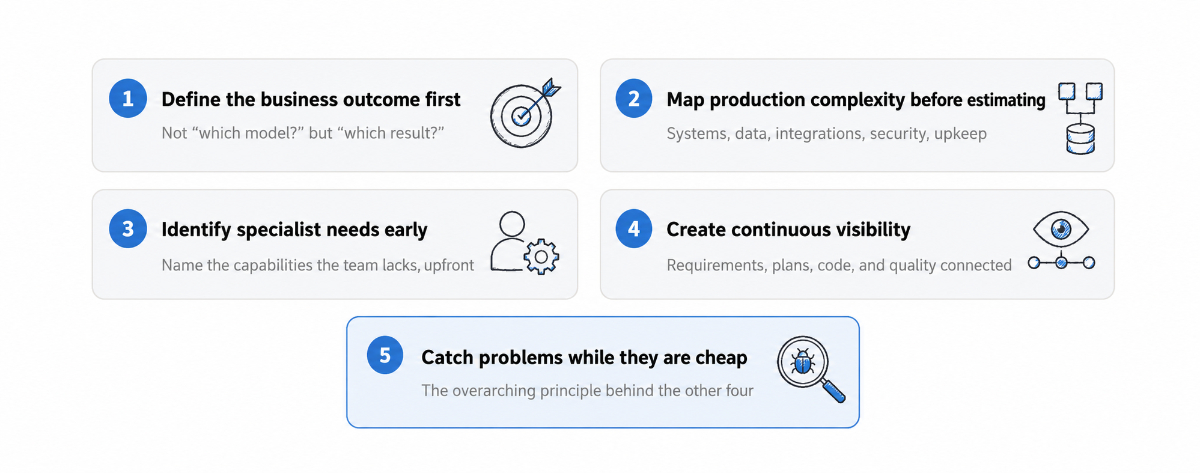
The five risks respond to five working practices, summarised in Figure 5. Together they form a practical framework for keeping AI project costs where the estimate put them.
Figure 5. Five Practices That Protect an AI Budget
1.Define the Business Outcome First
Don’t begin with: “What AI model should we use?” Begin with: “What business outcome are we trying to achieve?”
Starting from the outcome prevents the expensive version of success: a technically impressive system that is commercially irrelevant.
2. Identify Production Complexity Before Estimating
Before providing a delivery estimate, map the environment the solution has to live in:
systems
data
integrations
security
infrastructure
maintenance requirements
Every item left off this list at estimation time becomes unbudgeted engineering later.
3. Identify Specialist Requirements Early
Ask one question at the start of every engagement: what capabilities does this project require that the current team doesn’t have?
Naming the gap early lets the consultant close it deliberately. It is also the point at which external expertise becomes financially attractive, rather than a mid-crisis expense.
4. Create Continuous Visibility
Don’t wait until the end of a sprint or project to discover: “This isn’t what we intended.”
Keep requirements, delivery plans, code, and quality signals connected throughout development, so drift is visible while it is still cheap to correct.
5.Catch Problems While They Are Still Cheap
This is the principle behind the other four. Every practice above exists to move discovery earlier, because:
The cheapest problem is the one discovered before the team builds more work on top of it.
Using Umaku to Reduce Rework and Downstream Costs
Practices four and five are the hardest to sustain through discipline alone. Even a highly capable team generates expensive rework if problems aren’t identified early. That is where tooling earns its place.
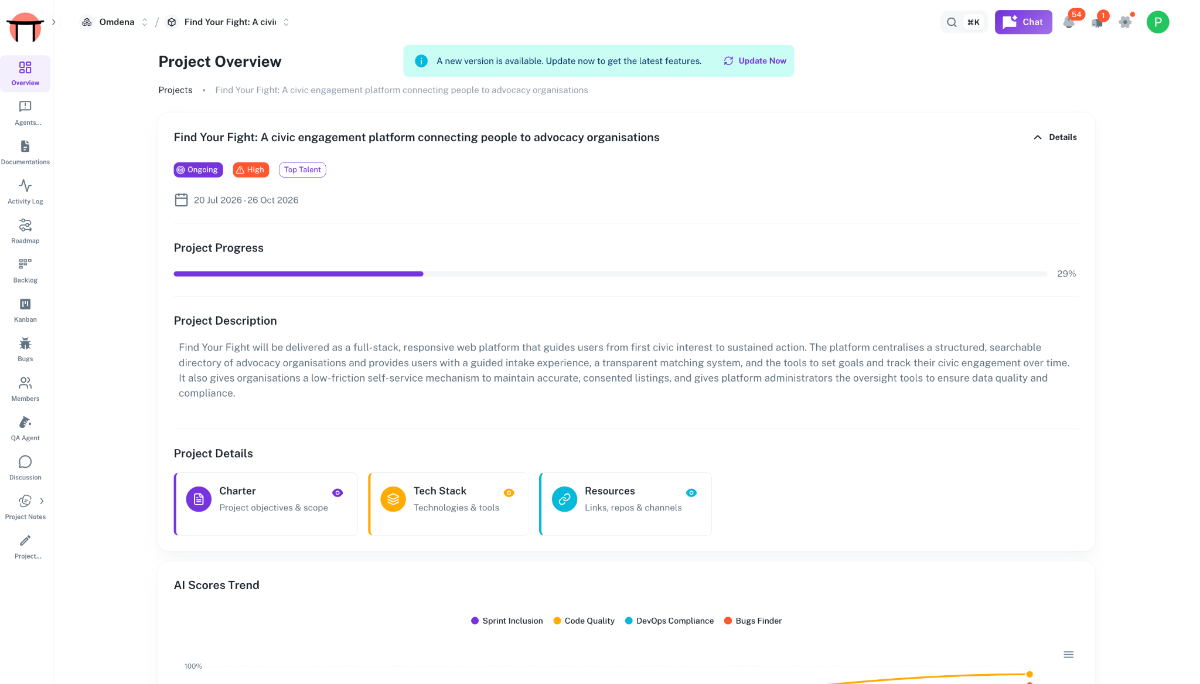
Umaku, Omdena’s delivery platform, connects the full project context:
business requirements and project charter
technical context
roadmap, sprints, and tickets
repositories and completed work
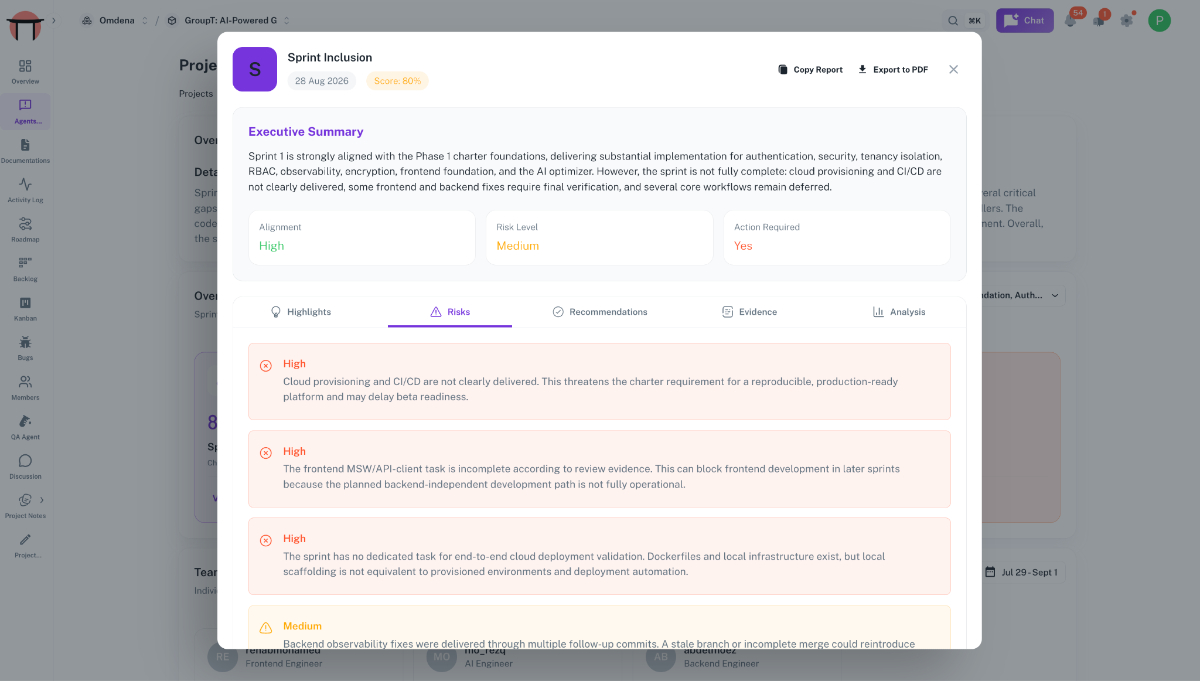
It then runs context-aware analysis across Sprint Inclusion, Code Quality, DevOps Compliance, and Bug Finder while the sprint is still active.
Sprint Inclusion shows whether planned work matches the agreed scope and flags requirements missing from the sprint; the technical analyses surface implementation problems before they reach a formal QA cycle.
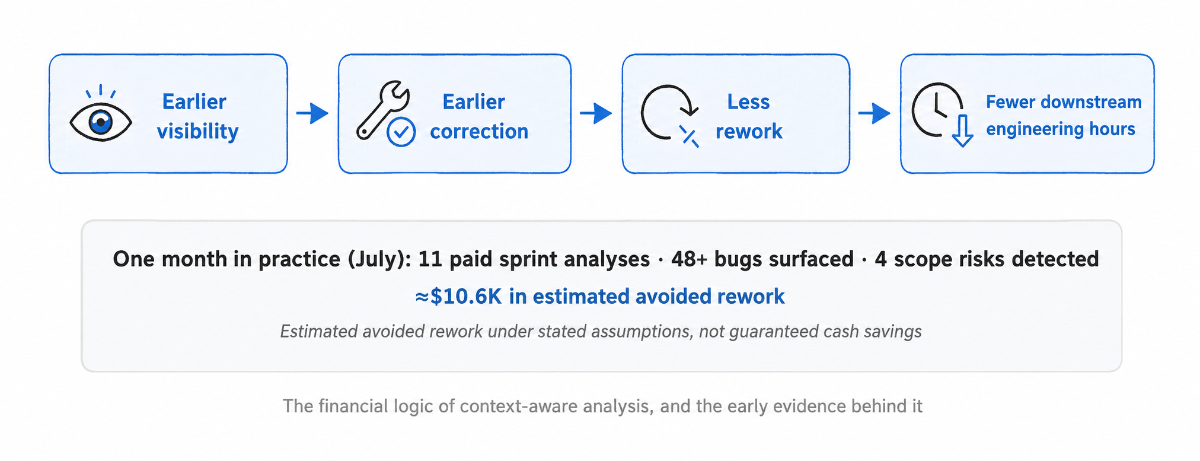
In July, across 11 paid sprint analyses, Umaku surfaced approximately 48 bugs and 4 scope risks while sprints were still active, producing a base estimate of $10.6K in avoided rework. That represents estimated avoided rework under stated assumptions, not guaranteed cash savings.
Figure 8. The Financial Logic of Early Detection
Using Specialized Talent Without Increasing Permanent Costs
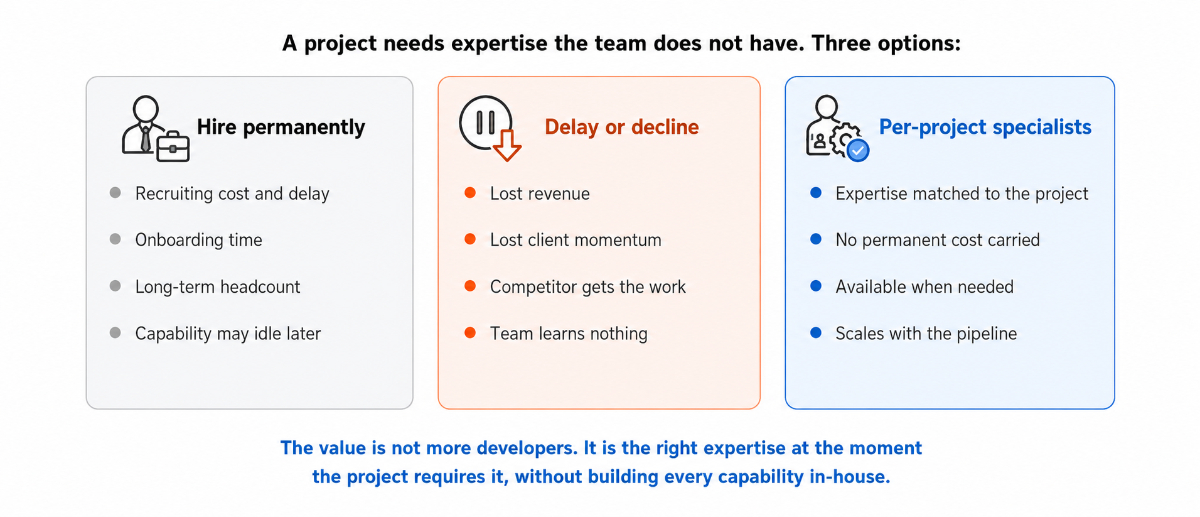
Tooling addresses visibility; it does not close a capability gap. When a consultant wins an AI project requiring expertise the team doesn’t have, there are three options:
Hire permanently
Turn down or delay the project
Bring in specialised external expertise for the project
Figure 8 compares their economics.
Figure 9. Three Ways to Close a Capability Gap
The third option is what Omdena’s global talent network provides. Specialists are matched to the project’s requirements rather than carried as permanent headcount, and a client-billable project doesn’t stall while a recruiter searches:
RAG/LLM engineers
computer vision specialists
data engineers
MLOps engineers
AI/ML specialists
cloud engineers
The value isn’t simply access to more developers. It’s access to specialised expertise when the project requires it, without requiring the consultant to build every capability in-house.
Handled well, the arrangement compounds. External specialists transfer knowledge as they deliver, so each engagement leaves the core team more capable than it started, at no cost beyond the work itself.
The Consultant’s Cost-Saving Model
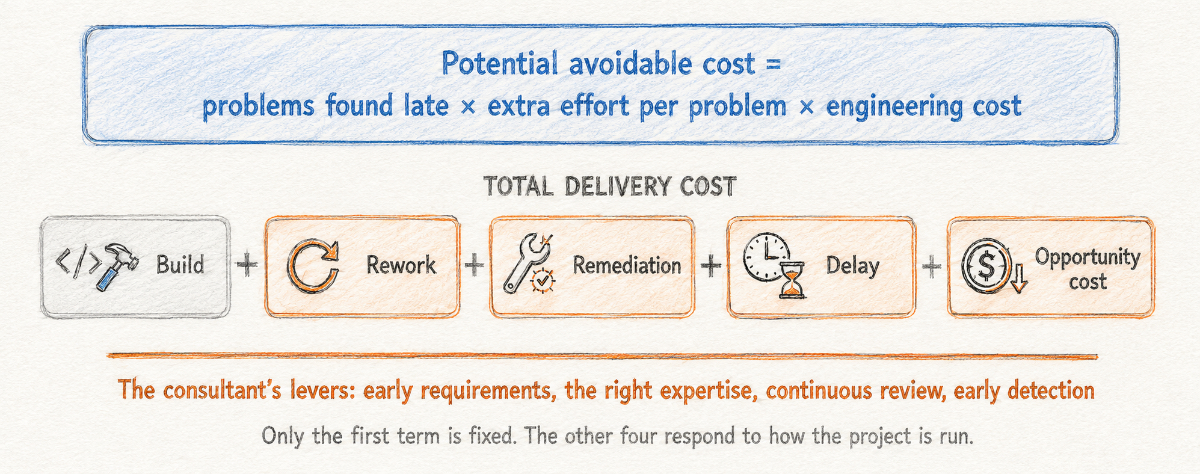
The whole argument compresses into a formula worth keeping on hand:
The build term is largely fixed once scope is set. The other four are the consultant’s levers, and each responds to a specific practice:
identifying requirements early
bringing in the right expertise
continuously reviewing delivery
catching problems before they compound
That is what makes the framework useful beyond any single tool or vendor. Figure 9 summarises it.
Figure 10. The Consultant’s Cost-Saving Model
The Consultant’s Role Is to Protect the Client’s Investment
A consultant is not valuable for recommending AI; clients can get that recommendation anywhere. The value is turning an AI investment into a successful outcome without unnecessary waste. That means:
The consultant has to manage not only what gets built, but also how much unnecessary work gets created along the way.
The two Omdena capabilities in this article serve that role from opposite ends.
Global talent network
Addresses capability gaps, so projects are neither under-skilled nor stalled while a search runs.
Umaku
Addresses visibility, quality, and rework, so problems surface while they are still cheap.
Together:
The right expertise + earlier visibility = fewer avoidable delivery costs.
Conclusion
AI projects don’t become expensive only because the technology is expensive. They become expensive when engineering time goes to problems that could have been identified earlier, and when teams lack the expertise to solve hard problems efficiently. Both drains are controllable, and both are the consultant’s job to control.
Helping clients adopt AI is the easy half of the role. Helping them avoid wasting money while doing it is where a consultant earns the relationship.
Omdena helps consultants reduce these costs through access to specialised AI and engineering talent and Umaku’s context-aware delivery platform. Either conversation can start from a single current project.
FAQ
Why do AI projects end up costing more than the original estimate?
Rarely because the estimate was wrong in one place. The approved budget usually covers only initial development, while the real total is initial development plus rework, downstream remediation, delay, and opportunity cost. Small events during delivery . A misread requirement, a missing capability, a failed integration, a bug that survives until QA, unnoticed scope drift... each convert into extra engineering hours, and they accumulate. Industry data reflects this: 79% of enterprise finance leaders reported AI cost overruns in the previous twelve months, and Gartner predicts at least half of generative AI projects will overrun their budgets.
What are the five delivery risks that turn into real costs?
Unclear requirements (a misunderstood requirement becomes a wrong implementation, then rework), underestimated technical complexity (a working prototype hides most of what production needs — model performance, integrations, evolving requirements, new AI infrastructure), capability gaps (the team lacks specialists such as ML, data, MLOps, computer vision, LLM/RAG or cloud engineers), problems discovered too late (the cheapest problem is the one found before more work is built on top of it), and lack of delivery visibility (drift and defects go unnoticed until a formal QA cycle).
How can consultants reduce these costs before and during a project?
By following five practices: define the business outcome first, (objectives, expected outcomes, scope and testable acceptance criteria), before estimating; identify production complexity before pricing the work rather than trusting the prototype; identify specialist requirements early; create continuous visibility across the sprint; and catch problems while they are still cheap. Each practice shrinks one of the terms in the cost equation beyond “build”.
How does Umaku help reduce rework and downstream costs?
Umaku, Omdena’s delivery platform, connects the full project context, (business requirements and project charter, technical context, roadmap, sprints and tickets, and repositories), and runs context-aware analysis (Sprint Inclusion, Code Quality, DevOps Compliance and Bug Finder) while the sprint is still active. Sprint Inclusion checks whether planned work matches agreed scope and flags missing requirements; the technical analyses surface implementation problems before they reach QA. In one month of practice (July), across 11 paid sprint analyses, it surfaced roughly 48 bugs and 4 scope risks, producing a base estimate of about $10.6K in avoided rework, an estimate under stated assumptions, not guaranteed savings.
How can a consultancy fill capability gaps without adding permanent headcount?
When a project needs expertise the team doesn’t have, there are three options: hire permanently (recruiting cost, onboarding time, long-term headcount, capability that may sit idle later), delay or decline (lost revenue, lost client momentum, a competitor takes the work), or bring in per-project specialists through a global talent network like Omdena’s. The third option matches expertise to the project, carries no permanent cost, is available when needed and scales with the pipeline. The value is not more developers but the right expertise at the moment the project requires it — and specialists transfer knowledge as they deliver, leaving the core team more capable after each engagement.
Continue with Omdena
Share this article
Share on LinkedIn, send by email, or copy the direct link.