How AI Is Transforming Agribusiness Supply Chains: 6 Solutions & Implementation Guide
11 min readUpdated April 30, 2026
Omdena
A shipment arrives at your packhouse. At intake, it looks fine. Two days later, a quarter of it shows deterioration that started before it reached you. A buyer calls. A relationship built over years starts to crack over a problem your operation had no system to prevent.
This is not a one-off. The Food and Agriculture Organization identifies supply chain inefficiencies as a leading driver of income loss for agricultural SMEs globally (FAO, 2019). The damage accumulates across six specific failure points, most of which are invisible without the right systems in place. AI gives agri-SMEs the tools to see and fix each one.
The Supply Chain Problems Costing Agri-SMEs the Most
Supply chain losses in agribusiness don’t arrive as a single event. They accumulate quietly across intake, procurement, transit, and storage, each failure point invisible until it shows up as a rejected load, a write-off, or a buyer that doesn’t call back. By then, the margin is already gone.
Most of it comes down to one gap: no real-time information. Procurement runs on last season’s numbers, product moves without condition visibility, and inventory gets managed by gut feel across multiple lines. The result is a chain where every stage is running one step behind.
The compliance pressure is making it urgent. Supermarkets, food service operators, and export buyers now require end-to-end traceability as a condition of supply. Operations without it are not losing on price or quality. They are simply not eligible to bid. That is a market access problem, and it is exactly where AI is now closing the gap.
6 AI Solutions: One for Each Supply Chain Failure Point
AI is a category of tools, each targeting a specific point in the supply chain. McKinsey’s Food Systems Practice notes that these tools have moved from large-enterprise to SME-accessible scale. The six use cases below address each failure point from Section 1 directly.
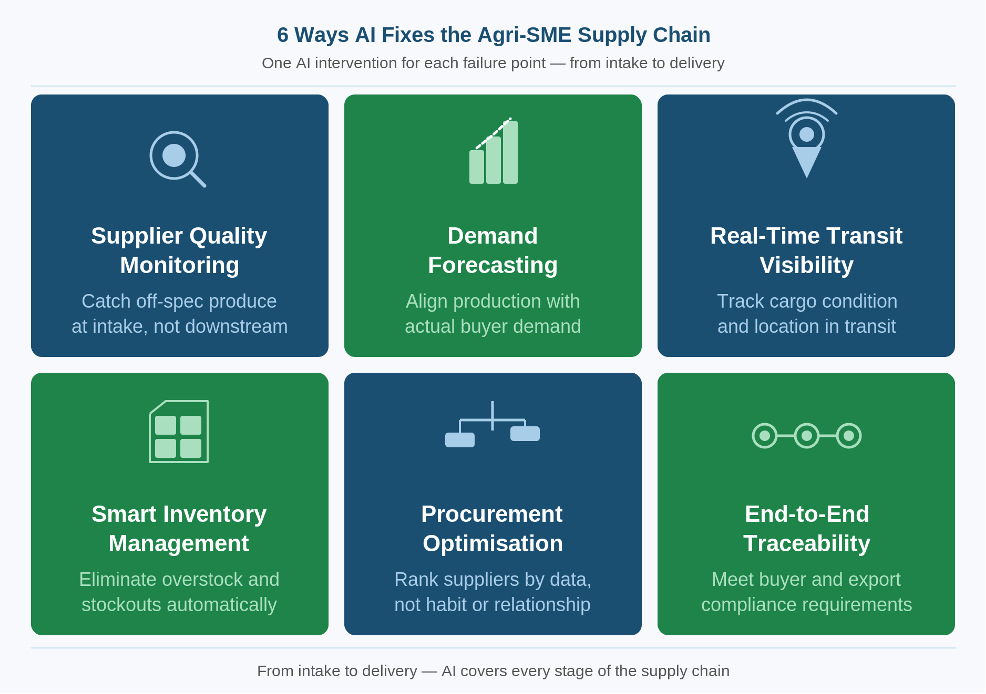
6 Ways AI Fixes the Agri-SME Supply Chain.
Demand forecasting alone can cut overproduction waste by up to 30 percent. Most agri-SMEs are still running on last season’s numbers.
1. AI Supplier Quality Monitoring
Documented deployments of AI quality monitoring at intake are cutting rejection rates by up to 25 percent. Computer vision and sensor data assess every incoming batch objectively and consistently, replacing manual spot checks that are inconsistent and miss early-stage deterioration.
Over time, the system builds a performance record for each supplier. Patterns of underperformance become visible, enabling SMEs to shift volume toward more reliable partners based on data rather than habit. IFC’s 2020 food loss report highlights intake quality control as one of the highest-return intervention points for SME operations.
2. Demand Forecasting
AI demand forecasting consistently reduces overproduction waste by up to 30 percent. The models analyse sales history, buyer behaviour, seasonal patterns, and market signals, aligning procurement with actual demand rather than last season’s estimates.
Both overstock and understock fall because the model flags demand gaps in time to act on them. McKinsey’s Food Systems Practice points to demand forecasting as one of the top two AI use cases by ROI for agri-supply chain operations.
3. Real-Time Transit Visibility
IoT sensors combined with AI monitoring provide agri-SMEs with continuous visibility into products in transit, including temperature, humidity, location, and estimated arrival time. Deviations trigger alerts, allowing action before quality deteriorates beyond recovery.
For perishables moving to distant or export markets, this is particularly valuable. Transit losses are the least visible loss category because they appear as buyer disputes and rejected loads rather than as internal waste. AgriChain’s 2025 industry data identifies transit as the most underreported loss stage across agri-SME operations.
4. Smart Inventory Management
AI inventory tools connect supply with demand forecasts to give a live view of what is in stock, what is moving, and what is at risk of expiry. Alerts flag slow-moving stock before it becomes a write-off and signal when replenishment is needed.
For agri-SMEs managing multiple product lines across different storage conditions, this level of visibility is difficult to maintain manually. AI makes it manageable without a dedicated inventory team or complex enterprise system.
5. Procurement Optimisation
AI procurement tools score suppliers on quality, delivery reliability, price stability, and rejection rates. Instead of volume decisions driven by habit and relationships, SMEs can allocate based on a data-backed picture of which suppliers are actually performing.
Pricing analysis tools also identify when market conditions favour locking in supply contracts versus buying on the spot market. For operations with tight cash flow, timing procurement correctly has a direct impact on margins.
6. End-to-End Traceability
Supermarket and export buyers increasingly make traceability a condition of supply, not a preference. AI traceability systems meet this requirement automatically. As the WRI’s Creating a Sustainable Food Future report notes, compliance traceability is now a market access requirement across most formal retail and export channels (WRI, 2019).
Every stage from intake to delivery is logged digitally, with each batch carrying a record accessible instantly by the SME, buyer, or auditor. SMEs with robust traceability are winning contracts that less-equipped competitors simply cannot bid for.
Find out how much AI could save your business — use our free tools below:
Tools, Costs, and What to Evaluate Before Committing
The agri-supply chain AI market now sits in four broad categories: standalone quality monitoring for intake and storage, demand forecasting and inventory platforms, logistics and transit visibility tools, and integrated platforms that connect all of these in a single view. Most successful SME deployments start with one category and expand once results are established.
Standalone monitoring and forecasting tools are available as cloud subscriptions at SME-accessible price points, typically ranging from $5,000 to $30,000 depending on scope (IFC, 2020). Integrated platforms cost more upfront but replace four or five disconnected systems with one source of truth. If you are evaluating agri-tech tools more broadly, supply chain AI fits within that evaluation rather than sitting outside it.
Three things matter most when evaluating any vendor.
First, crop and product-specific capability. A platform built for grain handling will not perform the same way for fresh produce. Ask for references from operations handling your specific product category before committing.
Second, integration with what you already use. The best tool connects to your existing systems rather than requiring you to replace them.
Third, vendor approach. A credible vendor will propose a structured pilot before a full rollout and be transparent about setup requirements from the start. Any vendor pushing straight to full deployment should be treated with caution.
The ROI Case: What Agribusinesses Are Actually Seeing
AI in agriculture is no longer at the proof-of-concept stage. Analysis from McKinsey's Food Systems practice points to consistent returns across the core supply chain use cases: demand forecasting, reducing overproduction waste by 20 to 30 percent, and supplier quality monitoring,g cutting intake rejections by 15 to 25 percent (IFC, 2020). The table below summarises the key benchmarks.
AI Use Case
What It Delivers
Source
Demand Forecasting
Up to 30% reduction in overproduction waste by aligning production with actual buyer demand
McKinsey Food Systems Practice
Supplier Quality Monitoring
15 to 25% fewer intake rejections, catching off-spec produce before it enters the chain
IFC, 2020
Transit Visibility
Measurable reduction in spoilage-on-delivery losses, a category typically underreported as buyer disputes
AgriChain, 2025
Traceability
Access to a supermarket and export contracts requiring end-to-end traceability as a condition of supply
FAO / WRI, 2019
Payback Period
6 to 12 months for most agri-SME deployments when matched to the right problem first
Cross-industry deployment data
Transit visibility tools have shown measurable reductions in spoilage-on-delivery rates, a loss category that shows up in buyer claims rather than internal waste figures. Research in ScienceDirect (2025) confirms real-time monitoring as one of the highest-impact AI deployments for SMEs in perishable categories.
With overproduction waste down by up to 30 percent and intake rejections cut by up to 25 percent, a 6- to 12-month payback is realistic for most operations. The real question is not whether the numbers work. It is about which solution fits your operation and how to deploy it well.
Before deployment, establish baselines on the KPIs that matter: supplier rejection rate at intake, spoilage-on-delivery rate by route, demand forecast accuracy, inventory write-off rate, and traceability compliance rate by buyer. These are the numbers that will tell you exactly what AI is returning for your operation.
Real Deployments, Real Results
The ROI benchmarks above describe industry-wide patterns. These two examples show what those numbers translate to in real operational terms.
How Demand Forecasting Cuts Overproduction Waste
CropIn, an agri-data platform with deployments across South and Southeast Asia, has documented demand analytics use cases with fresh produce SMEs and packing operations. Procurement volumes were aligned with actual buyer order forecasts, reducing the gap between planned and actual demand that drives overstock and disposal.
The result was a measurable reduction in overproduction, consistent with the 20-30% range observed across demand-forecasting deployments. Critically, the tool added an analytics layer to the data that operations were already capturing, without requiring a system replacement.
How Traceability Won New Market Access
In Australia, fresh-produce SMEs on the AgriChain platform have used end-to-end batch tracking to meet supermarket traceability requirements that were previously out of reach, moving from manual spreadsheet records to automated documentation at every stage, from grower intake to retail delivery.
The practical outcome for participating SMEs has been access to buyer contracts that carry traceability as a condition of supply. For operations without the traceability infrastructure, those contracts are simply not available. AgriChain's 2025 industry reporting highlights this shift as a consistent pattern: traceability compliance is increasingly the deciding factor in contract award, not price.
How to Start: A Step-by-Step Roadmap
The most common mistake agri-SMEs make is trying to solve everything at once. A phased, problem-first approach consistently delivers better results than a broad rollout. Here is how to do it.
Step 1: Identify Your Biggest Loss Point
Look at the six failure points in Section 1 and identify where the most revenue is disappearing in your operation. Each one points to a different starting tool. The right entry point is the one with the largest financial impact.
Step 2: Scope a Focused Pilot
A good pilot covers one supplier category, one product line, or one storage facility, running alongside current operations rather than replacing them. Most well-scoped pilots reach measurable results within three to six months.
Step 3: Select the Right Vendor
Ask for references from operations of similar size that handle your specific crop type, and confirm that the tool integrates with your existing systems rather than replacing them. Any vendor pushing a full rollout without a pilot phase should be treated with caution.
Step 4: Measure, Then Scale
Use the KPIs established before deployment to assess pilot results. If the pilot delivers, expand to the next product line or supply chain stage. If it underdelivers, adjust the scope or vendor before committing further.
Full deployment typically takes an additional six to twelve months after the pilot, bringing the total timeline to nine to eighteen months from first pilot to full operation.
Common Failure Points to Avoid
Assuming your data is not good enough to start, basic spreadsheets and order records are usually sufficient, and data quality improves during deployment.
Selecting tools built for enterprise-scale operations: setup complexity and cost mismatch are the most common reasons SME deployments stall
Skipping the vendor reference check: results in your specific product category and market context are the only reliable indicator of what a vendor will actually deliver
The Path Forward: Making AI Work for Your Supply Chain
Supply chain losses are not inevitable. Each of the six failure points in this article has a proven AI solution now accessible at the agri-SME scale. The technology is mature, the costs have come down, and the results are consistent across operations of all sizes and crop categories.
Omdena works with agri-SMEs to design, pilot, and deploy AI supply chain solutions built for real-world operations. Whether the starting point is supplier quality monitoring, demand forecasting, or traceability for a specific buyer requirement, we scope the right solution for your operation and see the deployment through to measurable results. Connect with Omdena to find out what is achievable for your operation.
FAQ
How do I know if my supply chain is ready for AI?
If you track supplier deliveries, sales, and inventory in any format, you have enough to start. Basic spreadsheets and order records are sufficient. AI deployments improve data quality as they run, so waiting for perfect data is not necessary or productive.
Which supply chain problem should I tackle first?
Start with your largest loss point. If supplier quality is costing you the most, begin with intake monitoring. If overproduction is the problem, start with demand forecasting. If a traceability gap is blocking a specific contract, that is your immediate priority. Solve the biggest problem first, measure the results, then expand.
How long does implementation take?
A pilot covering one supplier category or product line typically takes three to six months from scoping to measurable results. Full deployment takes an additional six to twelve months. Most agri-SMEs go from first pilot to full operation within nine to eighteen months.
Do I need a dedicated technology team?
No. A good implementation partner handles setup, system integration, and staff training. Your existing team manages the day-to-day operation throughout. AI tools are designed to fit into existing workflows, not replace them with ones requiring specialist knowledge to manage.
Does this work for my crop or product type?
AI supply chain tools have been deployed across fresh produce, grains, dairy, and processed foods. Effectiveness varies by product and vendor, so always ask for references from operations handling your specific crop before committing to any platform.
Can AI help with traceability compliance for export markets?
Yes. AI-powered traceability systems automate the documentation that export buyers and certification bodies require. Every stage of your product's journey is logged automatically, making compliance reporting faster and more reliable than manual record-keeping and significantly easier to audit.
Share this article
Share on LinkedIn, send by email, or copy the direct link.