How AI Reduces Post-Harvest Losses for Agribusinesses: ROI, Tools, and Real Results
7 min readUpdated May 18, 2026
Omdena
According to the Food and Agriculture Organization (FAO), approximately $940 billion worth of food is lost or wasted globally every year, and a significant portion occurs after harvest, before food ever reaches consumers. For agribusinesses, it is not a food security headline. It is revenue that left the farm and never reached the bank account.
What percentage of your harvest revenue never reaches a buyer? For a small agribusiness handling $3 million annually, a 15 percent loss rate means $450,000 gone before a buyer ever sees it. AI is now solving this for SMEs with affordable tools that deliver real results without requiring a large team or technology budget.
The Real Cost of Post-Harvest Losses, and Why Old Fixes Are Not Working
Post-harvest losses accumulate across the entire value chain. Spoilage starts at harvest and continues through the packhouse, cold storage, and transit before the product reaches its destination. Each stage adds its own risk: inconsistent grading, poor temperature control, handling damage, and delays that shorten shelf life.
SMEs feel this most acutely. Wide margins do not absorb losses at their scale. They come directly out of the bottom line. A fresh produce operation handling $4 million annually and losing 12 percent is leaving $480,000 on the table every year, before accounting for failed deliveries and lost buyer relationships.
Traditional methods have consistently failed to close this gap. Manual inspection is slow, inconsistent, and does not scale. Standard cold storage runs on fixed settings that cannot respond to real-time changes in product condition. The core problem is simple: you cannot manage what you cannot measure. That is precisely what AI addresses.
5 High-Impact Ways AI Reduces Post-Harvest Losses for Agribusinesses
AI is not a single tool. It is a category of technologies applied at different points across the post-harvest chain. What has changed in the last three years is accessibility: these solutions are no longer reserved for large enterprises. Five use cases are now delivering measurable results for SMEs across fresh produce, grains, dairy, and processed foods.
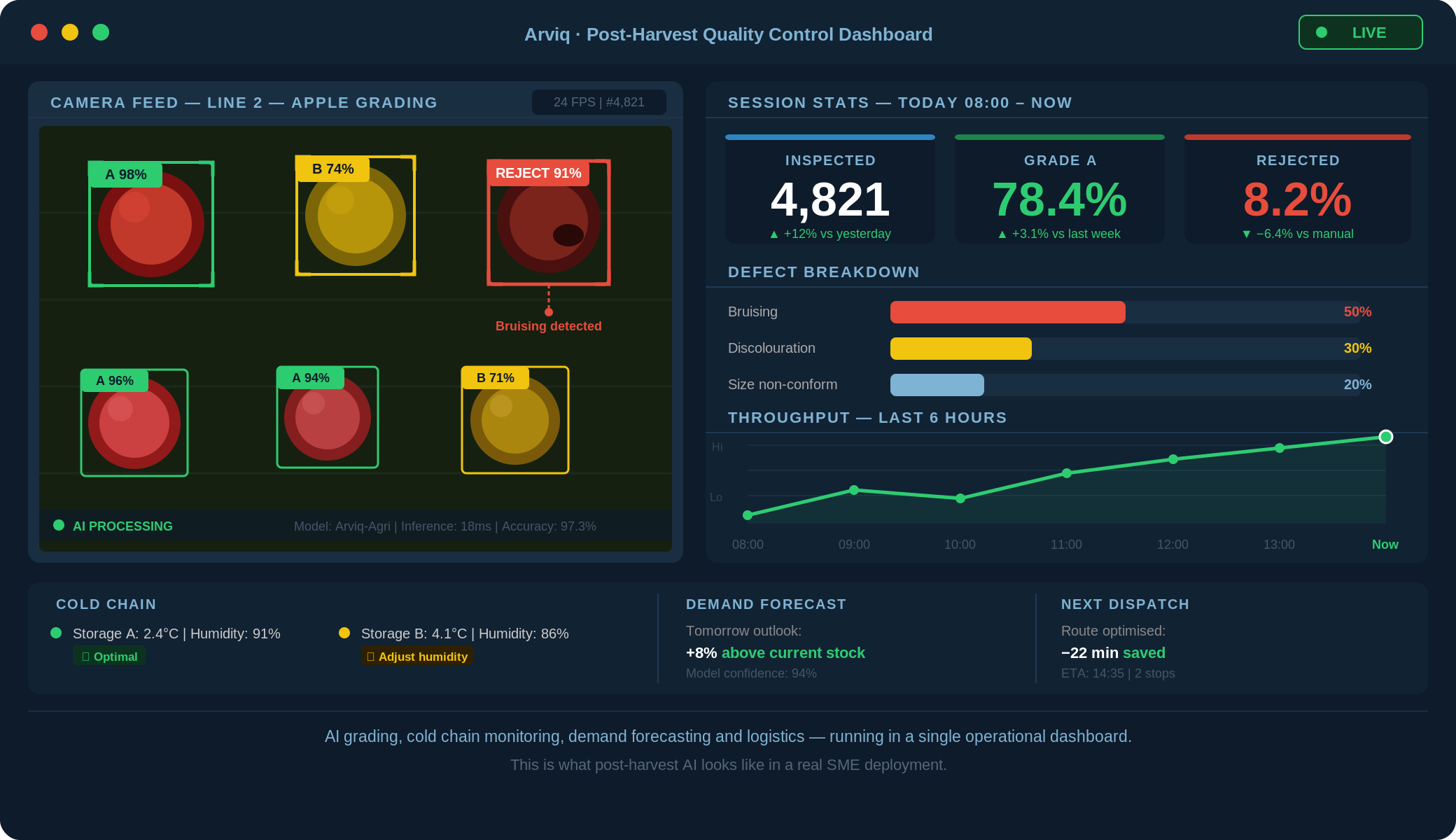
A real-time AI quality control dashboard showing computer vision grading, cold chain monitoring, demand forecasting, and logistics. Four operational layers working simultaneously in a post-harvest SME deployment. Image Source: AI-generated.
1. Predictive Spoilage Detection
Computer vision systems, combined with IoT sensors, detect early markers of spoilage before they are visible to the human eye. Deployed in cold storage or packhouses, these systems monitor produce continuously and flag deterioration in real time. The result is intervention before the product is lost, not discovery after the fact.
2. AI-Powered Grading and Sorting
Manual grading introduces inconsistency at scale. Inspector fatigue sets in, standards drift between shifts, and teams over-reject when in doubt, all of which cost revenue. AI vision systems grade produce to consistent, objective standards at speeds no manual process can match. Reported reductions in rejection rates range from 15 to 25 percent.
3. Demand Forecasting
One of the most underappreciated drivers of post-harvest loss is the mismatch between production volume and actual demand. AI forecasting models analyze sales history, buyer behavior, and seasonal patterns to align harvest volumes with buyers’ purchasing behavior. Reducing overproduction is one of the most direct routes to reducing waste.
4. Smart Cold Chain Management
Traditional cold storage operates on fixed settings applied uniformly to all produce. AI-powered systems use real-time sensor data to dynamically adjust temperature and humidity based on the actual product conditions. Intelligent cold chain management has delivered shelf-life extensions of 20 to 40 percent versus conventional approaches.
5. Logistics and Supply Chain Optimization
Transit losses are frequently underestimated in post-harvest loss calculations. AI-powered logistics tools optimize routing, load sequencing, and departure timing to minimize transit time and reduce exposure to adverse conditions. For businesses moving perishables to distant markets, even modest improvements in transit efficiency translate directly into lower losses at the destination.
Post-Harvest AI Tools: How to Choose the Right Fit
The AI tool market for post-harvest management has matured into four categories: computer vision platforms for grading and spoilage detection, IoT cold chain monitoring systems for storage and transit, demand forecasting tools that align production with buyer demand, and integrated agri-ERP platforms that connect all of these at an operational level.
You do not need all four tools at once. The right starting point is whichever use case represents your largest current loss. Fix that first, measure the results, and expand from there.
Most solutions are available as cloud subscriptions from a few hundred dollars per month, well within reach for SMEs. The real challenge is not cost. It is knowing which solution fits your crop and infrastructure, and deploying it correctly. Before committing, ask vendors about setup requirements, integration, and references from comparable businesses.
The ROI Case: Benchmarks, Proof, and Real-World Results
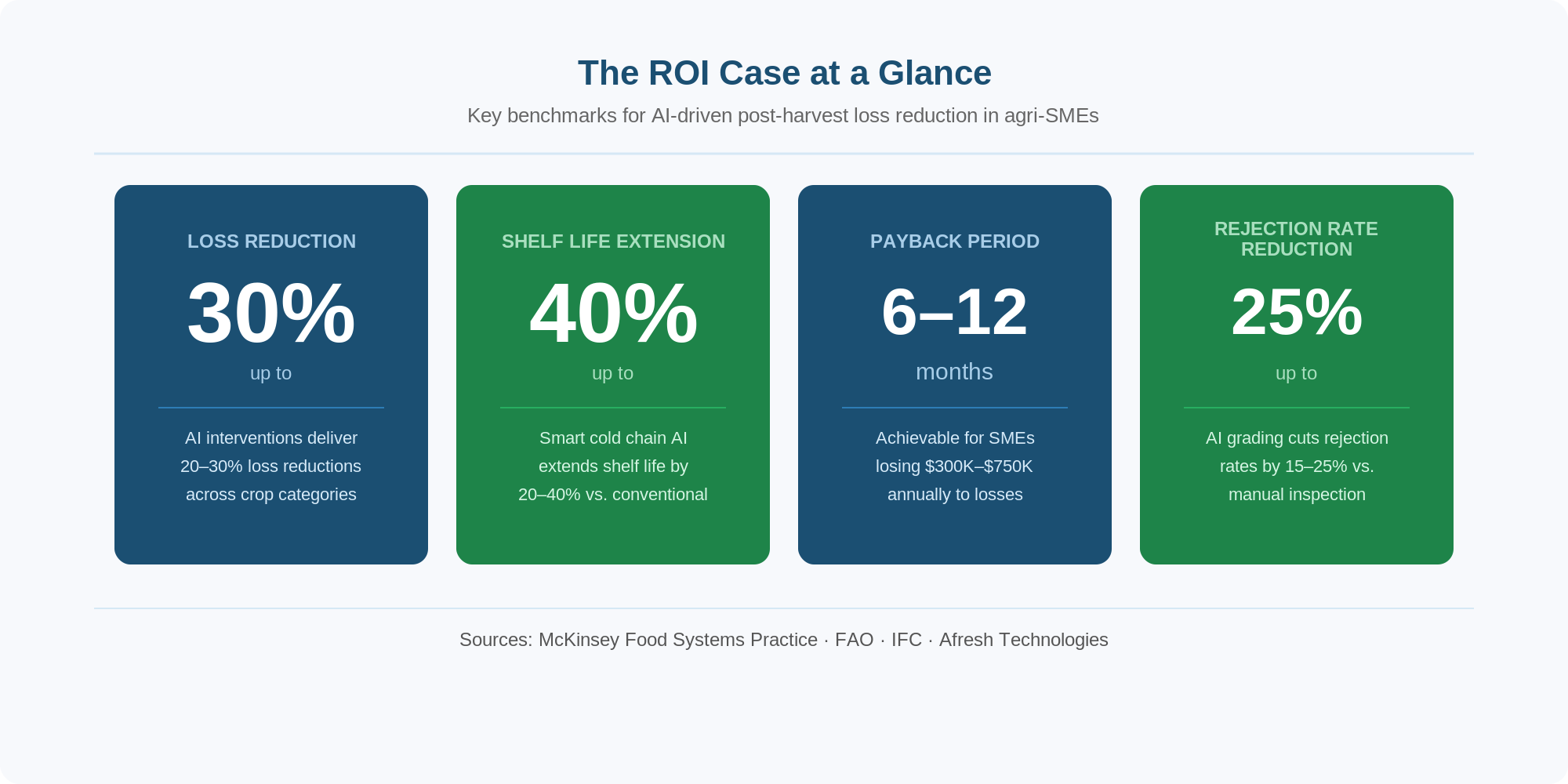
AI in agriculture is no longer experimental. Analysis from McKinsey‘s Food Systems practice indicates that AI-driven interventions deliver loss reductions of 20 to 30 percent across multiple crop categories. Cold chain AI extends shelf life by 20 to 40 percent, while AI grading reduces rejection rates by 15 to 25 percent versus manual processes.
Key benchmark for ai driven loss reduction.
For SMEs, the investment is more accessible than most assume. Getting started with AI grading typically costs $10,000 to $40,000, and cloud-based monitoring is available at SME-friendly price points. With results like 20 to 30 percent loss reduction and rejection rates cut by up to 25 percent, a 6 to 12 month payback is realistic for most operations. The real question is which solution fits your operation and how to deploy it correctly from the start.
Documented deployments confirm the case. In Southeast Asia, rice cooperatives piloting AI-enabled cold storage have reported spoilage reductions of up to 30 percent within their first season. For fresh produce, Afresh Technologies‘ demand forecasting platform has helped distributors recover significant value from previously lost product. In grain handling, operations deploying AI quality monitoring at intake have reported reductions in rejected shipments of 35 to 40 percent within 12 to 18 months.
The KPIs that matter most are the spoilage rate by product category, the grading rejection rate, the average shelf life at delivery, and the waste-to-revenue ratio. Establish your baseline on each before deployment to measure what AI is actually returning for your operation.
Implementation Roadmap: Costs, Timelines, and How to Start Right
Many SMEs worry that their data is not good enough to get started. In most cases, it is. Basic spreadsheets that track grading outcomes, storage temperatures, and sales volumes are sufficient. Consistency matters more than sophistication, and improving data quality alongside deployment is a standard approach.
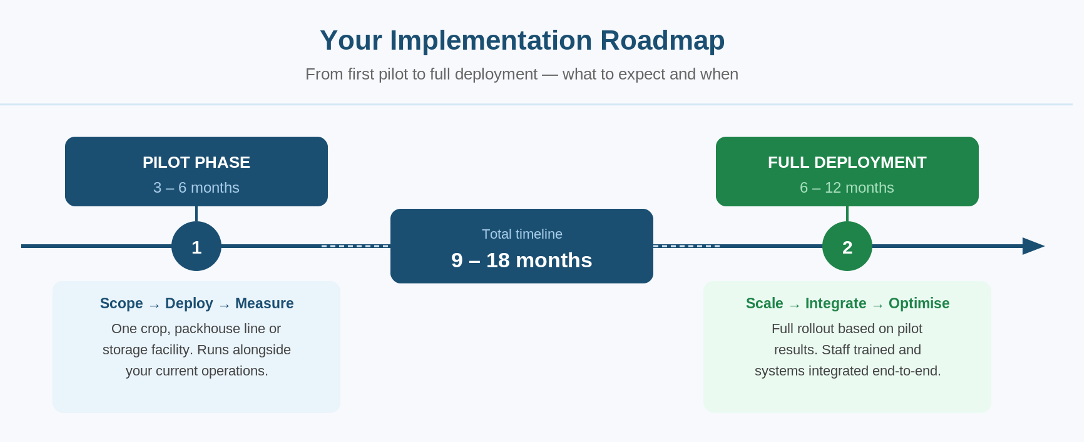
Almost every successful implementation begins with a pilot, not a full rollout. A well-scoped pilot covering one packhouse line, one storage facility, or one crop category gives you real performance data before committing further. A typical timeline looks like this:
Pilot phase: 3 to 6 months from scoping to measurable results
Full deployment: an additional 6 to 12 months, depending on scope and integration complexity
Implementation Roadmap: Costs, Timelines, and How to Start Right
The most common failure points to watch for:
Underestimating data readiness before deployment begins
Insufficient staff training on new systems and workflows
Selecting vendors whose solutions were not built for your specific operating environment
A well-run pilot does not disrupt existing operations. It runs alongside your current processes, so your team can compare results under real-world conditions. No dedicated tech team is required. The right implementation partner handles setup and trains your existing staff.
Ready to See What AI Can Do for Your Operation?
Post-harvest losses are not inevitable. The technology is mature, costs have come down, and results are consistent across operations at the SME scale. The question is not whether your operation is big enough for AI. It is whether you can afford to keep losing revenue to a problem that is now solvable.
Omdena works with agri-SMEs to design, pilot, and deploy AI solutions built for real-world operations, from cold chain to grading automation and demand forecasting. We work within your budget, infrastructure, and team capacity. Connect with Omdena to find out what is achievable for your operation.
FAQ
How do I know if my operation is ready for AI?
If you track grading outcomes, storage temperatures, and sales volumes in any format, you have enough to start. Consistency matters more than sophistication.
Which AI solution should I start with?
Start with your biggest loss point. Spoilage in storage points to the need for cold chain AI. Grading inconsistency points to AI vision systems. Fix the largest problem first, measure the results, then expand.
How long does implementation take?
A pilot typically runs three to six months. Full deployment takes an additional six to twelve months. Most SMEs go from first pilot to full operation within nine to eighteen months.
Do I need a dedicated technology team?
No. A good implementation partner handles setup, integration, and staff training. Your existing team manages day-to-day operations throughout.
What crops and products does post-harvest AI work for?
Fresh produce, grains, dairy, and processed foods. The tools vary by product, so ask any vendor for references specific to your crop before committing.
Can AI work with my existing cold storage and equipment?
In most cases, yes. IoT sensors and AI monitoring systems are designed to layer onto existing infrastructure rather than replace it. Your implementation partner should assess compatibility before deployment begins
Share this article
Share on LinkedIn, send by email, or copy the direct link.