Rooftop Solar Assessment from Satellite Imagery : Instance Segmentation Cuts Pre-Sales Survey Costs by 30-40%
16 min readUpdated August 27, 2026
Harshita Chopra
Every rooftop solar sale starts with an assessment. For a Singapore-based solar developer, that assessment consumed 30-40% of the pre-sales budget and took up to two full days per building. This project set out to replace it with an AI pipeline that extracts the same five rooftop attributes from satellite imagery, without a pre-sales site visit.
Executive Summary
Rooftop solar has a sales pipeline problem. Before a developer can quote, design, or commission a system, they need five data points for every building: obstacles, usable area, roof material, orientation, and slope. Gathering that manually takes an hour for a simple building and up to two full days for a complex commercial property, consuming a significant share of the project budget before a single panel is installed.
Omdena built a computer vision pipeline that extracts all five rooftop attributes from satellite imagery without requiring a surveyor to visit the site. The system uses instance segmentation to identify and isolate individual rooftops from high-resolution satellite images, then extracts each roof’s obstacles, usable area, material type, orientation, and slope, producing structured solar potential data ready for sales and design workflows.
The pipeline was built and validated in Singapore over eight weeks, with Mask R-CNN selected as the segmentation model after evaluation against YOLACT and Detectron2. It processes entire cities from a desktop, meaning the pre-sales survey cost does not scale with the number of buildings assessed. The result is a shift from field-heavy, building-by-building assessment to a scalable, data-driven process in which site visits follow after the pipeline has already identified the most viable targets.
KEY FINDINGS
30-40% of the project budget
Consumed by manual pre-sales rooftop surveys, based on the project’s baseline analysis of the client’s assessment workflow
1 hour to 2 full days
time required per building for manual assessment, depending on access, roof complexity, and documentation availability
5 attributes per rooftop
extracted automatically: obstacles, usable area, roof material, orientation, and slope
No site visit required
At the pre-sales screening stage, the full rooftop profile is generated from satellite imagery alone
Mask R-CNN selected
outperformed YOLACT and Detectron2 on rooftop instance segmentation across the 500+ annotated tile dataset
Scales to the city level
pipeline processes entire cities from satellite data without additional field resources
The Survey Cost That Stops Viable Solar Projects Before They Start
The solar rooftop market is constrained less by technology than by the cost of identifying where to deploy it. Assessing which buildings are viable is a manual, site-by-site process: each building requires a surveyor to visit, photograph the roof, measure obstacles such as HVAC units, water tanks, and skylights, calculate available panel area, document the roof material, and note the orientation and pitch. That process repeats across every building in the pipeline.
For large commercial properties, the process can require multiple visits and coordination with building management; for residential portfolios, costs accumulate quickly when dozens of assessments precede the first contract. This is part of a broader soft-cost problem:NREL benchmarking (2025) documents that soft costs account for up to 65% of total residential solar system costs in the United States. Pre-sales rooftop surveys are a significant contributor, incurring costs that scale with each building assessed rather than with each system installed.
The consequence is not just cost. It is selectivity. Developers cannot afford to survey every building that might be viable, so they rely on rough estimates and heuristics to prioritise. Buildings that would have been excellent candidates are never assessed. Viable projects die in the pipeline before they reach the stage where a proposal is even prepared. Computer vision addresses this directly: it makes assessment cheap enough to run at full portfolio scale, which changes what developers can know before they commit field resources.
Why Turning Satellite Imagery Into Sales-Ready Assessments Is Harder Than It Looks
Three constraints defined the difficulty of this project. Each one sits at the boundary between computer vision research and production engineering, and each had to be solved before the pipeline could deliver reliable outputs at city scale.
Before any model could be trained, 500+ satellite image tiles needed to be annotated with precise polygon labels at the individual rooftop level. Satellite imagery does not come pre-labeled, and standard annotation tools are not designed for the scale and density of urban rooftop coverage. The team used OpenStreetMap building footprints as a seed layer, cross-referencing and correcting them against the satellite tiles in QGIS, but the process still required significant manual effort before the first training run could begin. Annotation was the critical path.
Rooftop detection in a dense urban environment is harder than standard object detection benchmarks suggest. Rooftops in Singapore overlap at the pixel level, cast shadows onto adjacent structures, and vary enormously in shape, material, and obstacle density. The model had to distinguish individual rooftops from continuous roofscapes without relying on boundary markers that would not exist in a production deployment. Instance segmentation, which produces pixel-level polygon boundaries rather than bounding boxes, was the only approach that met the precision requirement for downstream area calculation.
Each of the five pipeline outputs requires a different computer vision technique applied to the same satellite image: obstacle location, usable area, material type, orientation, and slope. Obstacle detection is a localisation task; area calculation requires accurate polygon arithmetic; material classification is a texture recognition problem; orientation is a geometric inference from roof shape; slope estimation requires inferring a three-dimensional property from a two-dimensional image. Building all five into a single coherent pipeline, rather than five separate models that could fail independently, was the core engineering challenge of the project.
How 500 Annotated Rooftops Became the Training Dataset
Why Satellite Imagery Is the Right Input
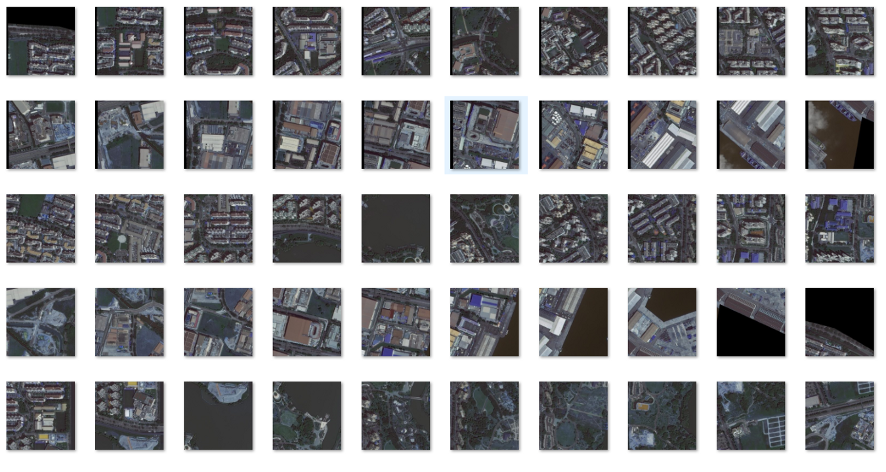
High-resolution satellite imagery provides a top-down view of rooftops at the level of detail needed for solar assessment: individual obstacles are visible, roof edges are distinct, and material textures are differentiable. Each satellite image of Singapore was approximately 2GB in size, so the team tiled the images into thousands of smaller analytical units, allowing the model to focus on one roof section at a time and improving both detection accuracy and processing speed.
Figure 1: Satellite image tiles created from the high-resolution Singapore imagery. Each tile is an independent analytical unit, capturing local rooftop detail without overwhelming computational resources.
Annotations were created using OpenStreetMap building footprints and cross-referenced in QGIS, providing a training dataset with geographically grounded labels at the individual rooftop level. The resulting dataset covered more than 500 annotated tiles across Singapore’s rooftop landscape, including residential blocks, commercial properties, mixed-use buildings, and industrial rooftops, with varying obstacle densities and material types.
Singapore was a deliberate choice as the validation environment. As one of the most densely populated urban environments in Southeast Asia, it represents a demanding test case. Rooftops are close together, often partially shadowed by adjacent structures, and frequently obstructed with equipment. A pipeline that performs reliably in Singapore transfers well to less dense markets, making the validation environment a meaningful test of real-world robustness.
The Three-Stage Pipeline: Detection, Extraction, Assessment Output
Mask R-CNN instance segmentation: identifies and isolates each rooftop polygon
Feature Extraction
5 attributes per rooftop: obstacles, usable area, material, orientation, slope
Assessment Output
Structured solar potential data per building, ready for sales and design workflows
↓
OUTPUT: Per-Building Solar Profile → Pre-Sales Assessment Data (no site visit)
Building the Detection Pipeline: How Mask R-CNN Was Chosen and What It Extracts
How the Vision Model Detects Rooftops
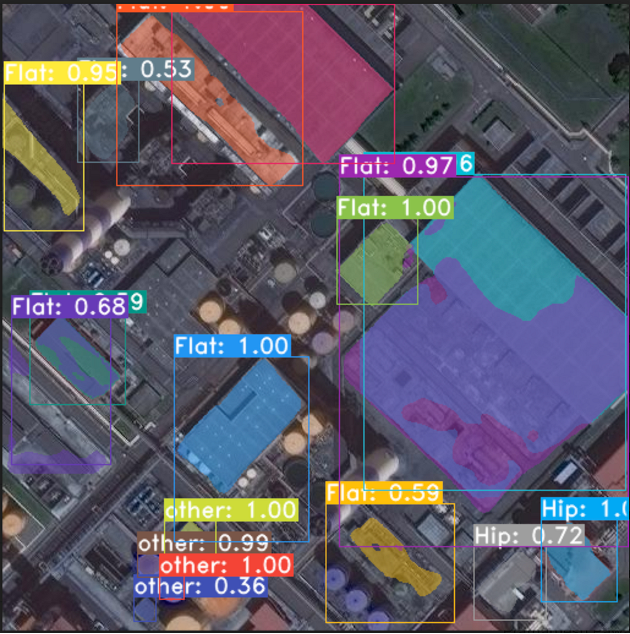
The core detection task is instance segmentation: identifying each rooftop in a satellite image and producing a precise pixel-level boundary for it. Unlike object detection, which draws bounding boxes, instance segmentation produces exact outlines that follow roof edges, gutters, and setbacks. That precision matters for solar assessment because usable area depends on accurate boundary delineation. A bounding-box approach overestimates the roof area; instance segmentation does not.
Three model architectures were evaluated: Mask R-CNN, YOLACT, and Detectron2. Mask R-CNN was selected based on its segmentation performance across the full range of building types in the Singapore dataset. Independent research onMask R-CNN applied to satellite PV imagery confirms the architecture’s suitability: it handles partial occlusion, overlapping rooftops, and irregular building geometries more reliably than the alternatives tested, which matters most in the dense urban environments where solar deployment is commercially concentrated.
The model was trained on the 500+ annotated tile dataset and validated against held-out imagery not seen during training. Training data was sourced from diverse building types to avoid the common failure mode of high accuracy on uniform residential rooftops but poor performance on commercial or mixed-use properties.
Figure 2: Instance segmentation output from the Mask R-CNN model, showing pixel-level roof boundary delineation across individual buildings in the Singapore dataset.
What the Pipeline Extracts from Each Rooftop
Once a rooftop boundary is identified, the feature extraction pipeline runs five separate analyses. Together, they produce the complete data profile a solar developer needs to move from assessment to proposal without visiting the building.
Obstacle Detection
The pipeline identifies, locates, and maps rooftop obstacles: HVAC units, water tanks, lift motor rooms, skylights, and other equipment that reduces available panel area. Each obstacle is located and its footprint estimated, showing which sections of the roof are available and which are blocked. In dense urban environments, particularly on commercial and mixed-use buildings, obstacle coverage can reduce usable area by 30-60% relative to total roof area, making obstacle detection one of the most actionable outputs the pipeline produces.
Usable Area Calculation
After obstacle mapping, the pipeline calculates the net usable roof area: total roof boundary minus obstacle footprints, setback margins, and access paths required by installation standards. The output is a square-metre figure per building, ready for use in panel count calculations and system sizing. For a developer producing preliminary proposals across a pipeline of 50 buildings, this replaces 50 manual measurements with a single pipeline run.
Roof Material Classification
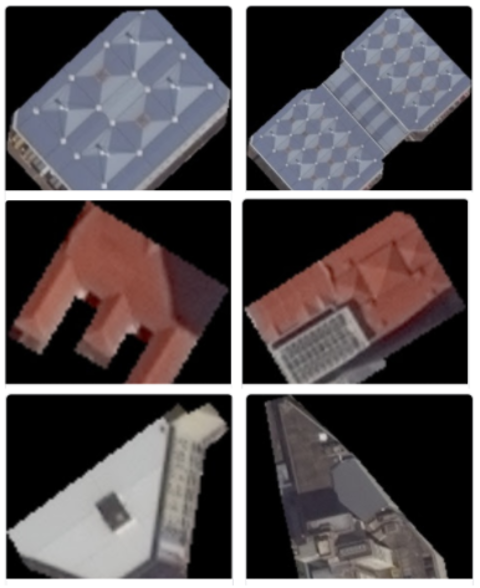
The pipeline classifies each rooftop by material type: concrete, metal, tile, Eternit, or composite shingles. Material classification determines whether a roof needs structural modification for panel fixings, what mounting system is appropriate, and whether waterproofing is required. These are direct inputs to the installation budget. Knowing the material type before the site visit means the developer arrives with the right equipment specification rather than discovering mid-survey that the mounting approach needs to change.
Figure 3: Distribution of roof material types across the Singapore dataset. Material diversity across the training set ensures the classifier generalises across the range of surfaces a developer encounters in a dense urban market.
Orientation and Slope Estimation
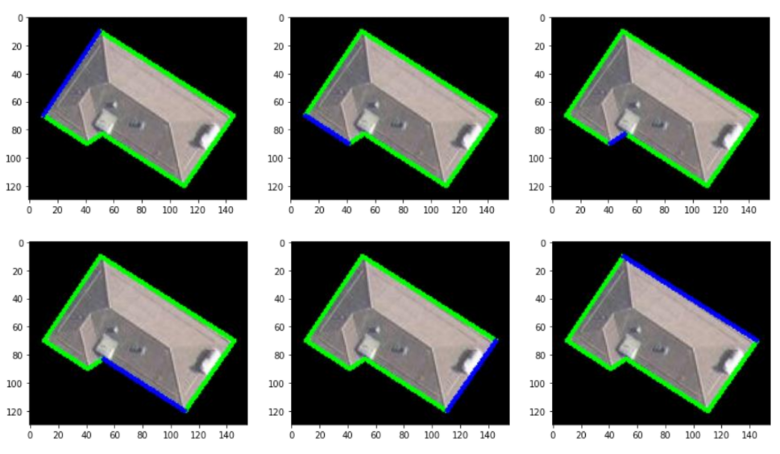
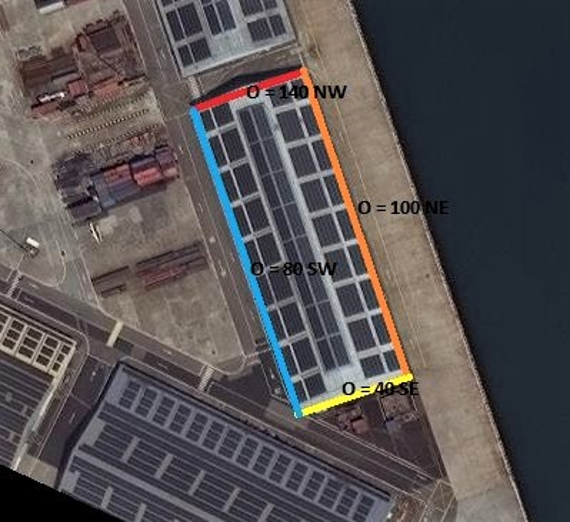
Panel yield depends heavily on the direction a roof faces and its pitch. The pipeline extracts azimuth orientation and estimates slope from the satellite imagery, flagging rooftops where orientation or pitch falls outside the productive range. Singapore’s equatorial position means flat rooftops often match or outperform steeply pitched surfaces. Slope estimation from 2D satellite imagery is inherently a range calculation rather than a precise measurement; the pipeline produces a bracket suitable for pre-sales screening, with detailed pitch verification reserved for the site survey that follows.
Figure 4: Orientation detection output showing azimuth direction mapped across individual roof facets. The pipeline determines which sections of each roof receive the most productive sun exposure for panel placement.Figure 5: Slope angle variation across different roof facets. The pipeline estimates the pitch range for each facet, enabling the developer to flag rooftops that fall outside the productive slope range before the site survey.
Results: Seconds per Building, Survey Costs Down 30-40%, Five Attributes Extracted
The pipeline was benchmarked against the developer’s manual assessment workflow. Across every measured dimension, the pipeline outperformed the baseline in speed, cost scaling, and coverage. The table below summarises the comparison.
Metric
Result
Manual assessment time
1 hour to 2 full days per building
Pipeline assessment time
Seconds per building at scale
Pre-sales survey cost baseline
30-40% of project budget (project measurement)
Soft costs, residential solar
Up to 65% of total system cost (NREL, 2025)
Attributes extracted
5 per rooftop (obstacles, area, material, orientation, slope)
Dataset size
500+ annotated satellite image tiles
Models evaluated
Mask R-CNN, YOLACT, Detectron2
Model selected
Mask R-CNN (best segmentation performance)
Site visit required
Not at the pre-sales stage
Geographic scope
Scalable to the city level from satellite data alone
Project timeline
8 weeks
From Site Visit First to Data First: What the Pipeline Changes for Solar Developers
What the Pipeline Delivers
The first shift is time compression. A building that previously required one to two days of surveyor time to assess is now profiled in seconds. Across a portfolio of hundreds of buildings, that is not incremental improvement; it is a different class of process.
The second shift is cost. Manual assessment scales linearly with every building surveyed, but the pipeline does not. Running it across 500 buildings costs roughly the same as running it across 50, allowing developers to screen entire districts and reserve field time for confirmed high-value targets.
The third shift is structural. At present, the sales cycle starts with a site visit and ends with a proposal; with the pipeline, it starts with a data run, moves to a ranked target list, and the site visit follows only after each building has been screened. The output is structurally consistent across all buildings assessed, enabling portfolio-wide ranking and market analysis that are not practical when assessment data reside in surveyors’ field notes.
The fourth shift is transferability. The pipeline was built and validated in Singapore, but its inputs are globally available satellite imagery, and its core model architecture is not location-specific. Omdena has applied the same satellite-first principle tofloating solar site assessment, where remote screening replaces reservoir field surveys before any capital is committed. The tool moves with the portfolio rather than requiring a separate assessment infrastructure in each geography.
How This Works in Practice
A solar developer preparing to enter a new district runs the pipeline across the full building stock before any sales activity begins. Within hours, every rooftop has an assessed profile: usable area, obstacle map, material type, orientation, and slope. Rooftops below the minimum viable panel count are filtered out; those with poor orientation or slope are flagged. The remaining list is ranked by estimated yield, surveyors are deployed only to the top tier, and field teams arrive with a full data briefing rather than starting from scratch.
A developer already active in a market uses the pipeline to identify upsell opportunities within an existing customer base. Buildings that were assessed manually two or three years ago are re-screened using current satellite imagery to check whether roof conditions or obstacle profiles have changed. New buildings added to managed portfolios are assessed and scored before the account manager picks up the phone. The pipeline becomes part of the ongoing commercial process, not just a one-time deployment tool.
Lessons Learned
Segmentation Precision Is a Prerequisite for Accurate Area Calculation
The choice of instance segmentation over bounding-box detection was not just an architectural preference but a functional requirement. Bounding boxes enclose the rectangular region around a rooftop, not the rooftop itself; in a dense urban environment where buildings sit close together, bounding boxes overlap and the derived area figures are meaningless. Mask R-CNN’s pixel-level polygon output is what makes usable area calculation credible. Evaluating three architectures and selecting on segmentation performance, not detection speed, proved to be the right call for this use case.
Imagery Acquisition Strategy Is a Project Decision, Not a Data Engineering Detail
Pipeline performance is determined by imagery quality before the model ever runs. Resolution affects whether individual obstacles are visible; image currency determines whether the obstacle map reflects current roof conditions; cloud cover in tropical markets limits the number of usable acquisition windows. Source, resolution, recency, and cloud-mask filtering all need to be defined at the project planning stage, not delegated to the data preparation phase. A model trained on high-quality imagery but run against low-quality inputs will underperform in ways that look like model failure but are actually a data problem.
Know Which Outputs Are Screening-Grade and Which Require Field Verification
Not all pipeline outputs carry the same precision, and using them correctly requires knowing the difference. Obstacle detection, usable area, and material classification are sufficiently accurate for pre-sales decision-making. Slope estimation from 2D satellite imagery is a range bracket, not a direct measurement; it reliably filters out unsuitable rooftops but is not appropriate for structural engineering or final system design. The correct use is to treat slope output as a screening signal and reserve detailed pitch verification for the site survey that follows for shortlisted buildings. Defining which outputs are screening-grade and which require field confirmation prevents the most common misuse of the pipeline.
Expanding Beyond Singapore: New Markets, Sharper Slope Data, Direct Design Integration
The immediate expansion path is geographic. The pipeline was validated in Singapore, but the underlying architecture is not location-specific: its inputs are globally available satellite imagery, and the model can be fine-tuned for a new market using locally annotated data. For markets with comparable building density, such as Malaysia, Indonesia, Vietnam, and the Philippines, fine-tuning typically requires two to three weeks on a new annotated dataset. India and other South Asian urban markets, where rooftop solar deployment is scaling rapidly, are the most commercially significant near-term expansion targets.
The current pipeline’s primary precision gap is slope estimation. Inferring pitch from a 2D top-down image produces a reliable range bracket but not a direct measurement. Integrating 3D data sources, including LiDAR coverage where available or stereo satellite imagery from platforms that provide digital surface models at urban resolution, would elevate slope estimation from a screening indicator to a measurement accurate enough for automated yield calculation and preliminary system design.
The longer-term integration step is connecting the pipeline directly to solar design platforms. The pipeline already produces structured per-building data: usable area, obstacle map, material type, orientation, and slope bracket. Mapping those outputs to the input schema of design tools such as PVsyst, HelioScope, or Aurora Solar would complete the handoff from satellite assessment to proposal without human intervention between stages, turning a pipeline that compresses the assessment phase into one that automates it end to end.
About the Project
Omdena led this project on AI-powered rooftop solar assessment for a Singapore-based solar developer across four parallel engineering streams: satellite image preprocessing and tiling; rooftop instance segmentation with Mask R-CNN; obstacle detection and usable area calculation; and roof attribute extraction covering material, orientation, and slope. The parallel structure compressed the eight-week timeline and let each stream’s outputs inform the others.
Combining satellite imagery processing, instance segmentation, and multi-attribute feature extraction within a single pipeline is a multi-domain scope that typically requires an enterprise AI team. Omdena delivers that capability at around a third of what enterprise AI development typically costs, through a proprietary agentic AI platform and a structured delivery process.
FAQ
Does this replace on-site surveys entirely?
Not entirely. It replaces surveys at the pre-sales screening stage, where most of the wasted spend occurs. Buildings that fail screening never incur survey costs; those that proceed arrive at fieldwork with their roof profile already documented.
How accurate is the obstacle and area detection?
The pipeline was validated on 500+ annotated tiles, with Mask R-CNN selected because it outperformed the alternatives across all tested building types. Output is calibrated to pre-sales decision-making, not final engineering specification, which is the appropriate standard at this stage.
Can the pipeline be applied in other cities or countries?
Yes. The inputs are globally available satellite imagery, and the model architecture is not Singapore-specific. Applying it to a new geography typically requires a fine-tuning run on locally annotated imagery in which the building stock differs from the training data.
What does Omdena deliver?
A configured computer vision pipeline, the annotated training dataset, and feature extraction modules for all five rooftop attributes. Delivery includes documentation and the modular codebase, enabling the client's team to run it independently after handover.
Share this article
Share on LinkedIn, send by email, or copy the direct link.