Automated Fact-Checking in El Salvador: NLP and Machine Learning for Misinformation Detection”
9 min readUpdated August 27, 2026
Omdena
In El Salvador, 68% of the population has encountered fake news on social media — and nearly half have shared content they later discovered was false. Omdena partnered with a global development and education organisation to build an AI-powered fact-checking tool that combines machine-learning classification and AI agents to validate news items before they reach the public. The result: a working Spanish-language tool deployed in two months and demonstrated live to partner media organisations.
KEY OUTCOMES
Timeline
2 months from planning to deployment and live demonstration
Classification model
MFEND algorithm trained on local Salvadoran news and augmented Spanish-language datasets
Validation approach
AI agents replicating professional fact-checker processes, cross-referencing 4 verification sources
Verification sources
Verifica.EFE, DB-Known Fakes, Voz Pública, Infodemia
Interface
Spanish-language Streamlit application with classification results and PDF report export
Deployment
Flask APIs served via Docker (local) and Streamlit Cloud
Stakeholders engaged
6 media and civil society organisations across El Salvador
The Problem: Misinformation at Scale in El Salvador
Misinformation and disinformation have become a defining challenge for journalism in El Salvador’s digital media landscape.
The spread of false information through digital channels has become a structural challenge for journalism in El Salvador, and the scale of the problem is well documented. A study by the University of El Salvador found that 68% of Salvadorans have been exposed to fake news on social media, with 45% admitting to believing and sharing such content.
The consequences extend into the country’s political and social fabric. During the 2019 presidential elections, false information targeting candidates spread widely across social media, with 74% of Salvadorans saying fake news had a moderate to significant impact on the election, according to a National Democratic Institute survey. False stories about crime, immigration, and economic conditions have also fuelled social tensions and stigmatised communities in gang-controlled areas, according to the International Crisis Group.
The COVID-19 pandemic exposed a further dimension of the problem. A study by the Universidad Centroamericana José Simeón Cañas found that 62% of Salvadorans encountered fake news related to the virus, with 28% acting on information they believed to be accurate.
For journalists and media practitioners operating in this environment, manual fact-checking is the primary defence, and it does not scale. Verifying a single news item against multiple credible sources, tracing its origin, and confirming that a headline matches the article content is a time-intensive process. As the volume of content circulating on social platforms continues to increase, manual verification cannot keep pace.
The Partner: Global Media Literacy and Development Organisation
Omdena collaborated with a global development and education organisation with extensive experience in media literacy and countering disinformation across Latin America. Their deep understanding of the Salvadoran media landscape and their existing relationships with journalists, fact-checkers and civil society organisations shaped the design of the tool from the outset.
The partner’s expertise ensured that the AI system reflected how verification actually works in practice, not just what is technically feasible. Their involvement in stakeholder engagement and user evaluation was central to producing a tool that journalists would adopt.
Project Objectives
The project had three core objectives:
Build an AI system capable of classifying news items as likely real or fake, based on patterns learned from local and augmented Spanish-language datasets.
Develop AI agents that replicate the verification processes used by credible fact-checking organisations, providing a process-based validation layer alongside the classification result.
Deliver a Spanish-language interface deployable in constrained infrastructure environments, enabling journalists to validate news items without requiring technical expertise.
Building the Fact-Checking System: Data, Classification, and Deployment
Data Collection and Curation
Building an effective classifier for El Salvador required data that reflected local news patterns. The team scraped news articles from multiple Salvadoran online newspapers, assembling a representative dataset of authentic local content. To complement this, the team sourced Spanish-language fake news datasets from third-party repositories on Kaggle and GitHub, augmenting the local data with documented examples of false information.
The combined dataset was subjected to extensive exploratory data analysis — data visualisation, statistical analysis, and text mining — to identify patterns and characteristics that distinguish false information from authentic reporting. To verify data quality, a subset of news items was manually fact-checked, and reverse engineering techniques were used to trace the origin and spread of items where authenticity was uncertain.
Model Building: Classification and Agent-Based Validation
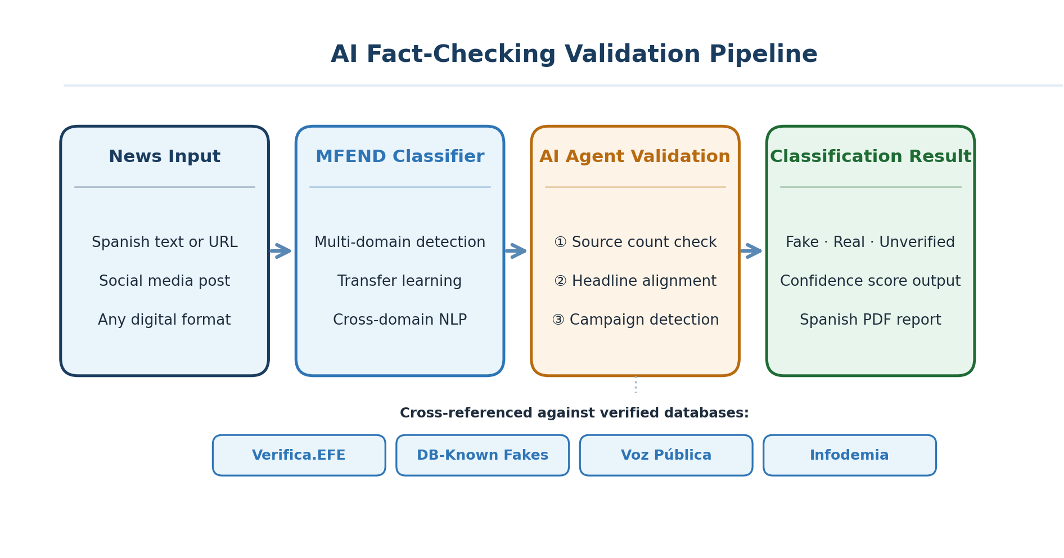
The AI tool combines two complementary approaches to news verification.
The first is pattern-based classification. The team used the MFEND (Multi-domain Fake News Detection) algorithm to classify news items based on their similarity to known examples of real and fake news. Where labelled Salvadoran data was limited, transfer learning from models trained on similar tasks in other Spanish-language contexts extended coverage without requiring a large local ground truth dataset.
The second is process-based validation through AI agents. These agents replicate the steps that credible third-party fact-checkers perform manually:
Determining how many times a news item appears in other credible sources
Confirming whether the headline aligns with the content of the article
Identifying how many media outlets carry the same headline — an indicator of coordinated misinformation campaigns
The agents cross-reference results against four established verification sources active in El Salvador: Verifica.EFE, DB-Known Fakes, Voz Pública, and Infodemia. This cross-referencing layer gives journalists both the classification signal and the evidence trail behind it.
Stakeholder Engagement
Before finalising the tool’s design, the team conducted structured engagement with six organisations representing the media, civil society, and fact-checking ecosystem in El Salvador: FUNDE, APES, Moon Shot Team, Acción Ciudadana, Disruptiva Magazine, and the independent digital newspaper Voz Pública.
These conversations surfaced how verification actually works in Salvadoran newsrooms — the workflows journalists follow, the sources they trust, and the time constraints they operate under. The insights shaped both the validation logic and the interface design, ensuring the tool addressed real workflows rather than assumed ones.
Deployment and Interface
The team built a Spanish-language interface using Streamlit, designed from the outset for journalists without technical backgrounds. Users input a news item, receive a classification result with the supporting agent findings, and can view the verification sources driving the assessment. A PDF export function allows validation reports to be saved, shared, and archived.
The tool was served through Flask APIs and deployed on both Docker and Streamlit Cloud—giving partner organisations the option to run the application locally or in the cloud, depending on their infrastructure. The dual deployment approach was a direct response to the variable infrastructure conditions identified during stakeholder engagement.
A live demonstration of the deployed tool was delivered to the partner organisation, confirming the system performed as intended under real operating conditions.
What Building an AI Fact-Checking Tool for Journalists Taught Us
Transfer learning makes NLP viable in low-resource language contexts.
The absence of large, labelled local datasets is a common constraint in applied NLP projects outside high-resource language environments. Combining data augmentation with transfer learning from Spanish-language models trained on comparable tasks produced a functional classifier without the volume of ground truth data that a purely supervised approach would require. The MFEND algorithm’s design for multi-domain scenarios made it well suited to a context where news source types and content categories vary widely.
Stakeholder engagement shapes what gets built, not just how it gets used.
In projects with direct end-user impact, the gap between technically correct and practically useful is often wide. Structured engagement with FUNDE, APES, Moon Shot Team, Acción Ciudadana, Disruptiva Magazine, and Voz Pública before final design decisions ensured the tool reflected actual verification workflows. Without that engagement, the system might have been accurate but not adopted.
Flexible deployment is a requirement in infrastructure-constrained markets.
Media organisations in El Salvador operate with variable infrastructure — some have reliable cloud access, others depend on local hardware. Building to a single deployment model would have excluded a significant portion of the intended users. The Flask/Docker/Streamlit Cloud architecture provided both options without requiring users to modify their working environment, and sets a reusable pattern for similar deployments in other markets.
What Was Delivered: The Fact-Checking Tool and Live Demonstration
The project delivered a complete AI-powered fact-checking system within a two-month timeline.
The core system combines the MFEND classification model with a suite of AI agents that cross-reference news items against Verifica.EFE, DB-Known Fakes, Voz Pública, and Infodemia. Together, these components give journalists both a pattern-based signal and a process-based validation trail for any news item submitted to the tool.
The Spanish-language Streamlit interface provides the classification result, the agent findings, and the option to export the full validation report as a PDF. Deployment via Docker and Streamlit Cloud means partner organisations can run the tool in whichever environment their infrastructure supports.
The system was demonstrated live to the partner organisation as proof of deployment, confirming both the technical integration and the usability of the interface under real operating conditions.
What’s Next
Three extensions were identified during the project for future development:
Ground truth improvement — a structured feedback programme in which journalists flag incorrect classifications over time, building a labelled local dataset that will improve classification accuracy for Salvadoran-specific content and language patterns.
Geographic expansion — adapting the pipeline for other Central American markets facing similar misinformation challenges, using the same transfer learning and agent-based validation approach developed for El Salvador.
Language and dialect extension — extending the Spanish-language model to handle regional dialects and informal language patterns common in social media content, where much of the misinformation originates.
Key Achievements
Working AI Fact-Checking Tool
A complete news validation system combining MFEND pattern-based classification and AI agent validation, delivered and demonstrated to the partner organisation within a two-month project timeline.
Agent-Based Verification Against Four Sources
AI agents cross-reference every news item against Verifica.EFE, DB-Known Fakes, Voz Pública, and Infodemia — replicating the manual verification process used by professional fact-checkers and surfacing the evidence trail behind every classification.
Spanish-Language Interface with PDF Export
A Streamlit-based interface designed for journalists without technical expertise, fully localised in Spanish and including PDF report generation for sharing and archiving validation results.
Flexible Dual Deployment
Flask APIs deployable on Docker for local infrastructure and Streamlit Cloud for cloud-based access — ensuring the tool operates regardless of infrastructure constraints, with no requirement to modify the user’s working environment.
About the Project
This case study documents work delivered by Omdena, a global applied AI organisation with more than 300 projects across 60+ countries, in partnership with a global development and education organisation with expertise in media literacy and countering disinformation in Latin America.
If you are evaluating an AI tool for media verification, fact-checking, or misinformation detection, contact Omdena to discuss what a scoped implementation would look like for your context.
FAQ
What does the tool do?
The tool validates news items by combining two methods: pattern-based classification using the MFEND algorithm, which compares a news item against known examples of real and fake news, and AI agent validation, which replicates the verification steps that professional fact-checkers perform — checking source counts, headline-content alignment, and coverage patterns across media outlets.
Which verification sources does the tool cross-reference?
The AI agents cross-reference news items against four established verification sources active in El Salvador: Verifica.EFE, DB-Known Fakes, Voz Pública, and Infodemia.
Is the tool available in Spanish?
Yes. The interface was designed and built entirely in Spanish, with localisation as a core requirement from the outset. All outputs — including the PDF validation report — are in Spanish.
Can the tool be deployed without cloud access?
Yes. The tool is deployable both locally via Docker and on Streamlit Cloud. The dual deployment approach was built specifically for media organisations operating in infrastructure-constrained environments.
Can this approach be adapted for other countries or languages?
The methodology — combining MFEND classification, transfer learning, and agent-based validation against local fact-checking sources — is adaptable to other Spanish-speaking markets and, with appropriate model selection, to other languages. The primary requirement is identifying the equivalent local verification sources for the target country.
Share this article
Share on LinkedIn, send by email, or copy the direct link.