Agentic AI frameworks are software toolkits that help developers build autonomous AI agents. These agents can reason, plan, and execute multi-step tasks. The frameworks provide key components such as memory, tool integration, orchestration, and multi-agent coordination. This allows teams to move from simple LLM prompts to production-ready AI systems.
Traditional models respond to single prompts. Agentic systems go further. They break down goals, use tools, retain context, and adapt based on outcomes. This makes them more capable than linear workflows.
In this guide, I break down the architecture behind agentic AI frameworks, how to choose the right framework, compare the top options, and map them to real-world use cases. Let’s get started.
Quick Summary
Agentic AI frameworks are software platforms that simplify the development of autonomous AI agents. These frameworks provide reusable building blocks for reasoning, planning, memory, and tool integration, allowing agents to complete complex, multi-step tasks with minimal human input.
Best Agentic AI Frameworks:
LangChain → Best for flexible agent development and RAG systems
LangChain4j → Best for Java-based enterprise applications
LangGraph → Best for complex, stateful workflows with branching logic
AutoGen → Best for multi-agent collaboration and conversational workflows
CrewAI → Best for role-based multi-agent teams and business processes
LlamaIndex → Best for data-driven agents and knowledge retrieval systems
Semantic Kernel → Best for enterprise AI and Microsoft ecosystem integration
OpenAI Swarm → Best for lightweight multi-agent experiments
Rasa → Best for conversational AI and dialogue management
Smolagents → Best for rapid prototyping and learning
Agentic AI frameworks are software platforms that simplify the development of autonomous AI agents. These frameworks provide reusable building blocks for reasoning, planning, memory, and tool integration, allowing agents to complete complex, multi-step tasks with minimal human input.
In practice, they act as the infrastructure layer between large language models and real-world actions. Instead of manually handling prompts, tool calls, and context management, developers use frameworks to orchestrate workflows, coordinate multiple agents, and manage state efficiently.
To understand how these systems work in practice, it is important to look at their underlying architecture.
Architecture Behind Agentic AI Frameworks
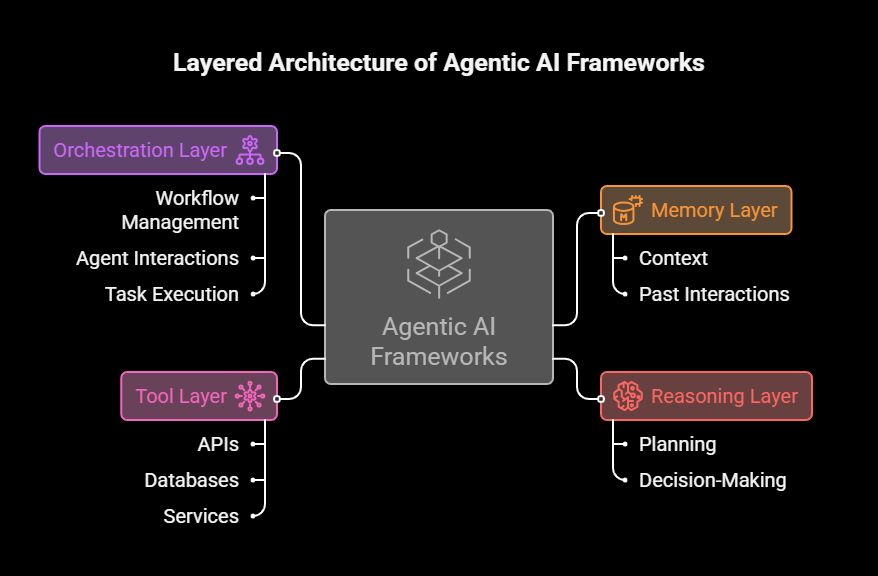
Agentic AI frameworks rely on layered architectures to enable autonomous behavior. The core layers include:
Layered Architecture of Agentic AI Frameworks
Memory layer: Stores context and past interactions to maintain continuity across tasks.
Reasoning layer: Handles planning and decision-making, often powered by LLMs.
Tool layer: Connects agents to external systems such as APIs, databases, and services to perform real-world actions.
Together, these layers transform static models into goal-driven systems that can plan, act, and adapt dynamically.
Next, let’s explore the key factors to consider when choosing an agentic AI framework.
Factors to Consider When Choosing an Agentic AI Framework
Choosing the right agentic AI framework depends on your use case, technical capabilities, and long-term goals. Different frameworks optimize for different trade-offs, so it is important to evaluate them based on how your agents will operate in production.
Key factors to consider:
Ease of use and learning curve: Clear documentation, strong examples, and an active community help teams get started quickly.
Language and ecosystem support: Most frameworks are Python-first, while some support Java or JavaScript for enterprise environments.
Model and tool interoperability: Look for support across multiple LLM providers and seamless integration with APIs, databases, and vector stores.
Workflow complexity: Choose based on your needs. This could range from simple linear flows to multi-agent systems or graph-based orchestration.
Memory, reasoning, and state management: Persistent context and structured reasoning are essential for complex agent behavior.
Scalability and production readiness: Logging, monitoring, debugging, and deployment capabilities become critical beyond prototyping.
Security and compliance: Features like access control, sandboxing, and data governance are important for enterprise use cases.
Community and long-term support: Active development and strong backing indicate long-term reliability.
Cost and licensing: Balance open-source flexibility with the operational cost of managing and scaling systems.
The right framework is not the most feature-rich one, but the one that aligns with your specific use case and system requirements.
Next, let’s explore the most popular agentic AI frameworks and where each one fits best.
Popular Agentic AI Frameworks
Agentic AI has led to a growing ecosystem of frameworks built for different needs, from rapid prototyping to enterprise deployment. Some prioritize flexibility, while others focus on structured workflows and multi-agent systems.
Below, I have listed the most widely used agentic AI frameworks and where they fit best.
1. LangChain
LangChain is one of the earliest and most widely adopted agentic AI frameworks. It was built to simplify the process of composing LLM-powered applications by chaining together prompts, tools, memory, and models into structured workflows.
LangChain4j appeals strongly to organizations with existing JVM infrastructure.
3. LangGraph
LangGraph is a newer framework designed to address one of LangChain’s limitations: managing complex control flow. It introduces graph-based orchestration for agents.
LangGraph is especially useful when agent behavior cannot be represented as a simple linear chain.
4. AutoGen
AutoGen focuses on structured multi-agent collaboration, where agents communicate with each other using defined protocols.
AutoGen enables complex LLM-based workflows using multi-agent conversations. (Left) AutoGen agents are customizable and can be based on LLMs, tools, humans, and even a combination of them. (Top-right) Agents can converse to solve tasks. (Bottom-right) The framework supports many additional complex conversation patterns.
Key features: Minimal abstractions, fast setup, and tool calling.
Advantages: Great for experimentation and learning.
Applications: Prototyping, research experiments, educational use.
Smolagents trades structure for speed and simplicity.
Some Notable Mentions
Several other agentic AI frameworks are gaining traction, but didn’t make this list:
DSPy: Declarative framework for building and optimizing AI systems without manual prompt engineering
Haystack: Production-ready framework for RAG pipelines and scalable AI applications
AutoAgent: No-code framework for building agent workflows using natural language
MetaGPT: A multi-agent framework focused on software development workflows
These frameworks are still evolving but offer unique approaches worth exploring based on specific use cases.
With a clear understanding of how these frameworks differ, the next section compares them side by side in a table to highlight trade-offs across language support, workflow complexity, and ideal use cases.
Comparing Different Agentic AI Frameworks
With so many agentic AI frameworks available, it can be difficult to evaluate them purely through descriptions. A side-by-side comparison helps clarify where each framework excels and what trade-offs it introduces. The table below summarizes the most important dimensions teams typically consider when selecting an agentic AI framework.
Framework
Language Support
Multi-Agent Support
Workflow Orchestration
Memory / State
Best Fit Use Case
Community
Production Readiness
LangChain
Python, JS
Partial
Chains, agents, tools
Yes
Complex reasoning, RAG systems
Very strong
Medium–High
LangChain4j
Java, Kotlin
Partial
Chains, tools
Yes
Enterprise JVM-based AI services
Growing
Medium
LangGraph
Python
Yes
Graph-based, conditional flows
Persistent state
Long-running, branching workflows
Growing
High
AutoGen
Python
Yes
Agent-to-agent messaging
Shared context
Collaborative multi-agent reasoning
Strong
Medium
CrewAI
Python
Yes
Role-based task execution
Limited
Business process automation
Fast-growing
Medium
LlamaIndex
Python
Partial
Data-driven pipelines
Strong retrieval memory
Knowledge-intensive agents
Strong
High
Semantic Kernel
C#, Python, Java
Partial
Planner-based orchestration
Yes
Enterprise copilots
Enterprise-backed
High
OpenAI Swarm
Python
Yes
Agent handoffs
Minimal
Lightweight multi-agent experiments
Early
Low–Medium
Rasa
Python
Limited
Dialogue policies
Conversation state
Conversational AI systems
Mature
High
Smolagents
Python
Limited
Minimal orchestration
Minimal
Rapid prototyping, research
Growing
Low–Medium
This comparison highlights that no single framework is universally “best.” Each one targets a specific set of problems, teams, and maturity levels. In the next section, I break down the best use cases by framework to help you quickly map real-world scenarios to the most suitable agentic AI tools.
Choosing the right agentic AI framework becomes easier when you map it to your specific use case. Different frameworks are optimized for different types of workflows, data needs, and system complexity.
Use Case
Best Framework
RAG systems and knowledge retrieval
LlamaIndex
Multi-agent workflows and collaboration
CrewAI, AutoGen
Enterprise applications and copilots
Semantic Kernel, LangChain4j
Rapid prototyping and experimentation
LangChain, Smolagents
Conversational AI and chatbots
Rasa
Complex workflows with branching logic
LangGraph
Lightweight multi-agent experiments
OpenAI Swarm
This mapping helps you quickly identify which framework aligns with your technical requirements and use case. Next, let’s explore the key benefits of agentic AI frameworks and how they enable scalable, production-ready systems.
Benefits of Agentic AI Frameworks
Agentic AI frameworks offer several advantages that make it easier to build and scale autonomous systems:
Task decomposition: Break complex goals into smaller, manageable steps for better execution
Memory and context retention: Maintain state across interactions to improve accuracy and continuity
Multi-agent collaboration: Enable multiple agents to work together, share context, and solve complex problems
Tool and API integration: Connect with external systems, databases, and services to perform real-world actions
Scalability: Provide structured architectures that support growth from prototypes to production systems
These benefits make agentic frameworks essential for building reliable, goal-driven AI systems. Next, let’s explore how Omdena can help you build custom AI agents with one of these frameworks for your use case.
Custom AI Agent Development with Omdena
Building agentic AI systems that work in real environments requires more than assembling tools or frameworks. Omdena focuses on designing production-ready agentic AI systems that align with people, processes, and organizational constraints. This human-centered approach helps teams move beyond experiments toward reliable deployment.
Omdena’s Human-Centered Approach to Custom AI Agent Development
Omdena designs agentic AI to support human decision-making, not replace it. Each system defines clear boundaries for autonomy, escalation, and approval. Transparency, explainability, and human-in-the-loop controls are built into agent behavior from the start. This improves trust, safety, and long-term adoption, especially in high-stakes or regulated environments.
Umaku-Powered Project Delivery
Omdena delivers projects using Umaku, its AI-powered application development platform. Umaku structures the full lifecycle—from problem framing and data governance to architecture selection, evaluation, and deployment. It combines human expertise with AI-assisted execution to enforce quality, governance, and alignment across distributed teams. This keeps agentic systems grounded in real workflows rather than isolated demos.
Umaku Project View
Domain-Specific Training & Optimization
Custom agentic AI performs best when optimized for a specific domain. Omdena fine-tunes models and workflows using proprietary data, industry terminology, and operational context. This domain-specific optimization consistently improves accuracy, reliability, and decision quality compared to generic, off-the-shelf agents.
Build Your Custom AI Agent with Omdena
Agentic AI frameworks help teams move beyond simple LLM experiments. They make it possible to build systems that can think through tasks, make decisions, and act on their own. These frameworks reduce technical complexity and speed up development. They also help agents scale, connect with real workflows, and run safely in production. The right framework, combined with a human-centered approach, separates quick demos from systems that deliver lasting value.
If you want to use agentic AI to solve real problems in your organization, Omdena can support you. The team designs and builds custom AI agents based on your data, domain, and operational needs. Book an exploration call with Omdena today to turn your agentic AI ideas into working solutions.
FAQ
What is an agentic AI framework?
An agentic AI framework provides the structure, tools, and abstractions needed to build AI agents that can reason, plan tasks, use tools, maintain memory, and act autonomously.
How are agentic AI frameworks different from using LLM APIs directly?
LLM APIs handle single prompt–response interactions, while agentic AI frameworks support multi-step reasoning, memory, tool orchestration, and autonomous decision-making over time.
Which agentic AI framework should I choose for my use case?
The right framework depends on your needs—data-heavy systems benefit from LlamaIndex, multi-agent workflows from AutoGen or CrewAI, enterprise environments from Semantic Kernel, and rapid prototyping from LangChain or Smolagents.
Are agentic AI frameworks production-ready today?
Some frameworks are production-ready, especially when combined with proper evaluation, monitoring, and governance. Others are better suited for experimentation and prototyping.
When should organizations consider custom agentic AI development instead of off-the-shelf tools?
Custom development makes sense when organizations need domain-specific behavior, tighter workflow integration, stronger governance, or full control over data, security, and compliance.
Continue with Omdena
Share this article
Share on LinkedIn, send by email, or copy the direct link.