Traditional automation promised efficiency, but most organizations now face its limits. Rule-based RPA systems struggle with rigid workflows, require frequent human input, and break when faced with unstructured data like documents or conversations. Meanwhile, enterprise operations have become far more complex, involving multiple tools, data sources, and real-time decisions.
This gap is fueling a shift toward agentic AI and large language models that can interpret context and act independently. According to Gartner, by 2028, at least 15% of daily work decisions will be made autonomously by agentic AI. We are now moving from automating tasks to automating decision-making itself.
Organizations have already started exploring agent-based systems across agriculture, mining, energy, climate, healthcare, and supply chain operations. In this article, I will break down how Agentic Process Automation works, where it delivers value, and how enterprises can adopt it.
TLDR (Quick Summary):
Traditional automation is breaking due to rigid workflows and rising complexity, driving the shift toward AI agents and autonomous decision-making.
What is Agentic Process Automation: APA uses AI agents to understand context, plan actions, and execute workflows independently to achieve goals.
From RPA to APA: Automation has evolved from rule-based systems to adaptive, goal-driven agents that can handle complex and dynamic workflows.
How APA Works: Agentic systems follow a continuous loop of data ingestion, reasoning, planning, execution, and learning until the goal is achieved.
Core Components: APA systems rely on AI agents, memory, planning, integrations, feedback loops, and human oversight to function effectively.
Key Benefits: APA improves efficiency, decision-making, accuracy, and scalability by moving workflows forward without constant human input.
Use Cases: APA is transforming industries like customer service, IT, finance, healthcare, mining, agriculture, supply chain, and energy through intelligent automation.
Challenges: Key risks include data security, governance gaps, AI errors, and over-automation, requiring strong guardrails and monitoring.
Implementation: Successful adoption requires a phased approach with pilots, strong data pipelines, and multi-agent system design.
Why Partner with Experts: Building agentic systems requires AI expertise and real-world experience, making expert partners like Omdena critical for success.
Future: APA is driving the rise of autonomous enterprises, multi-agent ecosystems, and AI co-workers across industries.
What Is Agentic Process Automation?
Agentic Process Automation (APA) is a modern approach to automation where AI agents independently manage and execute workflows from start to finish. Instead of following fixed rules, these systems:
Understand context across data and systems
Plan actions based on goals
Execute tasks autonomously
This represents a shift from “if-this-then-that” logic to “what should happen next?” decision-making. AI agents are designed to perceive information, make decisions, and take actions to achieve outcomes, not just complete predefined steps.
At its core, APA combines:
Autonomous AI agents
LLMs and NLP for reasoning
Multi-step workflow orchestration
Real-time adaptability
For example, a customer support agent can read a query, check CRM data, draft a response, and escalate complex cases automatically.
This evolution raises an important question: how did we move from rule-based automation to goal-driven systems?
From RPA to Agentic Process Automation: What Changed?
Automation has evolved significantly over the past decade. Early systems like RPA focused on mimicking human actions through predefined rules. These systems worked well for repetitive, structured tasks but struggled with variability.
RPA:
Rule-based execution
Limited to structured data
Requires human intervention for exceptions
Intelligent Automation:
Adds ML and NLP capabilities
Improves data handling
Still depends on predefined workflows
Agentic Process Automation:
Autonomous and context-aware
Adapts to changing conditions
Handles complex, multi-step workflows
The core shift is in decision-making and adaptability:
Feature
RPA
APA
Logic
Fixed
Adaptive
Data
Structured
Structured + Unstructured
Decisions
Predefined
Context-aware
APA represents a move from task-driven systems to goal-driven systems that reason and act independently. To understand this better, let’s break down how Agentic Process Automation actually works in practice.
How Agentic Process Automation Works
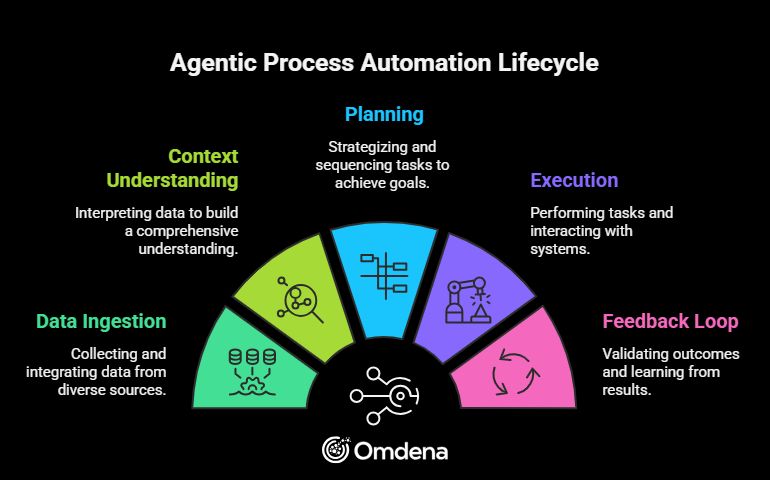
Agentic Process Automation operates as a continuous, goal-driven lifecycle where AI agents move a process forward step by step until the desired outcome is achieved. Instead of executing a fixed workflow, the system adapts at each stage based on context and new information.
Agentic Process Automation Lifecycle
Step 1: Data Ingestion
The process begins by collecting data from multiple sources. This includes structured data from databases and unstructured inputs like emails, documents, chats, and APIs. This also involves using advanced techniques like document parsing for RAG systems. Modern systems rely heavily on real-time data access to ensure decisions reflect current conditions.
Step 2: Context Understanding
AI agents interpret this data using natural language processing and semantic reasoning. They identify intent, extract key details, and build context. Many systems also use memory, both short-term for the current task and long-term for past interactions, to improve continuity and accuracy.
Step 3: Planning
Once the context is clear, the agent decides what to do next. It breaks down the goal into smaller tasks, determines the sequence of actions, and selects the tools or systems required. This planning step is dynamic and can change as new data becomes available.
Step 4: Execution
The agent then executes tasks by interacting with systems through APIs, updating records, generating outputs, or triggering workflows. In multi-agent setups, different agents may collaborate to complete complex processes supported by modern AI agent orchestration tools.
Step 5: Feedback Loop
Before completing the process, the system validates outcomes, checks for errors, and learns from results. This continuous feedback loop helps improve future performance.
This cycle repeats until the goal is achieved. This ability to adapt and self-correct is what makes agentic process automation powerful. Next, let’s look at the core components of an agentic system.
Core Components of an Agentic AI System
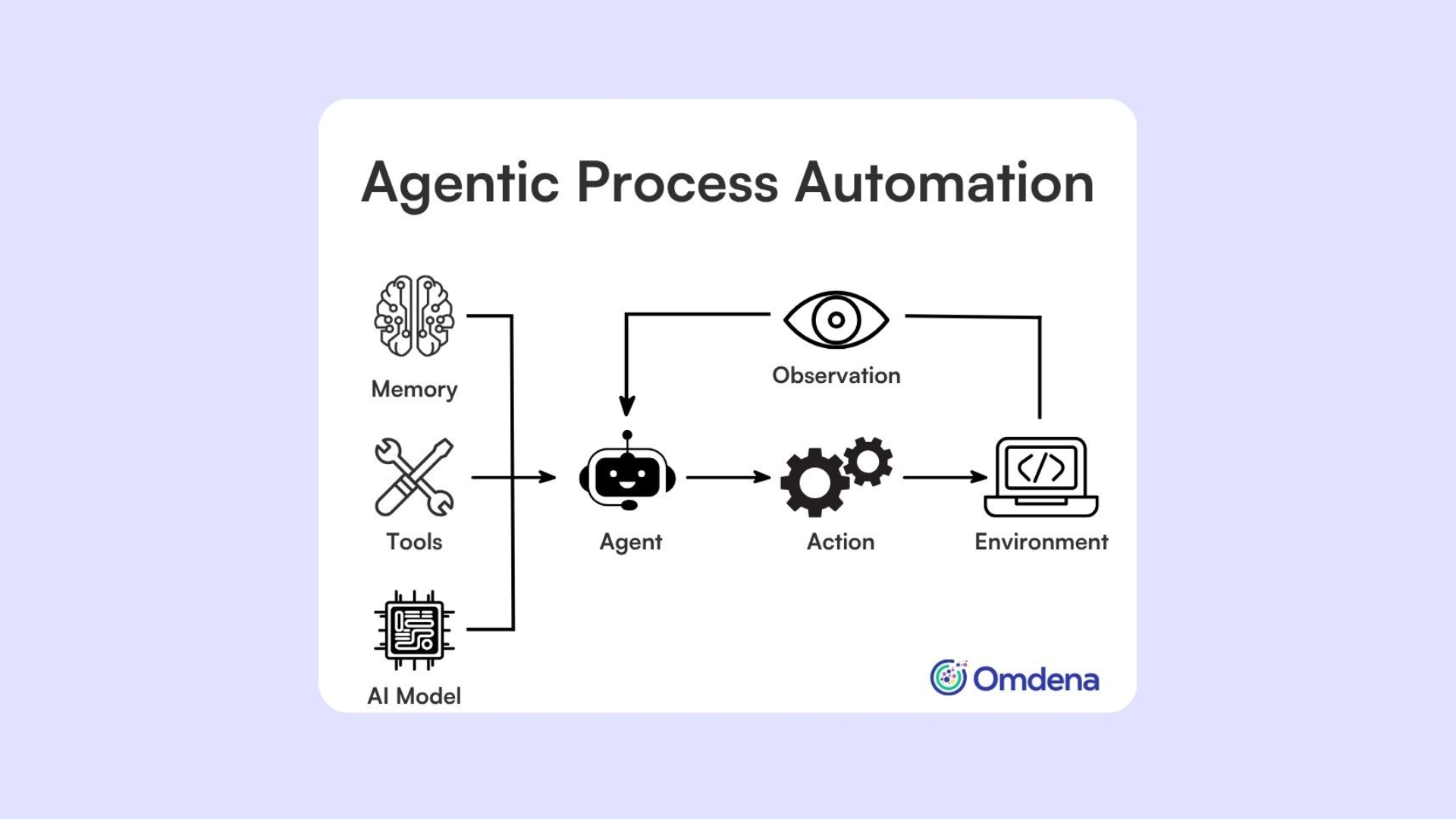
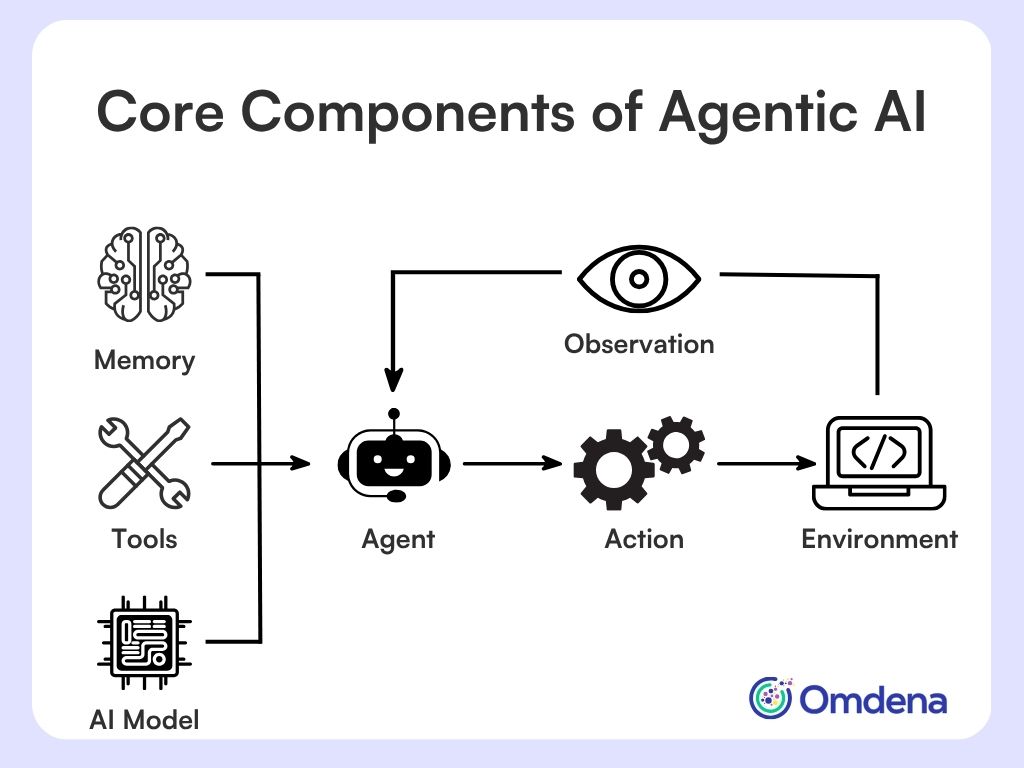
To understand how agentic systems function, it helps to break down their core building blocks:
Core Components of Agentic AI
Autonomous AI agents: Independent entities that perceive, reason, and act to complete tasks without constant human input.
Goals and planning: Agents operate toward defined outcomes, dynamically deciding what actions to take and in what sequence.
Memory systems: Short-term and long-term memory enable context retention, improving continuity and decision quality.
Tools and APIs (integration layer): Agents interact with external systems, databases, and applications to execute tasks across workflows.
Feedback loops: Continuous validation and learning improve performance over time.
Human-in-the-loop controls: Oversight mechanisms ensure accountability, especially in high-risk decisions.
Together, these components allow systems to behave like digital teams, not just tools. Next, let’s explore the key benefits of Agentic Process Automation.
Key Benefits of Agentic Process Automation
Agentic Process Automation delivers measurable business value by moving beyond static workflows and enabling intelligent execution.
Reduced manual intervention: AI agents handle end-to-end processes independently, reducing reliance on human input for routine and decision-heavy tasks.
Faster and smarter decision-making: Agents analyze context in real time and choose optimal actions, improving speed and accuracy of decisions.
Improved accuracy and consistency: Automation systems today can boost data accuracy by up to 88% and significantly reduce errors in workflows.
Scalability without headcount growth: Processes expand without proportional increases in operational teams.
Better exception handling: Agents detect anomalies and adapt workflows dynamically instead of breaking.
The key shift is this: APA does not just automate work, it moves work forward independently, driving lower cost-to-serve and higher operational agility.
Next, let’s explore real-world use cases of Agentic Process Automation across industries.
Real-World Use Cases Across Industries
Agentic Process Automation is already delivering value across industries by enabling systems to act, adapt, and complete workflows with minimal human input.
1. Customer Service
AI agents handle customer queries end-to-end. They understand intent, generate responses, analyze sentiment, and escalate complex cases when needed. This improves response time and customer experience.
2. IT Operations
Agentic systems enable self-healing infrastructure. They detect anomalies, diagnose issues, and trigger fixes automatically. One of Omdena’s projects show how autonomous agents can read codebases, interpret tickets, and assist engineering workflows in real time.
3. Supply Chain
Agents forecast demand, monitor inventory, and reroute logistics dynamically. This reduces disruptions and improves operational efficiency in complex, multi-system environments, particularly in areas like supply chain decarbonization.
4. Finance
Use cases include fraud detection, automated reconciliation, and compliance monitoring. Multi-agent systems like Omdena’s CarbonAgents demonstrate how structured pipelines can automate tasks such as document processing, emissions calculation, and reporting.
5. Healthcare and Social Impact
Agentic systems support patient triage, resource allocation, and disaster response. These mission-driven applications are critical in high-stakes environments where speed and accuracy matter, as seen in real-world agentic AI use cases in healthcare.
6. Agriculture, Mining, and Energy
In agriculture, agents optimize crop planning and monitor conditions through innovations like autonomous farming. In mining and energy, they enable predictive maintenance, safety monitoring, and resource optimization.
Across these industries, the shift is clear. Organizations are moving toward intelligent systems that actively drive outcomes, not just automate steps.
However, this shift also introduces new challenges and risks that must be addressed.
Challenges and Risks
While Agentic Process Automation offers strong potential, it also introduces critical risks that organizations cannot ignore.
Data privacy and security: AI agents access multiple systems and sensitive data, increasing exposure to breaches and misuse if controls are weak.
Lack of governance and accountability: Autonomous systems blur responsibility, making it harder to track decisions and enforce compliance.
Hallucinations and incorrect actions: Agents can generate confident but wrong outputs and even execute incorrect actions, compounding errors across workflows.
Ethical and bias risks: Decisions may reflect bias or produce unfair outcomes without proper oversight.
Over-automation: Excessive reliance on AI can reduce human judgment in critical processes.
To mitigate these risks, organizations must implement strong guardrails, continuous monitoring, and human-in-the-loop oversight guided by best practices for governing agentic AI systems.
Next, let’s explore how to implement Agentic Process Automation effectively.
How to Implement Agentic Process Automation
Implementing Agentic Process Automation requires a structured and phased approach, not a simple tool deployment.
Identify high-variability workflows: Focus on processes that involve frequent changes, unstructured data, or decision-making complexity. These are areas where traditional automation struggles most.
Audit data readiness: Ensure access to high-quality, real-time data across systems. AI agents rely on integrated data sources to make accurate decisions.
Start with a pilot use case: Begin with a focused workflow to validate impact and reduce risk before scaling.
Build agent architecture: Design agents with capabilities for reasoning, planning, and execution across tools and APIs.
Add governance and monitoring: Implement guardrails, audit trails, and oversight mechanisms to ensure safe and compliant execution.
Scale with multi-agent systems: Expand into coordinated workflows where multiple agents collaborate across functions.
APA adoption is not plug-and-play. It requires AI expertise, domain knowledge, and robust data pipelines, which is why many organizations choose to partner with experienced teams like Omdena to build and scale agentic systems effectively, often through custom AI development.
Why Organizations Partner with Experts
Building agentic systems is not just a technical challenge. It requires deep alignment between AI capabilities and real-world workflows. Building agentic systems isn’t just about tools, it’s about designing intelligent workflows that work in real-world environments.
This is where organizations partner with Omdena. Omdena combines AI expertise with hands-on experience across industries such as agriculture, mining, energy, climate, healthcare, supply chain, and social impact.
With a global network of AI engineers, data scientists, and domain experts, Omdena delivers custom solutions tailored to specific business challenges. From problem definition to deployment, teams handle end-to-end development with a focus on real impact.
If you are exploring Agentic Process Automation for your organization, consider booking an exploration call with Omdena to discuss your use case and next steps.
Future of Agentic Process Automation
Agentic Process Automation is shaping the future of how organizations operate. As enterprises move toward autonomy, we will see the rise of multi-agent ecosystems that collaborate across functions, integrate with IoT systems, and enable self-healing workflows. AI agents will increasingly act as co-workers, handling complex decisions and continuously improving outcomes.
Adoption is accelerating. Industry forecasts suggest that autonomous systems will handle a growing share of business decisions in the coming years, signaling a shift toward fully intelligent enterprises.
As discussed throughout this article, APA moves beyond task automation to goal-driven execution. Organizations that invest early will gain a strong competitive advantage.
If you are looking to implement Agentic Process Automation in your workflows, consider reaching out to Omdena to explore how agent-based systems can be designed and deployed for your specific use case.
FAQ
What is Agentic Process Automation (APA)?
Agentic Process Automation (APA) is a form of automation where AI agents independently manage workflows. These systems understand context, plan actions, and execute tasks to achieve goals without relying on fixed rules or constant human input.
How is Agentic Process Automation different from RPA?
RPA follows predefined rules for repetitive tasks, while APA enables autonomous decision-making. Agentic systems adapt to context, handle unstructured data, and decide what actions to take next.
What are the key benefits of Agentic Process Automation?
APA reduces manual work, improves decision speed, increases accuracy, and scales operations without adding headcount. It also handles exceptions better and drives workflows forward independently.
What industries can benefit from Agentic Process Automation?
APA can be applied across customer service, IT operations, finance, supply chain, healthcare, agriculture, mining, and energy, especially in complex, data-driven environments.
What are the main challenges of implementing APA?
Challenges include data security risks, lack of governance, incorrect AI decisions, and over-reliance on automation. Strong monitoring, guardrails, and human oversight are essential.
Continue with Omdena
Share this article
Share on LinkedIn, send by email, or copy the direct link.