AI-Powered Solar Battery Storage (BESS) Optimization for Sites Where Storage Still Feels Like a Cost Centre
11 min readUpdated July 1, 2026
Omdena
An asset manager at a 60 MW solar-plus-storage facility reviews BESS performance at the six-month mark. The battery is cycling twice daily with no alarms, no fault logs, and no availability issues. Revenue from storage is running 38 percent below the business case that justified the capital investment. The hardware is fine. The dispatch strategy is not.
Battery storage is one of the fastest-growing capital investments in solar. According to IEA’s Batteries and Secure Energy Transitions report, global utility-scale battery storage is expanding at a pace not seen in any other grid technology. What most business cases underestimate is that the revenue only arrives for operators whose dispatch intelligence can capture it in real time.
This article covers how AI BESS optimization works, why fixed dispatch leaves revenue on the table, which revenue streams AI unlocks, and which sites have the most to gain from replacing static scheduling with data-driven dispatch.
How AI BESS Optimization Works
AI BESS optimization replaces static dispatch rules with a continuously updated model that simultaneously reads price signals, generation forecasts, load patterns, and battery state. The model decides when to charge, when to hold, and when to dispatch based on real-time revenue opportunity rather than a preset schedule. Every decision is a calculation, not a rule.
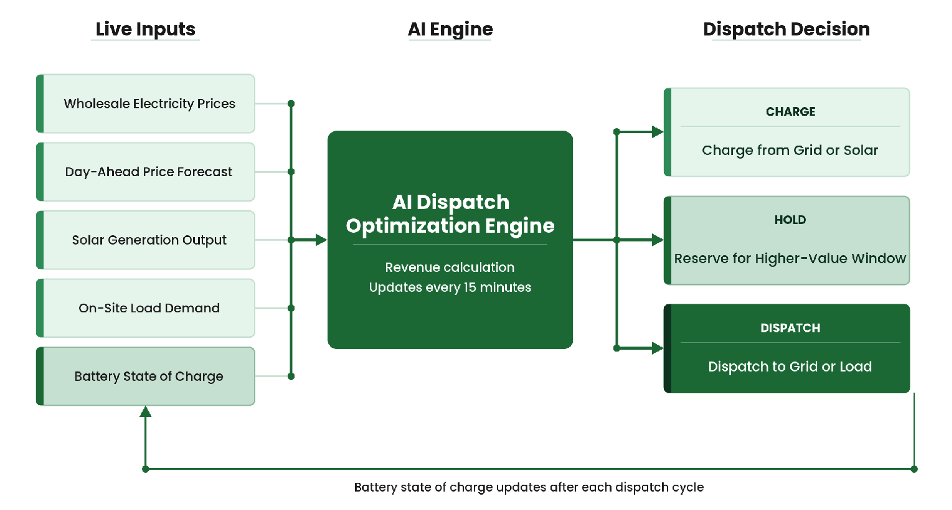
How the AI model processes live site and market data to decide when to charge, hold, or dispatch every 15 minutes.
Real-Time Inputs: Price Signals, Solar Forecasts, and Site Load
The AI model ingests wholesale electricity prices, day-ahead and intraday price forecasts, solar generation output and forecast, on-site load demand, and battery state of charge in real time. It processes these inputs continuously, building a decision window that looks 24 to 72 hours ahead and updates every 15 minutes as market and generation conditions change. No operator action is required to trigger a recalculation.
How the Model Decides When to Charge, Hold and Dispatch
Every dispatch decision is a revenue calculation. The model compares the current and forecast value of stored energy against the cost of charging, degradation per cycle, and the opportunity cost of holding capacity for a higher-value dispatch window later in the day. When the revenue case for discharging is stronger than holding, the model dispatches. When charging from excess solar costs less than the value of the energy it will store, the model charges.
Continuous Learning from Market and Site Patterns
The model learns the price patterns, generation rhythms, and load cycles specific to the site and its market over time. It improves forecast accuracy by accumulating operating history and identifying seasonal patterns in price spreads, peak-demand timing, and grid-service dispatch frequency. A model running for 12 months at a site is materially more accurate than one running for 30 days, and the revenue improvement compounds as accuracy increases.
Why Fixed Dispatch Leaves Revenue Behind
Most BESS systems today run on dispatch rules configured at commissioning: charge during off-peak hours, discharge during evening peak, hold capacity for grid services if enrolled. These rules are set once and rarely updated. They are designed to be operationally simple, not revenue-optimal. The gap between those two objectives widens every year as the market changes and the original business case falls further behind.
Fixed Rules Miss Peak Price Windows
Wholesale electricity prices are not predictable by the time-of-day rule. Price spikes from grid stress, weather events, or sudden generation shortfalls can occur outside any fixed discharge window. A battery set to discharge between 5 pm and 8 pm dispatches into whatever price exists in that window, whether it is $85 or $320 per MWh. The AI model dispatches into the highest-value window the forecast identifies, not the one the original rule specified.
Grid Services Revenue Sits Unclaimed
Frequency regulation, demand response, and capacity market participation generate revenue for BESS operators in most major grid markets. All three require a dispatch system that responds within seconds and continuously manages the state of charge. Fixed dispatch rules cannot coordinate arbitrage and grid services simultaneously. Most operators on fixed schedules are enrolled in one program or none.
Unoptimised Cycling Damages the Asset and Erodes the Business Case
Every charge and discharge cycle costs the battery a measurable portion of its calendar life. A fixed rule that cycles twice daily, regardless of revenue opportunities, accelerates degradation and fails to maximise what each cycle earns. AI dispatch reduces low-value cycles while ensuring each dispatch captures maximum return. Over a 10-year asset life, the degradation difference between optimised and unoptimised cycling is material in both replacement-cost and warranty terms.
The Revenue Streams AI Unlocks from Storage
Fixed dispatch rules typically target a single revenue stream because managing multiple streams simultaneously requires the decision-making speed and complexity that rule-based systems cannot deliver. AI dispatch handles all five simultaneously, allocating battery capacity across revenue streams based on the combination that yields the highest total return in each operating window.
Revenue Stream
Fixed Dispatch
AI-Optimized
Energy Arbitrage
Target has a fixed time window regardless of price
Dispatches into the highest-value window dynamically
Frequency Regulation
Rarely captured — conflicts with fixed schedule
Continuously available, responds to grid signals in real time
Demand Response
Limited participation — timing conflicts with arbitrage
Coordinated with arbitrage to maximise combined revenue
Curtailment Capture
Missed — no signal to charge from excess solar
Charges from curtailed solar automatically
Cycle Management
Unmanaged — fixed schedule regardless of revenue
Optimised — each cycle is revenue-justified before dispatch
Energy Arbitrage: Charging Low, Discharging High
Energy arbitrage is the core BESS revenue mechanism: charge when prices are low, discharge when they are high. A fixed time window cannot predict the spread between those two points. AI dispatch uses day-ahead and intraday market forecasts to identify the widest available price spread each day, charging and discharging at the points that maximise the margin. A fixed rule set for standard peak-to-off-peak timing consistently misses the best windows.
Frequency Regulation and Demand Response
Frequency regulation requires the battery to respond to grid operator signals within seconds. Demand response requires capacity availability at specific times to earn capacity market payments or reduce peak load charges. AI dispatch manages state of charge to maintain availability for both while simultaneously running arbitrage, something fixed dispatch rules cannot coordinate. According to NREL research on battery storage revenue stacking, operators participating in both arbitrage and ancillary services earn 25 to 40 percent more annually than those in arbitrage alone.
Curtailment Capture: Solar That Would Otherwise Be Wasted
Sites where solar generation exceeds grid export limits or on-site demand curtail energy that could be stored and dispatched later. Fixed dispatch rules charge from the grid during off-peak hours and miss curtailment events entirely. AI dispatch detects excess solar in real time and automatically charges for it, converting curtailed generation into stored revenue. On sites with persistent export constraints, curtailment capture alone can justify the platform cost.
Real-World Results: What AI Dispatch Delivers at Scale
Across utility-scale and commercial-and-industrial deployments, AI dispatch optimization consistently outperforms fixed-rule baselines in revenue per MWh stored. Two deployments illustrate what the improvement looks like at an operational scale.
80 MW Utility-Scale Site: Arbitrage Revenue Up 34 Percent in Year One
At an 80 MW solar-plus-storage facility in a high-volatility wholesale market, the site was running a fixed discharge rule targeting the standard evening peak window. The AI model identified that price spikes were concentrated in a narrower two-hour window and that morning demand events during cold weather were generating spreads that the fixed rule did not capture.
Dispatch was restructured around the AI model’s daily forecast. Arbitrage revenue increased by 34 percent in the first year. The site enrolled in a frequency regulation program that the fixed dispatch rule could not support, adding a further 18 percent to annual storage revenue. The platform cost was recovered within 9 months.
At a 12 MW commercial and industrial site with a 5 MW BESS, midday solar generation was regularly exceeding site load and export limits, curtailing an average of 380 MWh per month. The fixed dispatch rule charged from the grid during off-peak hours and missed the curtailment window entirely, meaning stored energy was purchased rather than captured from excess generation.
AI dispatch detected curtailment events in real time and restructured charging to capture excess solar generation. Curtailment dropped by 74 percent in the first quarter. The stored energy was dispatched during peak demand periods, reducing demand charges by 28 percent. Combined revenue improvement covered the platform cost within 6 months.
Where AI BESS Optimization Has the Biggest Impact
Revenue opportunity from AI BESS optimization is highest where price volatility is greatest. Markets with high renewable penetration produce the largest arbitrage spreads as midday solar depresses prices and evening demand events push them sharply higher. Operators in these markets under fixed dispatch rules consistently miss the best windows, and the performance gap widens as renewable penetration increases.
Sites with export constraints and high curtailment carry disproportionate upside from AI dispatch. When midday solar generation cannot be exported or consumed on-site, curtailment capture is pure revenue that fixed dispatch entirely misses. Solar-plus-storage sites where curtailment runs at 5 percent or more of total generation are strong candidates for AI dispatch optimization focused solely on curtailment capture, independent of arbitrage gains.
Commercial and industrial sites with high peak demand charges benefit from demand charge reduction stacked with arbitrage and grid services revenue. A BESS that discharges at the right moment to cut peak demand by 15 to 20 percent while capturing evening price spreads earns from multiple directions on the same operating day. Fixed dispatch rules can target one of these outcomes at a time, not both.
Deploying AI BESS Optimization: What Integration Looks Like
AI BESS optimization integrates with the energy management and solar performance monitoring systems that most operating BESS sites already run. It does not require hardware changes or new sensor installations. Most platforms connect via API to existing monitoring and telemetry infrastructure, continuously pulling battery state of charge, generation output, load data, and market price feeds. The first AI dispatch recommendation is typically available within days of the data connection being established.
Audit your current dispatch performance. Pull 12 months of dispatch data and map battery charge and discharge events against day-ahead and intraday market prices. Identify how many dispatch windows aligned with actual price peaks, how many missed them, and whether curtailment events occurred during scheduled off-peak charging windows.
Confirm your data infrastructure. AI BESS optimization requires real-time battery state of charge, site-level generation output, on-site load data, and access to market price feeds at a 15-minute resolution. Sites with existing energy management systems and market connections typically already have all the required data.
Start with your highest-volatility market. Deploy on the site operating in the most price-volatile market first. The revenue improvement is most visible and fastest to validate where price spreads are widest, and grid service dispatch frequency is highest. This site provides the clearest ROI case for portfolio-wide deployment.
Integrate dispatch output with your operations workflow. Confirm that AI dispatch recommendations connect to your battery management system and trading or scheduling workflow before deployment. A dispatch model that issues recommendations into a dashboard without connecting to the battery control system does not recover revenue.
Operators who run AI BESS optimization through a full calendar year before scaling to additional sites develop a detailed revenue attribution model across each dispatch stream, making the portfolio-wide business case straightforward to present to asset owners and investors. Integrating AI yield forecasting with dispatch also improves charge timing accuracy as the generation forecast sharpens; the two systems compound each other’s value the longer they run together.
Conclusion: Storage Should Earn on Every Cycle
Battery storage is not a passive asset. Every hour it sits charged without dispatching into a high-value window is revenue that does not come back. Fixed dispatch rules treat storage as a scheduling problem. AI optimization treats it as a revenue opportunity and recalculates it every 15 minutes across every market signal available to the site.
The gap between operators running AI-optimised dispatch and those on fixed rules will widen as energy markets become more volatile, grid services participation expands, and curtailment rates increase with higher renewable penetration. The hardware cost of storage is falling. The revenue available to operators who can capture it is rising. The constraint is dispatch intelligence, and AI removes it.
Omdena deploys AI BESS optimization for solar operators and asset managers, delivering real-time dispatch recommendations across energy arbitrage, grid services, and curtailment capture. To find out what your current dispatch strategy is costing your portfolio, get in touch with the Omdena team.
What is the typical revenue improvement from AI BESS optimization?
Revenue improvements typically range from 20 to 45 percent above fixed dispatch baselines, depending on market price volatility, grid service availability, and curtailment exposure. Sites in high-volatility markets with export constraints consistently sit at the upper end of this range.
Can AI dispatch manage grid services and energy arbitrage at the same time?
Yes. AI dispatch manages state of charge to maintain availability for frequency regulation and demand response while running arbitrage in the same operating window. Fixed rules cannot coordinate both simultaneously, which is why most sites on fixed dispatch are enrolled in one program or neither.
Does AI BESS optimization work for smaller commercial and industrial sites?
Yes. C&I sites with demand-charge exposure benefit from AI dispatch through peak shaving, stacked with arbitrage. A 1 to 5 MW BESS on a C&I site can recover platform cost within 6 to 12 months through demand charge reduction and curtailment capture, independent of wholesale market arbitrage gains.
How long does AI dispatch take to start improving revenue?
The first dispatch recommendations are available within days of data connection. Revenue improvement is measurable within the first month. Model accuracy improves over 3 to 6 months as it learns site-specific price patterns, seasonal demand behaviour, and generation rhythms.
What data does AI BESS optimization need to operate?
The core requirements are real-time battery state-of-charge, site generation output, on-site load data, and 15-minute market price feeds. Most operating BESS sites with existing energy management systems already have the required data flowing and do not need additional hardware to get started.
Share this article
Share on LinkedIn, send by email, or copy the direct link.