How AI Detects Hidden Solar Panel Faults Before They Cause Revenue Loss
11 min readUpdated July 1, 2026
Omdena
A 50 MW solar farm in southern Spain had been running at apparently normal output for two seasons. Routine visual inspections found nothing unusual. An AI-powered thermal imaging survey revealed 340 panels operating at hotspot temperatures exceeding 80°C, with an estimated $180,000 in energy losses that conventional monitoring had never flagged.
Stories like this are not rare. Across utility-scale solar farms, commercial rooftops, and distributed energy portfolios, hidden faults are quietly eroding output every day. The panels look fine. The inverter data shows acceptable numbers. But somewhere beneath the surface, degradation is compounding.
AI-based fault detection changes that. By combining drone thermography, computer vision, and machine learning, these systems find what human inspectors and standard monitoring miss, often weeks or months before the fault causes a measurable revenue impact.
The Hidden Cost of Undetected Solar Faults
The solar industry has a performance gap problem. Most operators track total output against forecasts but lack the visibility to know where losses are occurring or why. Research from the National Renewable Energy Laboratory puts undetected faults at 10 to 30 percent of energy losses across operating assets, equivalent to hundreds of thousands of dollars in annual revenue on a 10 MW installation.
The challenge is that most faults develop gradually. Faults such as a hotspot on a single cell, a failing bypass diode, or uneven soiling across a string do not show up as dramatic output drops. They appear as a slow erosion of performance, written off as weather variation. By the time a fault registers on standard monitoring, the revenue loss is already months old.
Traditional inspection methods are not designed to catch these early signals. Visual walkthroughs miss faults that are invisible to the naked eye. Manual thermal surveys are expensive, infrequent, and cover only a fraction of a large site at any one time. The International Energy Agency consistently highlights early fault detection as one of the highest-value and most underinvested areas in solar asset management.
Types of Faults AI Detects
Understanding the specific fault types AI systems are built to find helps explain why traditional inspection methods fall short. Each of these faults has a distinct thermal, electrical, or visual signature that machine learning models are trained to recognise at scale.
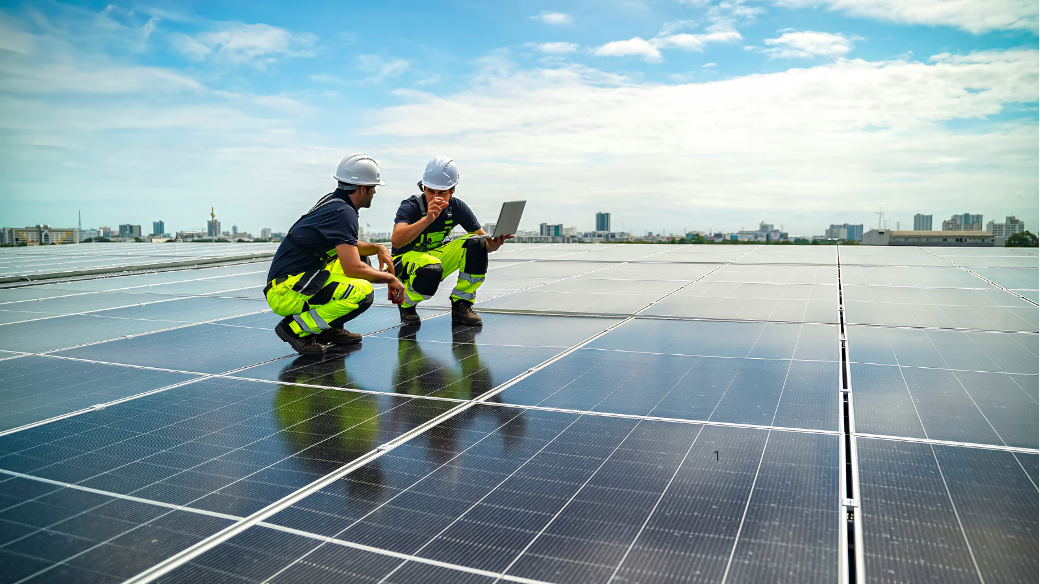
At scale, human inspection cannot detect the thermal, electrical, and structural faults developing silently across hundreds of panels. Image Source: Pixels.
Hotspots are among the most common and costly faults in solar installations. They occur when a cell or group of cells within a panel generates excess heat, often due to shading, contamination, or internal cell defects. Hotspot temperatures can exceed 80°C, causing permanent cell degradation if left untreated. Peer-reviewed research in Solar Energy Materials and Solar Cells estimates that hotspots affect between 3 and 10 percent of panels in typical utility-scale installations.
PID (Potential-Induced Degradation)is a fault caused by high voltage stress between the cell and the panel frame. It leads to gradual and often severe power loss, with some affected panels losing 30 to 50 percent of their rated output over time. PID is difficult to detect visually and progresses silently until it has caused significant damage.
Bypass diode failures occur when the protective diodes inside a panel fail, either short-circuiting or failing open. A failed bypass diode changes how current flows through the module and creates characteristic thermal patterns that AI models can identify precisely. An undetected bypass diode failure can reduce string output by 30 percent or more and is one of the most common causes of unexplained underperformance in ageing panels.
Soiling losses from dust, bird droppings, and the accumulation of organic matter reduce panel output by blocking sunlight. AI systems can map soiling distribution across a site and flag which strings need priority cleaning, turning a reactive maintenance task into an optimised operation that targets the areas with the highest recovery value first.
Micro-cracks and delamination are structural faults caused by mechanical stress, thermal cycling, or manufacturing defects. They are invisible to the naked eye but detectable through electroluminescence imaging and computer vision analysis. What makes them financially significant is their progression: a small crack that causes a 1 percent output loss today can propagate into a 10 to 15 percent loss over two to three seasons if not caught early.
How AI Fault Detection Works
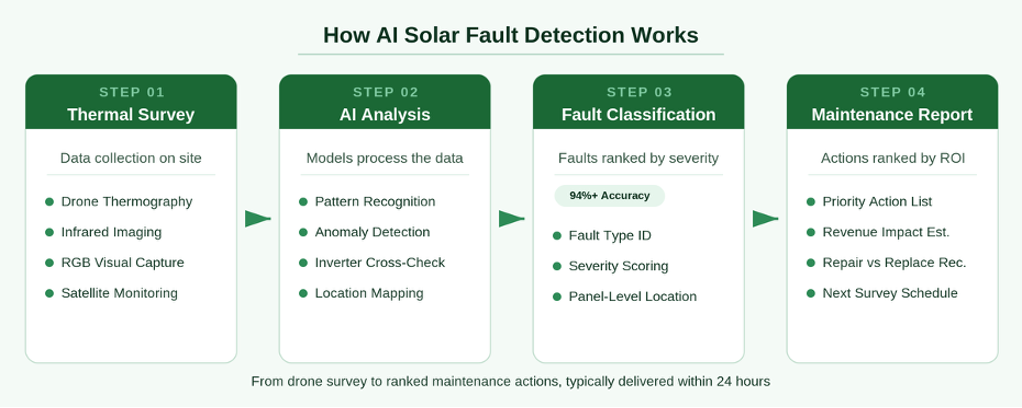
The process starts with a drone survey. Thermal cameras fly the entire site during peak solar hours, capturing infrared images of every panel. Heat anomalies invisible to the naked eye appear clearly in the thermal data. On larger sites, satellite monitoring runs continuously between surveys, flagging new problems before the next inspection.
That data is then run through AI models built for solar inspection, trained on thousands of confirmed fault examples. They identify each anomaly, classify it by fault type and severity, cross-reference it with inverter output data, and map its exact location on the site. The result is fault classification accuracy above 94 percent, according to published research, substantially higher than manual thermal review.
How AI Solar Faults Detection Works
What the operations team receives is not a raw data file. It is a ranked action list: these panels have critical faults, these have moderate issues developing, and these need cleaning before next month. Maintenance resources go exactly where they recover the most generation, not where it is most convenient to send a crew.
Real Results: How Operators Recovered Lost Revenue
Utility-Scale Solar, Europe
An AI-powered solar inspection firm deployed drone thermography and computer vision across a portfolio of utility-scale sites in Central Europe. Across 120 MW of inspected capacity, the system identified hotspot faults, bypass diode failures, and soiling patterns that had been missed by standard monitoring for up to 18 months. After targeted maintenance guided by the AI fault reports, operators recovered an average of 4.2 percent of lost generation per site on a 20 MW asset, translating to roughly $85,000 in recovered annual revenue.
Commercial Rooftop Portfolio, Australia
An AI-powered drone inspection platform with over 100 GW of processed capacity globally deployed fault analysis across 14 commercial rooftop sites in Australia and identified PID degradation affecting approximately 8 percent of panels. The degradation had been developing for over a year without triggering alerts in the existing monitoring system. Remediation guided by the AI analysis restored full-rated output within one maintenance cycle.
Utility-Scale Solar, India
An AI-based solar performance platform, operating across more than 7 GW in India and Southeast Asia, deployed continuous fault monitoring on utility-scale farms in Rajasthan and Gujarat. Using inverter-level data combined with AI anomaly detection, it identified underperforming strings, soiling hotspots, and equipment degradation in near real time, achieving performance ratio improvements of 2 to 4 percent within the first year. The Indian Ministry of New and Renewable Energy has made AI-based monitoring a national priority, citing the potential to recover 8 to 12 percent of generation losses across the country’s grid-connected fleet.
This approach is not limited to ground-mounted and rooftop assets. The same principles apply to floating solar installations, where remote sensing and drone inspection provide even greater operational value given the access challenges of water-based sites.
The Business Case: What the ROI Actually Looks Like
Most operators running a 10 MW solar asset assume their monitoring system would catch a serious problem. The research says otherwise. NREL studies show that between 10 and 30 percent of energy losses in operating solar assets go undetected by standard monitoring. On a 10 MW site, the midpoint of that range is roughly $150,000 in lost revenue per year. It is already happening. The question is whether it is being measured.
What the ROI Actually Looks Like
A survey costs between $3,000 and $8,000, comparable to a standard thermography inspection, but delivers automatic fault classification in hours rather than days. Analysis from Wood Mackenzie estimates AI-guided maintenance reduces O&M costs by 15 to 25 percent. A single survey recovering 4 percent of the lost generation on a 10 MW asset returns $70,000 to $90,000 annually. The survey pays for itself many times over in the first year.
The operators most exposed are running assets two to five years old. This is when manufacturing defects, thermal cycling damage, and early degradation faults begin to appear, consistently below standard monitoring thresholds. Waiting until faults show up on a dashboard means the revenue loss has already been running for months. The asset that looks fine on paper rarely is.
How to Get Started with AI Fault Detection
Starting does not require you to replace your existing monitoring infrastructure. The most effective implementations layer AI detection onto what is already in place.
Baseline your current performance. Pull 12 months of inverter and string-level data for each asset and calculate your actual performance ratio against the design estimate. Assets running more than 3-4 percent below design are the strongest candidates for a first AI inspection.
Time your pilot survey correctly. Commission your first AI-powered drone thermography survey between late spring and early autumn, when irradiance levels are high enough to make thermal anomalies clearly visible. A survey conducted under low irradiance produces lower-quality thermal data and misses faults that would be clear in summer.
Prioritise by revenue impact. Use the fault severity classifications from the AI report to sequence maintenance by expected generation recovery, not by convenience or location. A string with a bypass diode failure on the far side of the site recovers more revenue than a soiling issue near the access road.
Validate the AI model before scaling. Before rolling out AI monitoring across your entire portfolio, manually cross-check a sample of the flagged faults. Knowing where the model performs well and where it needs calibration protects against acting on misclassifications at scale.
Track and report recovery. After each maintenance cycle, measure and document the generation recovery per site. This creates the business case for scaling AI monitoring across your entire portfolio and provides the data to evaluate inspection vendors objectively.
Challenges and Honest Limitations
AI fault detection delivers real results, but there are constraints worth understanding before implementation.
Weather dependency affects data quality. Thermal imaging requires clear skies and appropriate solar irradiance. Surveys conducted in overcast conditions produce less reliable thermal data. Scheduling surveys during optimal weather windows is essential.
AI models require quality training data. Models trained on one panel technology or climate type can underperform in different environments. Local calibration against known fault cases is important before relying on AI classification for high-value decisions.
Integration complexity varies. Connecting AI platforms with legacy inverter management infrastructure can require significant technical work. Sites with fragmented monitoring setups may face higher integration costs.
AI detection supports decisions; it does not replace engineers. Fault classification at 94 percent accuracy still means a small percentage of anomalies are misclassified. Experienced O&M engineers should review AI reports before committing to major maintenance interventions.
These are not reasons to avoid AI fault detection. They are the things worth knowing before you begin.
Conclusion: The Cost of Waiting
Hidden solar faults are one of the most controllable sources of revenue loss in a solar portfolio. The technology to find them accurately and at scale exists today, and the economics are straightforward. What is changing is accessibility. AI-powered inspection is now available to operators of all sizes, not just the largest utilities, and a single survey typically pays for itself within the first maintenance cycle.
The operators who are now building this into their standard O&M workflow are not just recovering lost revenue. They are building an operational advantage that compounds. Each inspection cycle produces better fault data. Better fault data means more precise maintenance. More precise maintenance means higher performance ratios and lower O&M spend per megawatt-hour. Over a five- to ten-year asset life, that difference is significant.
If you are looking to reduce generation losses and build a smarter O&M programme across your solar assets, connect with Omdena. We deliver AI-powered fault detection, performance monitoring, and computer vision inspection tools at about a third of typical enterprise AI development costs, enabled by a proprietary agentic AI platform and a structured delivery process.
FAQ
How often should I run an AI fault detection survey?
Once or twice a year is sufficient for most utility-scale assets. Sites showing performance degradation or running two to five years old benefit from quarterly surveys. Continuous satellite monitoring can fill the gaps between drone inspection cycles.
Can AI fault detection work alongside my existing monitoring system?
Yes. AI inspection platforms are designed to layer on top of existing inverter and SCADA systems, not replace them. Integration complexity varies by site, but newer installations with standard monitoring setups are typically straightforward to connect.
How accurate is AI fault classification compared to manual inspection?
AI-based systems achieve above 94 percent fault classification accuracy, substantially higher than manual thermal review. A qualified O&M engineer should still review flagged faults before committing to major maintenance interventions.
What size of solar asset justifies an AI inspection?
Assets from 1 MW upward can benefit, but the return is clearest on sites of 5 MW and above. On a 10 MW site, recovering 3 to 4 percent of lost generation more than covers the cost of a survey within the first year.
How long does an AI-powered drone survey take?
A 10 MW site can typically be surveyed in a single day. Fault classification reports are usually delivered within 24 to 48 hours, ready for the maintenance team to act on.
Share this article
Share on LinkedIn, send by email, or copy the direct link.