Carbon Farming Explained: How It Works, Benefits, Technology, Profitability, and AI’s Role
16 min readUpdated May 19, 2026
Omdena
Most people think of farmland as a place that grows food. But it holds a less obvious power: it can pull carbon dioxide out of the air and store it deep in the soil. Farming accounts for 10 to 12 percent of global greenhouse gas emissions (US EPA), yet the IPCC, the United Nations panel of climate scientists, estimates this same land could store up to 1.85 billion tonnes of CO₂ per year. Carbon farming is how farmers put that potential to work and get paid for doing it.
This is no longer a niche idea. The global carbon farming market was valued at USD 1.45 billion in 2025 and is projected to reach USD 2.25 billion by 2032, growing steadily year-on-year (Research and Markets, 2025). That growth is driven by real demand: farmers across the US, Europe, Australia, and parts of Africa are already earning income from carbon credits, on top of their regular crops.
What Is Carbon Farming?
Carbon farming is the practice of managing land so it stores more carbon in soil and plants than it releases into the atmosphere. By adopting specific farming methods, land can act as a carbon sink, capturing CO₂ and storing it in the soil long term. This stored carbon can be measured and verified, then converted into carbon credits that companies and governments buy to offset their greenhouse gas emissions.
This process is driven by photosynthesis. Plants absorb CO₂ from the air and convert it into energy for growth, with some of that carbon moving into the soil through roots and decaying plant material. Over time, this carbon becomes part of soil organic matter. Carbon farming focuses on practices that protect and increase the amount of stored carbon, rather than allowing it to break down and return to the atmosphere.
Carbon farming generates value in two main ways. Sequestration involves actively removing CO₂ from the air and storing it in soil or vegetation, while avoidance focuses on preventing emissions that would otherwise occur, such as preserving wetlands instead of draining them. In both cases, one carbon credit represents one verified tonne of CO₂, issued only after independent measurement and verification.
How Carbon Farming Works
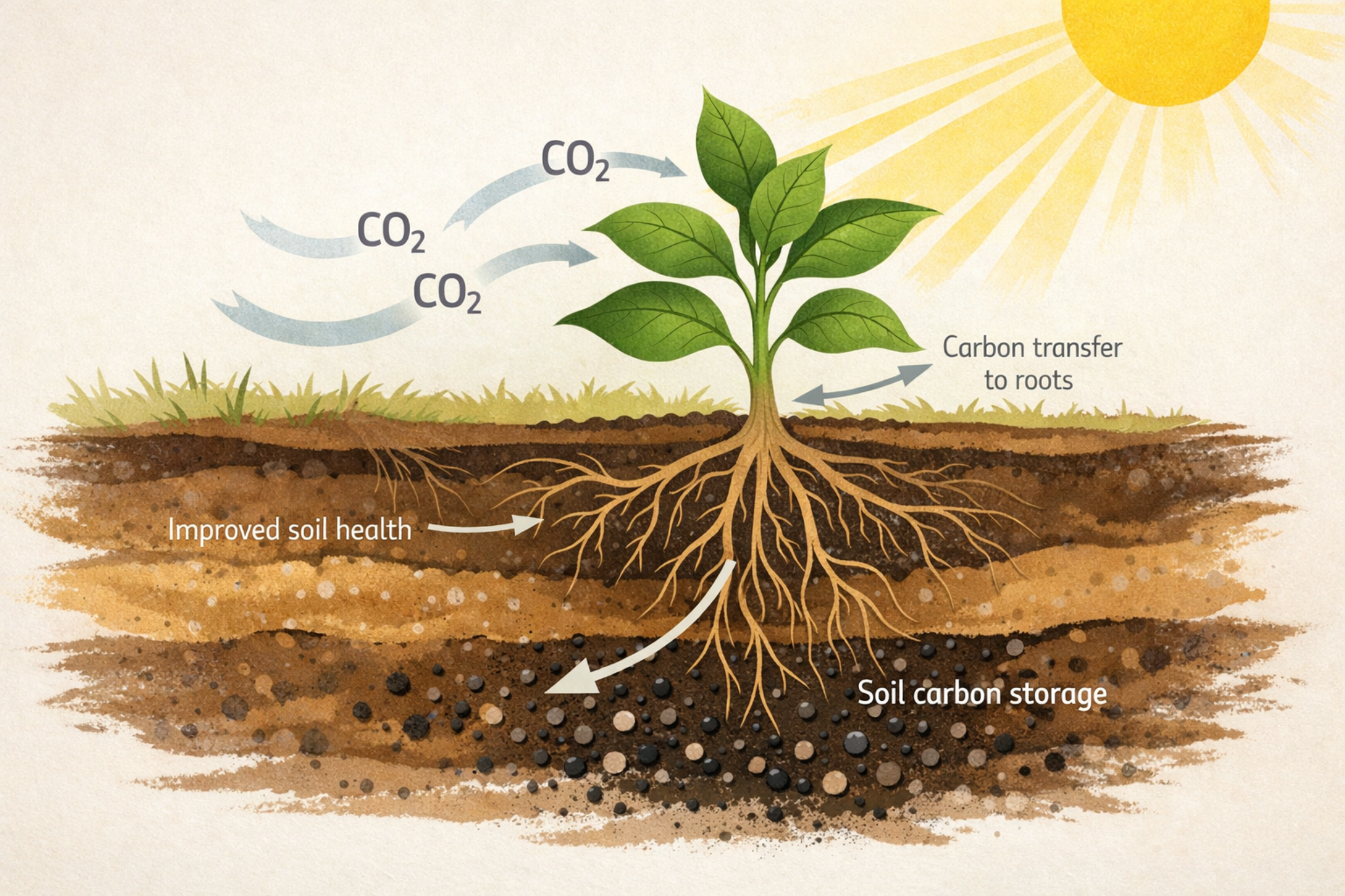
Carbon farming captures CO₂ and stores it in soil through natural plant and root processes. Image Source: Ai Generated.
Carbon farming works by helping plants capture carbon dioxide (CO₂) from the air and store it in the soil. Through photosynthesis, plants convert CO₂ into carbon-rich compounds, some of which move into the soil through their roots. Over time, this carbon becomes part of soil organic matter, improving soil structure, water retention, and fertility.
To support this process, farmers adopt practices such as reduced tillage and cover cropping, which keep the soil undisturbed and allow carbon to build up rather than be released back into the atmosphere. As carbon accumulates, the soil becomes more productive while also storing increasing amounts of CO₂ underground.
Carbon programmes measure this change by comparing current soil carbon levels against an initial baseline and verifying the increase over time. Once verified, the additional carbon stored is converted into carbon credits, with each credit representing one tonne of CO₂. Farmers can then sell these credits on carbon markets, creating a reliable additional income stream alongside their regular farming operations.
Core Carbon Farming Practices
The right practice for your farm depends on your soil type, local climate, and how much change you are ready to take on. The table below presents the six main options, their carbon storage potential, typical cost, and difficulty level, sourced from the FAO Soil Carbon Portal.
If you are just getting started, no-till farming and cover cropping are the most practical first steps. They are low-cost, easy to adopt, and fit most existing operations, delivering steady carbon gains. Agroforestry and silvopasture store more carbon but require more planning, whereas wetland and peatland restoration deliver the highest potential and apply only to specific lowland or wetland areas.
How Carbon Is Measured and Verified
Before any credits are issued, your farm’s existing carbon level is measured and recorded as a baseline. This starting point is what all future carbon gains are compared against.
Each year, field records, satellite data, and modelling tools estimate the amount of additional carbon stored. These results must be verified by an independent auditor before credits are issued. If a programme validates its own results without external review, treat that as a red flag.
Benefits of Carbon Farming
The Intergovernmental Panel on Climate Change identifies soil carbon storage as one of the most cost-effective ways to cut emissions. Its Sixth Assessment Report estimates that carbon farming could deliver 5 to 14 percent of the reductions needed to keep warming below 1.5°C. This makes farmland a meaningful part of the climate solution.
For farmers, the benefits go beyond additional income. Carbon-rich soil holds water longer, reduces fertiliser use, and delivers more stable yields. These improvements lower input costs and increase resilience, with practices like no till farming saving around USD 25 per acre annually in fuel and labour.
Carbon credits add a new revenue stream without replacing existing operations. The strongest results come from combining multiple benefits: credit payments, conservation incentives, lower input costs, and price premiums for sustainably produced crops. Together, these gains significantly improve overall farm profitability.
Technology Powering Carbon Farming
For years, the biggest barrier to scaling carbon farming was the cost and complexity of measuring soil carbon. Today, advances in satellites, ground sensors, digital verification, and blockchain make large-scale measurement and verification practical. Together, these technologies enable reliable, scalable carbon monitoring and credit generation.
Satellites
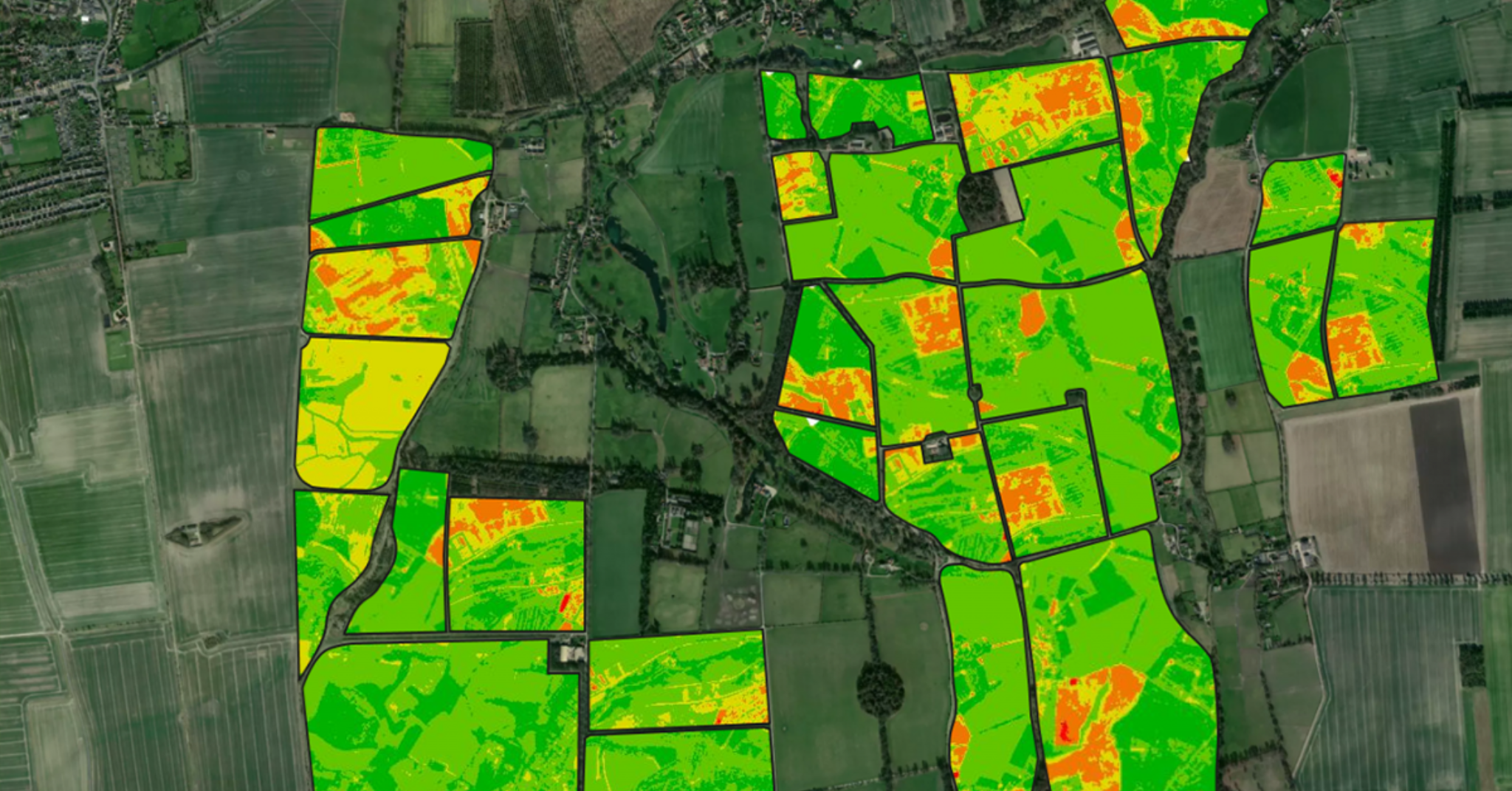
Satellites from providers like Planet Labs, the European Space Agency’s Sentinel-2, and NASA’s Landsat programme capture frequent images of farmland across the globe. By tracking changes in vegetation, soil conditions, and land use over time, they provide a cost-effective way to monitor carbon-related patterns at scale. AI-powered drones complement this with closer field-level imagery between passes.
Satellite-based monitoring uses spectral data to track vegetation, soil conditions, and carbon-related changes across mapped farm plots. Image Source: Omdena.
While satellites do not measure soil carbon directly, they can detect trends that indicate whether soil carbon is rising or declining between physical tests.
Ground Sensors
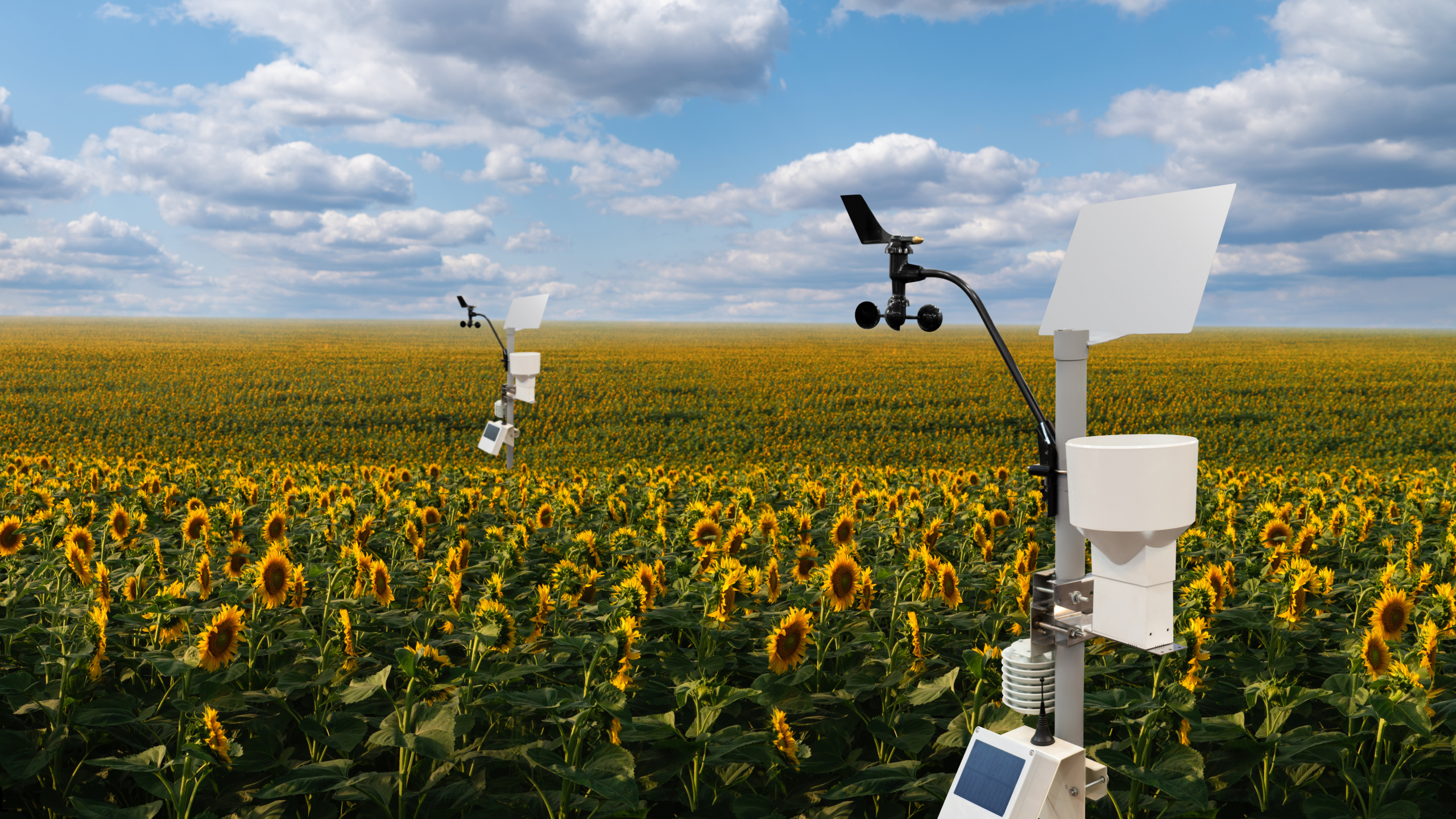
Ground-based sensors add precision by measuring what satellites cannot capture directly. Placed in the soil, these devices track moisture, temperature, and microbial activity in near real time, which are key factors that influence how carbon is stored.
Smart field sensors continuously monitor soil and environmental conditions, enabling real-time carbon tracking and data-driven farming decisions. Image Source: Canva
Some advanced systems can also estimate changes in soil carbon, reducing reliance on infrequent manual sampling and providing continuous, high-resolution data to support accurate carbon measurement.
Digital Verification (MRV)
MRV (Measurement, Reporting, and Verification) systems convert raw field data into verified carbon measurements. Farmers submit field data via digital platforms, which automatically integrate satellite imagery, sensor readings, and models to estimate carbon storage. This significantly reduces verification time while ensuring results are consistent, auditable, and ready for certification.
Blockchain
Blockchain ensures that each carbon credit is unique and traceable, and that it cannot be sold more than once. Every verified credit is recorded as a tamper-proof entry on a shared digital ledger, linking it back to the specific farm and practices that generated it. This transparency prevents double-counting and strengthens trust in carbon markets.
Leading Platforms in 2026
Platform
What It Does
Best For
Indigo Ag
Manages the full carbon programme from enrolment to payment
Large US row crop farms
Regrow
Uses machine learning to speed up carbon verification
Programme developers and aggregators
EarthOptics
Maps soil carbon at the field level using AI and sensors
High-precision carbon measurement
Pachama
Monitors forest carbon using satellite data
Agroforestry and reforestation projects
Soil Carbon Initiative
Groups smaller farms into one verified project
Smallholder farming communities
The Role of Artificial Intelligence in Carbon Farming
Satellites and sensors generate massive amounts of field data, and AI in agriculture turns this into accurate carbon estimates. Without it, processing this data would be too slow and costly to be practical. A 2025 study in Advanced Science found that machine learning models can predict soil carbon more accurately than traditional methods. These systems are already being used commercially.
What AI Does in Carbon Farming
Carbon mapping across entire regions. Machine learning models combine satellite images, weather records, and soil survey data to produce detailed carbon maps covering whole regions. This gives a far more complete picture than physical soil tests alone, at a fraction of the cost.
Estimating your farm’s potential before you sign up. AI tools can predict how much carbon a specific practice on your land is likely to store, based on your soil type and results from nearby farms. This helps farmers understand what they can realistically earn before committing to a programme, so there are no surprises.
Faster and cheaper verification. AI systems automatically cross-check satellite images, sensor readings, and field records to produce a verified carbon report with far less manual work involved. Regrow has reported significant cost reductions in project verification using this approach, making smaller projects more financially viable.
Watching for carbon loss. AI continuously monitors enrolled farms for warning signs like drought stress, sudden vegetation loss, or fire risk. Catching these early means action can be taken before large amounts of stored carbon are permanently lost, protecting both the farmer and the buyer of those credits.
Case Study: Smallholder Farmers in Kenya
A group of 340 smallholder farmers in Kenya, each managing about 2 hectares, adopted agroforestry and composting practices to improve soil health. Their carbon was tracked entirely using Boomitra’s satellite and AI system, eliminating the need for on-site measurements.
By Year 2, the group earned 1,240 verified credits, generating USD 22,320 at USD 18 per credit and increasing farmer income by 15 to 20 percent. They also reported maize yields rising by around 30 percent. Without AI, verifying results like these at scale would not be possible.
Current Limitations of AI
AI reduces the need for frequent soil testing and lowers costs, but it does not eliminate physical measurements entirely. Models are only as accurate as the data they are trained on, so in regions with limited soil data, such as parts of sub-Saharan Africa and South Asia, predictions can be less reliable.
Ground-level validation by agronomists remains essential to ensure accuracy, meaning AI works best as a support system rather than a replacement. Its performance improves in controlled environments such as vertical farming, where consistent, high-quality data makes predictions more reliable.
Carbon Farming Profitability and Market Economics
Earnings from carbon farming depend on land quality, chosen practices, and the programme you join. Most farms store between 0.2 and 1.5 tonnes of carbon per acre each year. With credit prices ranging from USD 10 to USD 50 per tonne, that translates to roughly USD 2 to USD 75 per acre annually from carbon credits alone.
Well-run programmes can significantly increase returns. Indigo Ag reports some farmers earning around USD 47 per acre per year. For example, a 1,200-acre grain farm in Illinois earned about USD 86,400 in additional income by Year 3 after adopting no-till and cover cropping, combining credit payments with input savings. Most farms see stronger returns from Year 3 onwards as soil improvements begin to compound.
Where the Income Comes From
Income Source
Estimated Annual Value
Notes
Carbon credits
USD 3 to USD 47+ per acre
Varies by practice, soil type, and registry
USDA conservation payments
USD 20 to USD 100+ per acre
Available via EQIP, CSP, and RCPP programmes
No-till cost savings
Approximately USD 25 per acre
Less fuel, fewer passes, lower labour costs
Sustainable produce premiums
5 to 20 percent price premium
Where buyers require verified supply chains
Which Carbon Registry Should You Use?
The registry you choose determines how your credits are verified, what standards they meet, and what price they can fetch in the market. Think of it like a quality certification: a more rigorous registry tends to command higher prices but also has stricter requirements.
Registry
Credit Price Range
Verification Standard
Easy to Access?
Best For
Verra (VCS)
USD 10 to USD 50
High
Medium
Broad project types
Gold Standard
USD 15 to USD 80
Very High
Harder to access
Premium quality credits
American Carbon Registry
USD 12 to USD 45
High
Easy
US-based farmers
Regen Network
USD 20 to USD 60
Medium to High
Easy
Regenerative farming
Gold Standard pays the most but has the strictest requirements to qualify. For most farmers just getting started, the American Carbon Registry and Regen Network are the most accessible options and a practical place to begin.
Risks You Should Know About
Most programmes involve long-term contracts, typically 5 to 20 years, with penalties for early exit. They also hold back 10 to 20 percent of earned credits in a reserve fund to cover potential carbon loss from events such as drought, fire, or changes in practices. Credit prices can fluctuate between earnings and payouts, so that actual payouts may differ from initial estimates.
Before signing, clarify exit terms, total fees, and who pays for soil testing and verification. Avoid programmes that charge more than 30 percent in total fees or do not use an independent auditor.
Challenges and Limitations
Will the Carbon Stay in the Ground?
Soil carbon is not permanent. Drought, wildfire, or changes in land management can release in months what took years to store. A 2022 study in the Journal of Environmental Management showed that permanence cannot be guaranteed in a changing climate. Reserve funds help manage this risk,k but cannot eliminate it.
How Accurate Is the Measurement?
Soil carbon varies across a single field, and current methods have an error margin of roughly 15 to 30 percent. AI is improving measurement accuracy, but physical soil tests are still needed to confirm results, as no programme can claim complete precision.
Greenwashing and Weak Standards
Early carbon markets faced widespread greenwashing, with credits issued without proper verification. Standards are improving: the EU’s Carbon Removal Certification Framework (2024) sets legal quality benchmarks. However, a 2025 study in the International Journal of Sustainable Development and World Ecology still found inconsistencies across programmes. Farmers should carefully evaluate any programme before committing to it.
Small Farms Face More Barriers
Most programmes require 50 or more acres, as verification costs are too high for smaller farms individually. Cooperative models, where farms group under a single project, offer a practical solution, though they are not yet widely available
How to Get Started with Carbon Farming
You do not need to overhaul your entire operation to begin. Most farmers start with one or two practices and expand over time based on what works on their land.
Step 1: Find Out How Much Carbon Your Land Can Store
Start by using tools like the USDA’s COMET-Farm (free online) to estimate your current soil carbon and potential gains under different practices. Farms with lower starting carbon levels often earn more, as there is greater room for improvement.
Step 2: Choose Practices That Fit Your Farm
Choose practices that fit your existing system. Crop row farmers often start with no-till and cover crops, while livestock farmers use rotational grazing. Small, consistent changes build meaningful results over time.
Step 3: Evaluate Programme Partners Carefully
Choose your programme with care. Confirm the registry used, whether an independent third party handles verification, contract length, and exit terms, who pays for soil testing, and how much is held in reserve. If a programme cannot answer clearly or verify its own results, walk away.
Step 4: Get Your Baseline Measured and Enrolled
Once you select a programme, soil samples are taken to establish your baseline, the reference point for future progress. This typically costs USD 5 to USD 20 per acre and takes one to three months, though some programmes cover the cost. Always confirm who is paying before any work begins.
What to Expect Over Time
Period
What Happens
Year 1
Soil baseline is measured, you adopt new practices, and you officially enrol. No credits are issued yet.
Year 3
First credits are issued after verification. You receive your first payment. Soil health improvements start showing up.
Year 5+
The programme reaches full speed. Credit income becomes stable. Input costs drop as your soil gets healthier.
Carbon farming works best when three conditions align: your farm is 50 acres or more, your soil has low carbon levels and room to improve, and you can commit for at least five years. If your farm is on a short-term lease, already has high soil carbon, or is smaller than 50 acres and lacks access to a group programme, the economics may not yet work. In those cases, revisit in a year or two as group options expand and carbon markets mature.
Conclusion
Carbon farming is real, effective, and growing rapidly. It is not a get-rich-quick scheme, but for farmers who approach it seriously, it offers additional income, healthier soil, and a meaningful contribution to climate solutions. The market was valued at USD 1.45 billion in 2025 and continues to grow steadily, supported by improving standards and wider adoption of AI tools.
If you are considering getting started, start by using the COMET-Farm tool to understand your baseline potential. Then compare at least three programme partners and review contracts carefully before committing. Your soil has always stored carbon; what has changed is the ability to measure it accurately, verify it independently, and earn revenue from it.
At Omdena, we work with teams building AI solutions for agriculture, sustainability, and climate. If you are developing carbon monitoring tools, MRV systems, or climate-smart farming technology, explore how Omdena can help.
FAQ
How accurate is AI at measuring soil carbon?
A 2025 study in Advanced Science (Wiley) found that machine learning models now predict soil carbon more accurately than traditional methods, especially when paired with satellite data. That said, physical soil tests are still required to confirm results. AI makes testing cheaper and less frequent, but it does not replace it entirely.
What is the minimum farm size to join a carbon programme?
Most programmes require at least 50 to 100 acres. If your farm is smaller than this, look for cooperative or group programmes in which several small farms join together under one project and split the verification costs.
How long does it take to get your first payment?
You will not receive any payment until your baseline is measured and your first year of new practices has been verified. In most programmes, your first payment arrives 12 to 24 months after you enrol. It is important to plan your cash flow around this gap before you sign up.
Do you have to change your entire farming operation?
No. Most programmes only require you to add one or two new practices, such as cover crops or switching to no-till. You keep growing the same crops as before. The changes add to what you are already doing rather than replacing it.
What happens if a drought or fire releases stored carbon?
Registries hold back 10 to 20 percent of your earned credits in a reserve fund for exactly this reason. If a natural disaster or extreme weather event releases stored carbon, the reserve fund covers the loss. You are not required to pay anything back out of your own pocket.
Are AI-based measurement methods officially accepted?
Yes. Perennial's ATLAS-SOC model is approved by Verra, the world's largest carbon registry. Boomitra's satellite and AI system is also Verra-registered. Both still require physical soil sampling to validate results, but the leading standard-setting bodies officially recognise the AI methods themselves.
What is the difference between a carbon credit and a carbon offset?
A carbon credit is the unit itself: one independently verified tonne of CO₂ that has been removed from the atmosphere or avoided. A carbon offset is what a company or government does with that credit, using it to balance out their own emissions. They are the same thing, just described from two different perspectives.
Share this article
Share on LinkedIn, send by email, or copy the direct link.