Carbon Credit Verification Explained: Best AI and Satellite Tools Farmers Use in 2026
8 min readUpdated May 18, 2026
Omdena
In 2023, a Guardian investigation revealed that more than 90% of rainforest carbon offsets approved by Verra were essentially worthless. The claimed reductions had not happened. The problem was not dishonest farmers. It was a verification system that could not keep pace with what it was asked to measure.
In 2026, the field is maturing. ICVCM’s Core Carbon Principles are reshaping approval standards, the first cropland programmes have achieved Verra verification at scale, and new satellite sensors are approaching direct soil carbon measurement from orbit.
How Carbon Credit Verification Works
Every carbon credit represents one tonne of CO₂ equivalent removed from the atmosphere. Verification proves that the claim is real. Carbon is stored through practices such as reduced tillage or carbon farming, measured using field data and remote sensing, independently audited, and issued as credits.
Picture a wheat farmer in Kansas who has stopped ploughing the soil between harvests and planted cover crops to keep the ground covered year-round. A verification platform documents those changes, monitors soil carbon using satellite and field data, and submits results to an auditor. Once approved, the farmer receives tradeable carbon credits.
The two largest voluntary registries, Verra and Gold Standard, together account for the majority of credits issued globally, according to Ecosystem Marketplace’s State of the Voluntary Carbon Markets 2023. The VCMI has consistently identified weak verification as the single biggest barrier to buyer confidence.
Why Carbon Credit Verification is Challenging
The core problem is that carbon in soil is not readily measurable. Research published in Global Change Biology found that soil organic carbon can vary by as much as 50% within a single hectare. What you measure in one corner of a field can look completely different just 200 metres away.
Carbon stocks also shift with every season, tillage pass, and rainfall event, so a one-time measurement quickly becomes unreliable. Estimating carbon at deeper soil horizons adds further cost and requires specialist equipment that most farms simply do not have.
The cost is the other barrier. A World Bank report on agricultural carbon markets estimated that conventional MRV costs between $15 and $30 per tonne of CO₂, often exceeding the market value of the credits themselves. At those prices, most small and mid-sized farms are locked out before they even start.
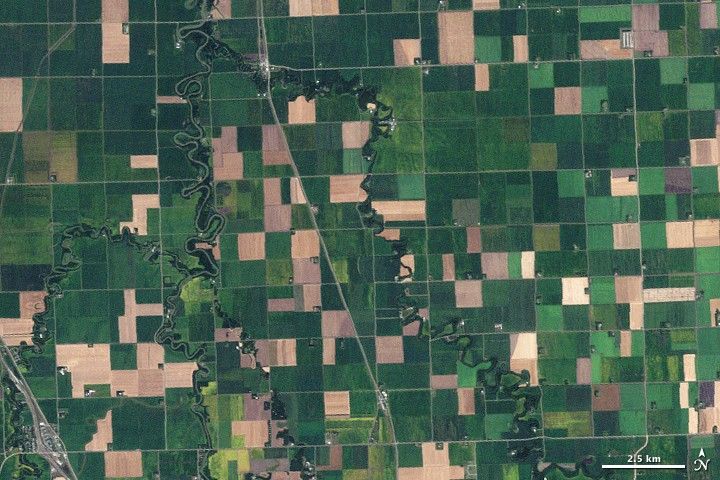
NASA Landsat image of Minnesota farmland. Green and tan field variations are the same signals AI models analyse to estimate soil carbon at scale. Image credit: USGS/NASA Landsat
How AI and Satellite Data Improve Verification
Satellites detect changes in vegetation, soil moisture, and surface reflectance. Machine learning models translate those signals into carbon estimates across millions of hectares without a single soil sample.
A 2023 study in Nature Food found that AI-driven models reduced measurement error by up to 40% compared with traditional methods. A 2022 review in Remote Sensing of Environment confirmed that the combination substantially improved carbon stock mapping at the farm and landscape scale.
In practice, these approaches now cover tens of millions of acres across North America and Australia, generating verified estimates without requiring soil sampling on every field. A handful of companies are translating this into programmes farmers can enrol in. Here is how the leading ones compare.
Best AI and Satellite Tools for Carbon Credit Verification
The five platforms below each take a different approach to verification. Understanding those differences before you sign up can save you from being locked into the wrong programme for years.
Tool
Primary Use
Geography
Best Suited For
Regrow Ag
Biogeochemical MRV + satellite data
Global (data infrastructure)
Food companies & programme administrators
Indigo Ag
Marketplace + end-to-end verification
USA (grain belt focus)
US grain farmers want one point of contact
Agreena
Cropland carbon credits, Verra-verified
Europe + international
Cropland farmers seeking a proven buyer network
Boomitra
Grassland & smallholder satellite verification
Developing regions
Smallholder & grassland farmers globally
Planet Labs
Daily satellite imaging (permanent layer)
Global
Carbon programmes monitoring long-term integrity
1. Regrow Ag
Regrow Ag combines satellite data, practice records, and biogeochemical modelling to estimate field-level changes in carbon. The platform publishes peer-reviewed validations and is used by food companies in Bayer’s Carbon Initiative. It provides infrastructure, not a direct enrolment programme.
Best for: Food companies and programme administrators that need scientifically rigorous, auditable MRV.
2. Indigo Ag
Indigo Ag handles both marketplace and verification in one place. You report practice changes; Indigo produces Verra-aligned credits and pays per tonne. It has worked with thousands of US grain farmers but operates primarily in the US and is less suited to livestock operations or farms outside North America.
3. Agreena
Best for: US grain farmers seeking a single point of contact from enrolment through payment.
Agreena became the first large-scale cropland programme to achieve Verra verification, issuing 2.3 million credits across 1.6 million hectares as of 2025. It combines remote sensing, soil sampling, and machine learning, and doubled its corporate buyer base in 2025, adding Ryanair and Louis Dreyfus as buyers.
Best for: European and international cropland farmers seeking a Verra-verified programme with a proven buyer network.
4. Boomitra
Boomitra uses satellite imagery and AI to verify soil carbon on grasslands and smallholder farms in regions that most platforms ignore. It is designed for farmers with smaller holdings and limited data infrastructure, making it one of the few options genuinely accessible to a global audience.
Best for: Smallholder and grassland farmers in developing regions underserved by other verification platforms.
5. Planet Labs
Most satellites revisit a location every few weeks. Planet Labs does it daily. You would not enrol in Planet directly, but it underpins the permanence monitoring of many programmes on this list. Knowing it exists helps you ask better questions about how your chosen programme monitors carbon permanence over time.
Best for: Carbon programmes and administrators that need continuous permanence monitoring at the landscape scale.
Limitations of Current Verification Systems
Understand what the technology cannot yet do. A2023 study in Science found nearly 90% of credits in one major forest programme were not backed by genuine reductions. The issue was not satellite data. There were flawed assumptions in the methodology. Better sensors alone cannot fix that.
Accuracy varies by geography. Most models perform well in temperate grain-growing regions where training data is plentiful. Performance drops in tropical smallholder or arid rangeland contexts where field samples are scarce.
Satellite signals only reach so far. Estimating carbon at deeper soil horizons still relies on modelled relationships rather than direct measurement. Below 30 cm, confidence intervals widen considerably.
No universal standard yet. Verra, Gold Standard, and the American Carbon Registry each have their own approved methodologies. Credits accepted by one may not qualify under another, limiting liquidity and creating confusion among buyers.
The rules are still being written. TheICVCM’s Core Carbon Principles, published in 2023, are the most serious attempt yet at a common quality benchmark, but full market convergence is still some years away.
What to Look for Before Choosing a Verification Platform
Start with the methodology documentation, not the marketing material. A 2022 CarbonPlan analysis found that programmes with transparent, peer-reviewed methodologies consistently delivered better long-term credit prices than those using proprietary black-box models.
Then check the economics. Some platforms retain 20 to 40 percent of your credits as a fee. Others charge upfront. Model both options against realistic carbon prices before signing. And confirm registry compatibility early. Credits your buyer will not accept are worthless, regardless of the science behind them.
Finally, think about fit. A platform built for US grain farmers may not serve a mixed livestock operation in Australia. The right tool is one that matches your farm type, your geography, and the registry your programme targets. Getting this right at the start saves years of frustration later.
The Future of Carbon Credit Verification
The next step in change will come from hyperspectral satellites that measure soil carbon directly from orbit. Both NASA and ESA have research programmes developing this. If they succeed, the reliance on proxy variables that introduce so much current uncertainty could be dramatically reduced within the decade.
The ICVCM’s Core Carbon Principles are pushing buyers toward higher-integrity credits. Smart contract systems like Regen Network are being piloted to automate credit issuance once verified thresholds are met, cutting the lag between practice change and payment from months to days.
Carbon markets only work if the credits they trade are trustworthy. The tools are improving, the standards are converging, and costs are coming down. For any farmer considering a carbon programme, verification is not a technical detail. It is the most important question you can ask.
If you’re exploring how AI can improve carbon verification and scale MRV across landscapes, connect with Omdena. We’ve built satellite-based monitoring and soil carbon measurement solutions for real-world deployment.
FAQ
What is carbon credit verification, and how does it work?
Carbon credit verification confirms that carbon removed from the atmosphere is real and measurable. Practices like no-till farming or cover cropping are monitored using field data and remote sensing, independently audited, and issued as tradable credits representing 1 tonne of CO₂ equivalent each.
How does AI improve carbon credit verification?
AI-driven models analyse satellite signals, including soil moisture, vegetation, and surface reflectance, to estimate carbon stocks across millions of hectares without requiring physical soil sampling on every field. Studies show this can reduce measurement error by up to 40% compared to traditional methods.
What does MRV mean in carbon markets?
MRV stands for Measurement, Reporting, and Verification. It covers the process of quantifying carbon changes, documenting them, and having them independently confirmed before credits are issued. Conventional MRV can cost $15 to $30 per tonne, often exceeding the value of the credits themselves.
Which is the best carbon credit verification platform for farmers?
It depends on your farm type and geography. Regrow Ag suits large food companies needing an auditable MRV infrastructure. Indigo Ag works well for US grain farmers. Agreena is strong for European cropland. Boomitra specialises in smallholder and grassland farms in developing regions.
How accurate is satellite-based soil carbon measurement?
Accuracy varies. Models perform well in temperate grain-growing regions with ample training data, but confidence drops in tropical or arid rangeland contexts. Satellite signals also struggle at soil depths below 30 cm, where modelled estimates widen considerably.
What should farmers look for before choosing a verification programme?
Start with the methodology documentation. Peer-reviewed programmes consistently outperform black-box models in predicting long-term credit prices. Then check the fee structure, as some platforms retain between 20 and 40 percent of credits, confirm your credits will be accepted by your target registry, and verify the platform fits your farm type and geography.
Share this article
Share on LinkedIn, send by email, or copy the direct link.