How to Start Carbon Farming: Step-by-Step Guide, Practices, Requirements, and AI Tools
11 min readUpdated May 18, 2026
Omdena
Farmers are getting paid to improve their soil. Not through a subsidy or a grant, but by storing carbon underground and selling proof of it as carbon credits.
It sounds straightforward. In practice, it is a long-term commitment with a steep learning curve, real upfront costs, and income that does not arrive for years. Most articles gloss over this. This one will not.
This guide walks you through everything: who qualifies, how the process actually works, which programs are worth joining, and which AI tools are changing how carbon gets measured and verified in 2026. By the end, you will know exactly whether carbon farming is right for your operation and, if it is, how to get started.
Can You Start Carbon Farming? (Eligibility and Reality Check)
Not every farm qualifies, and not every farmer should pursue this. Most programs evaluate your soil type, climate zone, land use history, and farm size. Minimum acreage requirements typically range from 50 to 500 acres, depending on the program. One thing that surprises most people: degraded or low-carbon soils often have more earning potential, because there is more measurable improvement to demonstrate over time. According to the USDA Natural Resources Conservation Service, soils with lower organic matter have a significantly greater capacity for carbon sequestration.
The commitment is longer than most people expect. Contracts run 5 to 10 years, income is typically delayed by 1 to 3 years, and the process involves agronomists, program administrators, and third-party verifiers. Programs also vary significantly by country, so if you are outside the US, the EU, Australia, or the UK, each operates under different frameworks worth researching separately.
If your land qualifies and the timeline works for your operation, here is how the process unfolds.
Step-by-Step Process to Start Carbon Farming
Carbon farming does not happen overnight. It follows a structured sequence, and understanding the timeline up front saves a lot of frustration later.
The early steps are about planning and paperwork: assessing your soil with an agronomist and matching your land to the right practices and program. Enrollment takes longer than expected, so read every line of the contract before signing. The next section covers exactly what to look for.
Your carbon baseline is the most underestimated step. It is the reference point against which all future soil carbon storage is measured. Get it wrong, and your credit earnings will suffer for the entire life of the contract. Carbon credit verification, done by a third-party auditor, is equally non-negotiable. Credits are issued only after an external party confirms that the carbon is actually there.
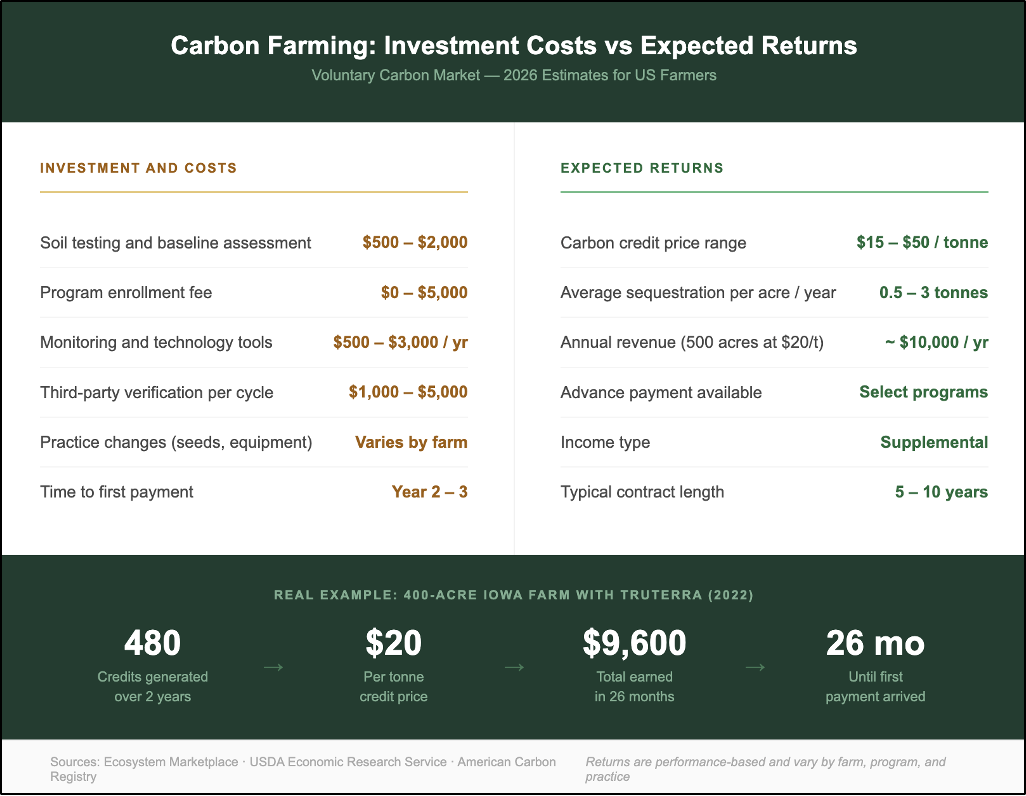
To make this concrete: a 400-acre corn and soybean farm in Iowa enrolled with Truterra in 2022, switched to no-till and cover cropping, and earned roughly $9,600 from 480 credits at $20 per tonne. Their first payment arrived 26 months after enrollment. That is what a realistic outcome looks like for a mid-sized operation.
Carbon Credit Programs and Registries: Which One to Join
Almost all farmers sell on the voluntary carbon market, where companies buy credits to offset their emissions. Credit prices here currently range from $15 to $50 per tonne, according to the Ecosystem Marketplace’s State of the Voluntary Carbon Markets report. The compliance market (like California’s cap-and-trade) is legally mandated and largely inaccessible to individual farmers, so the voluntary market is where your focus should be.
Before you sign anything, get clear answers on four things: who actually owns the credits, you or the program; whether permanence liability puts you on the hook if stored carbon is lost to drought or fire; whether exclusivity clauses block you from switching programs later; and who pays for third-party verification. These terms vary significantly between programs and compound in impact over a 10-year contract. The American Carbon Registry’s Soil Carbon Quantification Methodology is a reliable reference for understanding credible program standards.
Key Carbon Farming Practices to Implement
The practices you implement directly determine how much carbon you store and how many credits you earn. Choosing the right ones for your land type matters more than trying to do everything at once.
Practice
Carbon Potential
Complexity
Notes
Cover cropping
Medium
Low
Most widely accepted across programs
No-till / reduced tillage
Medium–High
Medium
Most widely accepted across programs
Crop rotation
Low–Medium
Low
Strengthens other practices
Agroforestry
High
High
Long setup time
Managed / rotational grazing
Medium–High
Medium
Gaining traction in 2026 programs
Biochar application
High (long-term)
High
Eligible in select programs only
For most operations, no-till combined with cover cropping is the smartest starting point. It is accepted across nearly all major programs, requires no significant equipment changes, and produces measurable results within one to two growing seasons. According to Project Drawdown, regenerative annual cropping practices, including no-till and cover cropping, are among the most scalable land-based carbon solutions available today. Combining no-till, cover cropping, and crop rotation consistently outperforms single-practice approaches. The USDA NRCS has detailed guidance on practice effectiveness by soil type if you want to go deeper.
AI and Technology Tools for Carbon Farming (2026)
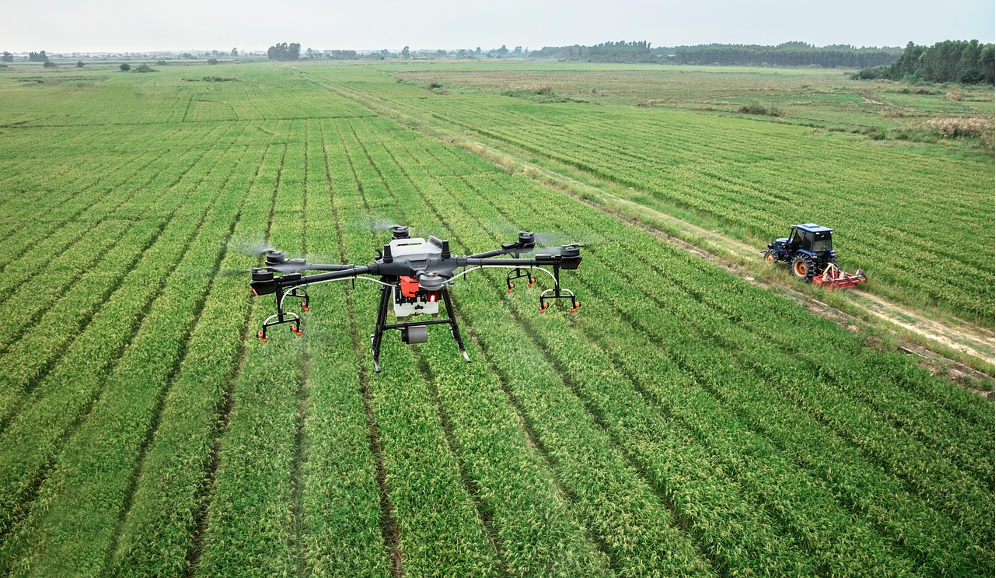
Manual carbon tracking is expensive, slow, and prone to gaps. A farmer relying on spreadsheets and occasional soil sampling will spend more on verification and substantiate fewer credits than one using modern tools. In a program where every verified tonne counts, that gap adds up fast. Tools like AI-powered drones and remote sensing are changing what farms can measure and prove.
AI-powered drones and precision farming tools help carbon farmers monitor soil health, track carbon sequestration, and optimize field management at scale. Image Source: Unsplash.
The best precision farming tools in 2026 combine machine learning, satellite remote sensing, and continuous field monitoring to measure carbon storage more accurately and at far lower cost than traditional methods. This matters directly to your income: credits are only issued for carbon that can be verified, so better measurement means more credits and lower verification bills. According to McKinsey’s Blueprint for Scaling Voluntary Carbon Markets, improving measurement and verification is one of the most critical levers for expanding farmer participation in carbon programs. Technology is no longer optional for farmers who want to maximize their earnings.
Regrow Ag uses satellite imagery and machine learning to model soil carbon across your entire operation without requiring physical sampling at every point. It verifies practice changes remotely, integrates with major carbon programs, and significantly cuts verification costs and turnaround time.
Climate FieldView (by Bayer) automatically logs planting, input applications, and harvest activity, building a timestamped record that holds up under third-party verification. It runs quietly in the background of your existing operation and requires no changes to how you work.
Indigo Ag is a full end-to-end platform: enrollment, practice tracking, measurement, and credit issuance all in one place. For US row crop farmers who want simplicity over fragmented tools, it is the most consolidated option available.
Granular (by Corteva) brings carbon accounting into an existing farm management workflow. If you are already using it operationally, adding carbon tracking requires no separate system, making it one of the easiest integrations for farmers already in the Corteva ecosystem.
CarbonSpace focuses on satellite-based carbon stock monitoring at scale, best suited for larger operations that need wide-area, continuous monitoring rather than manual field-by-field tracking. These platforms are also expanding into AI crop disease detection, giving farmers a broader view of field health in one place.
The defining shift in 2026 is the move from annual soil-sampling snapshots to continuous, AI-driven monitoring. Several major programs now accept AI-verified data in place of physical soil sampling, reducing costs, improving accuracy, and lowering the barrier to entry for more farmers. The programs recognizing this technology are evolving fast, and farmers adopting these tools now are building a meaningful head start. See how AI in agriculture is reshaping what farms can measure, prove, and earn.
Costs, Investment, and Expected Returns
Getting started typically means soil testing and baseline assessment ($500 to $2,000), program enrollment ($0 to $5,000 depending on the registry), and monitoring tools ($500 to $3,000 per year). Factor in the costs of practice changes, such as seed and equipment adjustments, which vary by farm size and setup. Ongoing expenses include annual documentation, third-party verification every one to three years ($1,000 to $5,000 per cycle), and agronomist fees if you are working with one.
A breakdown of typical startup costs and expected returns for a carbon farming operation, based on voluntary market credit prices and USDA sequestration estimates.
On the income side, voluntary market credit prices currently range from $15 to $50 per tonne, according to the Ecosystem Marketplace. The USDA Economic Research Service estimates that most agricultural soils can sequester between 0.5 and 3 tonnes of CO2 per acre per year, depending on practices and baseline conditions. A 500-acre farm sequestering 1 tonne per acre generates 500 credits, and at $20 per tonne, that is $10,000 annually once verified and issued. First payments typically arrive 2 to 3 years after enrollment, though some programs offer partial advance payments worth asking about upfront.
In short, returns are performance-based, delayed, and program-dependent. Carbon farming is best treated as a long-term supplemental income stream, not a replacement for your existing revenue.
Common Mistakes to Avoid
The two most damaging mistakes are expecting early income and letting practices slip. Most farmers wait 2 to 3 years for their first payment; that is not a pessimistic estimate, but a realistic one. Reverting to old practices, even temporarily, can void your credits entirely, since programs require proof of consistent, sustained change. The American Carbon Registry outlines strict additionality and permanence requirements that make practice consistency a legal obligation, not just a recommendation.
Documentation failures and contract blind spots are the next most common issues. Verbal records do not survive third-party audits, so a digital tracking platform or a detailed written log from day one is non-negotiable. Many farmers sign contracts without fully understanding who owns the credits, what permanent liability means for them, or whether exclusivity clauses limit their options down the road. These terms can lock you into unfavorable conditions for a decade.
Finally, do not evaluate programs by headline credit price alone. A program offering $50 per tonne with high verification costs and restrictive terms can easily underperform one offering $25 per tonne with a simpler structure. Skipping proper monitoring technology is a similar trap: the credits lost to poor record-keeping almost always cost more than the tool’s subscription.
Is Carbon Farming Right for You?
Carbon farming rewards patience, consistency, and good record-keeping. It works best for farmers with a 5- to 10-year time horizon, access to qualifying programs in their region, and land with room to improve. Degraded or low-SOC soils tend to generate the most credits because the sequestration potential is highest. The USDA NRCS offers free soil health assessments to help you understand your land’s starting point before committing to a program.
It is the wrong fit if you need income within the next 12 to 18 months, if your land is already carbon-rich with limited upside, or if maintaining consistent documentation is not realistic for your operation.
Done right, carbon farming adds a meaningful income stream to an existing operation without replacing what already works. It is a long game, and for farmers who approach it that way, it pays off.
If you’re looking to implement carbon farming on your land or scale soil carbon monitoring across your operation, connect with Omdena. We build AI-powered tools for satellite-based carbon measurement, soil health monitoring, and MRV solutions designed for real-world deployment.
FAQ
What is carbon farming in simple terms?
Carbon farming involves changing agricultural practices to store more carbon in the soil. Farmers earn carbon credits for the carbon they sequester, which they then sell to companies seeking to offset their emissions. Learn more from the USDA NRCS soil carbon overview.
How much money can you make from carbon farming?
Returns depend on farm size, practices, and the program you join. A 500-acre operation can realistically earn $10,000 to $30,000 per year once credits are verified. Credit prices on the voluntary market range from $15 to $50 per tonne, according to Ecosystem Marketplace.
How long does it take to start earning carbon credits?
Most farmers receive their first payment 2 to 3 years after enrollment. Verification cycles typically run every 1 to 3 years, depending on the program. Check individual program timelines at Verra or American Carbon Registry.
What land qualifies for carbon farming?
Most programs require a minimum of 50 to 500 acres, suitable soil conditions, and land not previously enrolled in a carbon program. Degraded or low-SOC soils often have the strongest earning potential. Use the USDA Web Soil Survey to assess your land's soil organic matter before applying.
Is carbon farming worth it for small farms?
Most programs favor larger acreages, but some newer platforms allow smaller farms to participate through land aggregation models. If you are under 100 acres, look into aggregation options before assuming you do not qualify.
Which carbon farming program pays the most?
There is no universal answer. Higher credit prices often come with stricter requirements and higher verification costs. Indigo Carbon and Truterra are popular among US row-crop farmers for balancing credit pricing with program simplicity.
Do you need special equipment for carbon farming?
Not typically. Most core practices use existing farm equipment. Technology tools usually involve software subscriptions rather than hardware purchases. Platforms like Regrow Ag and Climate FieldView work directly with your existing data.
Is carbon farming risky?
The main risks are unfavorable contract terms, delayed income, and credit invalidation from inconsistent practices. All are manageable with careful program selection, thorough contract review, and consistent record-keeping from day one. Reviewing the Verra permanence and risk guidelines before signing any contract is a good starting point.
Share this article
Share on LinkedIn, send by email, or copy the direct link.