How Agribusinesses Are Using AI to Reduce Fertilizer and Pesticide Costs
10 min readUpdated May 18, 2026
Omdena
Fertilizer prices hit record highs in 2022, eased through 2023 and 2024, and are rising again in 2026. For agribusinesses running 200 to 5,000 acres, fertilizer and pesticide costs account for 33 to 44 percent of operating costs across corn and wheat, according to theUSDA Economic Research Service. AI capabilities, includingclimate risk management tools and soil nutrient prediction, are delivering measurable returns on this exact cost line.
Most operations do not have a price problem. They have an application problem: applying more than the field needs at the wrong time and in the wrong zone. AI does not lower prices. It lowers how much you apply. Those capabilities are now within reach for mid-size operations without an in-house data team.
This article covers where fertilizer and pesticide money leaks, what AI is realistically saving in the field, and how to start without committing significant budget upfront.
Where Most Agribusinesses Lose Money on Inputs
Most operations apply field-average fertilizer rates, but soil and crop performance vary even across small acreages. Over-fertilized zones waste 15 to 25 percent of fertilizer cost. A second leak compounds the first: fertilizer applied before peak demand is lost to runoff, and precautionary pesticide is wasted on absent pest pressure.
A third leak is reactive treatment: by the time damage is visible, operations switch to broad-spectrum spraying at a 30-50 percent cost premium. The fourth is data blindness: planning purchases based on prior-year averages, only to watch those plans go off as conditions shift. Operations on less than 1,000 acres lose the most to this leak.
The first move is not choosing an AI tool. It is about identifying which of these four leaks is the biggest in your operation, because the AI capabilities that address each one differ significantly.
Four AI Capabilities Cutting Input Costs
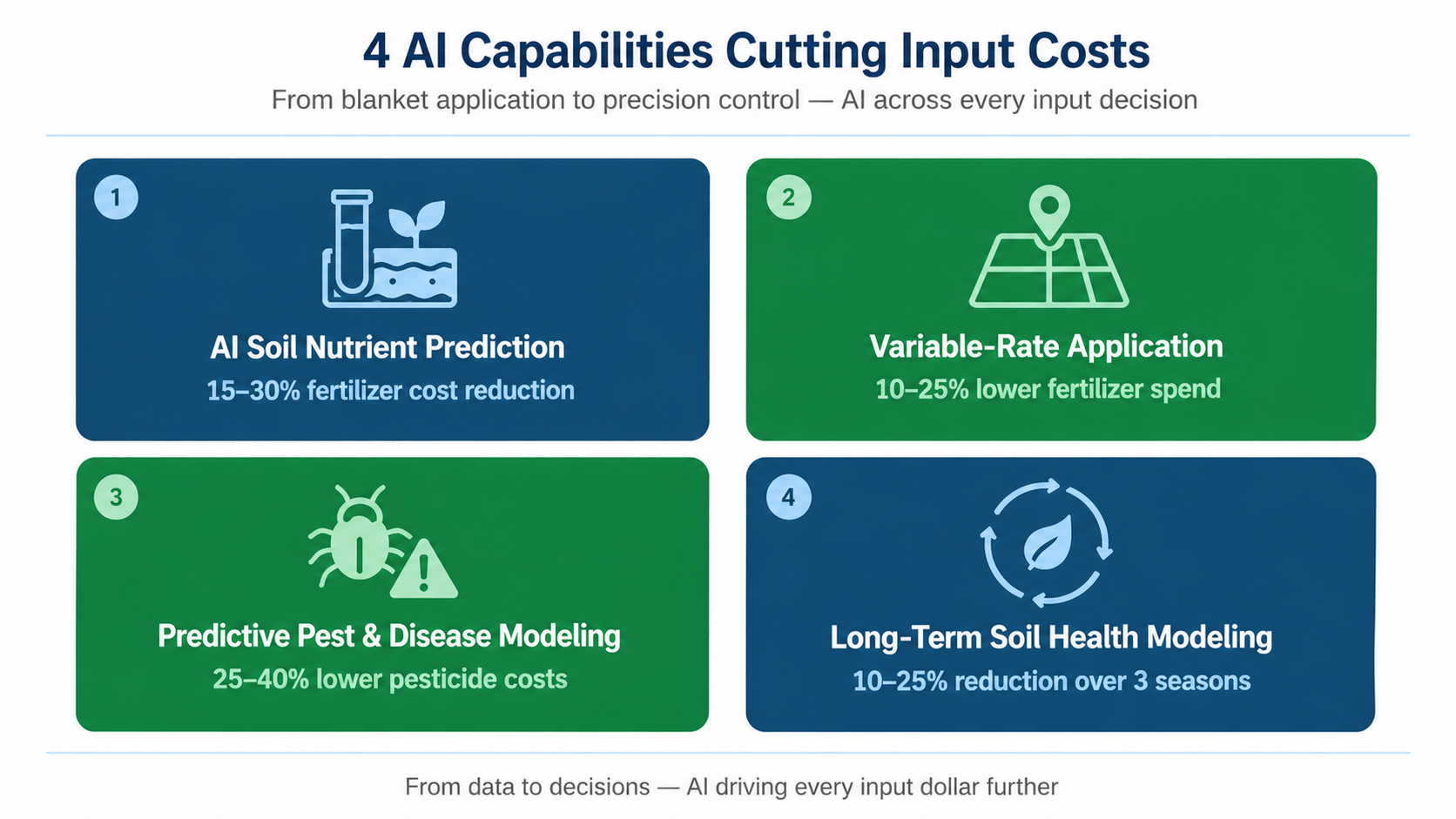
These AI applications are already helping agribusinesses reduce fertilizer and pesticide costs by 10–40% through precision input management.
1. AI Soil Nutrient Prediction
Most fertilizer waste comes from applying field-average rates to non-average soil. AI nutrient prediction models, trained on existing soil sensor and lab data, reveal what is actually missing, including micronutrients such as boron and zinc that conventional NPK testing overlooks. The result is a targeted application instead of blanket coverage.
Operations using AI-driven soil nutrient prediction are seeing a 15 to 30 percent reduction in fertilizer costs with maintained yield. On a 1,500-acre Midwest corn operation, this typically targets nitrogen and zinc, with savings measurable in the first season. Omdena has deployed this approach in Bangladesh at a scale that translates directly to commercial operations.
2. Variable-Rate Application from Satellite and Sensor Data
Applying fertilizer on a calendar means missing the windows when crops can actually use it. AI-driven variable-rate systems use satellite NDVI, soil moisture, and weather data to direct fertilizer to the right zone at the right moment, not the right week on a planner. That shift from calendar to condition-based application is where timing waste gets recovered.
AI prescription maps have reduced fertilizer spend by 10 to 25 percent in commercial deployments, with the strongest gains in fields with high spatial soil variability. For operations already running variable-rate equipment, this is the layer that turns expensive hardware into ROI. Omdena built a nitrogen flow-tracking system for UK farmland using this same approach.
3. Predictive Pest and Disease Modeling
Pesticide cost spikes when treatment becomes reactive. AI models trained on weather patterns, historical outbreak data, and field-level signals flag elevated risk 10 to 21 days before pressure peaks, enabling targeted preventive treatment instead of full-coverage emergency spraying. The shift from reactive to preventive is where the largest pesticide savings sit.
Operations using AI pest and disease modeling are cutting pesticide spend by 25 to 40 percent compared with reactive blanket treatments. For specialty crop operations where a single disease event can wipe out 30 to 40 percent of seasonal revenue and compound into post-harvest losses, this has the fastest payback of any AI input tool.
4. Long-Term Soil Health Modeling
Short-term optimization caps at one season. Soil health modeling predicts organic carbon trajectories, cover-crop nitrogen contribution, and rotation impacts, informing a multi-season strategy that reduces fertilizer dependency year over year. Each season of data improves the next set of recommendations.
Operations applying AI to long-term soil health modeling are seeing 10 to 25 percent reductions in fertilizer use over 3-season cycles, with savings compounding annually. For operations already running cover crops or considering regenerative transition, this is the AI layer that quantifies the practice in dollars rather than principles.
Most operations do not have a price problem. They have an application problem: applying more than the field needs at the wrong time and in the wrong zone.
Real Deployments, Real Results: Omdena
Predicting Hidden Soil Nutrients for Smallholder Operations
Conventional soil tests measure NPK but miss micronutrients like boron and zinc. Lab testing costs $40 to $80 per sample with a multi-week turnaround, leaving most farms with incomplete data. The gap costs money both ways: overapplying macronutrients and underapplying the micronutrients that limit yield.
Omdena partnered with a Bangladesh-based agritech company to train a machine learning model on soil sensor data validated against chemical lab results. The model predicts boron, zinc, and soil organic carbon at the field level and delivers fertilizer recommendations through portable hardware, no lab required.
Real-Time Nitrogen Flow Tracking for UK Farmlands
Nitrogen applied above crop demand is lost to runoff and volatilization, wasting cost and creating regulatory exposure. Chesapeake Bay plans, Mississippi watershed compliance, and the EU Nitrates Directive limits are tightening. Operations need real-time visibility into nitrogen flow at the field level, not just application records.
Omdena built an AI system for a UK climate-tech company, integrating NASA POWER, COSMOS-UK, and UKSO data with DNDC model simulations. The system tracks nitrogen flow in near-real time and delivers compliance-ready emissions data. The same capability is now being funded via a $16M USDA Mid-Atlantic AI initiative for US producers.
Operations pursuing carbon farming goals under SBTi commitments, or selling to food companies with FLAG sector targets, will need verifiable nitrogen-efficiency data within two to three years. This deployment demonstrates that the required infrastructure is buildable now, not at some future point when regulatory pressure arrives.
Calculating Real ROI for Your Operation
Based on USDA cost data and a conservative 18 percent fertilizer reduction, a 1,500-acre Midwest corn operation applying nutrient prediction and variable-rate application could save around $48,600 in year one, with implementation costs of $25,000 to $50,000—payback: six to nine months.
For a 250-acre EU specialty crop operation applying AI-based disease detection, a conservative 22 percent combined reduction points to around $54,000 saved in year one, against $15,000 to $30,000 in implementation costs—payback: four to seven months.
ROI on AI fertilizer and pesticide optimization is not measured against the platform subscription. It is measured against the waste you did not catch: the over-fertilized zone, the mistimed spray, the pest outbreak that doubled your bill. The question is not the cost. It is whether the tool is configured to catch your specific leak.
AI Capability
What It Reduces
Reported Saving
Source
AI Soil Nutrient Prediction
Fertilizer waste from over-application on non-average soil
15 to 30% fertilizer cost reduction
CGIAR / Omdena Bangladesh deployment
Variable-Rate Application
Timing waste from calendar-based input scheduling
10 to 25% input spend reduction
Multi-region commercial deployments
Pest and Disease Modeling
Pesticide cost from reactive broad-spectrum spraying
25 to 40% pesticide cost reduction
CGIAR / commercial field deployments
Long-Term Soil Health Modeling
Baseline fertilizer dependency across seasons
10 to 25% reduction over 3-season cycles
Multi-season deployment data
Operation size determines payback period, not whether AI works. The variable that matters more is data readiness. Operations with two or more years of soil testing data move through preparation significantly faster, eliminating a stage that would otherwise consume the first months of deployment.
How to Start: Four Decisions Before Buying Anything
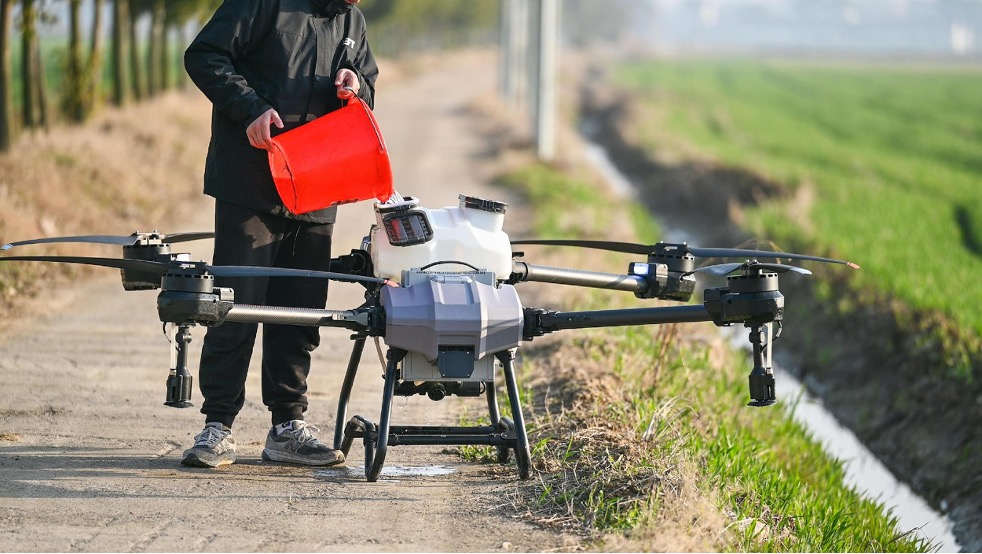
An operator prepares an agricultural drone for a pesticide run. The decision of when, where, and how much to spray is where AI is now replacing reactive guesswork. Image Source: Pexels
Decision 1: Is Fertilizer or Pesticide Your Bigger Leak?
Look at the past three seasons. Has fertilizer or pesticide grown faster as a share of operating cost? Has either category seen unexpected spikes that point to reactive spending? The answer determines where you start. No tool yet, just diagnostic clarity. Most operations skip this step and start with whatever vendor is in their inbox.
Decision 2: What Soil and Field Data Do You Already Have?
Three scenarios. Two or more years of field-level soil data means you are ready to predict nutrients. Variable-rate equipment with limited soil data: start with satellite or drone-based monitoring to build the baseline. Neither: start with predictive pest modeling, which requires no soil data infrastructure, and build data in parallel.
Decision 3: Custom, Off-the-Shelf, or Neither?
Off-the-shelf platforms such as Climate FieldView, Granular, and John Deere Operations Center are well-suited to operations with average soil profiles and standard rotations. They are a strong choice when your operation looks like the regional norm. AI irrigation and input management can layer on top of what you are already running.
Custom models pay back faster for operations with non-standard soil, specialty crops, or complex rotations. Implementation cost is higher, but the model is built for your profile rather than the regional average. For operations already running close to optimal with strong agronomic advice, neither may be the right answer.
Decision 4: One-Season Pilot or Full Deployment?
Pilot one tool on one field for one season before committing at scale. Set one metric: fertilizer or pesticide spend per acre, yield maintained. Expand based on actual results, not vendor projections. Operations that pilot first consistently report stronger ROI, and one field’s data informs every subsequent decision.
What Buyers Get Wrong, and When AI Does Not Pay Back
Most buyer mistakes start with how AI tools are evaluated. Buying tools by feature list rather than by integration with the existing data infrastructure is the most common error. The best AI model is useless if it cannot read your soil-test data, integrate with your application equipment, or connect to your current precision-ag platform.
Three patterns recur: underestimating year-one data preparation costs, which vendors rarely quote up front; measuring ROI against subscription costs rather than the fertilizer-and-pesticide baseline; and choosing generic platforms for non-standard soils or crops. Skipping the pilot makes all three worse.
AI fertilizer and pesticide optimization does not pay back for operations under 100 acres with simple rotations and good agronomic advice already in place. It also does not pay back when fertilizer and pesticide costs are not the binding constraint, or when data infrastructure is so far behind that year-one preparation costs exceed year-one savings.
Where This Goes Next
The agribusinesses pulling ahead are not waiting for prices to stabilize. They are building optimization capability now, one season at a time. Each season of soil data improves the next fertilizer recommendation; each season of pest data sharpens the next spray decision. The largest gains are in years two and three.
The strongest returns come from custom models built around your soil, crop rotation, and decision cycle, not generic dashboards. If your current platform is not giving you field-level fertilizer and pesticide decisions, the next step is not another demo.
Omdena works with agribusinesses to design and deploy custom AI models to reduce fertilizer and pesticide costs. If you are ready to move beyond off-the-shelf tools, get in touch to start with a scoping session tailored to your operation.
FAQ
What is the minimum farm size where AI input optimization makes financial sense?
200-plus acres for off-the-shelf tools, 500-plus for custom AI. Below those thresholds, implementation costs don't amortize well. Specialty and intensive crops can justify smaller minimums because savings per acre are higher.
Can AI input optimization integrate with my existing precision ag platform?
Yes. Custom AI models typically integrate with existing platforms via APIs or data exports. Generic tools sometimes require replacement. Confirm integration capability before evaluating any vendor.
Does this work for organic operations where pesticide use is already minimized?
Partially. Pesticide-reduction tools have less leverage, but fertilizer optimization and soil-health modeling remain valuable. Soil health modeling is often the highest-ROI AI capability for organic operations.
What happens if my agronomist disagrees with the AI recommendation?
AI recommendations are advisory. The agronomist retains final authority. When recommendations diverge, investigate: disagreement usually indicates a data-quality issue or a local factor the model missed.
Do I need to replace my soil testing program, or does AI work alongside it?
AI works alongside soil testing, not instead of it. Lab analysis stays in place; AI fills gaps between sample points and predicts micronutrients conventional tests miss.
How is my operation's data used, and who owns it?
Terms vary by vendor. Off-the-shelf platforms typically license your data for aggregate model training; custom AI partners typically leave ownership with you. Before signing, confirm who owns the raw data and the trained model, and whether your data is used to train models for other operations.
What is the typical implementation timeline for a 1,000-acre-plus operation?
8 to 12 weeks to first recommendations. Year one: data integration and pilot on one field. Year two: full deployment. Year three: optimization and expansion. Cleaning existing data shortens the timeline.
Share this article
Share on LinkedIn, send by email, or copy the direct link.